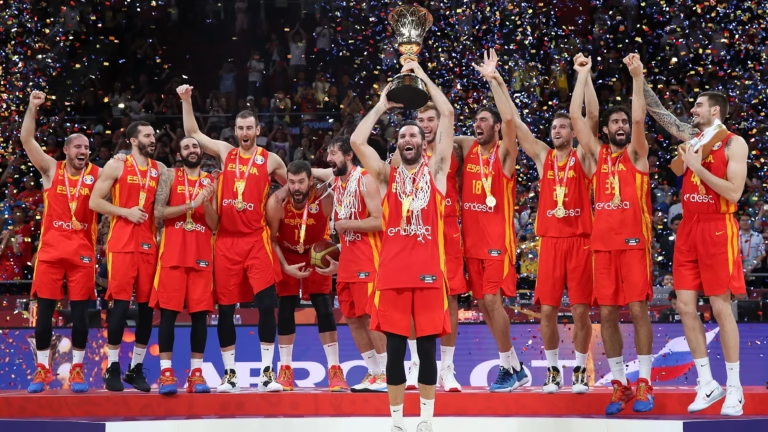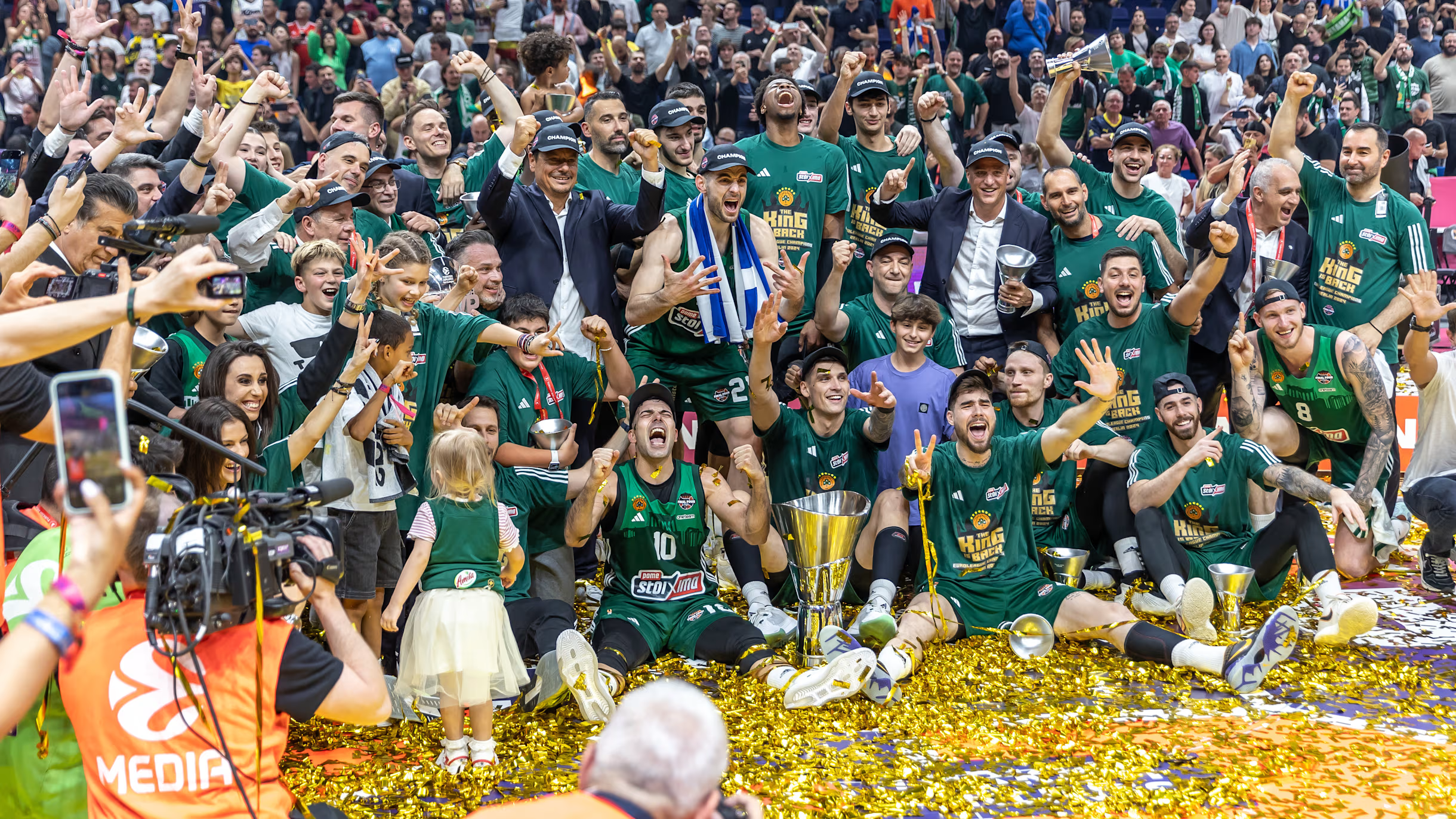
Real Madrid stands atop the list of EuroLeague winners with 11 total championships, most recently in 2023. Fenerbahçe claimed the 2025 EuroLeague winners trophy after defeating Monaco in the Final Four.
Europe’s top basketball competition has crowned 22 different EuroLeague winners since 1958.
The competition began as the FIBA European Champions Cup and became the modern EuroLeague in 2000 under Euroleague Basketball management.
All-Time EuroLeague Winners
| Rank | Team | Championships | Finals Appearances | Best Era | Country |
| 1 | Real Madrid | 11 | 18 | 1964-1980, 2015-2023 | Spain |
| 2 | CSKA Moscow | 8 | 11 | 1969-2019 | Russia |
| 3 | Panathinaikos | 7 | 13 | 1996-2024 | Greece |
| 4 | Maccabi Tel Aviv | 5 | 9 | 1977-2014 | Israel |
| 5 | Ignis Varese | 4 | 8 | 1972-1976 | Italy |
| 6 | Olympiacos | 3 | 6 | 1997-2013 | Greece |
| 7 | Anadolu Efes | 2 | 4 | 2020-2022 | Turkey |
| 8 | Fenerbahçe | 2 | 3 | 2017-2025 | Turkey |
| 9 | FC Barcelona | 2 | 6 | 2003-2010 | Spain |
| 10 | Jugoplastika Split | 2 | 2 | 1989-1990 | Croatia |
Real Madrid’s dominance spans six decades, winning their first title in 1964. The club won four consecutive championships from 1964-1968, establishing themselves as a European powerhouse.
They captured additional titles in 1974, 1978, and 1980 before a 15-year gap until their next championship.
Modern era Real Madrid success started with their 2015 victory. They won three more titles in 2018, 2023, and made the final in 2024. Real Madrid’s consistency proves them as the most decorated club in European basketball.
Recent EuroLeague Winners (2015-2025)
| Year | Champion | Runner-Up | Finals Result | Location |
| 2025 | Fenerbahçe | Monaco | 81-70 | Abu Dhabi |
| 2024 | Panathinaikos | Real Madrid | 95-80 | Berlin |
| 2023 | Real Madrid | Olympiacos | 79-78 | Kaunas |
| 2022 | Anadolu Efes | Barcelona | 91-83 | Istanbul |
| 2021 | Anadolu Efes | Monaco | 86-73 | Cologne |
| 2020 | Not Held | (COVID-19 Pandemic) | – | – |
| 2019 | CSKA Moscow | Real Madrid | 106-101 | Vitoria-Gasteiz |
| 2018 | Real Madrid | Fenerbahçe | 92-83 | Madrid |
| 2017 | Fenerbahçe | Olympiacos | 92-80 | Istanbul |
| 2016 | CSKA Moscow | Real Madrid | 77-74 | Madrid |
| 2015 | Real Madrid | Barcelona | 78-59 | Berlin |
Fenerbahçe emerged as a recent EuroLeague winners when claiming its second title in 2025, defeating Monaco 81-70 in Abu Dhabi. This marked their first championship in eight years, returning to European glory.
The 2025 Final Four was held outside Europe for the first time since 2004, a historic moment for EuroLeague winners.
Panathinaikos reclaimed their crown in 2024 after a 13-year drought. They defeated Real Madrid 95-80 in the Berlin Final Four, one of the biggest upsets in recent EuroLeague history. Kostas Sloukas led the Greeks with 24 points in the championship game.
Real Madrid lost back-to-back finals in 2023-2024 seasons. They won in 2023 against Olympiacos in a thrilling 79-78 victory in Kaunas. The Spanish club remains the most consistent contender on European basketball’s biggest stage.
Turkish dominance defined the early 2020s. Anadolu Efes won back-to-back titles in 2021 and 2022, becoming only the third team in modern history to repeat as champions.
Their two consecutive victories proved Turkish basketball’s growing strength in European competition.
RELATED ARTICLES
Dynasties and Dominant Eras
Real Madrid (1964-1980, 2015-2023)
Real Madrid’s first dynasty under coach Pedro Ferrándiz was unstoppable. They won four consecutive titles from 1964-1968, a feat unmatched in European basketball. Their fast-paced style revolutionized the game across the continent.
The Spanish club remained a Final Four regular even during title droughts. They returned to European elite in 2015 under coach Pablo Laso. From 2015-2023, Real Madrid won three titles and appeared in five Finals.
CSKA Moscow (1969-2019)
CSKA Moscow became a powerhouse under Soviet influence, winning eight championships spanning five decades. Their first title came in 1969, establishing dominance through the 1970s and 1980s. Russian military club basketball produced elite athletes year after year.
CSKA’s modern success continued into the 2010s despite geopolitical challenges. They won back-to-back titles in 2016 and 2019, proving their sustained excellence. The 2019 championship over Real Madrid showcased their continued competitiveness.
Panathinaikos (1996-2024)
Panathinaikos dominated Greek basketball while competing at the highest European level. Their first title came in 1996, followed by four more championships in 2000, 2002, 2007, and 2011. Coach Željko Obradović established a winning culture that persisted through decades.
The Greeks’ 2024 championship ended their 13-year title drought with dramatic style. They defeated the heavily favored Real Madrid to win their seventh crown. Panathinaikos proved that traditional powerhouses could return to glory when properly built.
Anadolu Efes (2020-2022)
Anadolu Efes became the first Turkish club to win back-to-back EuroLeague titles. Their 2021 and 2022 consecutive championships announced Turkey’s arrival at European basketball’s apex. The Istanbul club built a roster that competed with established powers.
Anadolu Efes won in 2021 and 2022 before losing the 2023 Final Four. Their rapid rise demonstrated how strong domestic competition produces European champions. Turkish basketball’s investment and development proved successful.
Teams with Single Championships
Nine clubs have won exactly one EuroLeague title in competition history. Virtus Bologna won in 2001, the modern EuroLeague’s first official champion. FC Barcelona claimed a title in 2003 before later championships proved elusive.
Limoges CSP, Joventut Badalona, and Zalgiris Kaunas each won once during different eras. Cibona Zagreb, Bosna Sarajevo, and Partizan Belgrade won championships before the competition evolved. Kinder Bologna and Tracer Milano claimed titles in Italian basketball’s golden age.
EuroLeague Format Evolution
The competition began in 1958 as the FIBA European Champions Cup. Finals were decided through various formats including two-legged playoffs and knockout tournaments. The modern Final Four format became permanent in 1988, creating an exciting championship weekend.
In 2000, the competition split into FIBA SuproLeague and ULEB EuroLeague. Top clubs chose sides, fragmenting European basketball temporarily. The leagues merged in 2002, creating the unified modern EuroLeague that continues today.
Starting 2016, the EuroLeague expanded to a 16-team league format with regular-season playoffs. The 2024-25 season expanded to 18 teams, increasing competition depth. The modern EuroLeague maintains long-term licensed teams ensuring stability and investment.
Regional Championship Distribution
Spain has produced the most champions with Real Madrid and Barcelona. Greece follows with Panathinaikos and Olympiacos winning multiple titles. Russia contributed CSKA Moscow’s eight championships before geopolitical sanctions.
Italy won four championships through Ignis Varese and Milan clubs during the 1970s-1980s. Turkish clubs emerged recently with Fenerbahçe and Anadolu Efes combining four titles. Israel’s Maccabi Tel Aviv won five championships as the most decorated non-European team.
FAQs
Which Team Has Been the Most Successful EuroLeague Winner?
Real Madrid is the most successful EuroLeague winner with 11 total titles. Their dominance spans from 1964 to 2023. Fenerbahçe is the current EuroLeague winner after claiming the 2025 championship.
How Many EuroLeague Titles Does Panathinaikos Have?
Panathinaikos has won seven EuroLeague championships. Their most recent victory came in 2024. They are the third most successful team in competition history.
Has Any Team Won Back-to-Back EuroLeague Titles?
Yes, three teams won consecutive EuroLeague championships. Anadolu Efes won in 2021 and 2022. Maccabi Tel Aviv won in 2003-2004 and 2004-2005. Olympiacos won in 2011-2012 and 2012-2013.
What Country Has the Most EuroLeague Champions?
Spain has the most champions with two different teams. Real Madrid and Barcelona won EuroLeague titles. Greece, Russia, and Israel each have two or more champion franchises respectively.
RELATED ARTICLES