College football has never had an NCAA-sanctioned championship tournament. Instead, selection committees determine the “mythical” champion; creating 29 legitimate disputes across 157 years.
This unique structure explains the confusion: Alabama claims 18 NCAA-recognized championships (most all-time), yet Princeton claims 28 (only 15 officially recognized).
Championship legitimacy depends entirely on selection era; early retroactive assignments (1869-1935) versus AP Poll consensus (1936-1950) versus conflicting polls (1950-2013) versus objective CFP competition (2014+).
How College Football Champions Are Actually Determined
Selection methodology has fundamentally shaped which teams claim titles. Here’s why the same year can produce multiple “legitimate” champions:
Pre-1936 Era: Retroactive Historian Selection
Before 1936, no contemporaneous championship existed. Historian Parke H. Davis retroactively assigned 94 championships across 1869-1932, creating immediate controversy. His Eastern bias excluded Southern and Western teams. Result: 21 Davis-only selections exist; claimed by schools but not universally accepted.
1936-1950 Era: AP Poll Begins (First Objective Method)
The Associated Press introduced weekly rankings and crowned the champion after the regular season. Problem: teams played different schedules in different regions with no playoff, creating legitimate disagreement about comparative strength.
1950-1968 Era: Multiple Polls Create Co-Champions
The UPI Coaches Poll began in 1950, directly competing with the AP Poll. When they disagreed, both teams legitimately claimed championships. First split: 1954 (Ohio State vs. UCLA, both undefeated). This created the “co-champion” problem lasting 60+ years.
1968-2013 Era: Post-Bowl Polls + Computer Rankings
AP switched to post-bowl voting, allowing teams to play in major bowls before championship selection. FWAA, NFF, and computer ranking systems added more selectors. By 1990s, 5+ organizations selected different champions in the same season. The BCS attempted to solve this (1998-2013) by mathematically combining polls and computer rankings but failed cases like 2003-2004.
2014-Present: College Football Playoff (First Objective Championship)
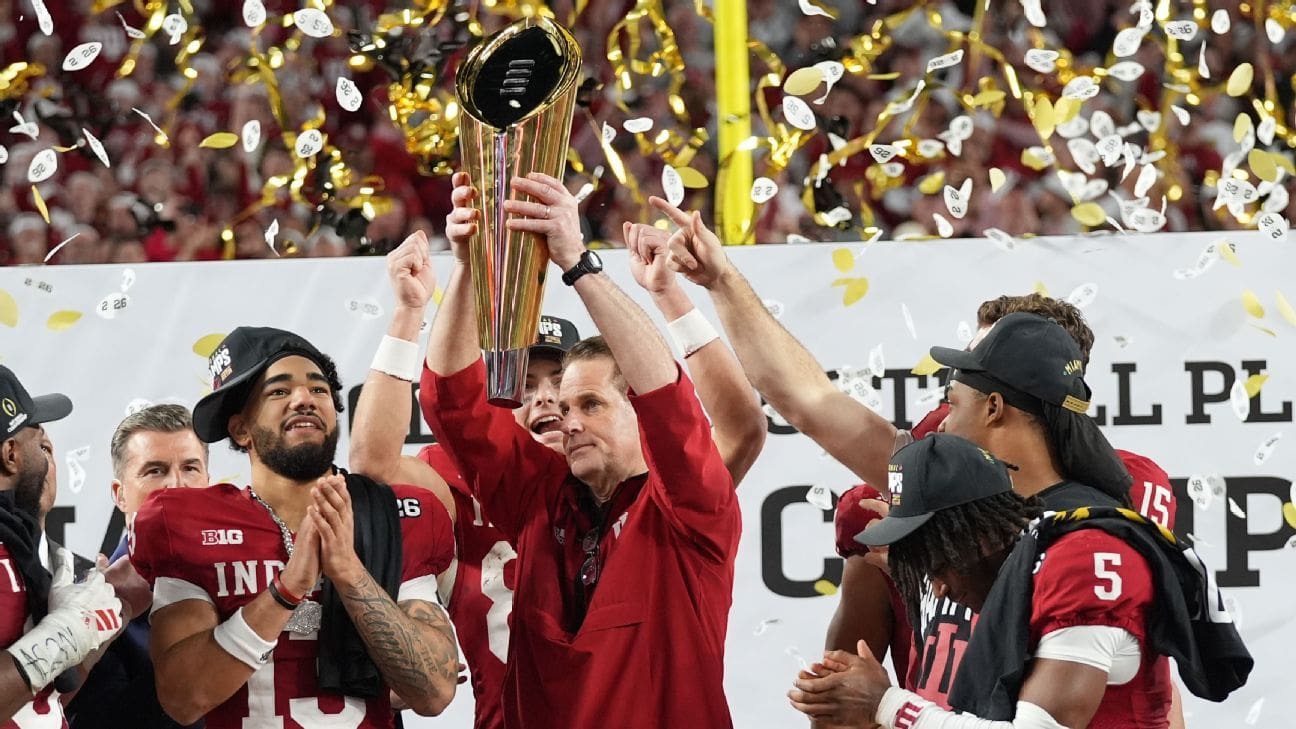
The CFP eliminates polling votes entirely. Four teams (now 12) compete in on-field playoffs. Winner determined by competition, not voting; the first objective national championship determination in 157 years.
Why This Matters: Pre-CFP titles depend on selector methodology. CFP titles are definitive.
Quick Facts: Essential Championship Information
| Fact | Answer |
| Most Championships (Verified) | Alabama – 18 NCAA-recognized |
| Most Championships (Claimed) | Princeton – 28 claimed; only 15 verified |
| Poll Era Leader | Alabama – 16 verified titles |
| Longest Modern Dynasty | Alabama – 5 CFP titles across 2007-2020 |
| Total Years Recorded | 157 seasons (1869-2025) |
| Different Champions | 40+ schools have won titles |
| Co-Champions (Same Year) | 29 instances total; none since 2014 CFP began |
| 2024-2025 Champion | Ohio State (defeated Notre Dame 34-23) |
| CFP Era Started | 2014 (objective competition vs. polls) |
| Last Pre-Poll Champion | Parke H. Davis retroactive selections ended 1932 |
| AP Poll Started | 1936 (first contemporaneous selection) |
| Greatest Controversy Era | 1950-2013 (multiple selectors; frequent splits) |
2024-2025 College Football Playoff Era Champions (2014-2025)
The CFP provides definitive championships through on-field competition. Before 2014, multiple organizations selected different champions in the same season.
| Year | Champion | Runner-Up | Record | Margin | Key Context |
| 2024 | Ohio State | Notre Dame | 14-2 | 34-23 | Ryan Day’s Buckeyes claim CFP title after expansion to 12 teams |
| 2023 | Michigan | Washington | 15-0 | 34-13 | Undefeated Wolverines overcome NCAA sanctions controversy |
| 2022 | Georgia | TCU | 15-0 | 65-7 | Bulldogs dominate; Kirby Smart establishes dynasty |
| 2021 | Georgia | Alabama | 14-1 | 33-18 | Back-to-back champions; repeat title in CFP era |
| 2020 | Alabama | Ohio State | 13-0 | 52-24 | Nick Saban’s 7th title surpasses Bear Bryant’s 6 |
| 2019 | LSU | Clemson | 15-0 | 42-25 | Joe Burrow‘s historic Heisman season |
| 2018 | Clemson | Alabama | 15-0 | 44-16 | Dabo Swinney’s repeat championship; defensive dominance |
| 2017 | Alabama | Georgia | 13-1 | 26-23 OT | Overtime championship; controversial Tua Tagovailoa entry |
| 2016 | Clemson | Ohio State | 14-1 | 31-0 | Deshaun Watson‘s excellence |
| 2015 | Alabama | Clemson | 14-1 | 45-40 | Derrick Henry‘s power season |
| 2014 | Ohio State | Oregon | 14-1 | 42-20 | First CFP National Championship Game |
All-Time National Championship Records by School (Top 20)
| Rank | School | Total Claimed | NCAA Verified | Poll Era | CFP Era | Last Title |
| 1 | Alabama | 18 | 18 | 13 | 5 | 2020 |
| 2 | Princeton | 28* | 15 | 0 | 0 | 1922 |
| 3 | Yale | 18 | 11 | 1 | 0 | 1927 |
| 4 | Ohio State | 9 | 9 | 7 | 2 | 2024 |
| 5 | Notre Dame | 13 | 7 | 7 | 0 | 1988 |
| 6 | Oklahoma | 7 | 7 | 7 | 0 | 2000 |
| 7 | USC | 9 | 8 | 8 | 0 | 2004† |
| 8 | Nebraska | 5 | 5 | 5 | 0 | 1995 |
| 9 | Penn State | 2 | 2 | 2 | 0 | 1986 |
| 10 | Georgia | 4 | 4 | 0 | 4 | 2022 |
| 11 | Clemson | 3 | 3 | 0 | 3 | 2018 |
| 12 | Michigan | 11 | 11 | 0 | 1 | 2023 |
| 13 | LSU | 4 | 4 | 2 | 2 | 2019 |
| 14 | Florida | 3 | 3 | 3 | 0 | 2008 |
| 15 | Minnesota | 6 | 6 | 1 | 0 | 1960 |
| 16 | Pittsburgh | 3 | 3 | 3 | 0 | 1976 |
| 17 | Harvard | 3 | 3 | 0 | 0 | 1903 |
| 18 | Tennessee | 2 | 2 | 2 | 0 | 1998 |
| 19 | Miami (FL) | 5 | 5 | 5 | 0 | 2001 |
| 20 | Washington | 3 | 3 | 0 | 0 | 1991 |
Note: *Princeton claims 28; only 15 NCAA-verified. †USC’s 2004 title was vacated by NCAA due to infractions.
Complete Year-by-Year National Champions 1869-2025
2020s Decade (2020-2025)
| Year | Champion | Record | Title Context |
| 2024 | Ohio State | 14-2 | CFP Championship: beat Notre Dame 34-23 |
| 2023 | Michigan | 15-0 | Undefeated; overcame NCAA violations |
| 2022 | Georgia | 15-0 | Kirby Smart’s first; 65-7 demolition of TCU |
| 2021 | Georgia | 14-1 | Back-to-back; beat Alabama 33-18 |
| 2020 | Alabama | 13-0 | Saban’s 7th; surpasses Bear Bryant’s 6 |
2010s Decade (2010-2019)
| Year | Champion | Record | Title Context |
| 2019 | LSU | 15-0 | Joe Burrow’s Heisman year; beat Clemson 42-25 |
| 2018 | Clemson | 15-0 | Swinney’s repeat; destroyed Alabama 44-16 |
| 2017 | Alabama | 13-1 | OT victory over Georgia |
| 2016 | Clemson | 14-1 | Deshaun Watson’s excellence |
| 2015 | Alabama | 14-1 | Derrick Henry’s power season |
| 2014 | Ohio State | 14-1 | First CFP Championship Game |
| 2013 | Florida State | 14-0 | Jameis Winston‘s freshman dominance |
| 2012 | Alabama | 13-1 | Third title in four years |
| 2011 | Alabama | 12-1 | Saban’s first championship |
| 2010 | Auburn | 14-0 | Cam Newton‘s legendary season |
2000s Decade (2000-2009)
| Year | Champion | Record | Title Context |
| 2009 | Alabama | 14-0 | First title since 1992; Mark Ingram Heisman |
| 2008 | Florida | 13-1 | Repeat champions; Tebow’s final season |
| 2007 | LSU | 12-2 | Only 2-loss champion in BCS era |
| 2006 | Florida | 13-1 | Urban Meyer’s first; national dominance |
| 2005 | Texas | 13-0 | Vince Young’s heroic Rose Bowl |
| 2004 | USC | 11-0 | NCAA later vacated this title |
| 2003 | LSU/USC | Co-champs | BCS split; both crowned separately |
| 2002 | Ohio State | 14-0 | Craig Krenzel’s excellence |
| 2001 | Miami (FL) | 12-0 | Perfect season; Ed Reed’s defense |
| 2000 | Oklahoma | 13-0 | Josh Heupel’s leadership |
1990s Decade (1990-1999)
| Year | Champion | Record | Title Context |
| 1999 | Florida State | 12-0 | Chris Weinke’s leadership |
| 1998 | Tennessee | 13-0 | Peyton Manning‘s dominance |
| 1997 | Michigan/Nebraska | Co-champs | Split national title |
| 1996 | Florida | 12-1 | Danny Wuerffel’s Heisman |
| 1995 | Nebraska | 12-0 | Tom Osborne’s final championship |
| 1994 | Nebraska | 13-0 | Back-to-back undefeated |
| 1993 | Florida State | 12-1 | Bobby Bowden’s dynasty begins |
| 1992 | Alabama | 13-0 | Gene Stallings’ first; 13 years drought ends |
| 1991 | Washington/Miami | Co-champs | Split national title |
| 1990 | Colorado/Georgia Tech | Co-champs | Colorado with tie (11-1-1) |
1980s Decade (1980-1989)
| Year | Champion | Record | Title Context |
| 1989 | Miami (FL) | 11-1 | Rivals victory over Nebraska |
| 1988 | Notre Dame | 12-0 | Lou Holtz’s magical season |
| 1987 | Miami (FL) | 12-0 | Defensive dominance; “The U” continues |
| 1986 | Penn State | 12-0 | Joe Paterno’s masterpiece |
| 1985 | Oklahoma | 11-1 | Barry Switzer’s era; Jamelle Holieway |
| 1984 | BYU | 13-0 | Steve Young’s excellence; undefeated with option |
| 1983 | Miami (FL) | 11-1 | Start of Miami’s 1980s dominance |
| 1982 | Penn State | 11-1 | Herschel Walker’s UGA nearly perfect |
| 1981 | Clemson | 12-0 | Danny Ford’s youth; perfect season |
| 1980 | Georgia | 12-0 | Herschel Walker’s legendary freshman year |
1970s Decade (1970-1979)
| Year | Champion | Record | Title Context |
| 1979 | Alabama | 12-0 | Bear Bryant’s excellence continues |
| 1978 | Alabama/USC | Co-champs | Split national title |
| 1977 | Notre Dame | 11-1 | Dan Devine’s upset championship |
| 1976 | Pittsburgh | 12-0 | Tony Dorsett’s legendary career |
| 1975 | Oklahoma | 11-1 | Barry Switzer era begins; Sooners dynasty |
| 1974 | Oklahoma/USC | Co-champs | Split national title |
| 1973 | Notre Dame/Alabama | Co-champs | Split national title |
| 1972 | USC | 12-0 | John McKay’s Trojans; last undefeated of era |
| 1971 | Nebraska | 13-0 | Johnny Rodgers’ dominance |
| 1970 | Nebraska/Texas | Co-champs | Split national title |
1960s Decade (1960-1969)
| Year | Champion | Record | Title Context |
| 1969 | Texas | 11-0 | James Street’s leadership; last decade undefeated |
| 1968 | Ohio State | 10-1 | Woody Hayes’ dominance despite one loss |
| 1967 | USC | 10-1 | O.J. Simpson’s junior year |
| 1966 | Notre Dame | 9-1 | Ara Parseghian’s championship |
| 1965 | Alabama/Michigan St | Co-champs | Split national title |
| 1964 | Alabama/Arkansas/ND | 3-way split | Most disputed championship |
| 1963 | Texas | 11-0 | Darrell Royal’s excellence |
| 1962 | USC | 11-0 | John McKay’s dynasty building |
| 1961 | Alabama | 11-0 | Bear Bryant’s championship year |
| 1960 | Minnesota | 9-1 | Most underrated team; split title |
1950s Decade (1950-1959)
| Year | Champion | Record | Title Context |
| 1959 | Syracuse | 11-0 | Jim Brown’s final year; dominant |
| 1958 | LSU | 11-0 | Undefeated Tigers; Billy Cannon Heisman |
| 1957 | Auburn | 10-0 | Unbeaten; Shug Jordan’s excellence |
| 1956 | Oklahoma | 10-0 | Bud Wilkinson dynasty; perfect season |
| 1955 | Oklahoma | 10-0 | Back-to-back undefeated; dynasty continues |
| 1954 | Ohio State/UCLA | Split title | First split championship dispute |
| 1953 | Maryland | 10-1 | First split title discussion; AP selected |
| 1952 | Michigan State | 9-1 | Sparty’s excellence |
| 1951 | Princeton | 9-0 | Last Princeton championship (29-year gap) |
| 1950 | Oklahoma | 10-1 | Bud Wilkinson era begins; dynasty starting |
1940s Decade (1940-1949)
| Year | Champion | Record | Title Context |
| 1949 | Notre Dame | 10-0 | Frank Leahy’s excellence |
| 1948 | Michigan | 9-0 | Bennie Oosterbaan’s coaching |
| 1947 | Notre Dame | 9-0 | Frank Leahy’s era; post-war dominance |
| 1946 | Army | 9-0-1 | Doc Blanchard & Glenn Davis; legendary backfield |
| 1945 | Army | 9-0 | Undefeated during WWII |
| 1944 | Army | 9-0-1 | Military academy dominance |
| 1943 | Notre Dame | 9-1 | War years championship |
| 1942 | Ohio State | 9-1 | Woody Hayes’ first title |
| 1941 | Minnesota | 8-0 | Golden Gophers excellence |
| 1940 | Stanford | 10-0 | Bobby Grayson; perfect season |
1930s Decade (1930-1939)
| Year | Champion | Record | Title Context |
| 1939 | Texas A&M | 11-0 | Bear Bryant era beginning elsewhere |
| 1938 | Tennessee | 11-0 | General Neyland’s excellence |
| 1937 | Pittsburgh | 9-1 | Jock Sutherland’s dominance |
| 1936 | Minnesota | 7-1 | First AP Poll Championship |
| 1935 | Minnesota | 8-0 | First Heisman Trophy year |
| 1934 | Minnesota | 8-0 | Three straight titles (1934-1936) |
| 1933 | Michigan | 7-0-1 | Fielding Yost’s legacy |
| 1932 | Michigan | 8-0 | Great Lakes dominance |
| 1931 | Alabama | 9-1-1 | Bear Bryant’s Alabama beginnings |
| 1930 | Notre Dame | 10-0 | Knute Rockne era; “Golden Dome” legacy |
1920s Decade (1920-1929)
| Year | Champion | Record | Title Context |
| 1929 | Notre Dame | 9-0 | Knute Rockne’s excellence |
| 1928 | Georgia Tech | 10-0 | Doc Heisman’s legacy |
| 1927 | Illinois | 7-0-1 | Big Ten dominance |
| 1926 | Yale | 9-0 | Eastern excellence continues |
| 1925 | Alabama | 10-0 | Bear Bryant’s Alabama begins era |
| 1924 | Notre Dame | 10-0 | Knute Rockne’s Four Horsemen |
| 1923 | Yale | 10-0 | Eastern dominance; final Yale championship |
| 1922 | Princeton | 8-0 | Last Princeton championship |
| 1921 | Cornell | 8-0 | Ivy League excellence |
| 1920 | Notre Dame | 9-0-1 | Knute Rockne’s beginning |
1900-1919 (Transitional Era)
| Year | Champion | Record | Year | Champion | Record |
| 1919 | Harvard | 9-0 | 1909 | Yale | 10-0 |
| 1918 | Pittsburgh | 4-1 | 1908 | Yale | 10-0 |
| 1917 | Georgia Tech | 9-0 | 1907 | Yale | 9-0 |
| 1916 | Pittsburgh | 8-0 | 1906 | Yale | 10-0 |
| 1915 | Cornell | 9-0 | 1905 | Yale | 10-0 |
| 1914 | Army | 9-1 | 1904 | Pennsylvania | 12-0 |
| 1913 | Harvard | 9-0 | 1903 | Harvard | 11-0 |
| 1912 | Harvard | 9-0 | 1902 | Yale | 11-0 |
| 1911 | Princeton | 8-0-1 | 1901 | Yale | 10-1 |
| 1910 | Yale | 8-1 | 1900 | Yale | 9-0 |
1869-1899 (Early Era – 31 Years)
Primarily Eastern schools dominated. Princeton won 11 of 31 championships. Selections retroactively assigned by historian Parke H. Davis.
RELATED ARTICLES
| School | Championship Years | Total |
| Yale | 1874, 1876, 1877, 1881-1887, 1891-1892, 1894 | 12 |
| Princeton | 1869-1870, 1872-1873, 1878-1880, 1885, 1889, 1893, 1896 | 11 |
| Penn | 1894, 1897-1899 | 4 |
| Harvard | 1875, 1890, 1898, 1903 | 4 |
| Rutgers | 1869 (co-champion) | 1 |
| Others | Various | 3 |
1869-1899 Context: 31 years of competition; primarily Ivy League; no nationwide media; retroactively selected by historians; many schools had no formal coaches until 1890s.
Championship Dynasty Patterns: Why Dominance Ended
| Era | Team | Span | CFP Titles | Success Factors | Why It Ended |
| Modern | Alabama | 2007-2020 | 5 | Recruiting depth; coaching consistency; no salary cap; SEC dominance | Transfer portal opened (2021+); recruiting equalized |
| 1980s-2001 | Miami | 19 years | 5 | Defensive innovation; aggressive recruiting; swagger factor | Program sanctions; coaching turnover |
| 1970-1995 | Nebraska | 25 years | 2 | Wishbone triple-option; 13-win consistency | Conference competition increased; coaching era ended |
| 2010-2024 | Ohio State | 15 years | 2 | Conference dominance; Tressel/Meyer consistency | Conference parity increased |
| 1950-1956 | Oklahoma | 7 years | 3 | Bud Wilkinson system; talent depth | Coaching departures; competition growth |
Dynasty Truth: Modern college football cannot sustain multi-year dominance. Alabama’s five CFP titles (2007-2020) represent the maximum achievable. Transfer portal parity (post-2024) makes Alabama-style dynasties structurally impossible going forward.
Championship Controversies Explained (& Resolved)
The 1964 Three-Way Championship Split (Most Disputed)
Three selectors crowned three champions:
- AP Poll: Alabama (undefeated regular season; lost Orange Bowl to Texas 21-17)
- FWAA Poll: Arkansas (finished undefeated after bowl games)
- NFF: Notre Dame (9-1 record)
Most Legitimate Claim: Arkansas (only undefeated team after bowl games). Most Commonly Cited: Alabama (AP’s pre-bowl selection). This controversy prompted the AP to switch to post-bowl polling in 1965, establishing methodology that lasted 48 years.
The 2003 LSU vs. USC Split (BCS Failure)
LSU (13-1) and USC (12-1) both claimed 2003 championship:
- LSU won the BCS National Championship Game 21-14
- AP Poll crowned LSU
- Coaches Poll crowned USC
Resolution: Both teams legitimately claim 2003; LSU’s on-field victory provides greater legitimacy.
The 2004 USC Championship Vacation (NCAA Infractions)
USC won the 2004 championship (11-0) but the NCAA vacated the title due to Reggie Bush’s benefits. Current Status: USC no longer officially claims 2004; the title is recognized as vacated by NCAA.
The 1954 First Split Championship (AP vs. UPI)
Both Ohio State and UCLA finished undefeated:
- Ohio State beat Wisconsin 20-7 in Rose Bowl
- UCLA beat Michigan State 28-20
AP crowned Ohio State; UPI crowned UCLA. Result: This first split initiated 60 years of co-champions, directly leading to the CFP’s creation in 2014.
Championship Selection Timeline: How It Evolved
- 1869-1935: Retroactive historian selections (primarily Parke H. Davis). Eastern bias; 21 selections disputed.
- 1936-1950: AP Poll introduces objective voting. Still creates disagreements due to different schedules.
- 1950-1968: UPI Coaches Poll competes with AP Poll. First split title in 1954. Co-champions become common.
- 1968-2013: Post-bowl AP voting + multiple selectors (FWAA, NFF, computer rankings). By 1990s, 5+ organizations select different champions.
- 1998-2013: BCS attempts mathematical solution (polls + computer rankings). Still creates disputed titles (2003-2004).
- 2014-Present: CFP eliminates polling. Competition determines champion objectively. Zero co-champions since 2014.
FAQs
Which team has won the most national championships?
Alabama leads with 18 NCAA-recognized championships. Princeton claims 28 historically; only 15 are officially verified. Alabama’s 16 poll-era titles lead the modern era.
What does “mythical national championship” mean?
College football has no NCAA-sanctioned tournament. Instead, selection committees determine the champion; creating a “mythical” title based on subjective evaluation rather than competition. This differs fundamentally from basketball’s March Madness, which the NCAA directly administers.
Why are there co-champions?
Before 2014, different organizations selected different champions in the same season. AP Poll and UPI Poll disagreed frequently (1954-2013), creating co-champions. The CFP eliminated this by determining winners through on-field competition.
How many co-champions exist in history?
Twenty-nine instances of co-champions occurred (1950-2013). The most recent: 2003 (LSU and USC). The CFP has produced zero co-champions since 2014.
Who won the 2024 championship?
Ohio State won the 2024 CFP National Championship by defeating Notre Dame 34-23.
Has anyone won back-to-back CFP championships?
Yes. Clemson (2018-2019, both 15-0) and Georgia (2021-2022, 14-1 and 15-0) each won consecutive titles.
Can a team win with one loss?
Yes. LSU won 2003 with 13-1 record (BCS formula); LSU also won 2007 with 12-2 record (only 2-loss champion ever). Modern CFP prefers undefeated teams.
Why did USC lose their 2004 title?
NCAA vacated USC’s 2004 championship due to infractions involving Reggie Bush’s benefits. USC no longer officially claims the title.
Does Princeton really have 28 championships?
Princeton claims 28 total championships. Only 15 are NCAA-verified. Claimed titles are concentrated in the pre-1922 era when selection methodology was retroactive and controversial. NCAA’s official count: 15.
How is the CFP different from previous eras?
The CFP uses on-field competition to determine champions; not polling votes. Four teams (now 12) compete in playoffs. The winner is determined by what happens on the field, not what pollsters think. This provides objective championship determination for the first time in college football history.
Which era had the most controversial selections?
1950-2013 saw the most disputes. Multiple organizations frequently crowned different champions. Notable: 1954 (split), 1964 (three-way split), 1974 (split), 1997 (split). The BCS attempted to reduce controversy (1998-2013) but failed with cases like 2003-2004.
Why was the CFP created?
The CFP was created to eliminate co-champions and polling disagreements. Before 2014, legitimate questions existed about championship legitimacy. The CFP answered: whichever team wins the playoff is the definitive champion. Simple, objective, settled.
RELATED ARTICLES