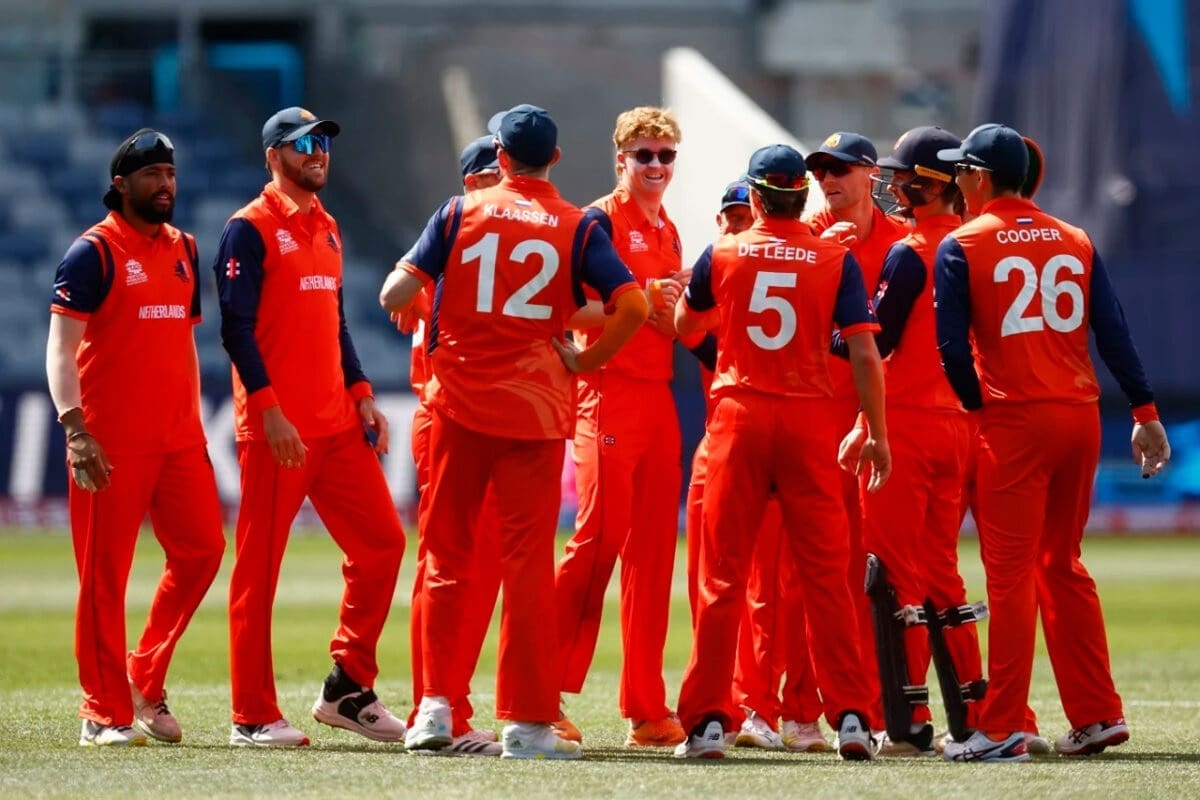
The Royal Dutch Cricket Association slashed player salary budgets by 53% from €720,000 to €340,000 for 2025 amid €1.2 million funding shortfall threatening the national program.
Only nine full-time contracts remain active with captain Scott Edwards and Bas de Leede among elite earners while remaining squad members juggle jobs or studies alongside international cricket.
Historical icon player contracts paid $135,000 annually before financial crisis eliminated guaranteed payments for most players.
The KNCB faces potential staff layoffs and domestic competition cancellations as ICC declined emergency funding requests creating existential threat to Netherlands cricket infrastructure.
View comprehensive player biography and net worth information for Netherlands’ cricket roster.
| Player Name | Positions Name |
| Bas de Leede | All-rounder |
| Logan van Beek | All-rounder |
| Saqib Zulfiqar | All-rounder |
| Roelof van der Merwe | All-rounder |
| Teja Nidamanuru | All-rounder |
| Max O’Dowd | Batsman |
| Michael Levitt | Batsman |
| Vikramjit Singh | Batsman |
| Wesley Barresi | Batsman |
| Sybrand Engelbrecht | Batsman |
| Scott Edwards | Wicket-keeper |
| Noah Croes | Wicket-keeper |
| Paul van Meekeren | Bowler |
| Aryan Dutt | Bowler |
| Fred Klaassen | Bowler |
| Vivian Kingma | Bowler |
| Kyle Klein | Bowler |
| Shariz Ahmad | Bowler |
| Daniel Doram | Bowler |
| Timm van der Gugten | Bowler |
| Ryan Klein | Right-arm medium-fast bowler |
| Colin Ackermann | All-rounder |
Top 10 Highest-Paid Netherlands Cricketers
Only nine players maintain full-time professional contracts in 2025 with remaining squad earning match fees, supplementing part-time cricket income. Budget cuts eliminated guaranteed salaries for 6-8 regular internationals forcing dual careers.
| Player | Role | Contract Status | Est. Annual Salary | Franchise Income | Total Earnings |
| Scott Edwards (c) | Wicketkeeper | Full-time | $115,000-$135,000 | – | $115,000-$135,000 |
| Bas de Leede | All-rounder | Full-time | $115,000-$135,000 | ₹1.01Cr IPL + £100K Hundred | $250,000+ |
| Logan van Beek | All-rounder | Full-time | $115,000-$135,000 | County cricket | $140,000-$160,000 |
| Max O’Dowd | Batsman | Full-time | $115,000-$135,000 | – | $115,000-$135,000 |
| Vikramjit Singh | Batsman | Full-time | $115,000-$135,000 | – | $115,000-$135,000 |
| Paul van Meekeren | Fast bowler | Full-time | $100,000-$115,000 | – | $100,000-$115,000 |
| Aryan Dutt | Spinner | Full-time | $115,000-$135,000 | – | $115,000-$135,000 |
| Kyle Klein | Fast bowler | Part-time | $30,000-$50,000 | – | $30,000-$50,000 |
| Teja Nidamanuru | All-rounder | Part-time | $30,000-$50,000 | – | $30,000-$50,000 |
| Shariz Ahmad | Bowler | Part-time | $30,000-$50,000 | – | $30,000-$50,000 |
De Leede earned $250,000+ in 2024 combining $135,000 KNCB contract, ₹1.01 crore KKR IPL deal, and £100,000 Northern Superchargers The Hundred salary. His all-rounder value creates franchise demand unavailable to most Dutch players restricted from global T20 leagues.
Edwards maintains $115,000-$135,000 salary as captain despite budget crisis. His wicketkeeping specialty and leadership responsibilities justify top-tier compensation among contracted players.
Richest Netherlands Cricketers by Net Worth
Limited franchise access restricts Dutch wealth accumulation to players securing IPL or county cricket opportunities. Edwards and de Leede lead current squad through strategic overseas earnings.
| Player | Role | Estimated Net Worth | Age | Primary Wealth Source |
| Scott Edwards | Wicketkeeper | $5M | 29 | KNCB + Endorsements |
| Bas de Leede | All-rounder | $3M-$5M | 25 | KNCB + IPL + The Hundred |
| Logan van Beek | All-rounder | $1.5M-$2M | 35 | KNCB + County cricket |
| Ryan ten Doeschate (retired) | All-rounder | $4M-$6M | 45 | Essex + IPL + KNCB |
| Roelof van der Merwe (retired) | All-rounder | $2M-$3M | 41 | IPL + BBL + County |
Edwards built $5 million through KNCB contracts totaling $800,000 over seven years, endorsements with Karma Tequila and Mercedes-Benz generating $300,000+ annually, and T10 league participation.
His world record 137 off 39 balls (fastest T10 century) created commercial appeal beyond typical Associate cricketers.
De Leede accumulated $3-5 million rapidly through ₹1.01 crore KKR IPL 2024 contract, £100,000 The Hundred deals, and KNCB salary averaging $130,000 annually since 2020. His famous 5-52 bowling plus 123 batting performance against Scotland (fourth ODI all-rounder to achieve five-wicket haul and century) elevated global recognition.
RELATED ARTICLES



Van Beek’s $1.5-2 million stems from Derbyshire county cricket contracts worth £150,000+ combined, Wellington (New Zealand) domestic deals, and KNCB salary totaling $700,000 over 10 years.
KNCB Financial Crisis and Contract Collapse
Netherlands’ €1.2 million budget shortfall forced 53% player salary cuts threatening World Cup qualification campaign infrastructure. The crisis reflects USD depreciation from parity to 0.95 euro reducing ICC grant values by 5% plus inflation-driven €180,000 wage increases.
Pre-Crisis Structure: €720,000 player salary budget, 15+ full-time contracts, icon players $135,000, marquee players $115,000.
2025 Crisis Budget: €340,000 total player salaries, 9 full-time contracts only, men’s HP program cut 60% (€1M to €410K), women’s program reduced 32% (€320K to €220K).
ICC Rejection: Emergency funding request declined forcing domestic competition cancellations and potential staff layoffs threatening cricket development programs.
Ireland’s €70,000 maximum contract remains stable while Netherlands’ $135,000 peak payments face elimination creating competitive disadvantage among Associate nations.
Limited Franchise and County Cricket Earnings
Dutch players access English county cricket and occasional franchise tournaments providing crucial supplementary income. De Leede and van Beek’s overseas success represents exception rather than norm for squad members.
IPL Access: Bas de Leede (KKR – ₹1.01Cr 2024) sole Dutch representative creating $121,000 supplementary income.
The Hundred: De Leede (Northern Superchargers – £100,000) provides domestic English opportunity during KNCB budget crisis.
County Cricket: Logan van Beek (Derbyshire T20 Blast) earned £40,000-£50,000 across multiple seasons supplementing KNCB contracts.
Limited Global Access: Dutch players restricted from BBL, PSL, SA20, CPL creating dependency on KNCB income versus franchise earnings.
Combined overseas opportunities generate $30,000-$130,000 for top five Dutch players while remaining squad earns $30,000-$50,000 annually from part-time cricket plus day jobs.
FAQs
Who is Netherlands’ highest-paid cricketer?
Bas de Leede earns $250,000+ annually combining $135,000 KNCB full-time contract, ₹1.01 crore KKR IPL salary, and £100,000 The Hundred deal with Northern Superchargers. His all-rounder value creates franchise demand generating triple typical Dutch cricket income.
How much does the KNCB pay contracted players?
KNCB maintains nine full-time contracts paying $115,000-$135,000 annually after 53% budget cut from €720,000 to €340,000 total. Part-time players earn $30,000-$50,000 plus match fees creating unsustainable income forcing most into dual careers balancing jobs with international cricket.
What caused Netherlands cricket’s financial crisis?
€1.2 million budget shortfall stems from USD depreciation reducing ICC grant values 5%, inflation-driven €180,000 wage increases, and failed sponsorship securing attempts. The KNCB’s emergency ICC funding request was declined forcing player salary cuts and program cancellations threatening World Cup qualification infrastructure.
Which Dutch cricketers play in global T20 leagues?
Bas de Leede (KKR – ₹1.01Cr IPL 2024, Northern Superchargers – £100K The Hundred) represents Netherlands’ sole consistent franchise participant. Logan van Beek maintains Derbyshire county cricket contracts while most teammates lack franchise access creating income disparity.
Can Dutch cricketers survive on cricket income alone?
Only nine full-time contracted players earning $115,000-$135,000 sustain professional cricket careers. Remaining squad members on $30,000-$50,000 part-time contracts maintain teaching, business, or university commitments treating international cricket as secondary income source amid KNCB budget crisis.
RELATED ARTICLES