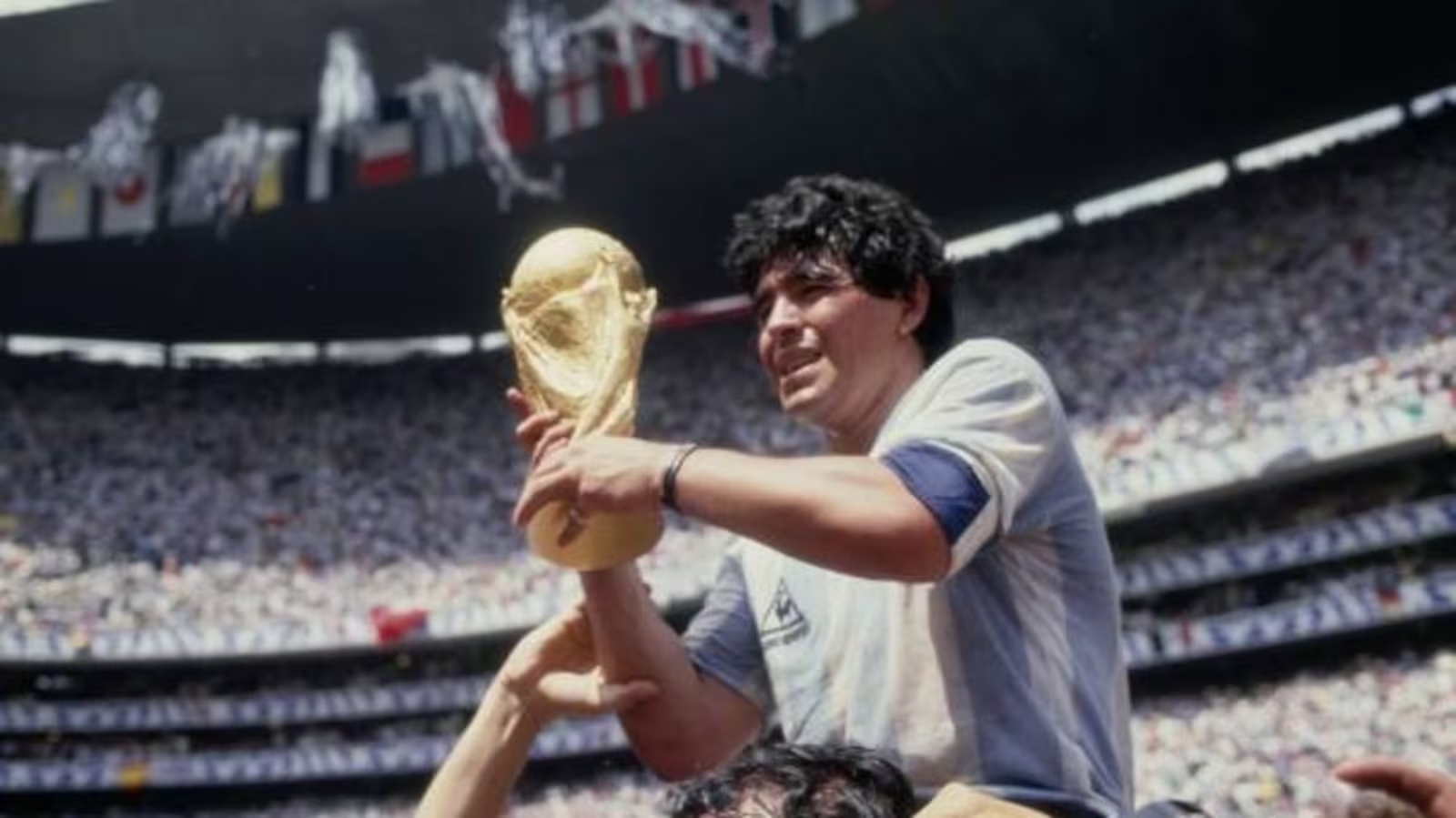
Eight nations have won the FIFA World Cup since 1930. Brazil leads with 5 titles (1958, 1962, 1970, 1994, 2002). Germany and Italy follow with 4 each.
Argentina won 3 times, most recently in 2022. This complete list shows every champion, why Brazil’s 1958-1970 era dominates football history, and surprising records spanning nearly a century.
In this article you will know about:
- Complete list of all FIFA World Cup winners from 1930 to 2024
- Which nations won the most World Cup titles and why
- Brazil’s golden era and why they haven’t won since 2002
- Modern champions from 2014 to 2024 and European dominance
- Surprising World Cup records and patterns
- Nations that won once and never returned
- Frequently asked questions about World Cup winners
Complete FIFA World Cup Winners Table (1930-2024)
| Year | Host | Champion | Final Score | Runner-Up |
| 1930 | Uruguay | Uruguay | 4-2 | Argentina |
| 1934 | Italy | Italy | 2-1 | Czechoslovakia |
| 1938 | France | Italy | 4-2 | Hungary |
| 1942 | — | Not held | — | — |
| 1946 | — | Not held | — | — |
| 1950 | Brazil | Uruguay | 2-1 | Brazil |
| 1954 | Switzerland | Germany | 3-2 | Hungary |
| 1958 | Sweden | Brazil | 5-2 | Sweden |
| 1962 | Chile | Brazil | 3-1 | Czechoslovakia |
| 1966 | England | England | 4-2 | Germany |
| 1970 | Mexico | Brazil | 4-1 | Italy |
| 1974 | Germany | Germany | 2-1 | Netherlands |
| 1978 | Argentina | Argentina | 3-1 | Netherlands |
| 1982 | Spain | Italy | 3-1 | Germany |
| 1986 | Mexico | Argentina | 3-2 | Germany |
| 1990 | Italy | Germany | 1-0 | Argentina |
| 1994 | USA | Brazil | 0-0 (3-2 penalties) | Italy |
| 1998 | France | France | 3-0 | Brazil |
| 2002 | South Korea/Japan | Brazil | 2-0 | Germany |
| 2006 | Germany | Italy | 1-1 (5-3 penalties) | France |
| 2010 | South Africa | Spain | 1-0 | Netherlands |
| 2014 | Brazil | Germany | 1-0 | Argentina |
| 2018 | Russia | France | 4-2 | Croatia |
| 2022 | Qatar | Argentina | 3-3 (4-2 penalties) | France |
Twenty-two tournaments have determined the world champion. Two were canceled during World War II (1942 and 1946).
The tournament expanded from 13 teams in 1930 to 32 by the 1990s. Now 48 teams will compete starting in 2026. This growth reflects how football became the planet’s most popular sport.
Which Nations Won the Most World Cups? Brazil Leads With 5 Titles
| Nation | Titles | Years | Record |
| Brazil | 5 | 1958, 1962, 1970, 1994, 2002 | 25% of all tournaments won |
| Germany | 4 | 1954, 1974, 1990, 2014 | Consistent across eras |
| Italy | 4 | 1934, 1938, 1982, 2006 | Early dominance plus late resurgence |
| Argentina | 3 | 1978, 1986, 2022 | 36-year gap before 2022 |
| France | 2 | 1998, 2018 | Modern era strength |
| Uruguay | 2 | 1930, 1950 | Pioneer era wins |
| England | 1 | 1966 | Only home victory |
| Spain | 1 | 2010 | One peak moment |
Brazil’s gap widens the competition: Brazil won 5 of the first 22 tournaments (23%). All other nations combined won 17 (77%). This shows how tournament competition intensified over time.
In the first era (1930-1970), Brazil won 3 consecutive tournaments over 12 years. This established unmatched dominance. Within the same period, Italy won twice non-consecutively (1934, 1938). This defined early European strength.
After 1970, no nation has won back-to-back titles. This pattern held for 54 years and counting. No nation has ever won three consecutive titles. If this record breaks, it would end a 94-year pattern.
Why Brazil’s 1958-1970 Era Changed Football Forever
Brazil’s five World Cup championships span two distinct periods. The first three titles (1958, 1962, 1970) created a golden era. This golden era revolutionized how football was played globally.
1958 Sweden: Brazil 5-2 Sweden Pelé, age 17, led Brazil to defeat the host nation. This victory established Brazil as a global power. The team introduced possession-based tactics that influenced global strategy.
1962 Chile: Brazil 3-1 Czechoslovakia This confirmed Brazil’s dominance wasn’t dependent on one player. Defensive resilience paired with attacking precision proved Brazil’s system worked.
1970 Mexico: Brazil 4-1 Italy Pelé won his third title. This record stands unmatched 54 years later. Brazil’s possession-based tactics influenced football strategy for decades.
Pattern of dominance: From 1958-1970, Brazil won 3 titles in 12 years. This concentrated dominance means Brazil won 25% of all World Cups during their peak era alone.
Later victories showed evolution: Decades later, Brazil won twice more (1994, 2002). But the style had evolved from their 1960s artistry. The 1994 victory came on penalties against Italy after a goalless draw. This meant defensive strength could overcome creative superiority.
The 2002 win came with a 2-0 defeat of Germany. This confirmed sustained excellence across generations. Brazil remained tournament favorites every cycle.
The longest drought begins: Since 2002, Brazil hasn’t won the World Cup. In the 22 years following their last title, Brazil reached the final twice. The 2014 loss came 7-1 at home to Germany. The 2002 loss came on penalties to France.
Modern era competition has fragmented titles among more nations. The longest drought since 1950 now stands at 22 years. This represents a fundamental shift in global football balance.
RELATED ARTICLES



Recent Champions 2014-2024: Why European Nations Now Dominate
The modern era shows how competitive the World Cup has become. European nations now win 50% of tournaments. This represents a dramatic shift from Brazil’s era.
2014 Brazil Tournament: Germany defeated Argentina 1-0 Mario Götze scored in extra time. This victory gave Germany their fourth title overall. Germany’s 4 titles across 1954-2014 (60-year span) show sustained excellence. This contrasts Brazil’s frontloaded wins (3 in 12 years between 1958 and 1970).
2018 Russia Tournament: France defeated Croatia 4-2 This was France’s second World Cup title. Their first title came in 1998. Proves modern era means titles shift between elite nations rapidly. France reached three finals in 26 years (1998, 2018, 2022).
2022 Qatar Tournament: Argentina defeated France 3-3 then 4-2 on penalties One of the most dramatic finals ever played. This victory gave Argentina their third title. Gave Lionel Messi the World Cup trophy he sought his entire career. He was age 35 at the time. Argentina’s 36-year gap between 1986 and 2022 finally ended spectacularly.
2026 expansion impact: When the World Cup expands to 48 teams in North America, competitive parity will likely increase further. European nations will likely continue winning 50% or more of titles. Unless African or Asian qualifying becomes significantly more competitive, this pattern will persist. Systemic changes to those confederations’ resources remain unlikely.
Records, Patterns and Surprising World Cup Facts
Pelé’s unmatched player record: Pelé is the only player to ever win the World Cup three times (1958, 1962, 1970). This record stands 54 years later. No other player has matched this achievement. Messi won once in 2022. This cemented his legacy after 16 World Cup tournament appearances.
Back-to-back champion nations: Only two nations have ever won consecutive World Cups. Brazil won back-to-back in 1958 and 1962. Italy won back-to-back in 1934 and 1938. No nation has ever won three consecutive titles. If any nation wins 3 consecutive World Cups, they would break an unmatched 94-year pattern.
Tournament size and expansion: In 1930, just 13 teams competed. By the 1990s, 32 teams participated. Starting in 2026, 48 teams will compete for the trophy. Making qualification more competitive but the knockout stage potentially less certain. This expansion means smaller nations now have pathways to compete. These pathways didn’t exist before.
Germany’s consistency across eras: Germany holds the record for most final appearances with eight. They appeared in finals across different eras (1954, 1974, 1990, 2014, 2022, and earlier tournaments). When Germany won as West Germany (1954, 1974), those records merged post-1990. This explains why Germany shows four modern titles despite the Cold War political split.
Penalty shootout history: The penalty shootout was introduced as the tiebreaker in 1986. Before that, matches would have been replayed if tied after extra time. This never happened in a final. Since 1986, three finals have gone to penalties. Argentina has won twice on penalties (1994, 2022). Italy won once (2006).
One-time champions versus repeat winners: The gap between one-time winners and repeat champions reveals a pattern.
Repeat champions have 20+ year elite player pipelines. They maintain institutional consistency. Spain won once in 2010 but haven’t returned to the final. Despite remaining a strong football nation, they couldn’t sustain excellence.
England won once in 1966 and haven’t won again. Despite multiple qualification appearances, they couldn’t repeat success.
This shows winning requires sustained excellence across generations. It requires more than just momentary peak performance.
Nations That Won Once and Never Returned: Single World Cup Champions
England’s 1966 Home Victory and 58-Year Drought England won at home in London, defeating Germany 4-2. This remains their only World Cup victory. Despite strong European performances, England hasn’t won again in 58 years. They reached Euro finals but not another World Cup final.
Spain’s 2010 Peak and 14-Year Absence Spain won in South Africa, defeating Netherlands 1-0. This was their first and only World Cup title. Since 2010, Spain hasn’t returned to the final despite remaining a strong football nation. Their tiki-taka style became predictable to opponents.
Uruguay’s Two Early Titles and 50-Year Final Gap Uruguay won in 1930 as the inaugural champion and again in 1950. These two victories established them as a historical power despite their small population. They haven’t reached the final since 1974. Their small player pool limited sustained excellence.
France’s One of Three Finals: 1998 Victory and Modern Disappointments France’s first World Cup title came in 1998 when they hosted, defeating Brazil 3-0. They returned to finals in 2006 and 2022 but lost both times. This gives France one title from three final appearances, showing modern finals are increasingly competitive.
FAQs
Why hasn’t Brazil won since 2002 despite being historically dominant?
Brazil lost the 2014 final 7-1 at home to Germany and the 2022 final on penalties to France. European nations now win 50% of tournaments. Competition is more balanced than Brazil’s 1958-1970 dominance era.
Can any nation win the World Cup three consecutive times?
No nation has ever won three consecutive World Cups. Brazil came closest with three titles in 12 years (1958-1970) but not consecutively. This pattern hasn’t been broken in 94 years.
What separates one-time winners from repeat champions?
Repeat champions maintain 20+ year elite player pipelines and institutional consistency. Spain won once in 2010 but couldn’t sustain success. England won in 1966 and never returned. Winning requires sustained excellence.
Has Germany won multiple World Cups?
Yes, Germany won four titles (1954, 1974, 1990, 2014). West Germany won twice during the Cold War. Records merged after 1990 reunification. Germany shows sustained excellence across eras.
Why do European nations now win more World Cups than South American nations?
Europe won 11 of 22 tournaments since 1950 (50%). South America won 9 (41%). Europe invested more in youth development and coaching systems. This structural advantage likely persists.
Which country won the first World Cup?
Uruguay won the inaugural 1930 FIFA World Cup, defeating Argentina 4-2 in Montevideo. This established them as a founding powerhouse despite their small population and no subsequent wins.
When did Argentina last win the World Cup?
Argentina won in 2022 in Qatar, defeating France 4-2 on penalties after 3-3 draw. This ended a 36-year gap since their 1986 victory. Messi finally achieved his World Cup dream at age 35.
How many countries have won the World Cup?
Eight nations have won: Brazil, Germany, Italy, Argentina, France, Uruguay, England, and Spain. Brazil leads with 5 titles. No other nation has claimed the trophy in 94 years.
Why is Pelé’s three-time World Cup record so significant?
Pelé is the only player to win three World Cups (1958, 1962, 1970). This record stands unmatched 54 years later. No other player achieved this while maintaining elite international careers.
What happens when the 2026 World Cup expands to 48 teams?
Format changes from 32 to 48 teams with 12 groups of 4. More nations qualify. Title chances fragment among additional competitors. European and South American nations likely maintain 50%+ win rate.