The Rugby World Cup is the international rugby union championship held every four years, bringing together the world’s elite national teams to compete for sport’s most prestigious trophy.
Since the inaugural tournament in 1987, the Rugby World Cup has grown from a 16-team event into a global spectacle featuring top rugby nations competing at the highest level of international competition.
This comprehensive guide covers all Rugby World Cup winners from 1987 through 2023, including champion teams, final scores, tournament hosts, and how this prestigious event has evolved over more than three decades.
Rugby World Cup Winners: Complete Year-by-Year Table
| Year | Host Country | Winner | Runner-Up | Score | Prize Money |
| 2023 | France | South Africa | New Zealand | 12-11 | $10,000,000 |
| 2019 | Japan | South Africa | England | 32-12 | $10,000,000 |
| 2015 | England | New Zealand | Australia | 34-17 | $8,000,000 |
| 2011 | New Zealand | New Zealand | France | 8-7 | $6,000,000 |
| 2007 | France | South Africa | England | 15-6 | $5,000,000 |
| 2003 | Australia | England | Australia | 20-17 | $3,000,000 |
| 1999 | Wales | Australia | France | 35-12 | $2,000,000 |
| 1995 | South Africa | South Africa | New Zealand | 15-12 | $1,000,000 |
| 1991 | England | Australia | England | 12-6 | $750,000 |
| 1987 | New Zealand | New Zealand | France | 29-9 | $500,000 |
Most Successful Rugby World Cup Winners
New Zealand has dominated the Rugby World Cup more than any other nation, claiming three titles across the tournament’s history.
The All Blacks won the inaugural 1987 tournament, then captured back-to-back championships in 2011 and 2015, establishing themselves as the sport’s most successful international team.
South Africa has emerged as a close second with three Rugby World Cup victories. South Africa won the inaugural post-apartheid tournament in 1995, then claimed titles in 2007 and most recently in 2023 with a thrilling one-point victory over New Zealand.
Rugby World Cup Champions by Nation:
- New Zealand: 3 wins (1987, 2011, 2015)
- South Africa: 3 wins (1995, 2007, 2023)
- Australia: 1 win (1999)
- England: 1 win (2003)
The Rugby World Cup winners represent the pinnacle of rugby excellence, with only five nations having claimed the trophy across ten tournaments.
This concentration of success highlights the competitive advantage held by these rugby powerhouses in international competition.
Most Recent Rugby World Cup: 2023 South Africa Victory
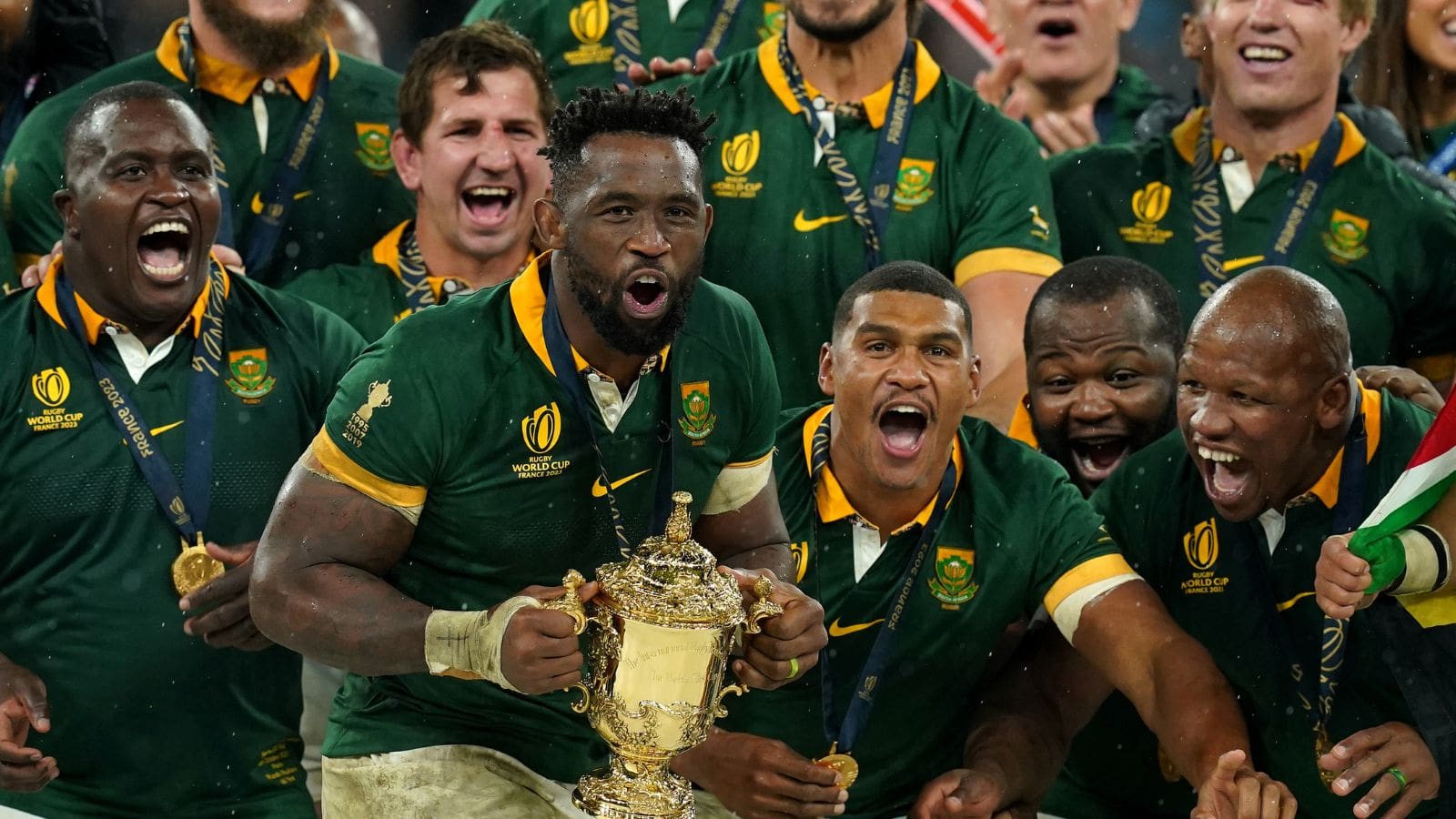
South Africa claimed the 2023 Rugby World Cup championship with a narrow 12-11 victory over New Zealand in the final held in France.
The match showcased the intense rivalry between these two southern hemisphere giants, with South Africa securing their third Rugby World Cup title through exceptional defensive performance and pressure kicking.
The 2023 final was one of the closest Rugby World Cup championship matches in recent history, decided by just a single point.
New Zealand’s loss marked only the second time in the tournament’s history that a team failed to successfully defend their Rugby World Cup title, highlighting the competitive nature of international rugby union.
Prize Money Evolution
Prize money for winning the Rugby World Cup has increased substantially since the tournament’s inception.
When New Zealand won the inaugural 1987 Rugby World Cup, the champion’s prize was only $500,000, reflecting the event’s relative youth and smaller global audience at that time.
The most recent Rugby World Cup tournaments in 2019 and 2023 offered $10,000,000 to the winning team, reflecting the tournament’s status as one of global sport’s most valuable international sporting events.
This represents a 20-fold increase from the inaugural tournament prize money, demonstrating rugby union’s remarkable growth as a professional sport.
Prize Money Growth Timeline
| Tournament Year | Winner’s Prize | Total Tournament Purse |
| 1987 | $500,000 | $2,000,000 |
| 1995 | $1,000,000 | $4,000,000 |
| 2003 | $3,000,000 | $8,000,000 |
| 2011 | $6,000,000 | $15,000,000 |
| 2019 | $10,000,000 | $20,000,000 |
| 2023 | $10,000,000 | $20,000,000 |
New Zealand All Blacks: Three-Time Champions
New Zealand emerged as the Rugby World Cup’s most successful nation by winning three championships across the tournament’s history.
The All Blacks won their first Rugby World Cup in 1987 as the inaugural champions, establishing New Zealand as an international rugby powerhouse from the tournament’s beginning.
RELATED ARTICLES




After 24 years without another Rugby World Cup title, New Zealand claimed back-to-back championships in 2011 and 2015.
The 2011 Rugby World Cup victory came with an 8-7 triumph over France on home soil at Eden Park in Auckland, one of the most dramatic finals ever played in rugby history.
The 2015 Rugby World Cup championship featured a dominant 34-17 victory over Australia at Twickenham in England.
The All Blacks’ three Rugby World Cup championships span 28 years, demonstrating remarkable consistency in maintaining excellence across different generations of players.
New Zealand’s rugby culture emphasizes continuous improvement and development of young talent, creating a pipeline that has sustained their competitive advantage throughout the modern rugby era.
South Africa Springboks: Championship Resurgence
South Africa has matched New Zealand with three Rugby World Cup championships, establishing themselves as one of international rugby’s two dominant nations.
The Springboks’ first Rugby World Cup victory came in 1995 on home soil, a historically significant moment that transcended sport and resonated throughout South African society.
South Africa claimed their second Rugby World Cup championship in 2007 with a 15-6 victory over England in France, showcasing the Springboks’ powerful forward play and defensive excellence. Most recently, South Africa won the 2023 Rugby World Cup championship in a thrilling 12-11 final against New Zealand in Paris.
The Springboks’ three Rugby World Cup titles span 28 years, from 1995 through 2023, demonstrating consistent excellence and competitive advantage throughout multiple generations of players.
Australia and England: Rugby World Cup Winners
Australia claimed the Rugby World Cup championship once, winning in 1999 with a 35-12 victory over France in Wales.
The Wallabies’ comprehensive triumph demonstrated Australia’s attacking prowess during the late 1990s competitive era.
England won their only Rugby World Cup championship in 2003 with an exciting 20-17 victory over Australia in extra time at the Telstra Stadium in Sydney.
Jonny Wilkinson’s drop goal in overtime secured the trophy and established England as a major rugby power capable of winning on the international stage.
England reached the Rugby World Cup final again in 2007 and 2019, demonstrating consistent ability to compete at the highest levels of international rugby union throughout the modern tournament era.
France: Top Nations Without a Championship
France has reached the Rugby World Cup final three times but has never claimed the championship trophy despite being one of the world’s top rugby nations.
The French team lost the inaugural 1987 Rugby World Cup final to New Zealand 29-9, beginning a pattern of near-misses that would continue throughout the tournament’s history.
France reached the Rugby World Cup final again in 1999, losing to Australia 35-12, and returned to the final in 2011, losing to New Zealand 8-7 in a closely contested match at Eden Park.
France has hosted the Rugby World Cup twice, in 2007 and 2023, yet failed to claim the championship trophy on home soil despite reaching the finals.
Legendary Rugby World Cup Moments
The 1995 Rugby World Cup final between South Africa and New Zealand holds profound significance beyond the sport itself.
This match represented South Africa’s integration into international rugby competition after decades of isolation, with the Springboks’ victory becoming a symbol of national reconciliation.
Nelson Mandela’s presence at the 1995 final, dressed in Springboks colors, became one of sport’s most iconic moments. The match transcended rugby, representing broader themes of unity and transformation within South African society during a pivotal historical period.
Jonny Wilkinson’s drop goal in the 2003 Rugby World Cup final overtime remains one of international rugby’s most remembered single plays. England’s dramatic victory over Australia came down to that single decisive moment, securing England’s only Rugby World Cup championship.
The 2011 Rugby World Cup final between New Zealand and France showcased rugby’s unpredictability, with the All Blacks winning 8-7 in one of the lowest-scoring championship matches ever contested.
The narrow margin demonstrated how rugby world championship finals often decide champions through tactical excellence rather than attacking exhibitions.
For deeper insights on rugby world tournament evolution, explore World Rugby’s historical tournament data and evolution.
FAQs
What is the Rugby World Cup?
The Rugby World Cup is the international rugby union championship held every four years, featuring the world’s 20 best national teams competing for the sport’s most prestigious trophy.
Which nation has won the most Rugby World Cups?
New Zealand and South Africa each have three Rugby World Cup championships, making them the tournament’s most successful nations in rugby history.
When did England win the Rugby World Cup?
England won their only Rugby World Cup championship in 2003 with a 20-17 victory over Australia in extra time at the Telstra Stadium in Sydney.
Has France ever won the Rugby World Cup?
France has reached the Rugby World Cup final three times but has never won the championship trophy despite being among the world’s top rugby nations.
Where was the first Rugby World Cup held?
The inaugural 1987 Rugby World Cup was held in New Zealand, with the All Blacks winning the championship with a 29-9 victory over France.
How often is the Rugby World Cup played?
The Rugby World Cup is held every four years, with ten tournaments contested between 1987 and 2023 across various international host nations. International Rugby Union tournament schedules and planning provide comprehensive information on upcoming competitions and organizational details.
RELATED ARTICLES