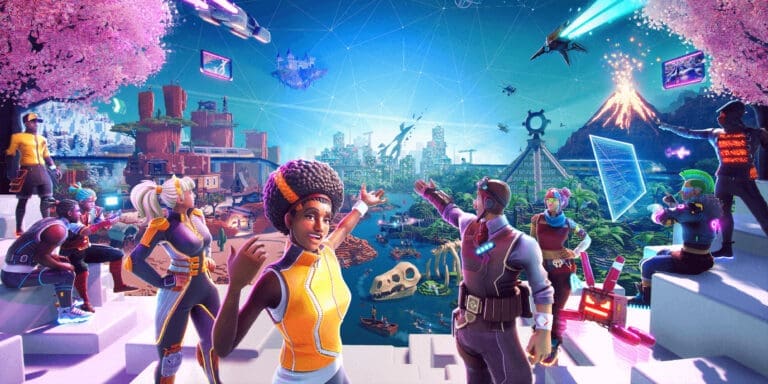
The regular refrain of parents throughout the decades is that their children should spend less time inside playing games and more time outside playing with their friends and socializing. Whilst this is certainly true, and something all parents should try to encourage, it doesn’t mean that gaming is an anti-social activity.
In fact, in recent years, gaming has become far more social than ever and was indeed used as a social lifeline by many during the COVID-19 pandemic.
In this article, we attempt to dig down a little more into the details, and beyond just COVID, to explain why social gaming has risen so much in popularity since the middle of the 2010s.
Pre-Online Gaming Industry Limitations
Up until around the end of the noughties, gaming was a relatively anti-social activity. Whilst family members may have played multiplayer games with one another and friends may have travelled to each other’s houses to take turns on games, largely gaming was something that you did on your own.
As such, there was a finite amount of content. Once you bought a game, you played through until the end and then forgot about it, until you randomly got an urge to play through it again in a couple of months or years’ time.
In terms of profits, that wasn’t ideal for gaming companies. Not only did it put pressure on them to ensure that their games were an instant hit to cover development costs, but it restricted their timeframe to make money to just a short period after release.
Cheap and widely available internet, when it came about in the mid-2000s, offered gaming companies a way to get people to play their games for longer and with a much higher level of engagement.
Online gaming not only gave players the chance to play with their friends from the comfort of their homes, but it also gave companies a much bigger window to sell their games.
(Video gaming was very different in the 1990s.)
Online and Social Integration Incentivised by Profits
The next step came in turning this increased engagement into increased profit. At some point in the mid-2010s, companies came to recognise that they could regularly update online titles to make them consistently relevant and fresh for audiences, and that they could charge for many of the items in their games.
Industry research also showed that players were not only more engaged by the regularly updating content on offer on online titles, but that they were also more engaged as a result of social interaction with other players.
Thus, online gaming companies were provided with an incentive to not just make their games available online and consistently update them, but also to encourage social interaction on their platforms.
It’s a lesson that was learned by the online gambling industry, too, where social casino games are common features, providing what they describe as a more authentic experience.
Online Gaming as an Answer to Loneliness
In almost every Western country on the planet, the rates of loneliness are rising amongst every demographic. The age groups most affected by it, however, appear to be those that came after the millennial generation.
Several professional organisations and bodies, along with leading scholars such as Jonathan Haidt, lay the blame for this at the door of smartphones and social media. Whilst smartphones have arguably never left us feeling more connected, they have also left us feeling more isolated and alone than ever before.
The result, then, of this loneliness epidemic amongst younger generations, is that many are turning to online gaming as a safe space to get their social fix. The rights and wrongs of this can be debated endlessly, but the data shows that there is a clear link.
(Younger generations are getting more and more lonely.)
COVID-19 as an Accelerant
Dried wood, arranged in a specific manner, may eventually catch fire on its own, but a sure-fire way to guarantee that it does is to pour gasoline on it and drop a lit match on top of that gasoline.
In much the same way, the conditions for a rise in social gaming were all there pre-2020, but Covid-19 was the spark that lit the flame.
It forced the majority of us indoors and left us all scrambling for a way to keep in touch with our friends and scratch that social itch. Online gaming offered us all that social lifeline. In 2020, online gaming numbers spiked dramatically and, despite dropping somewhat after the pandemic, have remained well above pre-pandemic levels.
Whilst all of the other reasons covered above are valid and substantial, it’s Covid-19 that kick-started social gaming. For the profit reasons covered above, it’s hard to see a future in which social gaming is not heavily prioritised by gaming developers as well.