Some things take longer than they should, while time seems to fly by when doing other things. For example, you don’t notice how time passes when having fun on a site like Fortunica casino, but a relatively simple task like writing an email or packing a suitcase can take up your entire afternoon. Have you ever wondered why this happens?
Parkinson’s Law can explain this phenomenon. It’s a simple concept that offers some very interesting ideas about time management. If you understand what it is and how it affects you, you can work smarter, finish your tasks faster, and gain more free time. Let’s take a closer look at this interesting concept.
What Is Parkinson’s Law?
The first person to use this term was C. Northcote Parkinson, an English historian. He began an essay he wrote for The Economist in 1955 with the following sentence: “Work expands so as to fill the time available for its completion.” This is actually a sarcastic statement because Parkinson wrote the entire essay to criticise bureaucracy.
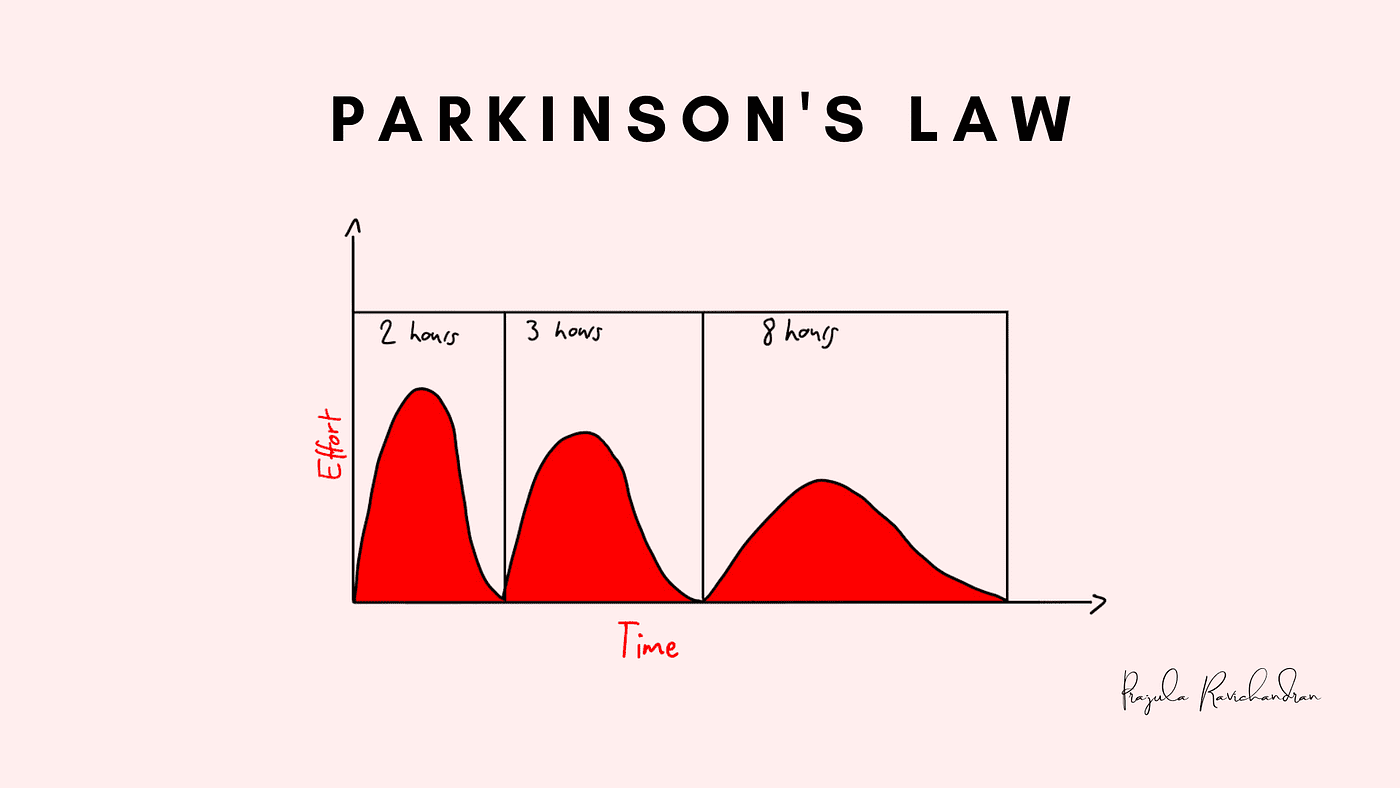
So, what does this sentence mean? Simply put, it means that however much time you give yourself to complete a task, that is how long the task will take. For example, let’s say you give yourself two weeks to write an article: in this case, writing this article will indeed take two weeks. However, if you give yourself two hours for the same task, you could complete it within that time.
If you’re thinking “laziness,” you’re mistaken. Parkinson’s Law is not a concept related to laziness. It’s about how our brain responds to stress and pressure: it adjusts our physical and mental capacity according to the time we think we have. So, if it thinks you have a lot of time, it doesn’t push you to hurry.
The Psychological Reasons Behind Tasks Taking Longer
There are multiple psychological reasons why some tasks take longer than others, but we can group them into four main categories:
- Lack of urgency: If we think we have plenty of time for a specific task, our brain starts to see it as something that can be “started later.” You postpone something you should do in the morning until noon, then until evening, and finally until the next morning. This cycle continues until there is very little time left to do the job.
- Perfectionism: If we think we have more time to complete a task, we tend to over-polish it. However, this is not healthy “polishing,” because it is actually unnecessary. For example, it is not necessary to rewrite an email ten times. Yet we do it, and we keep starting over on a job we have already finished.
- Task ambiguity: If we don’t have a clear idea of what a completed task should look like, completing the task becomes difficult and, in some cases, even impossible. For example, let’s say your job is to prepare a presentation. Should it consist of 3 slides or 5? If you can’t decide, it means you can’t visualise the finished product, and this alone can cause it to take much longer.
- Fear of failure: Sometimes, the fear of failure is the reason behind tasks taking longer. Completing a task makes it real, and the fear of being judged on that reality is emotionally very frightening for some people.
If you are affected by Parkinson’s Law, the reason is most likely one of these four scenarios. Whichever it is, it affects you more than you think because Parkinson’s Law means long working hours that are not rewarding, constant mental strain, and less time to rest.
You Can Beat Parkinson’s Law
You can’t beat Parkinson’s Law by working harder, but you can minimise its impact with the right time management strategies. Try these:
- Timeboxing: Before starting a task, decide how long it should take to complete. If you can’t finish it in one go, determine how many days it will take and how much time you will spend on it each day.
- The half-time rule: After determining how long you think it will take to complete a task, cut that time in half. Did you think it would take 6 hours? You can do it in 3 hours. Convince your brain that time is limited.
- Defining “Done:” Decide in advance what the completed work will look like and what it will include.
- Creating accountability: Tell someone about the task you are working on and when it will be completed. This person doesn’t need to check up on you: just mentioning it to someone else is enough to create a sense of responsibility in your brain to complete the task.
Don’t expect results in a short time: your brain will need some time to adapt to these new time management strategies. But if you persevere, you will see that completing tasks takes less time than before, feels more rewarding, and leaves you with more free time.