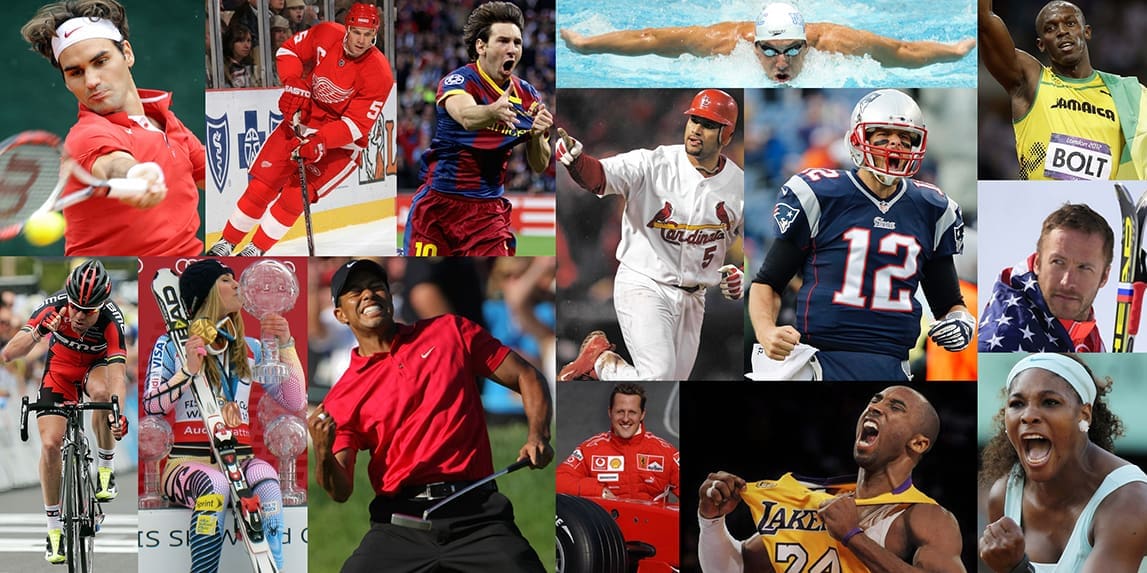
The endless debate about who is the greatest of all-time (GOAT) in sport is arguably one of the biggest exercises in futility known to man.
Attempting to provide answers on a sport-by-sport basis is equally futile, with the number of variables which factor into the equation making the task impossible.
GOAT: A debate fraught with danger
The GOAT debate is purely subjective, but generally hinges on a combination of career achievements, statistical data and overall influence on the individual’s sport.
For example, everyone would agree that Muhammad Ali was the best heavyweight boxer of all time. He’s not known as ‘The Greatest’ for nothing.
However, before debating whether he is the greatest sportsman of all-time, it is worth noting that a strong case can be made for saying he’s not the best boxer who ever lived.
Weight differences make this an impossible task. Sugar Ray Robinson, Floyd Mayweather Jr, Marvin Hagler – all great. But comparing them with fighters from different eras and weights? Impossible.
That point is by the elements we have seen SportsView talk about when trying to unravel the GOAT debate. Their start point was how athletes are judged across different sports:
- Key Evaluation Metrics: Tom Brady’s Super Bowl rings, Pele’s World Cup successes, Sir Steven Redgrave’s gold medals and so on.
- Statistical achievements: An unbeaten record in boxing, most goals in professional football, most tennis Grand Slams – the evaluation is already becoming more complicated.
- Longevity and consistency: Tiger Woods in golf. Lionel Messi and Cristiano Ronaldo in football. The debate is even more difficult now.
- Impact and influence: Wayne Gretzky transformed ice hockey. Sir Donald Bradman revolutionised cricket. The list is endless.
Judging the best athletes becomes even more difficult when factoring key skills into the equation. Different sports require a range of physical, mental and technical strengths.
When you start adding eras into the equation, the landscape becomes even cloudier. For instance, athlete Jesse Owens ran on cinder tracks rather than modern synthetic surfaces.
Comparing his on-track achievements against Usain Bolt’s is a waste of time. And that’s before bringing impact and influence into the debate.
The stats don’t lie – or do they?
Michael Jordan is widely regarded as the greatest basketball player of all-time. However, he ONLY won six NBA titles, five adrift of Bill Russell’s career tally.
Jordan averaged 30.1 points per game, 6.2 rebounds per game and 5.3 assists per game. Wilt Chamberlain averaged 30.1 points per game, 22.9 rebounds per game and 4.4 assists per game.
On paper, Chamberlain is statistically better than Jordan. However, he only won two NBA titles. If your brain isn’t hurting yet, it should be.
The debate becomes even more nuanced when considering achievements in different sports. For instance, Brady’s tally of seven Super Bowl rings is hugely impressive.
However, American Football is primarily a North American sport. On that basis, it could be argued that achievements in the NFL count for little in a global context.
Brady would probably argue that performing at an elite level while being attacked on all sides by muscle-bound opponents places greater weight on his achievements.
Boxers may contend that being punched in the face makes their sport more meritorious. The counter-argument sub-plots are endless.
My sport is better than yours
Which sport is the hardest? Which sporting achievement is the toughest? Answers to these and other impossible questions on a postcard please.
Many fans and athletes are insular about their chosen sport, not least because of the popularity of different sports. That naturally makes it and any achievements garnered better than anything else. However, their stance is flawed.
Comparisons between sports are impracticable. For example, there has been a long-running debate about which achievement is more a difficult – a nine-darter in darts or a 147 in snooker.
The former only takes nine throws, while a 147 requires 36 successful shots. However, the margin for error and luck in snooker is much greater than in darts.
However, modern dartboards have thinner wiring in the modern era, which makes nine-darters more attainable. We are now back at square one.
Looking beyond those comparisons, similar factors can be applied to the current debates surrounding which player is the greatest of all-time in darts.
Phil Taylor won the world title 16 times on boards with thick wiring. Luke Littler has won it twice on modern boards. Despite this, Luke Humphries thinks Littler is the GOAT in darts.
Taylor’s supporters point to his tally of world titles, while overlooking the fact that genuine competition was thin on the ground when he was in his pomp.
Those variables highlight why the wider debate about picking the sporting GOAT is too difficult to unravel. Can we just agree it was the WWE’s Mr Perfect and move on?