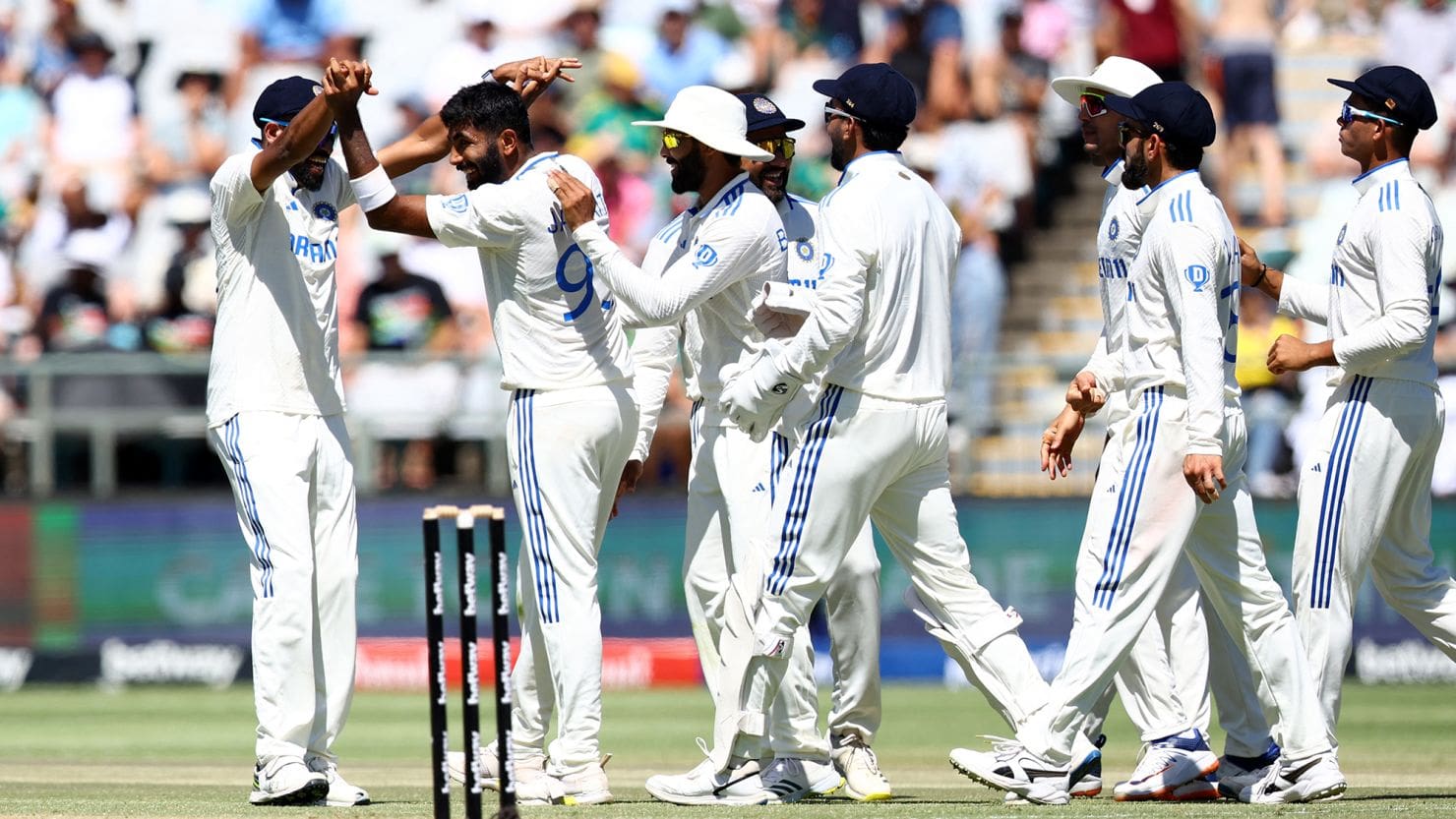
Test cricket requires a minimum of 90 overs per day, which means a full five-day Test match typically sees around 450 overs total.
However, unlike ODIs or T20s where the number of overs is fixed, Test cricket doesn’t have a hard cap on overs; it’s time-based rather than over-limited.
Each day has six hours of scheduled play divided into three sessions, with approximately 30 overs bowled per session at a rate of 15 overs per hour.
Test Cricket Overs vs. Limited-Overs Formats
The key difference between Test cricket and other formats is that Test matches are defined by time, not by overs. Let’s compare:
Cricket Formats: Overs Breakdown
| Format | Total Overs | Days/Innings | Key Rule | Flexibility |
| Test Match | ~450 (90/day) | 5 days, 2 per team | Minimum 90 overs/day | No max limit; time-based |
| One Day International (ODI) | 50 | 1 day, 1 per team | Fixed 50 overs | Strict over limit |
| T20 International | 20 | 1 day, 1 per team | Fixed 20 overs | Strict over limit |
| T20 League Matches | 20 | 1 day, 1 per team | Fixed 20 overs | Strict over limit |
The fundamental principle: Test cricket rewards patience and endurance, not rapid completion. A match can finish in 2-3 days if one team dominates, or it can go the full five days and still end in a draw.
The Daily Over Structure in Test Cricket
A standard day of Test cricket follows a predictable pattern:
Daily Session Breakdown:
- Morning Session: 10:30 AM – 1:00 PM (approximately 30 overs)
- Lunch Break: 1:00 PM – 1:40 PM (40 minutes)
- Afternoon Session: 1:40 PM – 4:00 PM (approximately 30 overs)
- Tea Break: 4:00 PM – 4:20 PM (20 minutes)
- Evening Session: 4:20 PM – 6:00 PM (approximately 30 overs)
This schedule totals approximately 90 overs per day at a rate of 15 overs per hour.
What Counts as an Over? An over consists of 6 legal deliveries bowled from one end of the pitch by a single bowler. After 6 deliveries, the bowler switches ends and a different bowler takes over.
This system ensures variety in bowling attacks and prevents any single bowler from dominating without break.
Rules Governing Overs in Test Cricket
The International Cricket Council (ICC) enforces strict over-rate regulations:
Key Over-Rate Rules:
- Minimum daily overs: 90 overs must be bowled each day (unless weather/bad light interferes)
- Minimum over rate: 15 overs per hour (teams must maintain this average)
- Daily total: If not completed by scheduled close, umpires can extend play up to 30 minutes to complete the 90 overs
- Fifth day extension: On days 1-4, the final session can extend by 30 minutes if umpires believe a result is possible
- Penalties: Teams bowled out too slowly face fines, point deductions in World Test Championship, or potential bans
The ICC implemented these rules to prevent deliberate time-wasting and ensure spectators get a fair contest.
How Match Results Affect Total Overs
A 450-over Test match assumes:
- No weather interruptions
- Standard over rate throughout
- Match goes the full 5 days
In reality, total overs vary significantly:
- Quick finishes: If one team bowls out the other twice in 300 overs, the match can end in 3-4 days, well short of 450 overs
- Weather delays: Rain, bad light, or unsafe ground reduces playing time and overs bowled that day
- Early declarations: A team batting first can declare (voluntarily end their innings) before all 10 wickets fall, reducing total overs
- Follow-on scenarios: If the trailing team is forced to bat again immediately, overs can be completed faster
For example, a match might have only 380 overs if rain cost 8+ hours, or it might have 480 overs if play extended on multiple days to achieve a result.
What Happens If 90 Overs Aren’t Completed?
If the bowling team fails to bowl 90 overs by the scheduled close time:
30-minute extension: Umpires can extend play by up to 30 minutes to complete remaining overs.
If still incomplete: The team faces penalties under ICC regulations, including:
- Fines imposed on the team and captain
- Point deductions in World Test Championship standings
- Potential match bans for repeat offenders
This system ensures bowling teams remain motivated to maintain a reasonable over rate and not drag out the day deliberately.
Historical Context: The 6-Ball Over Rule
Modern Test cricket uses 6-ball overs since 1979-80. Prior to this standardization, different regions used varying over lengths:
- Before 1978: Over lengths ranged from 4 to 8 balls
- 1878-1978: England (6), South Africa (6), Australia & New Zealand (8), Pakistan (8)
- 1979-80 onwards: All Test cricket standardized to 6-ball overs globally
The standardization happened because shorter overs (4-5 balls) caused too many bowling changes, disrupting rhythm. Longer overs (8 balls) gave bowlers too much consecutive bowling. The 6-ball over struck the perfect balance.
Test Cricket vs. Day-Night Tests
In 2015, the first day-night Test was played (Australia vs. New Zealand, Adelaide Oval). These matches use a pink ball instead of red for better visibility under lights. The over structure remains identical:
- Daily overs: Still 90 minimum
- Session lengths: Still 6 hours total play
- Overs per session: Still approximately 30 per session
Day-night Tests haven’t changed the fundamental over structure; they’ve only changed the timing and ball color.
FAQs
Why doesn’t Test cricket have a fixed number of overs like ODI or T20?
Test cricket prioritizes strategy and endurance over rapid completion. A fixed over limit would force artificial finishes. Test cricket rewards patience, smart captaincy, and the ability to build long innings. The time-based format allows for genuine strategic depth.
Can a Test match end before 450 overs are bowled?
Yes, frequently. If one team wins decisively by bowlingout the opposition twice quickly, the match concludes regardless of total overs. A match could finish in 2-3 days with only 200-300 overs bowled. Conversely, a match can reach 450+ overs and still end in a draw.
What happens if weather delays prevent 90 overs being bowled?
Umpires account for lost time and may extend play the following day to make up overs. If overs can’t be recovered despite extensions, the day concludes with fewer than 90 overs. Teams aren’t penalized for weather delays; only for deliberately slow bowling.
How many overs does each bowler bowl in a Test match?
There’s no limit. A bowler can bowl 20, 30, even 40+ overs in a Test match depending on team strategy. However, no bowler can bowl two consecutive overs; a different bowler must bowl from the opposite end. This prevents one bowler monopolizing play.
Why is the over rate 15 overs per hour?
This rate was scientifically calculated to provide a good spectacle. At 15 overs/hour, viewers see adequate cricket action, but bowlers and fielders get sufficient rest between overs. Faster rates exhaust players; slower rates bore spectators. The ICC found 15 overs/hour to be the optimal balance.