
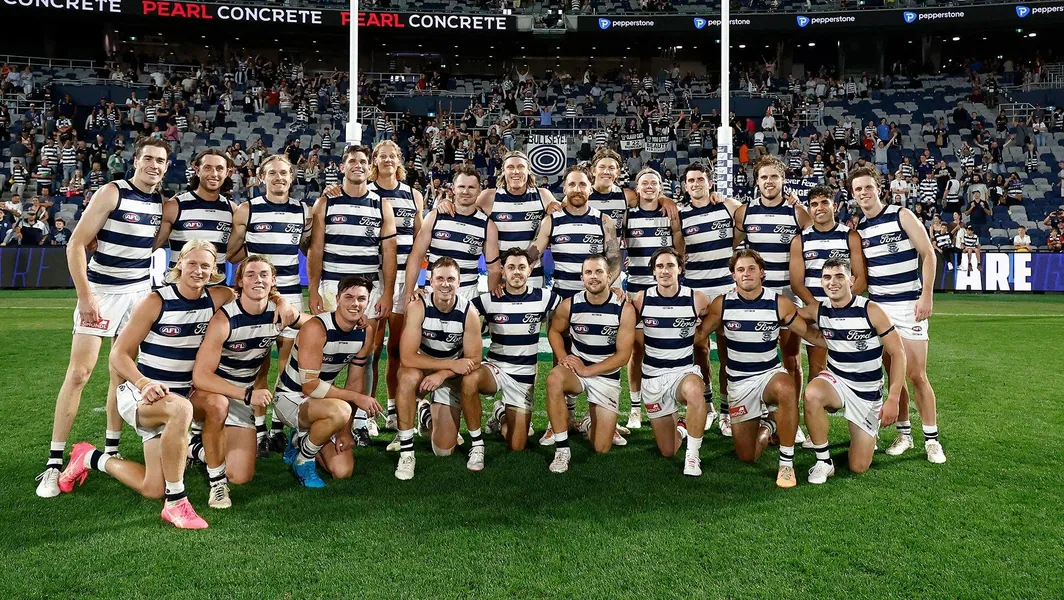
They’re the AFL’s oldest team and they refuse to stop winning. Geelong finished 4th in 2024 with a 14-9 record, reaching the Preliminary Final with an average list age of 26.1 years. Patrick Dangerfield is 34. Jeremy Cameron is 31. Tom Stewart is 31. None of it matters.
The Cats operate under the $16.49 million salary cap but exploit veteran list exemptions saving approximately $400,000-600,000 annually. Coach Chris Scott extended through 2027 after four Grand Finals since 2020. Geelong doesn’t rebuild. They reload with aging stars nobody else can afford.
Learn more about Geelong Cats players’ backgrounds and financial details by selecting their name below.

Geelong Cats’ Biggest Contracts
- Jeremy Cameron – Key Forward: Jeremy Cameron joined from GWS in 2020 on a six-year deal worth approximately $6 million total. He reportedly earns $950,000-1.05 million annually as a three-time All-Australian and 2022 premiership hero. The 31-year-old kicked 62 goals in 2024, leading Geelong’s forward line despite the Cats’ Preliminary Final exit.
- Patrick Dangerfield – Midfielder: Patrick Dangerfield remains on a veteran contract earning an estimated $850,000-950,000 annually through 2025. The 34-year-old 2016 Brownlow medallist played 24 games in 2024 despite chronic calf injuries. He averaged 24.8 disposals, maintaining elite output in his 15th AFL season.
- Tom Hawkins – Key Forward: Tom Hawkins retired after 2024 season, clearing approximately $700,000-800,000 from Geelong’s cap. The four-time All-Australian kicked 32 goals in his final season before retiring at age 36. His departure creates significant cap flexibility for 2025 list management.
- Tyson Stengle – Small Forward: Tyson Stengle extended through 2028 on a deal worth approximately $4.5 million total. He earns an estimated $750,000-850,000 annually after winning the 2022 Norm Smith Medal. The 26-year-old kicked 46 goals in 2024, providing elite forward pressure alongside Cameron.
- Max Holmes – Midfielder: Max Holmes signed a five-year extension through 2029 worth approximately $4 million total. He earns an estimated $700,000-800,000 annually after winning the 2024 Carji Greeves Medal. The 23-year-old averaged 26.3 disposals, representing Geelong’s next-generation midfield core.
Geelong’s top-five contracts total approximately $24-26 million across multiple years. The Cats consume roughly 38-42% of salary cap space on these five players. This veteran concentration creates immediate contention but limits long-term flexibility.
How Geelong Manages the $16.49M Salary Cap
The AFL’s salary cap for 2025 features a $16.49 million soft cap and $17.16 million hard cap. Geelong operates at maximum capacity, utilizing veteran list exemptions to fit expensive older players.
The Cats allocate 40-45% of salary cap to their top six highest-paid players. This concentration funds proven performers rather than developing youth. Geelong’s strategy differs from Fremantle’s youth model, which spreads 35% across five emerging stars.
Geelong benefits massively from veteran list exemptions for players with 10+ years service. The club exempts Patrick Dangerfield, Tom Stewart, and Mitch Duncan from portions of cap calculation. This saves approximately $400,000-600,000 annually compared to standard contracts.
The Cats cleared significant salary space with Tom Hawkins’s retirement ($800K) and trading Esava Ratugolea ($450K) to Port Adelaide. These moves created approximately $1.25 million cap flexibility for extending Max Holmes and securing Bailey Smith from Western Bulldogs.
Geelong faces moderate salary cap pressure in 2025-2026 with Tom Stewart (33 years old, $700K) and Mitch Duncan (33 years old, $600K) requiring contract decisions. The club must balance veteran retention against youth development as the aging list reaches succession point.
Geelong’s Biggest Salary Cap Decision: The Jeremy Cameron Recruitment
Geelong’s most significant salary cap decision came recruiting Jeremy Cameron from GWS in 2020 as a restricted free agent. The club committed approximately $6 million over six years plus surrendered picks 13, 15, and future first-rounder as compensation.
Cameron’s recruitment cost Geelong approximately $1.5 million annually in combined salary and opportunity cost. GWS received three first-round picks (used on Leek Aleer, Cooper Hamilton, and Finn Callaghan). The Giants essentially gained three premium prospects for a departing free agent.
The gamble delivered immediate results: Cameron kicked 51 goals in 2022 premiership season, including 5 goals in Grand Final victory over Sydney. His heroics validated the $6 million investment and compensation picks sacrificed. The 2022 flag represents Geelong’s only premiership since 2011.
Cameron’s dual role as key forward and secondary ruck creates tactical flexibility partnering with Rhys Stanley ($500K). His 62 goals in 2024 at age 31 show sustained elite output justifying the $1 million annual salary through 2026.
This decision reflects Geelong’s aggressive premiership window philosophy. The club prioritizes immediate success over long-term list building. The strategy delivered 2022 flag, four Grand Finals since 2020, and sustained top-4 finishes despite being AFL’s oldest list.
Salary Cap Strategy: Geelong vs Hawthorn
Geelong employs a veteran retention model allocating 40-45% of cap space to six proven players earning $700,000-1.05 million. Hawthorn pursues a youth rebuild spreading 32% across nine developing players earning $350,000-700,000.
The Cats maintain expensive veterans like Patrick Dangerfield ($900K), Tom Stewart ($700K), and Mitch Duncan ($600K) into their 30s. Hawthorn moved on from all veterans except Luke Breust ($450K), creating maximum draft capital for Sam Mitchell’s rebuild.
Geelong’s philosophy targets 2024-2026 premiership window before inevitable list refresh. Hawthorn accepts 2-4 year rebuild developing Will Day (23), Jai Newcombe (23), and James Sicily (29 as young captain). The Hawks finished 16th with 6 wins, securing top-5 draft picks.
The traditional rivals showcase extreme contrasts. Geelong’s 26.1 average age is AFL’s oldest, Hawthorn’s 23.9 is fourth-youngest. The spending shows: Geelong invested $24-26 million in six veterans, Hawthorn spreads $18-20 million across nine prospects.
FAQs
How much does Jeremy Cameron earn at Geelong?
Jeremy Cameron earns an estimated $950,000-1.05 million annually on his six-year deal through 2026 worth approximately $6 million total. The 31-year-old three-time All-Australian kicked 62 goals in 2024, leading Geelong’s forward line as their highest-paid player after winning the 2022 Norm Smith Medal.
What is Patrick Dangerfield’s contract worth?
Patrick Dangerfield earns an estimated $850,000-950,000 annually on his veteran contract through 2025. The 34-year-old 2016 Brownlow medallist benefits from veteran list exemptions that reduce his cap hit, allowing Geelong to maintain elite salary despite his age and injury history.
How does Geelong fit veterans under the salary cap?
Geelong utilizes veteran list exemptions for players with 10+ years service including Patrick Dangerfield, Tom Stewart, and Mitch Duncan. These exemptions save approximately $400,000-600,000 annually compared to standard contracts, allowing the AFL’s oldest list to remain under the $16.49 million soft cap.
Why does Geelong’s old list keep succeeding?
Geelong maintains sustained success with the AFL’s oldest list (26.1 average age) through veteran list exemptions saving $400K-600K annually and elite player development. The club reached four Grand Finals since 2020 with aging stars like Patrick Dangerfield (34), Tom Stewart (31), and Jeremy Cameron (31) still performing at All-Australian levels.