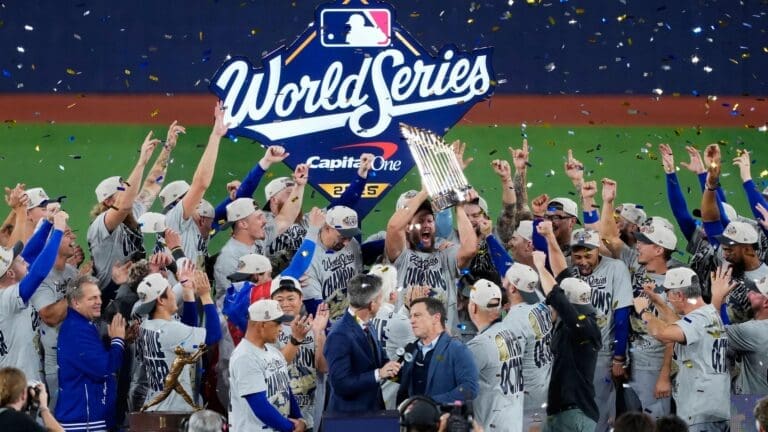
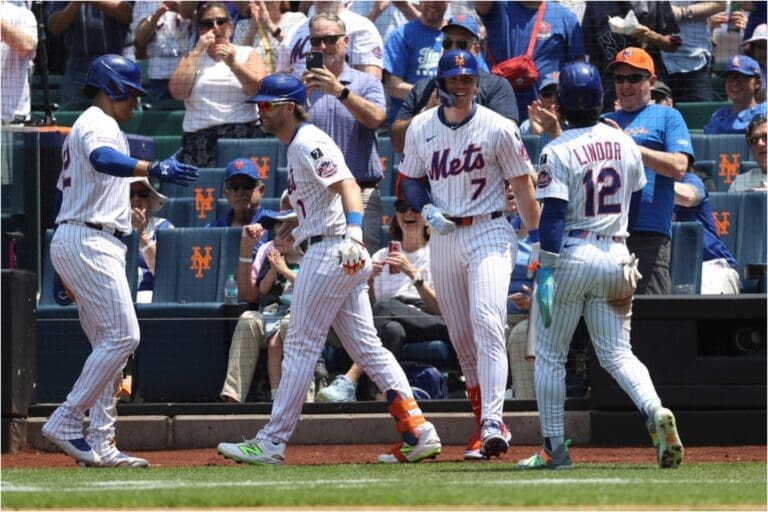
Los Angeles invested $321 million into their 2025 roster, ranking 2nd in MLB payroll behind only the New York Mets. Shohei Ohtani leads the team at $70 million annually through his unprecedented 10-year, $700 million contract featuring massive deferred payments.
Mookie Betts ($30M), Freddie Freeman ($27M), and Yoshinobu Yamamoto ($25M) form the championship core. Young talent like Gavin Lux ($4.8M) and Will Smith ($8.5M) provide cost-controlled production as Los Angeles builds dynasty potential through aggressive spending.
Explore Los Angeles Dodgers player biography and roster information for complete team analysis.
| Position | Player |
| SP | Yoshinobu Yamamoto |
| SP | Roki Sasaki |
| SP | Dustin May |
| SP | Bobby Miller |
| SP | Walker Buehler |
| RP | Evan Phillips |
| RP | Alex Vesia |
| RP | Tanner Scott |
| RP | Kirby Yates |
| RP | Anthony Banda |
| C | Will Smith |
| C | Dalton Rushing |
| 1B | Freddie Freeman |
| 2B | Tommy Edman |
| SS | Mookie Betts |
| 3B | Max Muncy |
| LF | Teoscar Hernández |
| CF | James Outman |
| RF | Jason Heyward |
| DH | Shohei Ohtani |
Top 10 Highest-Paid Los Angeles Dodgers Players
Ohtani earns $70 million in salary though his actual payroll impact is just $2 million due to deferred payments. He agreed to defer $68 million annually until 2034-43, allowing Los Angeles to maintain roster flexibility while building around baseball’s biggest star.
Betts makes $30 million through his 12-year, $365 million extension signed in July 2020. Freeman collected $27 million under his six-year, $162 million deal. Yamamoto earns $25 million in year one of his 12-year, $325 million contract signed in December 2023.
| Player | Position | 2025 Salary | Contract Through |
| Shohei Ohtani | DH/SP | $70M ($2M payroll) | 2033 |
| Mookie Betts | OF/SS | $30M | 2032 |
| Freddie Freeman | 1B | $27M | 2027 |
| Yoshinobu Yamamoto | SP | $25M | 2035 |
| Tyler Glasnow | SP | $22.5M | 2028 |
| Teoscar Hernández | OF | $15M | 2026 |
| Blake Snell | SP | $32M | 2026 |
| Will Smith | C | $8.5M | Arb-eligible 2026 |
| Gavin Lux | 2B | $4.8M | Arb-eligible 2026 |
| Tommy Edman | IF/OF | $9.5M | 2029 |
Glasnow earned $22.5 million under his five-year, $136.5 million extension. Snell makes $32 million through his two-year, $62 million deal signed in March 2024. Hernández collected $15 million providing power from the outfield.
Dodgers Net Worth Through Massive Contracts
Ohtani accumulated $85 million in career earnings building a $50 million net worth before his Dodgers contract. His 10-year, $700 million deal guarantees unprecedented wealth though deferred payments delay most earnings until retirement.
Betts earned $245 million creating a $155 million net worth across Boston and Los Angeles. His 12-year extension adds $365 million total. Freeman collected $175 million building a $110 million fortune across Atlanta and Los Angeles.
| Player | 2025 Salary | Career Earnings (Est.) | Net Worth (Est.) | Key Endorsements |
| Mookie Betts | $30M | $245M | $155M | Nike, Rawlings |
| Freddie Freeman | $27M | $175M | $110M | Marucci, New Balance |
| Shohei Ohtani | $70M | $85M | $50M | New Balance, Asics |
| Blake Snell | $32M | $78M | $48M | Under Armour |
| Tyler Glasnow | $22.5M | $42M | $25M | Nike |
| Yoshinobu Yamamoto | $25M | $35M | $20M | Mizuno, Asics |
Snell earned $78 million building a $48 million net worth across Tampa Bay, San Diego, and Los Angeles. Glasnow collected $42 million creating a $25 million fortune. Yamamoto accumulated $35 million in Japan before his MLB debut.
RELATED ARTICLES

Deferred Payments Create Roster Flexibility
Ohtani’s contract defers $68 million annually allowing Los Angeles to maintain a competitive balance tax hit of just $46 million. This structure enabled the Dodgers to sign Yamamoto ($25M), Snell ($32M), and Glasnow ($22.5M) simultaneously.
Freeman’s contract includes $57 million in deferred payments spread across 2028-40. Betts’ deal features deferred money reducing immediate payroll impact. Los Angeles leverages time-value-of-money calculations to maximize current roster construction.
| Position Group | Total Spending | Top Earner | Salary |
| Starting Pitchers | $142M | Blake Snell | $32M |
| Infield | $78M | Mookie Betts | $30M |
| Outfield | $42M | Teoscar Hernández | $15M |
| Bullpen | $35M | Evan Phillips | $6.5M |
| Catchers | $8.5M | Will Smith | $8.5M |
The pitching staff consumed $142 million—44% of total payroll. Yamamoto ($25M), Glasnow ($22.5M), Snell ($32M), and Clayton Kershaw ($10M) lead rotation spending. Los Angeles prioritizes elite starting pitching through aggressive free agency.
Young Core Provides Arbitration Value
Lux earned $4.8 million through arbitration anchoring second base. His offensive struggles created trade discussions despite defensive reliability. Will Smith makes $8.5 million as one of baseball’s best hitting catchers before reaching free agency.
Tommy Edman collected $9.5 million providing positional versatility across infield and outfield. His World Series MVP performance justified the trade acquisition cost. James Outman ($780K) fills fourth outfield spots at league minimum.
Andy Pages ($770K) and Diego Cartaya ($765K) represent organizational depth earning pre-arbitration salaries. Los Angeles develops internal talent while spending aggressively on established stars, creating sustainable competitive advantages.
Luxury Tax Penalties and Financial Strategy
Los Angeles’ $321 million payroll triggers fourth-tier luxury tax penalties totaling approximately $95 million. Their competitive balance tax bill exceeds $235 million—the threshold triggering maximum penalties including draft pick losses and international spending restrictions.
The Dodgers accept these penalties as cost of championship contention. Ownership views luxury tax as investment in winning rather than constraint on spending. Los Angeles’ revenue generation through regional broadcasting and attendance justifies aggressive payroll management.
Their financial model differs fundamentally from small-market teams. The Dodgers leverage market size, media deals, and ownership wealth to maintain baseball’s highest sustained spending over multiple seasons.
FAQs
Who is the Dodgers’ highest-paid player?
Shohei Ohtani earns $70 million annually though his payroll impact is just $2 million due to deferring $68 million yearly until 2034-43 under his 10-year, $700 million contract.
How do Ohtani’s deferred payments work?
Ohtani defers $680 million of his $700 million contract to 2034-43, reducing Los Angeles’ luxury tax calculation to $46 million annually despite $70 million salary.
What is the Dodgers’ total luxury tax bill?
Los Angeles pays approximately $95 million in luxury tax penalties on top of their $321 million payroll, totaling over $416 million in total baseball spending.
Why can the Dodgers afford such high payroll?
Los Angeles generates revenue through massive market size, regional broadcasting deals, attendance, and ownership wealth allowing sustained $300+ million payroll investments annually.
RELATED ARTICLES