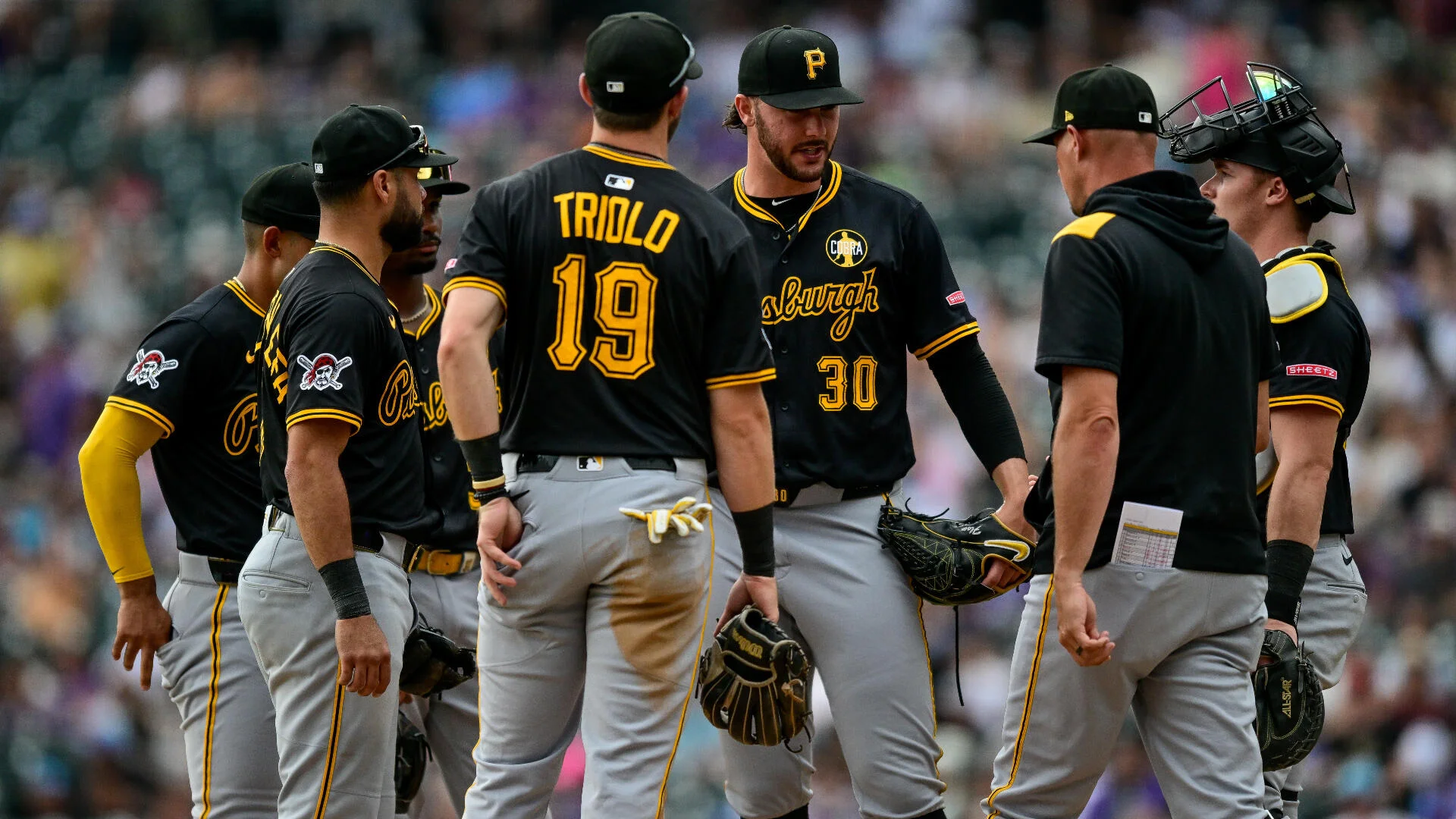
Pittsburgh operated with just $87 million in payroll for 2025, ranking 27th among MLB’s 30 teams. Mitch Keller leads the roster at $15 million annually while the Pirates continue operating as one of baseball’s lowest spenders despite competitive NL Central division.
Bryan Reynolds ($12M), Isiah Kiner-Falefa ($7.5M), and Andrew Heaney ($3.75M) form the veteran core. Young stars like Paul Skenes ($875K) and Oneil Cruz ($2.5M) provide exceptional value as Pittsburgh builds around cost-controlled talent.
Explore Pittsburgh Pirates player biography and roster information for complete team analysis.
| Position | Player |
| SP | Mitch Keller |
| SP | Bailey Falter |
| SP | Andrew Heaney |
| SP | Paul Skenes |
| SP | Carmen Mlodzinski |
| RP | David Bednar |
| RP | Ryan Borucki |
| RP | Colin Holderman |
| RP | Dennis Santana |
| RP | Kyle Nicolas |
| C | Henry Davis |
| C | Endy Rodriguez |
| 1B | Spencer Horwitz |
| 2B | Nick Gonzales |
| SS | Oneil Cruz |
| 3B | Ke’Bryan Hayes |
| LF | Bryan Reynolds |
| CF | Jack Suwinski |
| RF | Joshua Palacios |
| DH | Connor Joe |
Pittsburgh Pirates Highest-Paid Players and Top Salaries
Keller earns $15 million through his five-year, $77 million extension signed in April 2024. The right-hander’s breakout 2023 season justified the investment as Pittsburgh locked him through 2028.
Reynolds makes $12 million under his eight-year, $106.75 million extension signed in April 2022. His consistent production provides offensive stability despite playing for a rebuilding franchise.
| Player | Position | 2025 Salary | Contract Through |
| Mitch Keller | SP | $15M | 2028 |
| Bryan Reynolds | OF | $12M | 2029 |
| Isiah Kiner-Falefa | SS/3B | $7.5M | 2025 |
| Andrew Heaney | SP | $3.75M | 2025 |
| Oneil Cruz | SS | $2.5M | Arb-eligible 2027 |
| David Bednar | RP | $6.75M | 2027 |
| Dennis Santana | RP | $1.4M | Arb-eligible 2026 |
| Paul Skenes | SP | $875K | Pre-arbitration |
| Jared Jones | SP | $775K | Pre-arbitration |
| Nick Gonzales | 2B | $780K | Pre-arbitration |
Kiner-Falefa collected $7.5 million providing utility infield depth. Bednar earned $6.75 million as the closer through his extension. Heaney makes $3.75 million in rotation depth.
Paul Skenes Contract Value and Young Star Salaries
Skenes earns just $875K despite finishing second in 2024 NL Cy Young voting as a rookie. The No. 1 overall pick’s pre-arbitration status creates extraordinary value as comparable aces command $20+ million annually.
Jones makes $775K emerging as another rotation stalwart. His power arm provides quality innings at league minimum salary. Cruz collected $2.5 million through arbitration despite elite power potential at shortstop.
| Player | 2025 Salary | Career Earnings (Est.) | Net Worth (Est.) | Key Endorsements |
| Bryan Reynolds | $12M | $42M | $25M | Louisville Slugger |
| Mitch Keller | $15M | $28M | $16M | Rawlings |
| David Bednar | $6.75M | $12M | $7M | Under Armour |
| Oneil Cruz | $2.5M | $5M | $3M | New Balance |
| Paul Skenes | $875K | $12M | $8M | Nike, Topps |
| Andrew Heaney | $3.75M | $58M | $35M | Rawlings |
Skenes accumulated $12 million including his $9.2 million signing bonus building an $8 million net worth at age 23. His future earnings potential exceeds $200 million. Reynolds earned $42 million creating a $25 million fortune.
RELATED ARTICLES




Pirates Pitching Staff Salaries and Rotation Investment
Pittsburgh allocated $32 million to starting pitchers—37% of total payroll. Keller ($15M) leads spending while Heaney ($3.75M) provides veteran depth. The rotation features four players earning under $1 million.
| Position Group | Total Spending | Top Earner | Salary |
| Starting Pitchers | $32M | Mitch Keller | $15M |
| Bullpen | $12M | David Bednar | $6.75M |
| Outfield | $18M | Bryan Reynolds | $12M |
| Infield | $15M | Isiah Kiner-Falefa | $7.5M |
| Catchers | $1.5M | Joey Bart | $850K |
Skenes ($875K), Jones ($775K), and Luis Ortiz ($785K) combine for under $2.5 million while providing 400+ innings. Bailey Falter earned $1.5 million through arbitration. Pittsburgh develops pitching internally rather than pursuing expensive free agents.
How Much Pirates Spend on Position Players
Reynolds leads position players at $12 million anchoring center field. Kiner-Falefa makes $7.5 million providing defensive versatility across shortstop and third base. Cruz collected $2.5 million despite 30+ home run potential.
Nick Gonzales earned $780K at second base. Ke’Bryan Hayes makes $6M through his extension covering 2024-29. Joey Bart collected $850K as the primary catcher after arriving from San Francisco.
Pittsburgh spreads limited resources across positions rather than concentrating spending. Their $87 million payroll requires contributions from pre-arbitration players to field competitive rosters.
Pirates Payroll Compared to MLB Teams
Pittsburgh’s $87 million payroll ranks 27th, ahead of only Miami ($67M) and Oakland ($73M). The Pirates spend approximately 27% of the Mets’ league-leading $323 million budget.
Small-market economics limit Pittsburgh’s spending despite generating revenue through PNC Park attendance and television deals. Ownership prioritizes profitability over aggressive payroll investment, frustrating fans seeking competitive rosters.
The Pirates haven’t exceeded $100 million payroll since 2017. Their financial strategy emphasizes player development and team-friendly extensions over free agent acquisitions, creating perpetual rebuilding cycles.
FAQs
Who is Pittsburgh’s highest-paid player?
Mitch Keller earns $15 million through his five-year, $77 million extension signed in April 2024 running through 2028 as the rotation ace.
How much does Paul Skenes make?
Skenes earns just $875K as a pre-arbitration pitcher despite finishing second in 2024 NL Cy Young voting, creating exceptional roster value through 2027.
What is Bryan Reynolds’ contract worth?
Reynolds makes $12 million annually under his eight-year, $106.75 million extension signed in April 2022 running through 2029 with club option.
Why does Pittsburgh have such low payroll?
Pittsburgh operates at $87 million ranking 27th due to small-market economics and ownership’s conservative spending approach prioritizing profitability over competitive investment.
RELATED ARTICLES