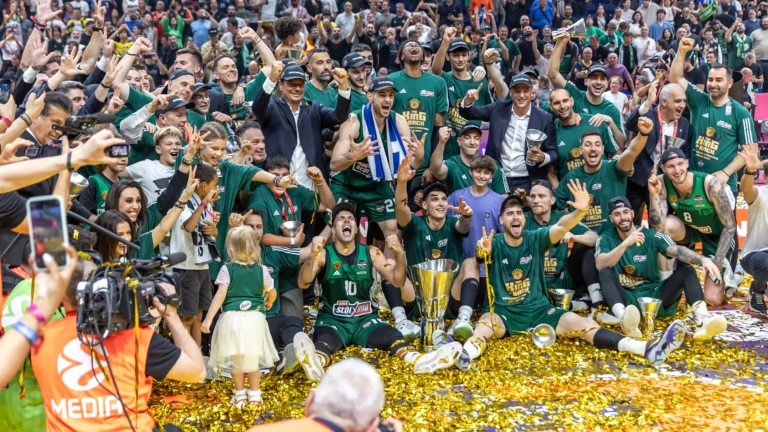
Germany won the FIBA Basketball World Cup for the first time in 2023, defeating Serbia 83-77 in Manila. The USA and Yugoslavia lead the all-time record with five championships each in this prestigious FIBA Basketball World Cup Winners List.
The FIBA Basketball World Cup has been held every four years since 1950. Nineteen editions have produced winners from seven different countries. Only USA, Yugoslavia, Soviet Union, Brazil, Spain, Argentina, and Germany have captured the title.
All-Time FIBA World Cup Champions
| Rank | Country | Titles | Finals Appearances | Best Year |
| 1 | United States | 5 | 10 | 1954, 1986, 1994, 2010, 2014 |
| 2 | Yugoslavia/Serbia | 5 | 8 | 1978, 1990, 1998, 2002, 2014 (Final) |
| 3 | Soviet Union | 3 | 5 | 1967, 1974, 1982 |
| 4 | Brazil | 2 | 4 | 1959, 1963 |
| 5 | Spain | 2 | 3 | 2006, 2019 |
| 6 | Argentina | 1 | 2 | 1950 |
| 7 | Germany | 1 | 1 | 2023 |
The United States holds the most titles among modern basketball nations with five gold medals in the FIBA Basketball World Cup Winners List.
They didn’t compete with full NBA rosters until 1994, then dominated consistently. Yugoslavia won five championships before the country dissolved in the 1990s.
FIBA World Cup Winners by Year: Complete Championship Records
| Year | Champion | Runner-Up | Score | Host |
| 2023 | Germany | Serbia | 83-77 | Philippines, Japan, Indonesia |
| 2019 | Spain | Argentina | 95-75 | China |
| 2014 | United States | Serbia | 129-92 | Spain |
| 2010 | United States | Turkey | 81-64 | Turkey |
| 2006 | Spain | Greece | 70-47 | Japan |
| 2002 | Yugoslavia | Argentina | 84-77 OT | USA |
| 1998 | Yugoslavia | Russia | 64-62 | Greece |
| 1994 | United States | Russia | 137-91 | Canada |
| 1990 | Yugoslavia | Russia | 92-75 | Argentina |
| 1986 | United States | Russia | 87-85 | Spain |
| 1982 | Soviet Union | United States | 95-94 | Colombia |
| 1978 | Yugoslavia | Russia | 82-81 OT | Philippines |
| 1974 | Soviet Union | Yugoslavia | — | Puerto Rico |
| 1967 | Soviet Union | Yugoslavia | — | Uruguay |
| 1963 | Brazil | Yugoslavia | 90-88 OT | Brazil |
| 1959 | Brazil | United States | — | Chile |
| 1954 | United States | Brazil | — | Brazil |
| 1950 | Argentina | United States | — | Argentina |
This FIBA Basketball World Cup Winners List shows Germany’s recent 2023 victory marked the first all-European final since 2006.
Spain had previously ended the US dominance, winning in 2006 and 2019. The tournament expanded from 16 teams to 32 in 2014 to increase global participation.
The Most Dominant FIBA World Cup Eras
South American Dominance (1950-1963)
Argentina won the inaugural tournament in 1950 as the host nation. Brazil captured back-to-back titles in 1959 and 1963, defeating the United States both times. South American teams won five of the first six championships through superior fundamentals and team play.
Argentina’s 1950 victory established basketball as a global sport. Brazil’s 1963 win came in a thrilling overtime final against Yugoslavia. These early championships showed that basketball excellence extended far beyond North America.
Soviet Union and Yugoslav Supremacy (1967-1990)
The Soviet Union dominated the 1960s-1980s with three world championships. Yugoslavia won five times during this period, rivaling the Soviets for Eastern European dominance. These communist nations produced elite players and innovative defensive strategies.
The Soviet Union won in 1967, 1974, and 1982 with consistent excellence. Yugoslavia claimed victories in 1978 and 1990 during their nation’s final years. Their gold medals represented the Cold War struggle across multiple Olympic sports.
United States NBA Era (1994-2014)
The USA entered with full NBA rosters starting in 1994 under professional rules. They won five gold medals between 1994 and 2014 without losing finals. This era established American dominance in international basketball.
Michael Jordan and Charles Barkley led the 1994 Dream Team successor. Shaquille O’Neal dominated as 1994 tournament MVP with unstoppable scoring. Future NBA legends including Kobe Bryant enhanced American rosters throughout the 2000s.
RELATED ARTICLES



European Resurgence (2006-Present)
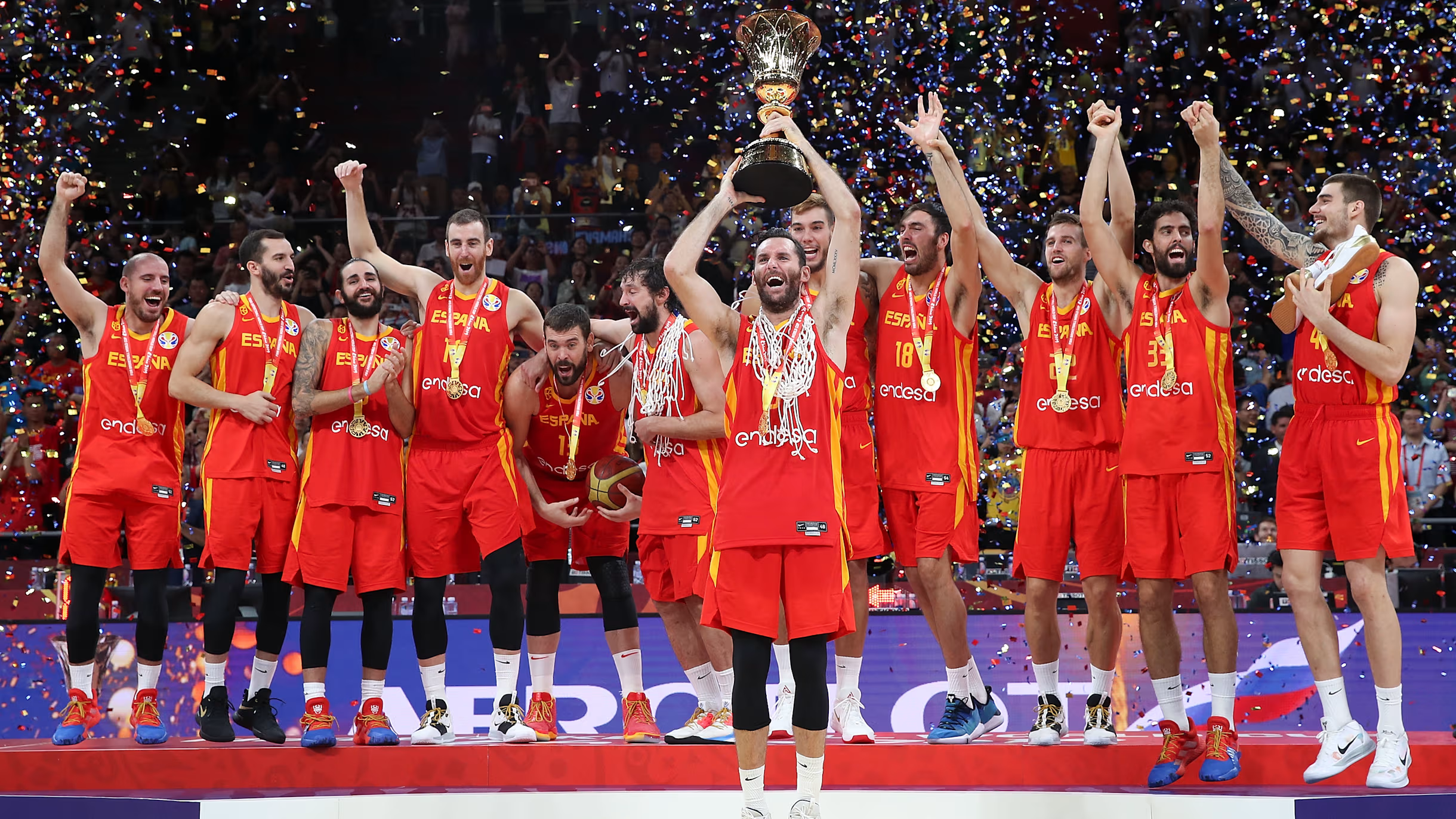
Spain ended American dominance in 2006, defeating Greece 70-47 in Japan. Spain repeated in 2019 with a dominant performance against Argentina. Germany’s 2023 victory showed European basketball had reached peak levels.
Spain’s success came through ball movement and international player development. Pau Gasol carried Spain to multiple deep tournament runs. Germany’s unbeaten 2023 run proved that careful player recruitment and team building beat individual superstars.
Recent FIBA World Cup Performances
2023 Germany Victory
Germany finished 8-0 in the tournament without losing a single game. Dennis Schroder scored 28 points in the final and won tournament MVP. The Wagner brothers provided secondary scoring and floor presence throughout the championship run.
Germany’s bronze medal in 2002 was their only previous podium finish. Dirk Nowitzki led that team but Germany couldn’t break through to gold. This 2023 victory validated a three-year commitment plan focused on national team basketball.
2019 Spain Championship
Spain defeated Argentina 95-75 in a dominant final performance in China. The tournament marked Spain’s second gold medal in fourteen years. This showed Spain’s consistency among European basketball powers.
Rudy Fernandez led Spain’s veteran squad with clutch three-point shooting. Spain’s ball movement offense overwhelmed Argentina’s defensive schemes. The victory cemented Spain’s place among basketball’s elite nations alongside the USA.
2014 and 2010 USA Wins
The United States defeated Serbia 129-92 in a dominant 2014 final. Kyrie Irving and other NBA stars overpowered Serbia’s strong squad convincingly. The 37-point margin remains one of the most impressive World Cup final performances.
USA beat Turkey 81-64 in 2010 with Kevin Durant leading the scoring attack. These victories showed American basketball quality remained superior despite international improvement. European and South American teams had narrowed the competitive gap significantly.
Teams That Have Never Won
Most FIBA nations have never won a championship despite competing for decades. France, Italy, Greece, Australia, and Canada have reached finals but never won gold. These nations have built strong programs without capturing the ultimate prize.
Canada won their first bronze medal in 2023, surprising many observers. Serbia reached two finals but lost both to the USA. Lithuania, Latvia, and other European nations continue building toward championship contention.
The Naismith Trophy
Winners receive the Naismith Trophy, named after basketball’s inventor James Naismith. The trophy has been awarded since 1967. FIBA commissioned the trophy with a donation of $1,000 in 1965.
The original trophy is kept at the Pedro Ferrándis Foundation in Spain. A new design was introduced in 1998 with Egyptian-inspired lotus shape. The current trophy features gemstones representing five continents of FIBA’s membership.
Key Facts About FIBA World Cup
The tournament expanded from 10 teams in 1950 to 32 teams by 2014. This growth reflects basketball’s global development and international participation. Each confederation now receives guaranteed berths for qualification.
The 2023 edition marked the first time three nations co-hosted the tournament. Philippines, Japan, and Indonesia split games with the final in Manila. The next World Cup will be held in Qatar in 2027, the first in the Middle East.
FAQs
Who Has Won the FIBA Basketball World Cup Most?
USA and Yugoslavia both won five championships each. USA won in 1954, 1986, 1994, 2010, and 2014. Yugoslavia’s five titles came before the country dissolved in the 1990s.
Has Germany Won the FIBA World Cup Before?
Germany won their first FIBA World Cup title in 2023. Their previous best finish was bronze in 2002. Germany’s victory came in Manila after going unbeaten through eight games.
Which Country Won the Most Recent FIBA World Cup?
Germany won the 2023 FIBA World Cup by defeating Serbia 83-77. Dennis Schroder led Germany with 28 points in the final. Germany became the first team to win World Cup gold in their first final appearance since Spain in 2006.
How Often Is the FIBA World Cup Held?
The FIBA World Cup takes place every four years. Nineteen editions have been held between 1950 and 2023. The tournament was originally called the FIBA World Championship until 2010.
RELATED ARTICLES