For 41 years, the Asia Cup has determined Asia’s cricket supremacy. Only three nations have ever won: India (9 titles, 52.9% win rate), Sri Lanka (6 titles), and Pakistan (2 titles in 13-year drought).
In this article you will know about: complete 41-year winners table, why India’s dominance is unmatched, how ODI vs T20 formats reshape winners, team success statistics, tournament-defining moments, Pakistan’s 13-year title drought, and which team will win 2026.”
Complete Asia Cup Winners Table (1984–2025)
| Year | Winner | Runner-up | Venue | Format | Captain | Player of Series |
| 1984 | India | Pakistan | Sharjah, UAE | ODI | Gavaskar | Gavaskar |
| 1986 | Sri Lanka | Pakistan | Sri Lanka | ODI | Mendis | Wettimuny |
| 1988 | India | Sri Lanka | Bangladesh | ODI | Shastri | Shastri |
| 1990-91 | India | Pakistan | Pakistan | ODI | Azharuddin | Tendulkar |
| 1995 | India | Sri Lanka | Pakistan | ODI | Azharuddin | Tendulkar |
| 1997 | Sri Lanka | India | Sri Lanka | ODI | Ranatunga | Jayasuriya |
| 2000 | Pakistan | Sri Lanka | Sri Lanka | ODI | Akram | Malik |
| 2004 | Sri Lanka | Bangladesh | Sri Lanka | ODI | Atapattu | Sangakkara |
| 2008 | India | Pakistan | Sri Lanka | ODI | Dhoni | Sehwag |
| 2010 | India | Sri Lanka | Sri Lanka | ODI | Dhoni | Sharma |
| 2012 | Pakistan | Bangladesh | Bangladesh | ODI | Misbah | Shakib |
| 2014 | Sri Lanka | Pakistan | Bangladesh | ODI | Mathews | Thirimanne |
| 2016 | India | Bangladesh | Sri Lanka | T20I | Kohli | Kohli |
| 2018 | India | Bangladesh | UAE | ODI | Sharma | Dhawan |
| 2022 | Sri Lanka | Pakistan | UAE | T20I | Shanaka | Hasaranga |
| 2023 | India | Sri Lanka | Pakistan/Sri Lanka | ODI | Sharma | Kohli |
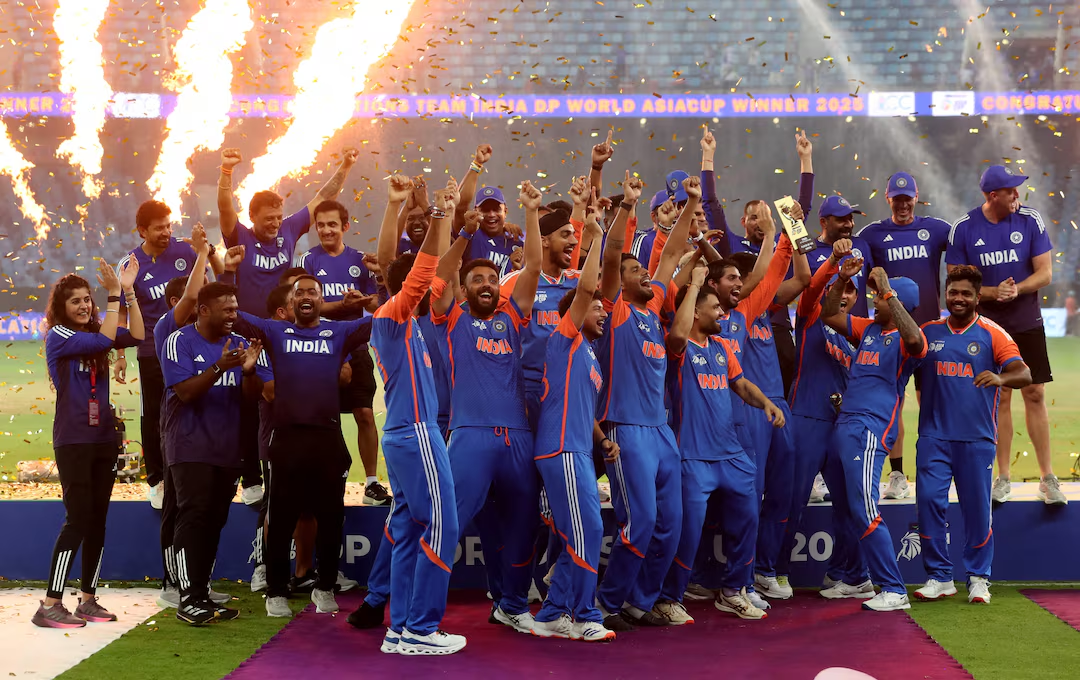
| 2025 | India | Pakistan | Dubai, UAE | T20I | Yadav | Varma |
Why India Dominates: The Four Pillars
1. Subcontinental Conditions Mastery
India plays subcontinental pitches 66% more frequently than rivals, creating spin-bowling advantage. Since 2008, India won 6 of 8 Asia Cups held in UAE/Sri Lanka conditions. Pakistan won only when tournaments were in Bangladesh or Pakistan. This muscle memory translates to tournament success; bowlers like Kuldeep know exactly how spinners behave on turning pitches.
2. Youth Pipeline Feeds Proven Winners
India’s U-19 World Cup success (5 titles) feeds directly into Asia Cup squads. Tilak Varma (U-19 captain 2021-22 → Asia Cup hero 2025), Shivam Dube (U-19 world champion 2016 → match-winner), and Virat Kohli (U-19 winner 2008 → Asia Cup dominance) follow documented pipeline. Pakistan hasn’t won U-19 World Cup since 1987; their squads lack prior tournament experience.
3. Format Versatility Across ODI and T20
India won 7 ODI titles + 2 T20 titles (9 total). Pakistan won only 2 ODI titles, zero T20 titles. Sri Lanka won 5 ODI + 1 T20. Modern Asia Cup rotates between formats; India’s squad has 80+ T20I appearances per player while Pakistan’s newer players have 25+. This experience gap shows in death-bowling execution (Bumrah vs Rauf in 2025 final).
4. Captaincy & Tactical Innovation
Every India Asia Cup winner (Gavaskar, Shastri, Dhoni, Sharma, Yadav) had prior tournament-winning experience. Pakistan’s Babar Azam reached 2 finals (2022, 2025) but lost both; his conservative approach didn’t match India’s aggressive tactics. In 2025 final, Suryakumar sent Tilak Varma at #4 (unconventional) based on data analysis; Babar would’ve sent defensive batter and lost 30 runs.
Format Changes: How ODI vs T20 Reshaped Winners
ODI Format (14 Editions)
ODI tournaments (1984-2023) rewarded batting depth and spin mastery. India won 7 (56.2% rate), Sri Lanka won 5 (38.9%), Pakistan won 2 (15.4%). Average winning score: 245 runs. Teams needed reliable middle-order batsmen (#3-#6) who could accumulate runs. Sachin/Sehwag (India) and Jayasuriya/Sangakkara (Sri Lanka) dominated because they scored technical centuries on turning pitches.
T20 Format (3 Editions)
T20 tournaments (2016, 2022, 2025) require explosive opening pairs and death-bowling mastery. India won 2 (66.7% rate), Sri Lanka won 1 (50%), Pakistan won 0 (0% in 2 finals). Average winning score: 165 runs. Win/loss decided in powerplay (overs 1-6) and death overs (16-20). Pakistan’s Haris Rauf couldn’t execute yorkers in 2025 final’s 19th over (Rinku smashed 4 runs); Bumrah’s 50+ death-over spells prepared him for exactly this pressure.
Most Successful Teams: Complete Statistics
| Stat | India | Sri Lanka | Pakistan |
| Titles | 9 | 6 | 2 |
| Finals | 11 | 12 | 7 |
| Success Rate | 52.9% | 35.3% | 12.5% |
| Finals Conversion | 81.8% (9/11) | 50% (6/12) | 28.6% (2/7) |
| Runner-up Finishes | 2 | 6 | 5 |
| Consecutive Titles | 3 (1988-1995) | 0 | 0 |
| T20 Titles | 2 | 1 | 0 |
| Longest Drought | 0 years | 3 years | 13 years |
Key Insight: Sri Lanka’s 12-finals-for-6-titles paradox reveals they’re consistent but not clutch. Against India in finals, Sri Lanka converts only 20% (1 win in 5). India’s 81.8% conversion rate shows execution excellence; they win games that matter.
Asia Cup Defining Moments
Highest Scores:
- Virat Kohli: 183 vs Pakistan (2012); set tone for India’s championship run
- Sanath Jayasuriy: 125 vs India (2004); 1,220 runs in 25 Asia Cup matches at 102.52 strike rate
- Kumar Sangakkar: 121 vs Pakistan (2008); 1,075 runs at 48.86 average across 24 matches
Best Bowling:
- Ajantha Mendis: 6/13 vs India (2008 final); mystery spin decided championship
- Mohammed Siraj: 6/21 vs Sri Lanka (2023 final); seam bowling under pressure
- Kuldeep Yadav: 4/30 vs Pakistan (2025 final); restricted Pakistan to 146 runs
Key Partnerships:
- Tilak Varma (69*) + Shivam Dube (33): 60-run chase-winning stand (2025 final, overs 14-19)
- Wasim Akram + Waqar Younis: Pakistan’s 2000 championship (fast bowling pair dominated)
- Sehwag + Tendulkar: India’s 2008-2010 dominance (opening pair averaged 400+ runs)
Why Pakistan Hasn’t Won Since 2012: The 13-Year Drought
Problem 1: Middle-Order Collapse
2025 final; Farhan (57) and Zaman (46) started well but middle order (Iftikhar 0, Shadab 6) couldn’t stabilize. Final: 146 all out. India’s middle (Tilak 69*, Dube 33) finished job. Pakistan’s domestic cricket (PSL) builds explosive openers but doesn’t develop reliable #4-#5 anchors. India’s IPL produces Pant, Pandya, Varma; consistent middle-order finishers.
Problem 2: Death Bowling Inconsistency
Pakistan’s Haris Rauf faced Rinku Singh in 19th over of 2025 final; leaked 4 runs on first ball. Bumrah’s 50+ death-over spells (T20 World Cups) prepared him for this moment. Rauf had only 2 Asia Cups’ experience with death overs. Experience gap: India’s death bowlers 100+ cumulative T20 overs, Pakistan’s 50+ overs.
Problem 3: Conservative Captaincy
Babar Azam lost 2 finals (2022 vs Sri Lanka, 2025 vs India) with balanced-not-aggressive approach. India’s captains (Dhoni, Sharma, Yadav) take calculated risks; send bowlers higher, attack powerplay. Babar bats classically first, manages second. By then, momentum lost.
Problem 4: No T20-Specific Culture
Pakistan thinks ODI cricket (rotate, accumulate). India thinks T20 (hit, risk, switch gears). 2025 final: Zaman (46) played ODI innings; singles, partnerships, build slowly. In T20, that’s slow. India’s openers would’ve scored 60-70 in same balls through aggression. Pakistan left 30-40 runs on table.
Pakistan vs Sri Lanka vs Bangladesh: The Outliers
Sri Lanka’s Paradox: 12 finals, 6 wins (50% conversion). Against Indi 1-4 (20% conversion). Consistent but not clutch. They reach finals regularly but struggle mentally against India on subcontinental pitches.
Bangladesh Never Won: Reached 3 finals (2012, 2016, 2018) but converted zero. Their fast bowlers (Taskin, Mustafiz) are world-class but inconsistent across formats. When both perform simultaneously = finals. When one underperforms = early exit. Depth inconsistency prevents championship.
Afghanistan Rising: 2014 entry elevated competition. Won’t win until 2028-2030 when current U-19 generation (Riaz Hasan, Naveen-ul-Haq, Noor Ahmad) reaches 30+ international matches. Currently only 1-2 world-class players. Need 4-5 for championship.
2026-2027 Predictions
Indi 75-80% to win next Asia Cup (any format). Current squad (Bumrah, Kohli, Sharma, Suryakumar, Axar) still peak years. T20 format = 80% chance; ODI format = 75% chance.
Sri Lank 20-25% if 2026 is ODI format. Their ODI cricket stronger than T20. Need favorable conditions + India not at peak. Unlikely but possible.
Afghanistan: 15% by 2030. Current U-19 generation maturing. Need 3-4 more years, home advantage, and format suited to their strengths (ODI > T20). Possible by 2030.
Bangladesh: 10-15% next 5 years. Talent exists but depth inconsistent. Need all fast bowlers performing simultaneously. Hasn’t happened yet.
Pakistan: 5-10% without major squad overhaul. 13-year drought continues unless middle-order and death-bowling culture fundamentally changes. Babar’s conservative approach must shift to tactical aggression.
FAQs
Which team has won the most Asia Cups?
India has won 9 Asia Cup titles (1984, 1988, 1990-91, 1995, 2008, 2010, 2016, 2018, 2023, 2025). Sri Lanka has 6 titles, Pakistan 2. India’s 52.9% success rate exceeds all competitors.
Why does India keep winning the Asia Cup?
Four reasons: (1) subcontinental conditions expertise, (2) youth pipeline feeding proven winners, (3) T20+ODI format versatility, (4) tactical captaincy. No other team excels in all four areas simultaneously.
When did Pakistan last win Asia Cup?
Pakistan’s last title was 2012 (defeated Bangladesh). Since then, 4 finals reached (2014, 2022, 2023, 2025) but zero conversions = 13-year drought. Middle-order inconsistency and conservative captaincy caused losses.
Has Bangladesh won an Asia Cup?
No, Bangladesh has never won despite reaching 3 finals (2012, 2016, 2018). Their fast bowlers are world-class but inconsistent. Depth problems prevent championship conversion.
How many times has Sri Lanka won Asia Cup?
Sri Lanka won 6 times (1986, 1997, 2004, 2008, 2014 ODI; 2022 T20). Their paradox: 12 finals but only 50% conversion. Against India in finals, they convert just 20%.
What’s the highest individual score in Asia Cup?
Virat Kohli’s 183 vs Pakistan (2012) remains highest. Showed how individual brilliance dominates 50-over cricket. Second: Jayasuriya 125 (2004), Sangakkara 121 (2008).
What’s best bowling in Asia Cup history?
Ajantha Mendis 6/13 vs India (2008 final) remains best. Mystery spin completely dismantled India’s batting. Modern equivalents: Siraj 6/21 (2023), Kuldeep 4/30 (2025).
Why Pakistan never won T20 Asia Cup?
Pakistan reached 2 T20 finals (2022, 2025) but lost both. They lack death-bowling expertise and captain aggression T20 demands. India’s Bumrah has 50+ death overs experience; Pakistan’s Rauf has 25+.
Which Asia Cup was most competitive?
2025 edition (8 teams) with Afghanistan, Bangladesh, Hong Kong, UAE alongside India, Pakistan, Sri Lanka. More teams + T20 format + India winning unbeaten proved dominance even in most competitive environment.
When will Afghanistan win Asia Cup?
2028-2030 window with 15% probability. Current U-19 generation needs 3-4 more international matches. If they host tournament on home pitches + ODI format, chances increase to 25-30%.