Japan has established itself as Asia’s premier football nation. The Japanese national team has won the AFC Asian Cup four times, making them the most successful team in the tournament’s history.
Their victories came in 1992, 2000, 2004, and 2011, showcasing Japan’s rise from a minor football nation to a continental powerhouse.
The AFC Asian Cup is the second-oldest continental football championship in the world, behind only Copa América. It began in Hong Kong in 1956 with just four teams.
Today it features 24 nations competing every four years. Over nearly seven decades, South Korea, Iran, Saudi Arabia, and Qatar have all claimed titles.
This guide covers every champion from 1956 through 2023, the records that define Asian football, and how Japan became unstoppable.
AFC Asian Cup Winners 1956-2023 (Complete List)
| Year | Host | Winner | Runner-Up | Result | Format |
| 1956 | Hong Kong | South Korea | Israel | Round-robin | 4 teams |
| 1960 | South Korea | South Korea | Israel | Round-robin | 4 teams |
| 1964 | Israel | Israel | India | Round-robin | 4 teams |
| 1968 | Iran | Iran | Myanmar | Round-robin | 5 teams |
| 1972 | Thailand | Iran | South Korea | 2-1 | Knockout stage |
| 1976 | Iran | Iran | Kuwait | 1-0 | Knockout stage |
| 1980 | Kuwait | Kuwait | South Korea | 3-0 | Knockout stage |
| 1984 | Singapore | Saudi Arabia | China | 2-0 | Knockout stage |
| 1988 | Qatar | Saudi Arabia | South Korea | 0-0 (4-3 pens) | Knockout stage |
| 1992 | Japan | Japan | Saudi Arabia | 1-0 | 8 teams |
| 1996 | UAE | Saudi Arabia | UAE | 0-0 (4-2 pens) | Knockout stage |
| 2000 | Lebanon | Japan | Saudi Arabia | 1-0 | 16 teams |
| 2004 | China | Japan | China | 3-1 | 16 teams |
| 2007 | Indonesia/Malaysia/Thailand/Vietnam | Iraq | Saudi Arabia | 1-0 | 16 teams |
| 2011 | Qatar | Japan | Australia | 1-0 (AET) | 16 teams |
| 2015 | Australia | Australia | South Korea | 2-1 (AET) | 16 teams |
| 2019 | UAE | Qatar | Japan | 3-1 | 24 teams |
| 2023 | Qatar | Qatar | Jordan | 3-1 | 24 teams |
The table reveals the evolution of Asian football. The earliest tournaments used round-robin formats where all teams played each other and points determined the champion.
Starting in 1972, knockout finals decided the winner. In recent years, expansion to 24 teams created a more competitive tournament where more nations could participate.
Japan’s four titles all came in the modern knockout era. They won back-to-back championships in 2000 and 2004, then captured their fourth title in 2011. No other nation has won the Asian Cup four times.
Japan’s Rise to Dominance: 4 AFC Asian Cup Titles
Japan was not always a powerhouse in Asian football. Before 1992, Japan had never won the Asian Cup.
They didn’t even qualify for the tournament until 1988, when they attended for the first time. Their transformation from outsider to champion happened remarkably fast.
Japan hosted the 1992 Asian Cup and won it immediately. They defeated Saudi Arabia 1-0 in the final to capture their first title. This victory marked the start of Japan’s emergence as a football nation.
Professional football was developing in Japan, and the national team benefited from better training systems and academy development.
Japan’s second and third titles came consecutively in 2000 and 2004. They beat Saudi Arabia again in 2000, winning 1-0 in Lebanon.
Then in 2004, they hosted China and defeated China 3-1 in the final. Back-to-back championships at different tournaments proved that Japan’s success was sustainable.
The 2011 title was special. Japan won their fourth title at home in Qatar, edging Australia 1-0 after extra time. Between 2000 and 2011, Japan won three of four AFC Asian Cups available.
This dominance was unprecedented in Asian football. They established themselves as the clear champion of Asia.
All-Time Championship Records and Statistics
| Nation | Titles | Final Appearances | Runners-Up |
| Japan | 4 | 5 | 1 (2019) |
| Iran | 3 | 4 | 1 (1976 lost in final) |
| Saudi Arabia | 3 | 6 | 3 |
| South Korea | 2 | 6 | 4 |
| Qatar | 2 | 2 | 0 |
| Israel | 1 | 1 | 0 |
| Kuwait | 1 | 2 | 1 |
| Iraq | 1 | 2 | 1 |
| Australia | 1 | 2 | 1 |
Japan’s record is clear: four titles with one runner-up finish. They’ve never lost a final outside of the 2019 edition against Qatar. Iran won their three titles between 1968-1976, dominated early Asian Cup history, and remains undefeated in finals.
RELATED ARTICLES



Saudi Arabia reached six finals but won only three. This shows they competed consistently but couldn’t always finish the job. They lost finals to Japan twice (1992, 2000) and once to Iraq (2007). The 1996 final against UAE went to penalties, which Saudi Arabia won.
South Korea won the first two AFC Asian Cups (1956, 1960) but has never won since. They reached six finals total but came up short consistently. This is remarkable for such a football-focused nation.
Qatar recently became a championship contender. After winning the 2019 title, they became the first nation to win consecutive AFC Asian Cups by beating Jordan 3-1 in 2023. They’ve never lost a final appearance.
Early Dominance: Iran’s Consecutive Titles (1968-1976)
Iran remains the only nation to win three consecutive AFC Asian Cups. They won in 1968, 1972, and 1976. The 1968 and 1972 tournaments were hosted in Iran, which provided home-field advantage. The 1976 tournament was also in Iran, making three straight at home.
These victories demonstrated Iran’s dominance in the 1970s. They controlled Asian football during this decade. Their success ended when other nations began developing stronger programs. Saudi Arabia and Japan later surpassed Iran’s achievement.
Early Era: South Korea and Round-Robin Tournaments (1956-1968)
South Korea won the first two AFC Asian Cups in 1956 and 1960. Both tournaments used round-robin formats where all participating teams played each other, and the team with the best record won the championship.
The 1956 tournament in Hong Kong featured just four teams: South Korea, Israel, India, and Republic of China. South Korea’s consistent play earned them the first title. In 1960, South Korea repeated by winning another round-robin tournament in South Korea itself.
Israel won in 1964 with a round-robin format against India and other teams. Israel competed in AFC competitions until 1972 when political tensions led to their expulsion from the Asian Football Confederation. Israel later joined UEFA and now competes in European competitions.
The early era featured limited teams and simple formats. As Asian football developed, the tournament expanded. By the late 1960s, more nations wanted to participate. The format evolved to include knockout stages starting in 1972.
The Knockout Era: Finals and Competition (1972-Present)
Starting in 1972, the AFC Asian Cup adopted a knockout final format. The final tournament feature group stages followed by a single-elimination knockout. This mirrored other continental championships like the European Championship and Copa América.
The 1972 final in Thailand saw Iran defeat South Korea 2-1. This marked the first time a knockout final determined the champion. Iran went on to dominate the 1970s with three consecutive titles.
Kuwait made their appearance in 1980, becoming the first Arab country to win the championship. They hosted the tournament at home and defeated South Korea 3-0 in the final. Kuwait’s victory proved that West Asian nations could compete at the highest level.
Saudi Arabia emerged in the 1980s as a major power. They won in 1984 and 1988, establishing themselves as a consistent champion. Saudi Arabia reached six finals total, more than any other nation, but converted only three into victories.
Japan’s emergence in 1992 changed the competition. From 1992 onward, Japan became the standard. Their technical approach and professional development systems created an advantage. Other nations worked to match Japan’s level, but Japan remained the most consistent winner.
Qatar’s Back-to-Back Achievement (2019-2023)
Qatar won their first AFC Asian Cup in 2019 when they hosted the tournament in the UAE. They defeated Japan 3-1 in the final, with Almoez Ali scoring four goals during the tournament. Qatar’s victory signaled their emergence as a championship contender.
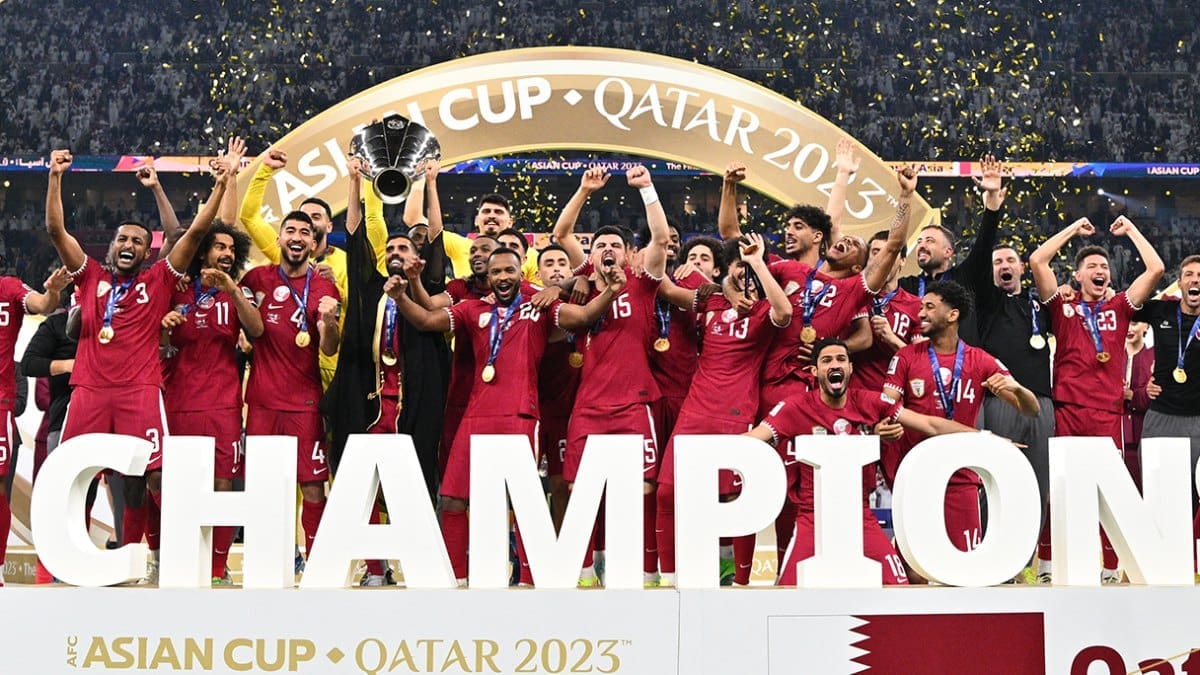
Then Qatar did something remarkable. They hosted the 2023 AFC Asian Cup at home and won it again, defeating Jordan 3-1 in the final. This made Qatar only the second nation after Iran to win consecutive titles. Akram Afif scored a hat-trick of penalties in the final to secure Qatar’s second championship.
Qatar’s success came despite being a smaller nation. They invested heavily in player development and international recruitment. Like Japan before them, Qatar built a system focused on consistency and technical excellence.
AFC Asian Cup Tournament Evolution
The tournament has changed dramatically since 1956:
- 1956-1968: 4-5 teams, round-robin formats, no single final
- 1972-1980: 5-6 teams, knockout finals introduced
- 1984-2000: Expanded to 8-16 teams, knockout structure
- 2004-2015: 16 teams standard, group stage plus knockouts
- 2019 onward: 24 teams, expanded group stage, 16-team knockout
The expansion to 24 teams in 2019 created a more inclusive tournament. More nations could participate and qualify. This led to stronger overall competition as second and third-tier football nations got chances to play.
FAQs
Which Country Has Won the AFC Asian Cup Most?
Japan holds the record with four titles (1992, 2000, 2004, 2011). Iran and Saudi Arabia each have three titles. South Korea and Qatar have won twice.
Who Was the First AFC Asian Cup Winner?
South Korea won the inaugural 1956 AFC Asian Cup in Hong Kong. They defeated Israel in a round-robin format tournament with just four teams.
Has Any Nation Won Consecutive AFC Asian Cups?
Iran won three straight titles from 1968-1976. Qatar became the second nation to win back-to-back titles by winning in 2019 and 2023. Saudi Arabia won in 1984 and 1988 but not consecutively (they missed the 1976 tournament).
Why Was Israel Expelled from the AFC?
Israel was expelled in 1972 due to the Arab-Israeli conflict and political tensions with Arab AFC member nations. Israel later joined UEFA and now competes in European football competitions.
How Many Teams Participated in the First AFC Asian Cup?
The 1956 tournament featured four teams: South Korea, Israel, India, and Republic of China. Teams played each other in a round-robin format with no final match.
When Did the AFC Asian Cup Expand to 24 Teams?
The 2019 AFC Asian Cup was the first to feature 24 teams. Previous tournaments from 2004-2015 used 16 teams. The expansion allows more AFC member nations to participate.
Who Is the Leading Goalscorer in AFC Asian Cup History?
Ali Daei of Iran holds the record with 14 goals. He played in multiple AFC Asian Cups during the 1990s and 2000s and was one of Asia’s greatest strikers.
What Is the Record for Most Finals Appearances?
Saudi Arabia reached six AFC Asian Cup finals. They won three but lost three times. South Korea also appeared in six finals but won only twice (both in the first two tournaments).