Soccer’s beauty is that it welcomes all; a sport where players of all sizes can excel with the right skills and drive. While height can help in some positions, many of history’s best players have shown that great technical skill can more than make up for being short.
This review looks at the most remarkably short pro soccer players ever.
Record-Breaking Short Soccer Players
The absolute shortest professional footballer on record is Marcin Garuch of Poland, who stands at just 153 cm (5’0″).
Despite his diminutive height, Garuch has competed professionally as a midfielder, demonstrating that exceptional skill can overcome physical limitations at the sport’s highest levels.
Top 10 Shortest Professional Soccer Players Ever
| Rank | Height (cm) | Height (ft/in) | Player | Nationality | Position |
| 1 | 153 | 5’0″ | Marcin Garuch | Poland | Midfielder |
| 2 | 154 | 5’0.5″ | Élton Arábia | Brazil | Midfielder |
| 3 | 155 | 5’1″ | Jafal Rashed Al Kuwari | Qatar | Midfielder |
| =4 | 157 | 5’2″ | Ji-Sung Kim | South Korea | Midfielder |
| =4 | 157 | 5’2″ | Benedict Vilakazi | South Africa | Midfielder |
| =4 | 157 | 5’2″ | Mambwene Mana | DR Congo | Midfielder |
| =4 | 157 | 5’2″ | Frederick Walden | England | Forward |
| =4 | 157 | 5’2″ | Madson Formagini Caridade | Brazil | Midfielder |
Shortest International Soccer Players
International soccer represents the pinnacle of the game, where players represent their countries on the world stage. Even at this elite level, several remarkably short players have earned international caps:
| Rank | Height (cm) | Height (ft/in) | Player | Nationality | Position | International Career |
| 1 | 155 | 5’1″ | Jafal Rashed Al Kuwari | Qatar | Midfielder | 1992-2002 |
| =2 | 157 | 5’2″ | Ji-Sung Kim | South Korea | Midfielder | 1949-1958 |
| =2 | 157 | 5’2″ | Mambwene Mana | DR Congo | Midfielder | 1973-1974 |
| =2 | 157 | 5’2″ | Frederick Walden | England | Forward | 1914-1922 |
| =2 | 157 | 5’2″ | Benedict Vilakazi | South Africa | Midfielder | 2002-2007 |
| =6 | 159 | 5’2.5″ | Martin Pando | Argentina | Forward | 1960-1962 |
| =6 | 159 | 5’2.5″ | Constant Huysmans | Belgium | Midfielder | 1953-1959 |
| =6 | 159 | 5’2.5″ | Rui Barros | Portugal | Midfielder | 1987-1996 |
Shortest Players at the FIFA World Cup
The FIFA World Cup represents soccer’s most prestigious tournament. Throughout its history, several exceptionally short players have competed at this highest level:
| Rank | Height (cm) | Height (ft/in) | Player | Nationality | Position |
| =1 | 157 | 5’2″ | Ji-Sung Kim | South Korea | Midfielder |
| =1 | 157 | 5’2″ | Mambwene Mana | DR Congo | Midfielder |
| =3 | 159 | 5’2.5″ | Martin Pando | Argentina | Forward |
| =3 | 159 | 5’2.5″ | Constant Huysmans | Belgium | Midfielder |
| =5 | 160 | 5’3″ | Carlos Aponte | Colombia | Defender |
| =5 | 160 | 5’3″ | Siboniso Gaxa | South Africa | Defender |
| =5 | 160 | 5’3″ | Fritz Léandre | Haiti | Forward |
| =5 | 160 | 5’3″ | Eduardo Reyes | Bolivia | Forward |
| =5 | 160 | 5’3″ | Charles Casali | Switzerland | Midfielder |
| =10 | 161 | 5’3.5″ | Soo-Nam Lee | South Korea | Forward |
| =10 | 161 | 5’3.5″ | Casimiro Torres | Chile | Midfielder |
| 12 | 164 | 5’5″ | Ilias Chair | Morocco | Midfielder |
Famous Short Soccer Legends
While not the absolute shortest, some of soccer’s greatest legends were notably short by professional athlete standards:
- Diego Maradona (165 cm / 5’5″) – Considered by many as the greatest player ever, the Argentine legend’s low center of gravity contributed to his exceptional ball control and balance.
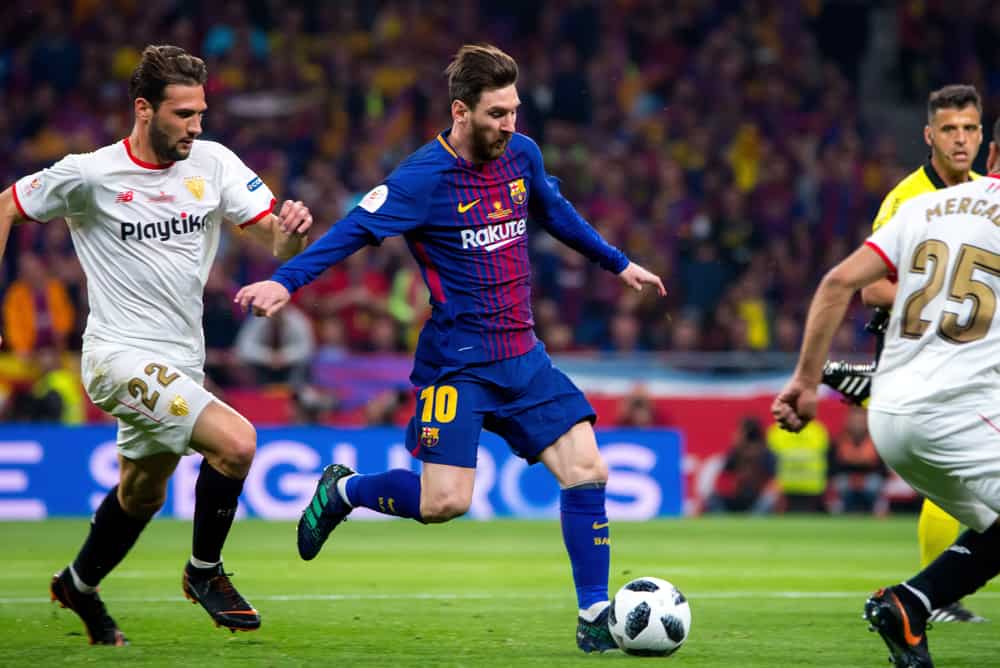
- Lionel Messi – Often compared to Maradona, Messi’s relatively small stature has been an advantage for his playing style, allowing him to change direction rapidly and maintain extraordinary balance.
- Xavi Hernandez (170 cm / 5’7″) – The Spanish midfield maestro used his technical brilliance to overcome height disadvantages.
- Andrés Iniesta (171 cm / 5’7″) – Alongside Xavi, formed one of soccer’s greatest midfield partnerships despite being shorter than most opponents.
- N’Golo Kanté (168 cm / 5’6″) – The French World Cup winner demonstrates how shorter players can excel even in physically demanding defensive midfield roles.
Advantages of Being a Shorter Soccer Player
Research and analysis by sports scientists have identified several advantages that shorter players often possess:
Biomechanical Advantages
- Lower center of gravity – Provides better balance and stability when changing direction
- Quicker acceleration – Less mass to move when initiating sprints
- Enhanced agility – Ability to change direction more rapidly
- Better maneuverability – Easier navigation through tight spaces and crowded areas
Tactical Advantages
- Ball control – Lower center of gravity often translates to superior close control
- Dribbling effectiveness – Shorter players typically keep the ball closer to their feet
- Space utilization – Ability to operate effectively in congested areas of the pitch
- Turn radius – Can execute tighter turns to evade defenders
Position-Based Analysis of Height in Soccer
Data analysis of player heights across positions reveals clear patterns:
Average Heights by Position (2018 World Cup)
- Goalkeepers: 188-199 cm (6’2″-6’6″)
- Defenders: 180-195 cm (5’11”-6’5″)
- Midfielders: 165-197 cm (5’5″-6’5″) – Widest range with shortest average
- Forwards: 170-194 cm (5’7″-6’4″)
This data confirms that midfielders tend to be the shortest players on average, which aligns with the position’s requirement for quick changes of direction, agility, and technical ball skills in congested areas.
FAQs
Who is the shortest professional soccer player of all time?
Marcin Garuch from Poland is known as the shortest pro soccer player ever, standing just 153 cm (5’0″). Despite his height, Garuch has played professionally as a midfielder.
What advantages do short players have in soccer?
Short players usually benefit from a lower center of gravity, which gives better balance, agility, and quicker speed-up. These traits are especially useful for midfielders and attacking players who need to move in tight spaces, change direction fast, and keep close ball control.
Which positions are best for shorter soccer players?
Midfield positions are usually best for shorter players, as World Cup data shows midfielders have the lowest average height. Attacking midfielders, wingers, and technical forwards can also do well despite lacking height. Goalkeeper typically needs height the most.
Has any short player won the World Cup?
Yes, many shorter players have won the World Cup. Good examples include Diego Maradona (165 cm/5’5″) with Argentina in 1986 and N’Golo Kanté (168 cm/5’6″) with France in 2018. These players’ technical skills and special abilities more than made up for their height limits.
Who are the most successful short soccer players in history?
Diego Maradona (165 cm/5’5″) and Lionel Messi (170 cm/5’7″) are widely seen as the most successful short players in soccer history, with both often named among the greatest players ever regardless of height. Other very successful shorter players include Xavi, Iniesta, and Roberto Carlos.
Can short players succeed as defenders?
While defenders tend to be taller on average, some shorter players have done great in defensive roles. Fabio Cannavaro (176 cm/5’9″) led Italy to World Cup victory in 2006 and won the Ballon d’Or. Franco Baresi (176 cm/5’9″) is seen as one of the greatest defenders ever despite being relatively short for the position.