The Super Ballon d’Or stands as perhaps the most special single honor in football history, known for how rare it is and its place in history. Unlike the yearly Ballon d’Or that rewards one season of great play, this one-time award praised a lifetime of amazing work in the beautiful game.
The Ultimate Recognition in Football
What makes the Super Ballon d’Or unique among football honors is its comprehensive evaluation criteria:
- Career-spanning achievement rather than single-season performance
- Transformative impact on the sport’s evolution and development
- Cultural significance and legacy beyond statistical accomplishments
- Voted by an elite panel including previous Ballon d’Or winners
- Extremely limited eligibility restricted to multiple Ballon d’Or recipients
The trophy represents the pinnacle of individual recognition in football, designed to identify the greatest of the greats in the sport’s history.

One-Time Award Ceremony (1989)
The Super Ballon d’Or has been awarded just once in football history, making it the sport’s most exclusive honor:
- Award Date: December 24, 1989
- Occasion: 40th anniversary celebration of the Ballon d’Or award
- Organizing Body: France Football magazine
- Selection Process: Combined votes from readers, expert panel, and former Ballon d’Or winners
This singular ceremony created a moment of historical significance that has never been replicated, cementing its legendary status within football lore.
Eligible Candidates
The award’s exclusivity was reinforced through its strict eligibility criteria. Only five football luminaries qualified for consideration:
- Johan Cruyff (Netherlands) – Three-time Ballon d’Or winner (1971, 1973, 1974)
- Michel Platini (France) – Three-time Ballon d’Or winner (1983, 1984, 1985)
- Franz Beckenbauer (Germany) – Two-time Ballon d’Or winner (1972, 1976)
- Karl-Heinz Rummenigge (Germany) – Two-time Ballon d’Or winner (1980, 1981)
- Alfredo Di Stéfano (Spain) – Two-time Ballon d’Or winner (1957, 1959)
- Kevin Keegan (England) – Two-time Ballon d’Or winner (1978, 1979)
This elite group represented the pinnacle of European football excellence from the 1950s through the 1980s.
Alfredo Di Stéfano: The Winner
The ultimate recipient of football’s most exclusive award was Alfredo Di Stéfano, whose selection reflected his transformative impact on the sport:
- Playing Career: Primarily with Real Madrid (1953-1964)
- Key Achievements: Five consecutive European Cups, eight La Liga titles
- Playing Style: Revolutionary “total football” approach
- Legacy: Considered the complete footballer who modernized attacking play
- Ballon d’Or History: Two-time winner (1957, 1959)
Despite being born in Argentina, Di Stéfano’s Spanish citizenship made him eligible under the European-only rules that governed the Ballon d’Or at that time.
Interesting Selection Notes
The voting process revealed some fascinating insights:
- Popular Vote Difference: If only public votes (readers and viewers) had been counted, Michel Platini would have won
- Expert Influence: The inclusion of the expert panel and former winners tilted the balance toward Di Stéfano
- Historical Perspective: The award bridged football eras, with Di Stéfano representing the 1950s generation against more recent stars
- European Limitation: The European-only eligibility criteria meant legends like Pelé and Diego Maradona were not considered
The Distinctive Trophy
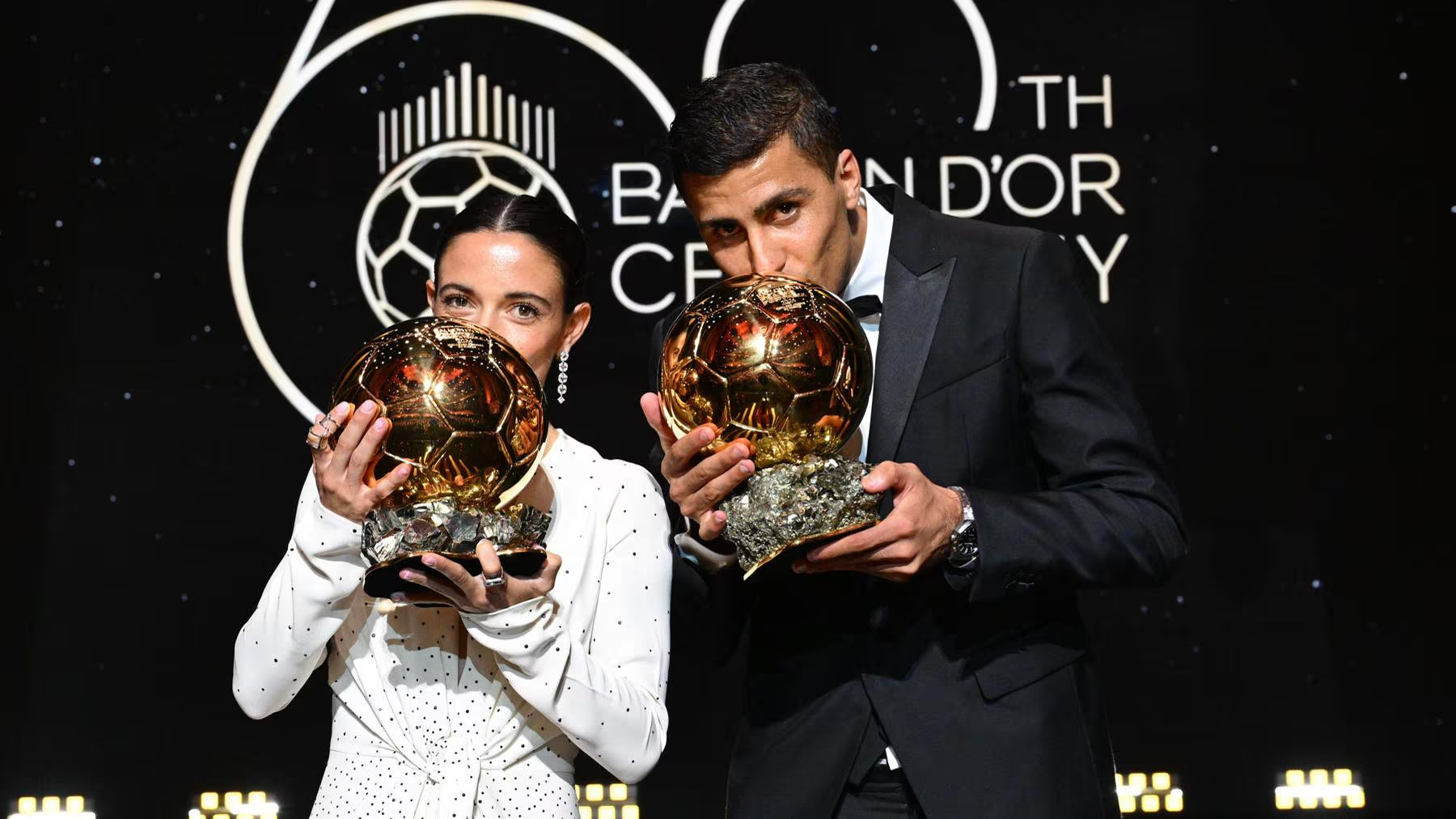
The Super Ballon d’Or trophy itself represented a dramatic elevation of the traditional Ballon d’Or design:
- Height: 52 centimeters (20.5 inches)
- Base Dimensions: 30 × 30 centimeters (11.8 × 11.8 inches)
- Design Elements: Golden ball atop crystal glass stand with multiple smaller golden balls around the base
- Visual Impact: Substantially more imposing than the standard Ballon d’Or
This unique physical manifestation of the honor created a visually striking representation of its significance.
Trophy’s Journey and Current Status
After being presented to Di Stéfano, the trophy followed a path that has added to its mystique:
- Initial Display: Featured prominently in the Real Madrid Museum at Santiago Bernabéu Stadium
- Public Visibility: Viewed by millions of visitors over several decades
- 2021 Auction: Sold as part of Di Stéfano’s memorabilia collection
- Final Sale Price: £187,500 (approximately $250,000)
- Current Location: Unknown, purchased by anonymous bidder
The trophy’s disappearance from public view has only enhanced its legendary status among football artifacts.
Legacy and Historical Context
The Super Ballon d’Or occupies a unique position in football history:
- Never Repeated: Despite subsequent milestones (50th, 60th anniversaries), the award has never been presented again
- Historical Snapshot: Represents football’s perspective on greatness as of 1989
- Evolving Context: Came before the dominance of modern icons like Messi and Ronaldo
- Exclusive Club: Remains football’s most selective individual honor
The decision not to reprise the award has preserved its singular significance in the sport’s historical narrative.
FAQs
Why was the Super Ballon d’Or only given once?
The Super Ballon d’Or was made just for the 40th year of the Ballon d’Or in 1989. It was meant to be given just once, to find the best player from the first 40 years of the award rather than to start a new award.
Would Pelé or Maradona have won if they could have?
This is one of football’s big “what if” questions. At that time, neither Pelé nor Maradona could win due to the Europe-only rule for the Ballon d’Or (which changed in 1995). Given how great they were, many football experts think either could have won if included.
Has there been talk about giving it again?
While France Football has never said they plan to give a second Super Ballon d’Or, people sometimes guess it might happen on big Ballon d’Or birthdays. The 50th (1999) and 60th (2009) years passed with no second award, suggesting they want to keep it a one-time thing.
How does the Super Ballon d’Or compare to FIFA’s Player of the Century award?
FIFA’s Player of the Century award in 2000 was like it but used a different way to pick, leading to Pelé and Maradona sharing the honor. The Super Ballon d’Or had more strict rules for who could win and just one winner, making it quite different despite covering a similar time span.
If given today, who might be able to win the Super Ballon d’Or?
Under the first rules (must have won multiple Ballon d’Ors), today’s choices would include Lionel Messi (8 wins), Cristiano Ronaldo (5), Michel Platini (3), Johan Cruyff (3), Marco van Basten (3), Ronaldo Nazário (2), and Franz Beckenbauer (2), among others.