Most athletes stick to standard routines with weights, cardio, and recovery drills. But the top performers often go off-script and experiment with unusual tools to sharpen their skills, boost endurance, or just break plateaus.
The stuff might look strange at first, but it usually serves a specific purpose—balance, focus, reaction time, or mental control.
Some of these tools might already be used by elite pros, while others are just now catching on. If your routine needs a shake-up, these ideas could offer something fresh.
1. Wooden Katanas for Strength and Control
Some trainers are turning to tools you wouldn’t expect in a gym, like wooden katanas. These aren’t about martial arts techniques or reenactments. They’re used in controlled movements that target coordination, grip, and body balance.
- Great for warm-up drills: Holding a wooden katana in both hands forces athletes to move more deliberately. This helps create a better mind-body connection before more intense sessions. Companies like com sell full-sized display swords, anime replicas, that you can keep as part of your home gear. They look great, but the wooden versions can also double as creative tools for training.
- Improves shoulder and core stability: Since the blade is long, using it through slow, controlled arcs strengthens your upper body and deep core.
- Used in focus-based training: Some athletes use them during movement patterns or tempo drills to work on precision and rhythm.
2. Indian Clubs
Indian clubs are one of the oldest training tools, but most modern gyms still don’t use them. These are long-handled weighted clubs swung in specific patterns to develop joint strength and full-body mobility.
- Strengthens shoulders and wrists: Regular use increases shoulder flexibility and grip strength, which can lower injury risk in overhead sports.
- Builds rhythm and coordination: The swinging patterns need timing and precision, which also keeps your brain involved during the workout.
- Easy to scale: You can start with light wooden versions and move to heavier ones as you improve.
3. Balance Boards
Balance boards help develop ankle strength and proprioception, which is your body’s sense of positioning. They’re simple but effective for building stability.
- Great for joint rehab: They help athletes returning from ankle or knee injuries rebuild joint control without overloading.
- Engages smaller muscle groups: Since you’re always correcting your position, your stabilizers work non-stop.
- Improves reaction time: Doing ball tosses or weight shifts while on a board forces the body to react quickly.
4. Resistance Parachutes
This is one of the most visually dramatic tools for runners and sprinters. Resistance parachutes attach to your waist and open up while you run to create drag.
- Increases stride power: The resistance makes your legs work harder to push forward, building speed.
- Boosts acceleration: Practicing with drag helps you drive more explosively off the starting line.
- Improves endurance: Because of the added work, your cardio has to adapt faster during sprints.
5. Sandbags
They look low-tech, but sandbags are tough. The shifting weight forces your body to constantly adjust, which builds real-world strength and control.
- Mimics unpredictable loads: The way the sand moves builds grip strength and full-body coordination.
- Can be used for functional carries: Athletes use them for walking lunges, cleans, and shoulder carries that build raw strength.
- Helps improve conditioning: You can use them for circuits that raise your heart rate without traditional cardio machines.
6. Reaction Lights
Speed, timing, and reflexes are crucial in almost every sport. Reaction lights test and train these skills in fun and competitive ways.
- Improves hand-eye coordination: Athletes have to quickly react to lights that randomly flash on or off.
- Used in team drills: Coaches set up challenges where players race to tap the lights, boosting competitiveness.
- Can test fatigue levels: Trainers use it at the end of workouts to see how sharp athletes remain when tired.
7. Weighted Vests
Weighted vests aren’t just for bodyweight workouts. They’re being used in high-performance sports to push capacity in running, jumping, and agility drills.
- Boosts bodyweight exercises: Push-ups, squats, and planks get significantly harder with added weight.
- Increases running resistance: Some sprinters use light vests to boost stride strength without resistance bands.
- Improves jumping power: Doing box jumps or bounds in a vest increases explosive strength.
8. Battle Ropes with Movement Variations
Battle ropes have been around, but athletes are taking it a step further by adding lunges, squats, or directional changes to the routine.
- Improves coordination: Moving while slamming or waving ropes keeps more muscles engaged.
- Increases full-body endurance: It becomes more of a cardio-plus-strength workout when movement is added.
- Used in circuit formats: Coaches use short bursts of rope training with directional shifts to keep sessions intense.
9. Vision Training Tools
Eyes are part of performance too. Vision tools help athletes track fast movements, focus on specific targets, and maintain visual clarity under pressure.
- Used in hand-eye sports: Tennis players, goalkeepers, and baseball hitters use it to improve tracking.
- Improves peripheral awareness: Some tools train athletes to be more aware of movements happening outside their direct vision.
- Sharpens reaction under stress: Practicing visual drills under fatigue helps simulate real-game stress.
10. Sled Pushes with Uneven Weight
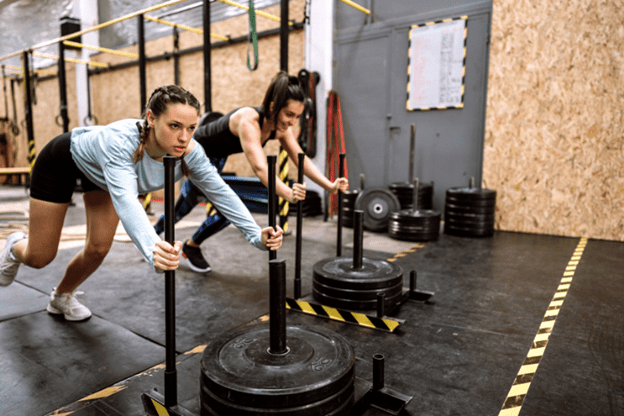
Sled pushes are already tough, but now some athletes are loading weight unevenly to build directional force and real-game adaptability.
- Builds pushing power: Even with even weight, this drill helps with explosive starts and leg drive.
- Engages core through imbalance: One side being heavier forces your abs and back to stabilize harder.
- Preps for in-game imbalance: Sports don’t always involve symmetrical movement. This mimics that unpredictability.
Conclusion
These tools might not be the first thing you think of when training, but that’s the point. When routines get stale, or performance stalls, sometimes a small twist can wake everything up.
Whether it’s the swing of a wooden katana, the blur of a reaction light, or the drag of a resistance parachute, adding something unexpected could give your training exactly what it needs.
If nothing else, they’ll make training way more interesting—and that can be the edge that keeps you going.