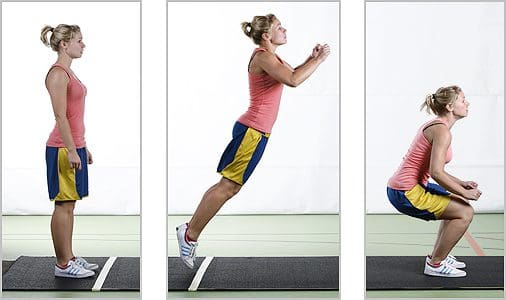
The standing long jump (also called the broad jump) is one of the best and easiest tests of lower body explosive power.
This simple test has been used to check athletes across many sports, from NFL combine players to Olympic hopefuls, giving key insights into how well an athlete can make force quickly.
What is the Standing Long Jump Test?
The standing long jump measures an athlete’s ability to explosively propel their body horizontally from a stationary position. Unlike its Olympic cousin that involves a running start, this assessment focuses purely on the power generated from a standing position, isolating lower body strength and coordination.
Test Purpose and Applications
- Primary measurement: Explosive leg power and horizontal force production
- Secondary insights: Coordination, balance, and kinetic chain efficiency
- Sporting relevance: Vital for sports requiring rapid acceleration, direction changes, and jumping
- Historical significance: Former Olympic event (1900-1912) and current component of fitness testing batteries worldwide
How to Perform the Standing Long Jump Test
Equipment Requirements
- Measuring tape (minimum 4 meters/13 feet in length)
- Non-slip takeoff surface (rubber mat or non-slippery floor)
- Soft landing area (preferable for safety and confidence)
- Marking tools (chalk, tape, or cones to mark the takeoff line)
Testing Protocol
- Starting position: Stand with feet shoulder-width apart, toes just behind the takeoff line
- Preparation: Bend knees and swing arms backward to load the body
- Execution: Explosively swing arms forward while extending hips, knees, and ankles
- Flight: Drive body forward and upward at approximately 30-38° angle
- Landing: Land on both feet simultaneously, bending knees to absorb impact
- Measurement: Distance from takeoff line to nearest point of contact (typically back of heels)
Administration Guidelines
- Allow 2-3 practice attempts to familiarize with technique
- Record the best of three official attempts
- Ensure consistent measurement methodology
- Provide adequate rest between attempts (45-60 seconds)
- Enforce two-foot takeoff and landing requirement
Performance Standards and Ratings
Standing Long Jump Norms (in centimeters)
| Rating | Males | Females |
| Excellent | > 250 | > 200 |
| Very Good | 241-250 | 191-200 |
| Above Average | 231-240 | 181-190 |
| Average | 221-230 | 171-180 |
| Below Average | 211-220 | 161-170 |
| Poor | 191-210 | 141-160 |
| Very Poor | < 191 | < 141 |
Conversion to Imperial Measurements
| Rating | Males | Females |
| Excellent | > 8’2.5″ | > 6’6.5″ |
| Very Good | 7’11” – 8’2.5″ | 6’3″ – 6’6.5″ |
| Above Average | 7’7″ – 7’10.5″ | 5’11.5″ – 6’2.5″ |
| Average | 7’3″ – 7’6.5″ | 5’7.5″ – 5’11” |
| Below Average | 6’11” – 7’2.5″ | 5’3.5″ – 5’7″ |
| Poor | 6’3″ – 6’10.5″ | 4’7.5″ – 5’2.5″ |
| Very Poor | < 6’3″ | < 4’7.5″ |
Sport-Specific Performance Benchmarks
Different sports have established their own standing long jump standards based on positional and performance requirements:
American Football
Elite college prospects: 10-11 feet (305-335 cm)
NFL Combine record: 12’3″ (373 cm) by Byron Jones (2015)
Position variations:
- Defensive backs/wide receivers: 10-11 feet (305-335 cm)
- Linebackers/running backs: 9.5-10.5 feet (290-320 cm)
- Linemen: 8.5-9.5 feet (260-290 cm)
Basketball
- NBA-level guards: 10-11 feet (305-335 cm)
- Collegiate players: 9-10 feet (275-305 cm)
- Position correlation: Guards typically outperform centers in this test
Track and Field
- Elite sprinters: 10.5+ feet (320+ cm)
- Jumpers (long/triple): 11+ feet (335+ cm)
- Training benchmark: Used to assess transfer of weight room strength to explosive power
Ice Hockey
- NHL prospects average: 8’6″ (260 cm)
- Elite forwards: 9’+ (275+ cm)
- Goalies: Typically 6-8 inches less than position players
Factors Affecting Performance
Biomechanical Considerations
- Takeoff angle: Optimal range between 30-38 degrees
- Arm swing contribution: Up to 21% of total jump distance
- Center of mass positioning: Lower pre-jump position enables greater force production
- Landing technique: Forward body lean with extended legs maximizes distance
Physiological Influences
- Fast-twitch muscle fiber percentage: Higher percentage correlates with better performance
- Strength-to-weight ratio: More important than absolute strength
- Neuromuscular efficiency: Rate of force development crucial for explosive movement
- Stretch-shortening cycle utilization: Effective countermovement enhances performance
Demographic Variables
- Age: Peak performance typically occurs between ages 20-25 for males, 16-20 for females
- Gender: Males generally jump 20-25% further than females due to physiological differences
- Height: Taller athletes have longer lever arms but must overcome greater mass
- Training status: Trained individuals typically jump 30-40% further than untrained
Training to Improve Standing Long Jump Performance
Research indicates that a multi-faceted approach yields optimal results for standing long jump improvement:
Strength Development
Primary exercises:
- Back squats (3-5 sets of 3-6 reps at 80-85% 1RM)
- Deadlifts (3-5 sets of 3-5 reps at 80-85% 1RM)
- Romanian deadlifts (3-4 sets of 6-8 reps at 70-80% 1RM)
- Split squats (3-4 sets of 6-8 reps per leg)
Frequency: 2-3 strength sessions per week
Progression: Focus on progressive overload while maintaining movement quality
Plyometric Training
Horizontal emphasis:
- Broad jumps (4-5 sets of 3-5 repetitions)
- Bounds (3-4 sets of 15-20 meters)
- Depth jumps to horizontal leap (3-4 sets of 5 repetitions)
- Single-leg hops (3 sets of 5-8 per leg)
Frequency: 2 plyometric sessions per week
Volume: Begin with 80-100 foot contacts per session, progress to 120-140
Recovery: Allow 48-72 hours between intense plyometric sessions
Technical Practice
Jump-specific drills:
- Standing jump technique practice (5-8 submaximal jumps)
- Arm swing coordination drills
- Landing mechanics training
Frequency: 1-2 technique sessions weekly
Integration: Include during warm-up for strength or plyometric sessions
Supplementary Training
- Sprint work: Short accelerations (10-30m) to develop horizontal force production
- Core training: Anti-rotation and anti-extension exercises to enhance force transfer
- Olympic lifts: Power cleans and snatches for explosive triple extension
Advantages and Limitations of the Test
Advantages
- Equipment simplicity: Requires minimal specialized equipment
- Time efficiency: Quick to administer for individuals or groups
- Practical relevance: Directly transfers to many sport movements
- Comprehensive assessment: Evaluates multiple components of athletic ability
- Normative data: Extensive comparison standards available
Limitations
- Skill influence: Technique impacts performance beyond pure power
- Measurement consistency: Proper protocol must be followed for valid results
- Surface variance: Different takeoff and landing surfaces affect distances
- Limited vertical assessment: Does not fully evaluate vertical power production
- Not sport-specific: May not perfectly correlate with all athletic movements
FAQs
What is a good standing long jump distance?
For adult men, jumps over 250 cm (8’2.5″) are seen as excellent, while women should aim for distances over 200 cm (6’6.5″) for the same rating. Usually, jumping a distance equal to your height is a solid base level for casual athletes.
How can I make my standing long jump distance better quickly?
Focus on three key areas: good form (especially arm swing and takeoff angle), lower body strength through squats and deadlifts, and explosive power training with box jumps and bounds. Most athletes can gain 6-12 inches within 8-12 weeks of hard training.
Does height affect standing long jump scores?
While height gives some edge through longer levers, the power-to-weight ratio and muscle-nerve skill are more key factors. Many shorter athletes with better strength and form outperform taller people with less explosive skill.
What’s the world record for the standing long jump?
The world record of 3.71 meters (12 feet 2.1 inches) belongs to Norwegian Arne Tvervaag. In modern sports, Byron Jones set the NFL Combine record of 3.73 meters (12’3″) in 2015, showing the great power of top athletes.
How does the standing long jump relate to vertical jump ability?
While both tests check lower body power, studies show a medium link (r=0.65-0.75) between the two. The standing long jump works on sideways force and uses slightly different muscles than the vertical jump, which focuses on upward force.
RELATED ARTICLES