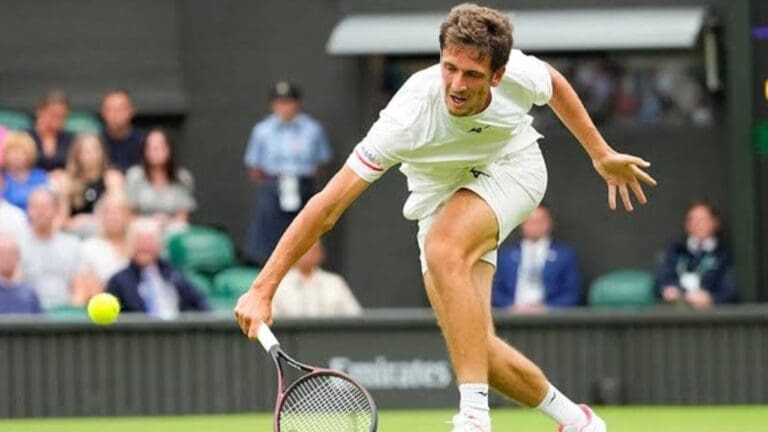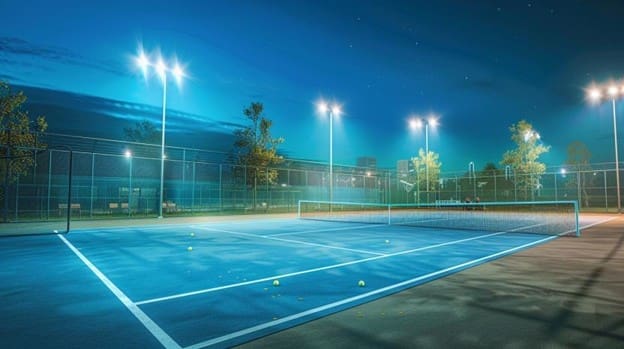
The first thing I see when I walk onto a tennis court at night isn’t the lines, though, or the players. It’s the lighting. Sometimes it is too bright, sometimes it is too dark and sometimes it is just right.
It’s not something that a lot of people even think about but lighting can make or break a game. The proper lighting system should do more than light the court, it sets the tone for how one feels the sport.
The Role of Lighting Quality in Tennis
If you’ve ever tried to return a fast serve in poor light, you know what I mean. Poor lighting can even interrupt matches entirely, and in some sports discussions, suspended play is often linked to visibility problems caused by lighting failures.
Low light levels increase fatigue and reaction time of the eye. When the ball is looked at easily, screams could be practically eliminated when the ball is moved under a different set of lights.
Consistent brightness, color temperature and uniformity are what the players count on. That’s why there are lighting standards. Competition courts are governed by stringent lighting requirements set by the International Tennis Federation, and these focus on visibility for not only the spectator, but also safety and fairness. Amateurs may not pick up on those things but pros can sense the smallest change.
I was in a small community club that once went from halogens to LED fixtures. It was like a brand new court with the players, they said. Same size, same surface but totally different environment. It was that big of a change.
Outdoor Tennis vs Indoor Tennis Lights 101
While it has lighting on outdoor courts and it also has lighting on the indoor tennis courts, there are differences. There are issues unique to each: light poles, reflection angles and environmental exposure.
Outdoor Tennis Lighting
Outdoor tennis courts are exposed to the elements and glare from the sun or other sources of light. You want light fixtures that are designed to be sturdy against rain, dust and wind. For most people that means IP65-rated (and above) LED fixtures that are moisture and debris resistant.
They’re rugged, dependable and they have energy savings in the long run. Players often assume tennis court lights are simple to operate, but many venues use timed switches or automation systems, similar to what’s explained in guides on how to turn on tennis court lights.
As guidance from the International Dark-Sky Association shows, best-practice outdoor lighting systems must direct at least 85 % of downward lumens onto play areas and limit each fixture to 1,000 candelas to control glare.
The design of the outdoor lighting also attempts to reduce the light that goes out of the boundaries, at least in residential areas. Dark sky regulations are in place in some areas. It’s all about aiming them correctly and using shielded fixtures and the right beam angle.
Another major factor is the height of the light poles. Poles holding outdoor tennis courts tend to be between 8 and 12 meters high. Go too low and this will result in uneven lighting. Too much, and you waste energy and cause glare. The rest is up to your lighting project and amount of playing involved.
Indoor Tennis Lighting
An indoor tennis court is more predictable. No rain, no wind, no alteration of sunlight. But it has its own set of problems. Low ceilings, bounce back from walls and not having points on which to mount your light can throw off your lighting layout.
Then there is the question of direct light and glare. From indoors, bright lighting can be reflected from shiny surfaces and cast shadows. The best answer is indirect or soft lighting in order to distribute light equally.
One of my favorite examples is in a college sporting venue. They replaced the old fluorescents with LED tennis court light fixtures, which were attached to trusses rather than above the playing area. The result? Those attending were able to see the ball a bit better without getting blinded, players said. That’s smart sports lighting.
Comparing the Levels and Standards of Light
Let’s talk numbers. The lighting requirements vary according to the type of play:
- Recreational outdoor courts: about 200 lux average
- Club or academy level: 300–500 lux
- Professional indoor courts: around 750 lux
The uniformity, which is commonly denoted by (Emin/Eavg), must be greater than 0.6. That in turn should result in uniform, or even coverage, over the entire court.
For example, county guidelines treat a “uniformity ratio” of 2:1 as acceptable for sports lighting, meaning the brightest spot should not exceed twice the dimmest, reinforcing how important consistent light levels are across the court.
But it’s not just about being bright. So too does color rendering index, abbreviated CRI. High-CRI LED lights enable players to see the color of the ball over the court surface. The majority of today’s LED court lights offer a CRI of over 80, making them ideal for amateur as well as professional TV broadcast.
Fixture Selection and Lighting Design
There are lots of factors to take into consideration when choosing the right fixture: pole height, beam spread, mounting angle and energy use.
For people who are going to go out and play tennis day and night outside, look for weather-proof flood lights with adjustable brackets. For indoor courts, go with ceiling-mounted or hanging fixtures in diffused lighting for reduced glare.
In any case, architecturally appropriate lighting begins with a photometric plan. That’s a layout plan and it shows how much light the different parts of it get.
If you’re taking your lighting project seriously, ask your supplier for one. It’s the only way to approximate performance in a real-world situation before installation.
I’ve seen clubs who skipped this step and regretted it. One local gym, it reflected, had bright spots on one side and dark shadows on the other. They wasted money on luxurious fittings but neglected the layout. It is like you bought a Ferrari and never took it in for an alignment.
The Role of LED Technology
The evolution of LED light technology gave a new look to the sports lighting game. They’re efficient, long-lasting and convenient to work. LEDs have power consumption that is up to 70% less than metal halide, and have a rated life of more than 50,000 hours. That’s enormous to facility owners.
LED fixtures are also cold-starting, with no lag time as with old lights that may take up to minutes to warm up to speed. And you can add them to smart control systems so your lights dim and brighten automatically with daylight or by planned events. Which means you’re not wasting electricity when you do not have to be.
I’ve seen saving thousands of dollars per year from facilities where the only change has been a switch in lighting solutions to the LED. And it’s not just the cost, it’s also comfort. Nothing buzzing, nothing flickering, just bright, steady light.
Maintenance and Costs Considered
The maintenance expenses will differ for an indoor and outdoor operation. Weather elements consume outdoor lighting systems.
Although the finest equipment must have routine maintenance and sanitation. Indoor applications, on the other hand, can last longer but do require an occasional dusting and calibration.
The up-front cost to install LED tennis courts ranges, on average, from $30,000–$200,000 depending on the size and complexity of the tennis court. But when you consider both the energy and maintenance savings, the return on investment will generally be recovered in under three years.
I know of one little Texas facility that took the plunge and reported a 60% drop in monthly power bills. It’s the sort of number even your most reluctant owners can’t argue with.
Where FSG Tennis Court Lighting Fits In
For the end-to-end provider that gets the fine line between performance and efficiency, check out FSG tennis court lighting. They do everything from the design and layout to installation and maintenance.
The team relies on photometric software to mock up light levels before they make a game-time decision, thus decreasing the guesswork and confirming them to meet industry standards.
I’ve seen their work on a couple of courts around the South and it’s an impressive result. A good spread, serious energy savings and a marked increase in the comfort of the players. You know it when the lighting is done right, it’s tangible, you can feel it.
Finding the Best in Lighting for Your Organization
Every court is different. Before making a purchase of anything, consider these factors:
- Style – Indoor or Outdoor Tennis Court
- Usage – Recreational, competitive or club play, broadcast play
- Current light pole or ceiling mount
- Environmental exposure (humidity, dust, heat)
- Budget and maintenance capacity
If possible, hire a pro that will deliver you a lighting design layout before installation. They’ll determine things like light levels, potential for glare and the number of fixtures. It’s worth it.
Don’t take shortcuts, such as mixing brands of light fixtures or not aiming properly. Consistency matters. You’re looking for a cohesive lighting system that’s reliable.
Common Mistakes and Lessons Learned
Here’s some of what I’ve seen go wrong over the years:
- Same lighting setup inside and out
- Over-lit small courts and glare
- Ignoring uniformity ratios
- Selecting less expensive fixtures with no warranty
- Ignoring spill light in outdoor tennis courts
I used to consult with a facility that had installed high-powered field lighting for their outdoor courts. It was eye-catching, but it blinded players and annoyed people who lived in the neighborhood.
They had to re-install everything with better shielding and 30-degree angles. Expensive mistake but I’ve learned my lesson.
Real-World Case Study
A private club located in (wiped out) upgraded their outdoor tennis courts with 1,000W metal halides and gave us a trial to re-light them with LED. The extra 100W of previous setup per fixture (500W) at each side was now another 40% brighter but only using 400W per fixture.
Members noticed visibility was improved and there was less glare. They also saved approximately $12,000 per year on power and maintenance.
Stories such as these prove that lighting is not just about seeing the ball better. It’s about delivering a consistent, positive experience to everyone who takes the court.
Designs of Light and the Human Experience
Well-designed lighting is a combination of performance and comfort. It’s not about overloading the court with light, but about providing even and consistent lighting on the court. The eyes should not have to struggle to accommodate.
When players say, “I can see the ball perfectly,” that is the real barometer for good lighting. Whether indoor or outdoor, good lighting makes every shot, rally and moment look sharper.
Final Thoughts
Tennis is all about precision, rhythm and concentration. So your lighting system is supposed to reflect that. Bad lighting doesn’t just look bad, it has an impact on how people play, whether they feel safe and how they remember the game.
If you are running a court, get to know your place. Compare the different lighting options, get advice from professionals in your area and opt for higher-end fixtures that will last the test of time.
Whether installing a new indoor tennis court or adding to the outdoor lighting of current courts, the correct system is worth its weight in performance and confidence in lighting plans and maintenance.
The difference between outdoor and indoor tennis court lights is not only technical. It’s experiential. You can see it, you can feel it, and once you’ve played under great lighting, there’s no turning back.