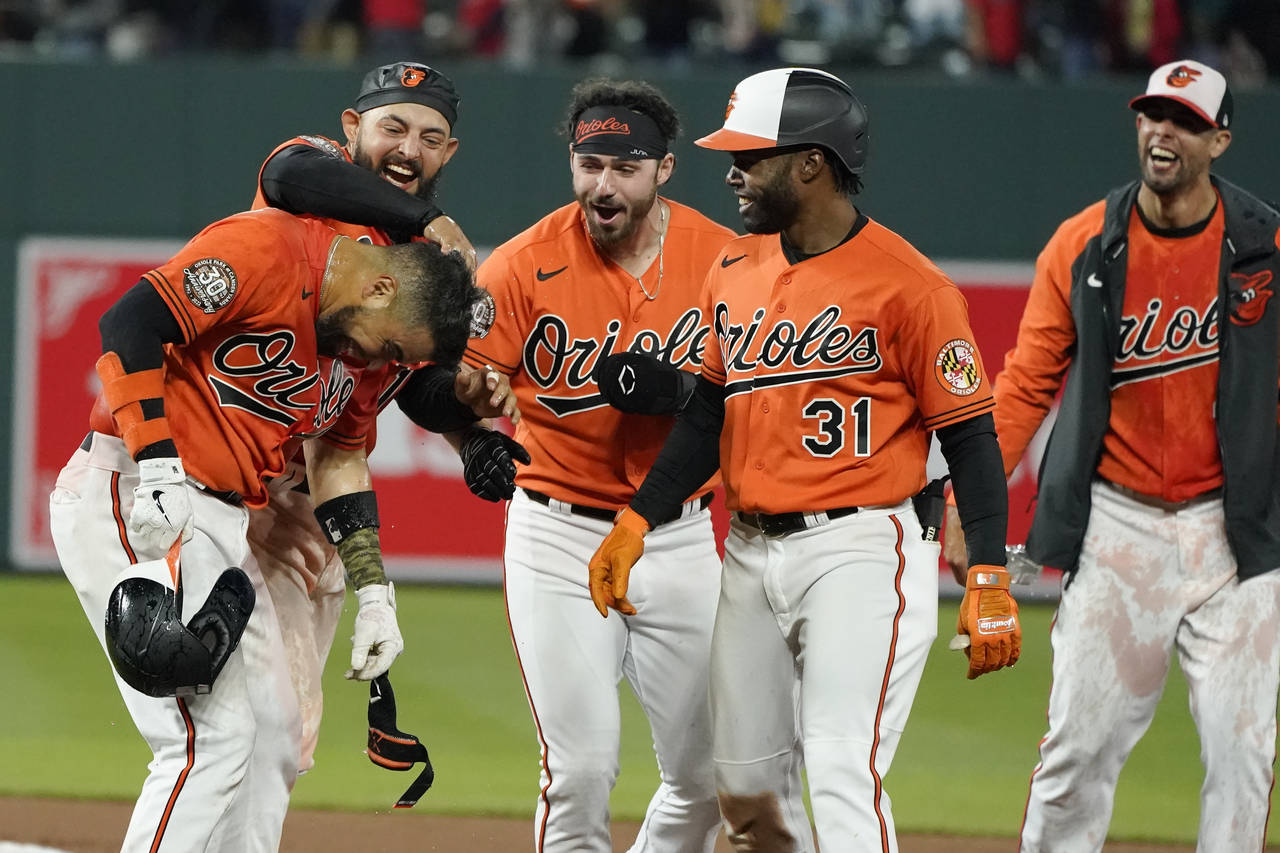
The Orioles operate with baseball’s lowest payroll at just $51 million for 2025, ranking 30th among MLB teams. Despite minimal spending, Baltimore fields a competitive roster built almost entirely through their farm system and pre-arbitration talent.
Ryan O’Hearn leads the team at $9 million annually while stars like Gunnar Henderson ($775K), Adley Rutschman ($800K), and Jackson Holliday ($770K) provide elite production at league minimum salaries. This unprecedented cost control allows Baltimore to compete while maintaining financial flexibility for future extensions.
Explore Baltimore Orioles player biography and roster information for complete team analysis.
| Position | Player |
| SP | Dean Kremer |
| SP | Charlie Morton |
| SP | Cade Povich |
| SP | Tomoyuki Sugano |
| RP | Yennier Cano |
| RP | Keegan Akin |
| RP | Bryan Baker |
| RP | Felix Bautista |
| RP | Seranthony Dominguez |
| RP | Gregory Soto |
| C | Adley Rutschman |
| C | Gary Sánchez |
| 1B | Ryan Mountcastle |
| 1B | Ryan O’Hearn |
| 2B | Jackson Holliday |
| SS | Gunnar Henderson |
| 3B | Jordan Westburg |
| 3B | Ramón Urías |
| LF | Heston Kjerstad |
| CF | Cedric Mullins |
| RF | Tyler O’Neill |
Pre-Arbitration Stars Dominate Baltimore’s Roster
Baltimore’s competitive advantage stems from elite young talent earning minimum salaries. Gunnar Henderson won the 2023 AL Rookie of the Year while making just $775K. His 28 home runs and 82 RBIs came at a fraction of what comparable production costs on the open market.
Adley Rutschman earns $800K as one of baseball’s best catchers. His defensive excellence behind the plate combined with a .280+ batting average would command $15-20 million annually in free agency. Jackson Holliday, the top prospect who debuted in 2024, makes $770K while developing into a future cornerstone.
| Player | Position | 2025 Salary | Contract Status |
| Ryan O’Hearn | 1B/DH | $9M | Free agent 2025 |
| Seranthony Domínguez | RP | $8M | Arb-eligible 2026 |
| Craig Kimbrel | RP | $7M | Free agent 2025 |
| Ryan Mountcastle | 1B | $6.8M | Arb-eligible 2026 |
| Cedric Mullins | OF | $5.2M | Arb-eligible 2026 |
| Adley Rutschman | C | $800K | Arb-eligible 2026 |
| Gunnar Henderson | 3B/SS | $775K | Arb-eligible 2027 |
| Jackson Holliday | 2B | $770K | Arb-eligible 2028 |
| Grayson Rodriguez | SP | $778K | Arb-eligible 2027 |
| Colton Cowser | OF | $770K | Arb-eligible 2028 |
Arbitration-Eligible Players Drive Salary Increases
Ryan Mountcastle earned $6.8 million in 2025 through arbitration, representing his final year of team control before free agency. His power bat produced 20+ home runs annually while costing a fraction of comparable first basemen across baseball.
Cedric Mullins makes $5.2 million after settling his arbitration case. The center fielder’s speed and defense justify the investment while remaining below market value. Jorge Mateo earned $2.5 million in his final arbitration year before potentially testing free agency.
Grayson Rodriguez’s $778K salary represents extraordinary value for a front-line starter. His 165+ innings and sub-4.00 ERA would cost $8-12 million annually on the open market. Cole Irvin ($3.5M) provides rotation depth at reasonable arbitration rates.
| Player | 2025 Salary | Career Earnings (Est.) | Net Worth (Est.) | Key Endorsements |
| Ryan O’Hearn | $9M | $22M | $12M | Rawlings |
| Craig Kimbrel | $7M | $95M | $60M | Under Armour |
| Ryan Mountcastle | $6.8M | $18M | $10M | New Balance |
| Cedric Mullins | $5.2M | $12M | $7M | Nike |
| Adley Rutschman | $800K | $3M | $2M | Under Armour |
| Gunnar Henderson | $775K | $2.5M | $1.8M | Louisville Slugger |
Baltimore’s Starting Rotation Built on Rookie Contracts
Baltimore assembled a competitive rotation for approximately $8 million total. Grayson Rodriguez ($778K), Dean Kremer ($1.4M), and Kyle Bradish (pre-arb) combine to provide 400+ innings at minimal cost compared to veteran free agents.
Cole Irvin earns $3.5 million as the rotation’s highest-paid arm. His reliability across 180 innings justifies the arbitration salary while remaining well below market rates for established starters.
| Position Group | Total Spending | Top Earner | Salary |
| Starting Pitchers | $8M | Cole Irvin | $3.5M |
| Bullpen | $22M | Seranthony Domínguez | $8M |
| Infield | $15M | Ryan Mountcastle | $6.8M |
| Outfield | $6M | Cedric Mullins | $5.2M |
| Catchers | $800K | Adley Rutschman | $800K |
The youth movement extends throughout the organization. Albert Suárez, Cade Povich, and Chayce McDermott fill out the rotation depth chart earning league minimum salaries. This approach allows Baltimore to allocate resources toward bullpen depth where veteran experience proves more valuable.
Bullpen Investment Creates Competitive Balance
Baltimore spent $22 million on relievers—43% of their total payroll. Seranthony Domínguez leads at $8 million following his arbitration settlement. Craig Kimbrel’s $7 million provides veteran closing experience despite declining velocity.
Keegan Akin earned $1.8 million while Yennier Cano made $1.2 million. Both left-handers offer matchup flexibility in high-leverage situations. Danny Coulombe ($2.1M) rounds out the higher-paid relief options.
The bullpen spending reflects Baltimore’s strategic philosophy. Young starting pitchers work efficiently through five innings before handing games to experienced relievers. This approach maximizes rookie pitcher development while leveraging veteran bullpen arms in crucial moments.
Cionel Pérez, Jacob Webb, and Bryan Baker combine for under $3 million while providing depth. Baltimore’s analytics department identifies undervalued relief arms annually, converting them into productive contributors at minimal cost.
Future Extension Candidates Reshape Payroll Landscape
Baltimore faces crucial extension decisions with Rutschman, Henderson, and Rodriguez approaching arbitration eligibility. Rutschman’s market value likely exceeds $150 million over six years given his elite catching skills and offensive production.
Henderson could command $200+ million if extended before arbitration. His versatility playing shortstop, third base, and outfield adds premium value. Waiting until free agency risks losing him to higher-spending markets.
Rodriguez represents Baltimore’s ace-in-waiting. Extending him now secures front-line pitching at below-market rates before arbitration awards escalate costs. Comparable starters sign for $100-120 million over five years.
Baltimore’s payroll will inevitably increase as young stars reach arbitration and free agency. The organization’s challenge involves timing extensions to maximize value while maintaining competitive rosters. Their $51 million payroll provides substantial financial flexibility other teams lack.
FAQs
Who is Baltimore’s highest-paid player in 2025?
Ryan O’Hearn earns $9 million as Baltimore’s highest-paid player, leading a roster dominated by pre-arbitration talent making league minimum salaries.
Why does Baltimore have baseball’s lowest payroll?
Baltimore built their roster almost entirely through the draft and farm system, resulting in elite young players like Gunnar Henderson and Adley Rutschman earning under $1 million.
How much does Adley Rutschman earn compared to his value?
Rutschman makes just $800K in 2025 despite providing production worth $15-20 million annually, representing baseball’s most team-friendly contract among starting catchers.
When will Baltimore’s payroll increase significantly?
Baltimore’s spending will jump when stars like Henderson, Rutschman, and Rodriguez reach arbitration eligibility in 2026-2028, potentially adding $50-80 million to the payroll.