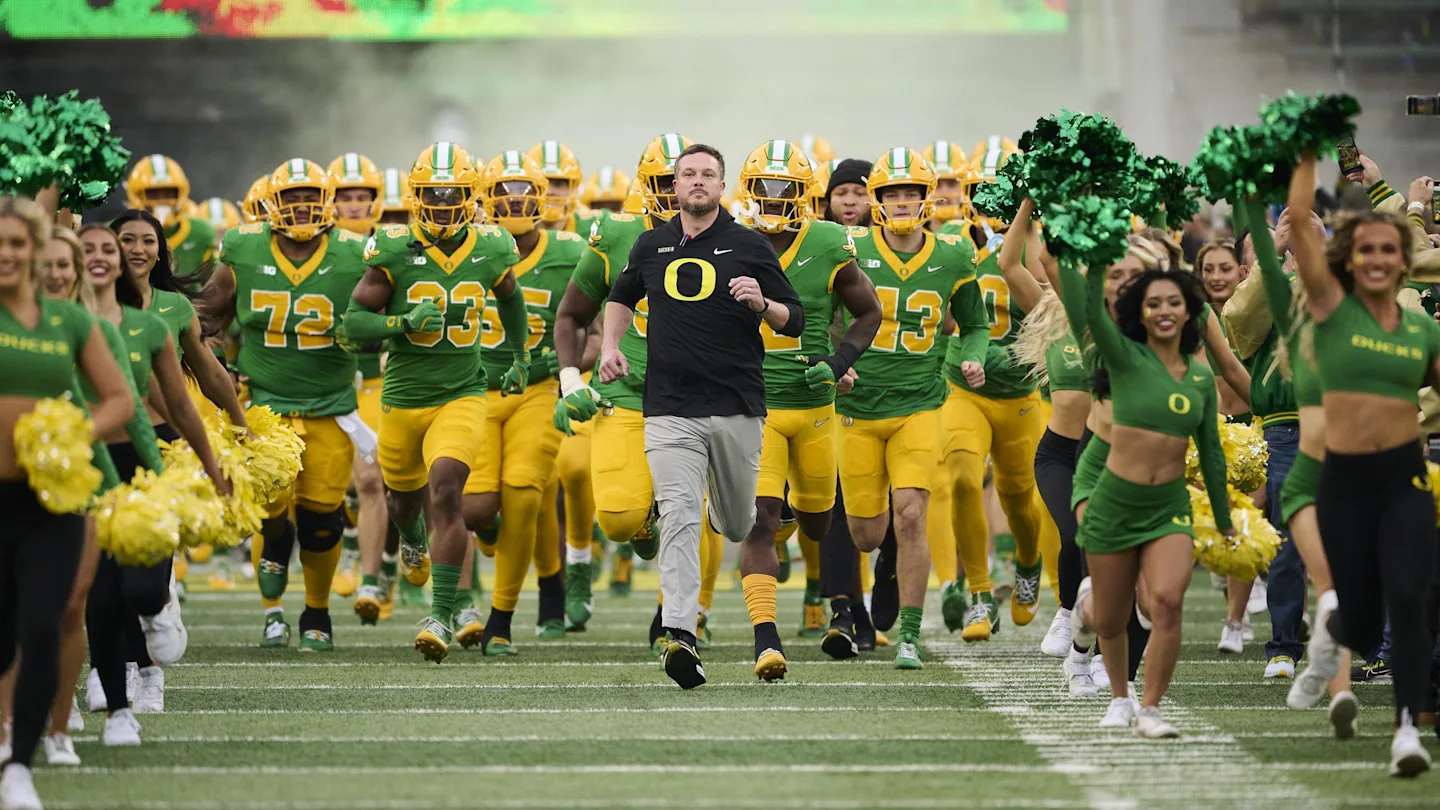
Oregon Ducks football salaries demonstrate Phil Knight’s championship commitment. Dan Lanning earns $10.4 million for 2025, ranking 6th nationally and 2nd in Big Ten. The Ducks generate approximately $130 million in football revenue during first full Big Ten season.
Oregon’s Division Street NIL collective operates with $23 million budget, college football’s most aggressive per-player investment with Nike co-founder Phil Knight personally bankrolling national championship pursuit.
Lanning’s $1.675 million maximum bonus potential combined with $10.4 million base creates $12.075 million total compensation ceiling if winning national title.
His $20 million buyout through 2031 extension makes him among college football’s most protected coaches following 40-6 record (.870 winning percentage) ranking 3rd nationally since 2022.
Discover the Oregon Ducks players biography and net worth by clicking on their name.
| Quarterbacks (QB) | Running Backs (RB) | Wide Receivers (WR) |
| Dante Moore | Ellis Bynum | Gary Bryant Jr. |
| Austin Novosad | Brison Cobbins | Jurrion Dickey |
| Luke Moga | Kilohana Haasenritter | Dillon Gresham |
| Ryder Hayes | Jay Harris | Traeshon Holden |
| Brock Thomas | Jordan James | Tez Johnson |
| Jayden Limar | Kyler Kasper | |
| Da’Jaun Riggs | Justius Lowe | |
| Noah Whittington | Jeremiah McClellan | |
| Preston Alford | Ryan Pellum | |
| Jack Ressler | ||
| Jalen Saint Paul | ||
| Evan Stewart | ||
| Darrian Anderson (Possibly WR) | ||
| Brady Bidwell (Possibly WR) |
Top 10 Highest Paid Oregon Football Staff 2024-2025
Oregon’s coaching staff salaries total approximately $22.9 million representing Big Ten’s second-highest combined investment, with Tosh Lupoi earning $1.9 million as college football’s 10th-highest paid assistant despite declining Cal head coaching offer.
| Rank | Name | Position | Annual Salary | Contract Length | Total Contract Value |
| 1 | Dan Lanning | Head Coach | $10,400,000 | Through 2031 | $76,000,000+ |
| 2 | Tosh Lupoi | Defensive Coordinator | $1,900,000 | Through 2027 | $7,600,000 |
| 3 | Will Stein | Offensive Coordinator | $1,700,000 | Through 2026 | N/A |
| 4 | Steve Greatwood | Offensive Line | $1,100,000 | Through 2025 | N/A |
| 5 | Aaron Feld | Strength & Conditioning | $850,000 | Through 2025 | N/A |
| 6 | Tony Washington | Defensive Line | $800,000 | Through 2025 | N/A |
| 7 | Marcus Arroyo | Co-OC/QBs | $750,000 | Through 2025 | N/A |
| 8 | DJ Johnson | Outside Linebackers | $725,000 | Through 2025 | N/A |
| 9 | Donte Williams | Defensive Backs | $700,000 | Through 2025 | N/A |
| 10 | Junior Adams | Wide Receivers | $675,000 | Through 2025 | N/A |
Tosh Lupoi’s $1.9 million defensive coordinator salary ranks 10th nationally among all assistants. His 2022 contract originally paid $1.7 million annually through 2025 with $130,000 bonus potential, but Oregon increased compensation matching elite SEC defensive coordinators after Cal offered him head coaching position.
Will Stein earns estimated $1.7 million as offensive coordinator after transforming Oregon into Big Ten’s highest-scoring offense averaging 36.6 points per game.
His salary reflects Oregon’s offensive evolution under Lanning, though exact figures remain undisclosed as Oregon avoids publicly reporting assistant salaries.
Oregon’s total assistant pool reaches approximately $12.5 million. Combined with Lanning’s $10.4 million, total staff compensation of $22.9 million trails only Ohio State ($24.275M) in Big Ten, demonstrating Phil Knight’s financial commitment matching powerhouses like Alabama ($19.45M) and LSU ($24.5M).
How Much Does Dan Lanning Make at Oregon?
Dan Lanning earns $10.4 million base salary for 2025, ranking 6th nationally and 2nd in Big Ten behind only Ohio State’s Ryan Day at $12.5 million.
His contract includes $200,000 annual raises reaching approximately $12 million by 2031 through automatic extensions triggered by 10-win seasons.
Lanning’s bonus structure allows maximum $1.675 million in additional earnings. He receives $150,000 for CFP first round qualification, $200,000 for quarterfinals, $250,000 for semifinals, $325,000 for championship appearance, and $500,000 for winning national title, plus academic progress bonuses.
His buyout stands at $20 million if leaving voluntarily through 2031, protecting Oregon’s investment.
If Oregon fires Lanning, the university owes 75% of remaining contract value, currently approximately $45 million through 2031, creating mutual financial security after contract restructuring in March 2025.
RELATED ARTICLES

Oregon Football Program Revenue Breakdown 2024-2025
| Revenue Source | Est. Amount | % of Total | Conference Rank | National Rank |
| Big Ten Media Rights | $32,500,000 | 25.0% | 17th Big Ten | Top 20 |
| Ticket Sales | $38,000,000 | 29.2% | 6th Big Ten | Top 12 |
| Phil Knight Donations | $35,000,000 | 26.9% | 1st Big Ten | Top 5 |
| Licensing/Merchandise | $20,000,000 | 15.4% | 2nd Big Ten | Top 8 |
| Other Revenue | $4,500,000 | 3.5% | N/A | N/A |
| Total Revenue | $130,000,000 | 100% | 4th Big Ten | 11th National |
Oregon generates approximately $130 million in football revenue during first full Big Ten fiscal year, ranking 11th nationally and 4th in Big Ten behind Ohio State ($254.9M), Michigan ($238M), and Penn State ($235M).
The program’s self-sufficient operation generated $35+ million profit in final Pac-12 season.
Big Ten media rights will distribute approximately $32.5 million to Oregon annually for first six years before doubling to full $65 million share starting 2030-31.
This reduced distribution affects short-term revenue but Oregon’s Phil Knight donations compensate creating competitive financial footing versus established Big Ten powers.
Phil Knight’s personal contributions estimated at $35 million annually through Nike partnerships and direct donations exceed most programs’ total booster fundraising.
Autzen Stadium’s 54,000 capacity generates $38 million in ticket sales despite smaller venue than Ohio State (102,321) or Michigan (107,601), reflecting premium pricing Phil Knight era created.
Oregon Top NIL Earners & Division Street Dominance
| Player Name | Position | Est. NIL Value | Top NIL Deal | Total Deals |
| Dillon Gabriel | Quarterback | $1,900,000 | Beats by Dre/Uber | 12+ deals |
| Evan Stewart | Wide Receiver | $1,200,000 | Regional partners | 6+ deals |
| Jordan Burch | Defensive Line | $900,000 | Multiple brands | 4+ deals |
| Terrance Ferguson | Defensive Tackle | $800,000 | Local businesses | 3+ deals |
| Tez Johnson | Wide Receiver | $750,000 | Stanley Brands | 4+ deals |
Dillon Gabriel’s $1.9 million NIL valuation ranked 22nd nationally through partnerships with Beats by Dre, Uber, Celsius, Great Clips, Stanley Brands, The GLD Shop, and EA Sports.
His 12 different brand deals demonstrate Division Street’s ability connecting athletes with premium sponsors beyond typical regional businesses.
Oregon’s Division Street collective operates with approximately $23 million budget according to Facebook reports, making it college football’s most aggressive NIL operation per-player.
Phil Knight personally bankrolls the collective, with NIL agents confirming “Phil Knight is bankrolling that whole thing and wants to see them win a national title.”
Division Street’s aggressive spending landed transfer portal stars including Dillon Gabriel ($1.9M from Oklahoma), Evan Stewart ($1.2M from Texas A&M), and five-star recruit Na’eem Offord whose custom Nike shoe deal demonstrated Knight’s personal recruiting involvement.
Oregon signed nation’s No. 5 recruiting class plus No. 3 overall class including transfers.
What Do Oregon Assistant Coaches Earn?
Tosh Lupoi’s $1.9 million defensive coordinator salary ranks 10th nationally behind Penn State’s Jim Knowles ($3.1M), LSU’s Blake Baker ($2.5M), Auburn’s DJ Durkin ($2.5M), Michigan’s Wink Martindale ($2.5M), Ohio State’s Jim Knowles ($2.2M), Georgia’s Glenn Schumann ($2M), and several others.
Will Stein earns estimated $1.7 million as offensive coordinator ranking approximately 15th nationally.
His compensation reflects Oregon’s offensive transformation averaging 455.7 yards per game (8th nationally) and 36.6 points per game (11th nationally), winning Big Ten Championship in conference debut season.
Position coaches earn $675,000-$1.1 million annually. Steve Greatwood’s $1.1 million offensive line salary leads position coaches, reflecting Oregon’s emphasis on elite line play producing Jordan James’s 1,253 rushing yards and protecting Dillon Gabriel for 3,558 passing yards during championship run.
Oregon vs Ohio State: Which Program Spends More?
Dan Lanning’s $10.4 million salary trails Ryan Day’s $12.5 million by $2.1 million, though both rank top-10 nationally.
Day’s $100 million eight-year extension exceeds Lanning’s $76+ million through 2031, reflecting Ohio State’s established powerhouse status versus Oregon’s Big Ten newcomer positioning.
Coordinator spending favors Ohio State. Matt Patricia’s $2.5 million and Brian Hartline’s $2 million combined $4.5 million exceeds Oregon’s Tosh Lupoi ($1.9M) and Will Stein ($1.7M) combined $3.6 million by $900,000, demonstrating Ohio State’s willingness paying premium assistant salaries.
NIL spending shows Oregon advantage. Division Street’s $23 million budget exceeds Ohio State’s estimated $20 million by $3 million, reflecting Phil Knight’s personal commitment.
Combined with smaller roster needs (85 scholarships), Oregon’s per-player NIL investment exceeds all programs creating recruiting advantages despite smaller total athletic revenue.
FAQs
How much does Dan Lanning make?
Dan Lanning earns $10.4 million base salary for 2025, ranking 6th nationally and 2nd in Big Ten. His contract includes $200,000 annual raises with potential $1.675 million bonuses for national championship.
How much NIL money do Oregon players get?
Oregon’s Division Street collective operates with approximately $23 million budget, college football’s highest per-player investment. Quarterback Dillon Gabriel led with $1.9 million NIL valuation through Beats by Dre, Uber, and 10 other deals.
What is Tosh Lupoi’s salary?
Tosh Lupoi earns $1.9 million as Oregon’s defensive coordinator through 2027, ranking 10th nationally among assistants. Oregon increased his compensation from $1.7 million after Cal offered him head coaching position.
How much does Oregon make from football?
Oregon generates approximately $130 million in football revenue, ranking 11th nationally and 4th in Big Ten. Phil Knight’s estimated $35 million annual donations plus Big Ten’s reduced $32.5 million media share create competitive budget.
RELATED ARTICLES