The UEFA European Championship, often called the Euros, is one of football’s most prestigious international tournaments. Held every four years, this event brings together Europe’s best women national teams in an exciting showcase of tactics, skill, and passionate competition that has created some of the sport’s most memorable moments.
Most Recent UEFA Women’s Euro Champions
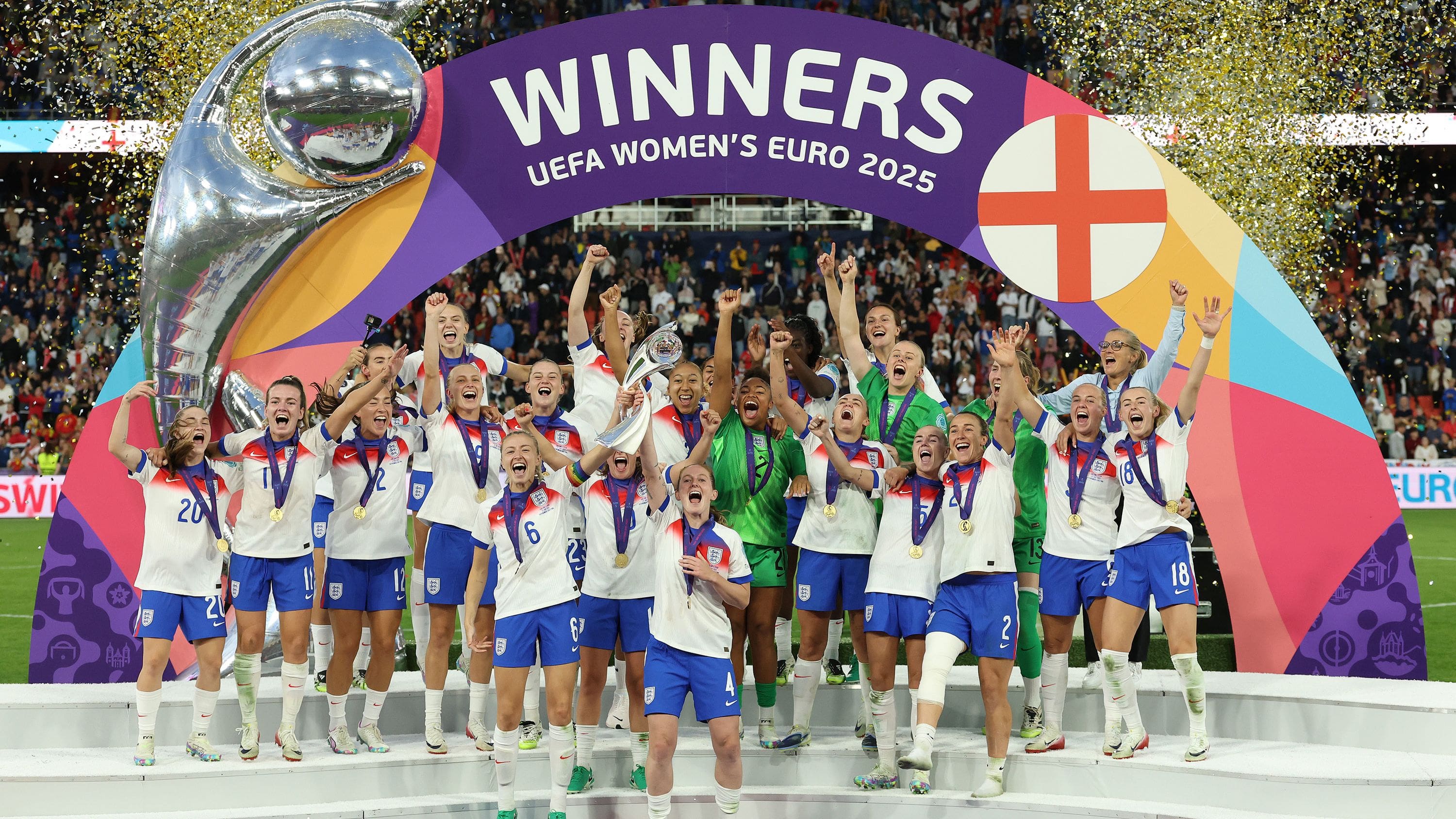
England currently reign as European champions, having secured back-to-back titles in the UEFA Women’s Euro:
| Year | Champion | Result | Runner-up |
| 2025 | England | 1–0, 0–1, (3–1 p) | Spain |
| 2022 | England | 2–1 (a.e.t.) | Germany |
England’s 2022 triumph at Wembley Stadium marked their first major tournament victory, achieved in front of a record 87,192 spectators. They followed this with a successful title defense in 2025, defeating Spain via penalties after the two-legged final ended with an aggregate score of 1-1.
Complete UEFA Women’s Euro Winners List (1984-2025)
| Year | Winner | Score | Runner-up |
| 2025 | England | 1–0, 0–1, (3–1 p) | Spain |
| 2022 | England | 2–1 (a.e.t.) | Germany |
| 2017 | Netherlands | 4–2 | Denmark |
| 2013 | Germany | 1–0 | Norway |
| 2009 | Germany | 6–2 | England |
| 2005 | Germany | 3–1 | Norway |
| 2001 | Germany | 1–0 (g.g.) | Sweden |
| 1997 | Germany | 2–0 | Italy |
| 1995 | Germany | 3–2 | Sweden |
| 1993 | Norway | 1–0 | Italy |
| 1991 | Germany | 3–1 (a.e.t.) | Norway |
| 1989 | West Germany | 4–1 | Norway |
| 1987 | Norway | 2–1 | Sweden |
| 1984 | Sweden | 1–0, 0–1, (4–3 p) | England |
- Legend: a.e.t. = after extra time | g.g. = golden goal | p = penalty shootout
Most Successful Women’s Euro Nations
Germany’s dominance in women’s European football is unparalleled, with a record that far outstrips any other nation:
| Nation | Titles | Years Won |
| Germany | 8 | 1989, 1991, 1995, 1997, 2001, 2005, 2009, 2013 |
| England | 2 | 2022, 2025 |
| Norway | 2 | 1987, 1993 |
| Sweden | 1 | 1984 |
| Netherlands | 1 | 2017 |
The Era of German Dominance (1989-2013)
Germany’s extraordinary success in the UEFA Women’s Euro represents one of the most dominant periods by any nation in international football history:
- Six consecutive championships from 1995 to 2013
- Eight total titles, including one as West Germany
- Nine appearances in the tournament’s 14 finals (64.3%)
- Record-breaking 6-2 victory over England in 2009 final
- 88.9% success rate in finals (8 wins from 9 appearances)
This unprecedented dominance was built on several key factors:
- Strong domestic league structure
- Superior youth development programs
- Technical excellence and tactical innovation
- Consistent pipeline of elite players
- Cutting-edge coaching methods
Tournament Evolution and Growth
The UEFA Women’s Euro has undergone remarkable transformation since its inception:
RELATED ARTICLES



Format Expansion
- 1984: 4 teams in inaugural tournament
- 1997: Expanded to 8 teams
- 2017: Current format of 16 teams established
Attendance Records
- 2022 Final: 87,192 at Wembley Stadium (England vs Germany)
- 2022 Total: 574,875 across the tournament
- Year-on-Year: Consistent growth in match attendance and television viewership
Professional Development
- Increased investment in women’s football infrastructure
- Establishment of professional leagues across Europe
- Greater media coverage and commercial partnerships
- Enhanced player development pathways
Recent Shifts in European Power Balance
The women’s European football landscape has undergone significant changes in recent years:
England’s Rise to Prominence
- Invested heavily in Women’s Super League development
- Built comprehensive talent pathway from grassroots to elite level
- Back-to-back European championships (2022, 2025)
- Leveraged successful tournament hosting in 2022
Netherlands’ Breakthrough
- 2017 victory on home soil marked end of German dominance
- Developed distinctive technical playing style
- Leveraged success to boost grassroots participation
- Created stronger domestic league structure
Spain’s Development
- Reached 2025 final despite internal conflicts
- Barcelona’s dominance in club football translating to national team
- Technical youth development bearing fruit
- Increasing depth of talent pool
Tournament Impact Beyond Football
The UEFA Women’s Euro has significant influence beyond match results:
- Participation Growth: Host nations typically see 20-30% increases in female football registration
- Media Visibility: Record television viewership expands awareness of women’s sports
- Commercial Development: Increased sponsorship and investment in women’s football
- Professional Opportunities: More players securing full-time professional contracts
- Social Impact: Advancing gender equity in sports across Europe
Finals Appearances Summary
The distribution of finals appearances demonstrates the historical competitive balance:
- Germany: 9 appearances (64.3% of all finals)
- Norway: 6 appearances (42.9%)
- Sweden: 4 appearances (28.6%)
- England: 3 appearances (21.4%)
- Italy, Denmark, Spain: 2 appearances each (14.3%)
- Netherlands: 1 appearance (7.1%)
FAQs
Which country has won the most UEFA Women’s Euro championships?
Germany has won the most UEFA Women’s Euro championships with 8 titles, including six in a row from 1995 to 2013. This is 57.1% of all tournaments held, making Germany the most successful nation in the competition’s history.
Who are the current UEFA Women’s Euro champions?
England are the current UEFA Women’s Euro champions, having won back-to-back titles in 2022 and 2025. Their first title came at home at Wembley Stadium, while the second was won through penalties against Spain after a two-legged final ended 1-1 overall.
How often is the UEFA Women’s Euro held?
The UEFA Women’s Euro is held every four years, following the same cycle as the men’s European Championship. This four-year pattern has stayed the same since 1997, allowing the tournament to line up with other major international football competitions.
What was the biggest winning margin in a UEFA Women’s Euro final?
The largest winning margin in a final was Germany’s 6-2 victory over England in 2009, a four-goal difference that is still a record for the tournament’s final match. This high-scoring final in Finland showed German football at its best and their dominance during that time.
How has the tournament format changed since it began?
The UEFA Women’s Euro has grown a lot over its history: starting with just 4 teams in 1984, growing to 8 teams in 1997, and reaching its current 16-team format in 2017. This growth shows the rising quality and popularity of women’s football across Europe.