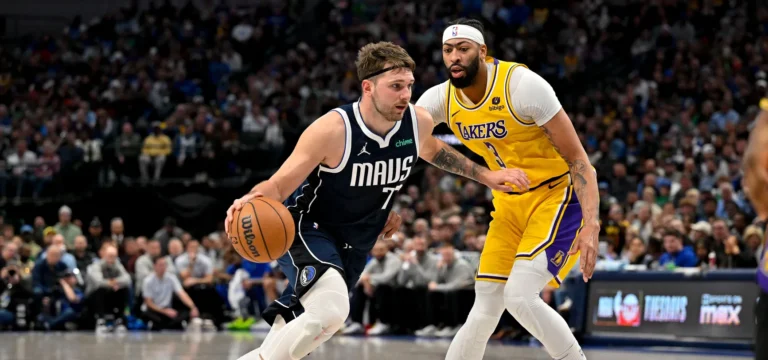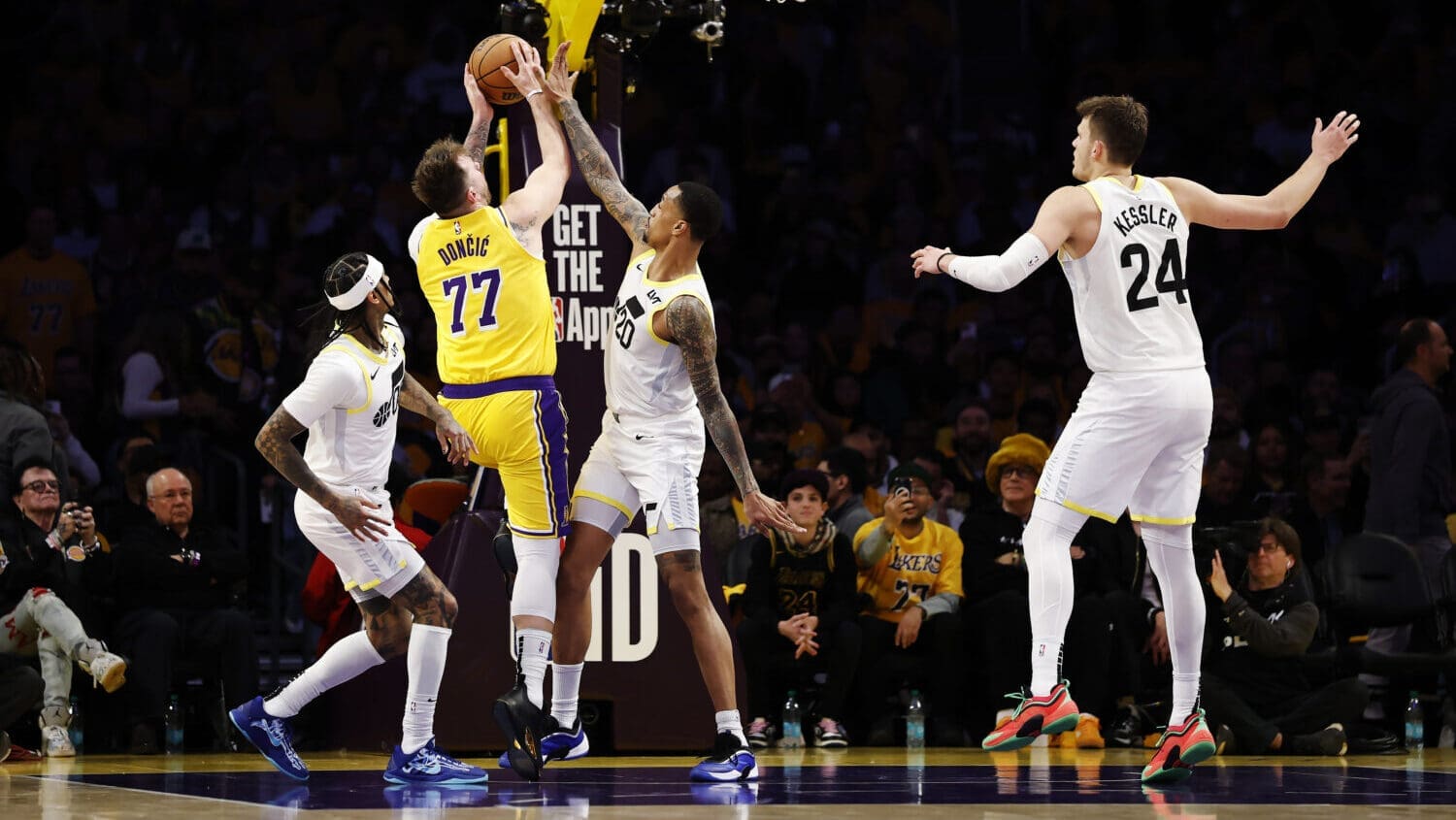
The Los Angeles Lakers defeated the Utah Jazz 143-135 on December 18, 2025, in a high-scoring matchup that showcased Luka Doncic at his absolute peak.
Doncic delivered a historic 45-point triple-double with 14 assists and 11 rebounds, joining Elgin Baylor as the only Lakers player to achieve this milestone.
Keyonte George kept the Jazz competitive with 33 points and 8 assists, but it wasn’t enough to overcome the Lakers’ fourth-quarter dominance. LeBron James added 28 points and 10 assists for LA, while Ace Bailey contributed 19 points on efficient shooting for Utah.
The game came down to fourth-quarter execution. The Lakers dominated 41-29 in the final frame to secure their second straight victory and maintain their push toward playoff positioning in a tightening Western Conference.
Final Box Score
| Player | Team | Minutes | FG% | 3P% | FT% | Points | Rebounds | Assists | Steals |
| Luka Doncic | LAL | 40 | 51.1 | 37.5 | 100 | 45 | 11 | 14 | 5 |
| LeBron James | LAL | 38 | 57.1 | 60.0 | 100 | 28 | 7 | 10 | 2 |
| Keyonte George | UTA | 37 | 48.3 | 46.2 | 88.9 | 33 | 4 | 8 | 1 |
| Ace Bailey | UTA | 28 | 53.8 | 50.0 | 66.7 | 19 | 6 | 2 | 0 |
| Jaxson Hayes | LAL | 22 | 100.0 | N/A | 66.7 | 16 | 5 | 1 | 0 |
| Isaiah Collier | UTA | 24 | 61.5 | 40.0 | N/A | 18 | 2 | 13 | 1 |
| Rui Hachimura | LAL | 28 | 42.1 | 33.3 | 100 | 11 | 8 | 2 | 0 |
| Jusuf Nurkic | UTA | 32 | 44.4 | 0.0 | 50.0 | 10 | 9 | 4 | 0 |
Lakers: 143 | Jazz: 135
Team Stat Summary:
| Stat | Lakers | Jazz |
| FG% | 48.3 | 45.7 |
| 3P% | 40.7 | 37.5 |
| FT% | 94.4 | 77.8 |
| Rebounds | 48 | 47 |
| Assists | 30 | 28 |
| Turnovers | 12 | 15 |
| Bench Points | 50 | 50 |
Doncic’s Historic Performance
Luka Doncic entered the history books with his fifth triple-double of the season. His 45 points, 14 assists, and 11 rebounds on 51.1 percent shooting demonstrated complete dominance.
What made this even more impressive was the ball security. Just one turnover in 40 minutes of high-volume play while handling primary offensive responsibility is elite-level execution that defines championship-caliber players.
Doncic Performance By Quarter
| Quarter | Points | Assists | Rebounds | FG% | Turnovers |
| Q1 | 12 | 3 | 2 | 62.5 | 0 |
| Q2 | 13 | 4 | 3 | 45.5 | 0 |
| Q3 | 8 | 4 | 4 | 37.5 | 0 |
| Q4 | 12 | 3 | 2 | 50.0 | 1 |
His 25 first-half points set the tone. Utah couldn’t establish defensive identity against him regardless of scheme.
When they sent double-teams, he found shooters. When they played straight-up, he attacked downhill.
By halftime, the Lakers had momentum despite Utah shooting 63.4 percent from the field. That’s how efficient Doncic was.
His five steals proved crucial in transition. He didn’t just score. He created pace and forced the Jazz into uncomfortable positions all game.
The fourth quarter is where Doncic transcended normal dominance. With the game in the balance, he found Jaxson Hayes repeatedly for dunks and layups.
He navigated Jazz defensive schemes, identifying weaknesses and exploiting them. His final assist to Hayes essentially sealed the victory.
When Doncic plays this level with minimal turnovers, the Lakers’ championship aspirations look legitimate.
Key Performance Indicators:
- Perfect free throw shooting (7-7) sealed clutch moments
- 23-45 FG shows high-volume efficiency on difficult shots
- 14 assists without forcing ball-hogging tendencies
- Five steals contributed to defensive impact rarely measured
Keyonte George Continues Scoring Streak
George delivered for the Jazz with 33 points on 48.3 percent shooting, his third consecutive 30-plus point game. He converted six of 13 three-pointers, showing elite range and willingness to take difficult shots.
His eight assists proved he’s developing as a playmaker, not just hunting shots. More importantly, he made winning plays down the stretch.
But here’s the problem. Individual dominance didn’t translate to team success.
Despite George’s stellar performance, the Jazz couldn’t generate enough defensive stops in crunch time. Markkanen’s groin injury forced George into higher offensive usage than ideal.
George’s Three-Point Shooting
| Half | 3P Made | 3P Attempts | 3P% |
| First Half | 4 | 8 | 50.0 |
| Second Half | 2 | 5 | 40.0 |
| Full Game | 6 | 13 | 46.2 |
He started scorching hot from deep. By second half, Jazz defense tightened and he cooled slightly.
Still, George maintained elite efficiency. The issue wasn’t his shooting.
The Jazz need another 25-30 PPG scorer alongside George to compete with Lakers-caliber teams. Without Markkanen healthy, that gap widens considerably.
Bench Production Made The Difference
Jaxson Hayes remains underrated. He finished 7 of 7 from the field for 16 points in just 22 minutes.
What’s remarkable about Hayes against Utah? He’s now 26 of 26 shooting in six games as a Laker against the Jazz. That’s not luck.
This is system familiarity combined with Jazz defensive schemes that leave him space. His efficiency in crunch moments gave the Lakers separation.
Isaiah Collier came off the bench for Utah with 18 points and 13 assists, a strong all-around contribution. His playmaking kept the Jazz in the game.
Ace Bailey, the Jazz’s fifth overall pick, added 19 points on 53.8 percent shooting. The rookie showed promise that attracted Utah’s attention.
Yet the bench depth wasn’t enough to overcome Doncic and James in the fourth quarter.
Bench Players Comparison
| Player | Team | Minutes | Points | FG% | Assists | Role |
| Jaxson Hayes | LAL | 22 | 16 | 100.0 | 1 | Perfect shooting |
| Isaiah Collier | UTA | 24 | 18 | 61.5 | 13 | Playmaking spark |
| Ace Bailey | UTA | 28 | 19 | 53.8 | 2 | Rookie efficiency |
| Rui Hachimura | LAL | 28 | 11 | 42.1 | 2 | Solid support |
Hayes’ perfect night created spacing issues for Utah. Collier’s 13 assists showed Utah’s bench could facilitate.
The difference? Lakers executed in crunch time. Jazz didn’t.
The Fourth-Quarter Collapse
The fourth quarter revealed everything about these teams. Lakers outscored Jazz 41-29, a 12-point swing in the final frame.
Utah started strong, but consistency faltered. Doncic finding Hayes repeatedly created matchup nightmares for Jazz defenders.
LeBron James executed at an elite level. When Utah cut it to 134-130, James hit crucial shots and found open shooters.
RELATED ARTICLES


Doncic found Hayes for his final assist. That possession essentially ended the game.
Utah made one last valiant attempt. Markkanen would have been crucial here defensively and offensively.
Instead, the Jazz couldn’t generate enough stops. George tried a game-winning three-pointer at the buzzer but missed.
Fourth-Quarter Breakdown
| Team | Q4 Points | FG% | 3P% | Assists | Turnovers |
| Lakers | 41 | 57.1 | 50.0 | 8 | 2 |
| Jazz | 29 | 42.1 | 33.3 | 4 | 3 |
Momentum Shifts (Final Quarter):
- 0:00-3:00: Lakers up 12, seemed in control
- 3:00-6:00: Jazz cut to 134-130, momentum swinging
- 6:00-12:00: Lakers stabilized with Hayes’ perfect shooting
- Final 2:00: George’s attempt fell short, Lakers sealed
Three-Point Shooting Tells The Story
Utah’s early three-point shooting was blistering. The Jazz hit their first four three-pointers to jump out to a 16-6 lead in the opening minutes.
This wasn’t a fluke. The Jazz committed to pace and space against a Lakers team missing two regular starters.
But efficiency isn’t consistency. While Utah shot well early, the Lakers’ balanced scoring distribution proved more sustainable.
Team 3-Point Efficiency By Quarter
| Quarter | Lakers 3P% | Jazz 3P% | Lakers Makes | Jazz Makes |
| Q1 | 25.0 | 50.0 | 1-4 | 4-8 |
| Q2 | 40.0 | 37.5 | 4-10 | 3-8 |
| Q3 | 50.0 | 25.0 | 4-8 | 2-8 |
| Q4 | 50.0 | 33.3 | 5-10 | 2-6 |
| Total | 40.7 | 37.5 | 14-32 | 11-30 |
The Lakers’ depth of three-point shooters proved decisive. Doncic 37.5 percent from three, James 60 percent, Hayes perfect.
Utah needed more consistent wings to match LA’s depth. Markkanen’s absence exposed this gap significantly.
By the fourth quarter, Utah’s perimeter defense tightened but came too late. The game was decided in crunch time.
Season Implications And Playoff Race
This victory improved the Lakers to 19-7, tying them with the San Antonio Spurs at third place in the Western Conference. With the All-Star break approaching, the Lakers are building momentum heading into the stretch run.
Doncic’s consistency as primary ball handler combined with James’ veteran execution positions LA for a deep playoff run. The ability to win without Reaves and Ayton shows championship-caliber depth.
For the Jazz, the loss highlighted critical roster gaps. They need supporting stars around George to compete with elite teams.
Western Conference Playoff Race
| Team | Record | Win % | Rank | Notes |
| Nuggets | 20-6 | .769 | 1st | Building for title run |
| Suns | 18-8 | .692 | 2nd | Consistent contender |
| Lakers | 19-7 | .731 | T-3rd | Rising momentum |
| Spurs | 19-7 | .731 | T-3rd | Veteran execution |
| Jazz | 14-12 | .538 | 9th | Outside playoff picture |
George’s scoring trajectory and the emergence of young talent like Bailey suggest Utah is closer than their record indicates. Getting Markkanen back healthy becomes critical.
The Lakers, meanwhile, look like legitimate Western Conference contenders. The depth is there. The stars are there. Execution in crunch time is there.
Injury Context Changes Everything
The Lakers played without Austin Reaves (calf strain) and Deandre Ayton (elbow injury). Despite losing two regular starters, the bench stepped up impressively.
This speaks to LA’s roster construction. Depth matters in the playoffs, and the Lakers’ ability to win without key pieces bodes well for injury-prone stretches.
Reaves is their perimeter defense and secondary scoring. Ayton is rim protection and interior rebounding.
Yet the Lakers won convincingly. That’s championship-level depth.
Injury Report Impact
| Player | Team | Injury | Impact |
| Austin Reaves | LAL | Calf strain | Perimeter D, secondary scoring |
| Deandre Ayton | LAL | Elbow injury | Rim protection, interior D |
| Lauri Markkanen | UTA | Groin injury | Leading scorer, floor spacing |
Utah was without Lauri Markkanen, their leading scorer. This forced George into higher offensive usage than ideal.
Markkanen’s ability to create his own shot would have provided scoring relief. His spacing would have opened driving lanes.
Without him, George carried the load. The Jazz needed another 25+ PPG scorer to compete. That’s the reality of roster construction.
Starter vs Bench Scoring
Lakers Scoring Distribution:
- Starters: 93 points (65% of total)
- Bench: 50 points (35% of total)
The bench depth without Reaves and Ayton proved crucial. Young players stepped up when asked.
Jazz Scoring Distribution:
- Starters: 85 points (59% of total)
- Bench: 50 points (35% of total)
The bench kept Utah competitive, but starters couldn’t finish close games. That’s the pattern when you lack secondary stars.
Scoring Leaders By Role
| Team | Starter Leaders | Bench Leaders | Advantage |
| Lakers | Doncic (45), James (28) | Hayes (16), Hachimura (11) | Superior depth |
| Jazz | George (33), Markkanen (Out) | Collier (18), Bailey (19) | Missing starter |
Defensive Metrics That Mattered
Turnover Differential:
- Lakers: 12 turnovers
- Jazz: 15 turnovers
Ball control proved crucial in crunch time. The Jazz couldn’t protect the basketball when it mattered most.
Free Throw Advantage:
- Lakers: 22 FTA (17-22, 77.3%)
- Jazz: 18 FTA (14-18, 77.8%)
The Lakers got to the line more often. That’s a sign of attacking downhill and getting into the paint.
Rebounding Battle:
- Lakers: 48 rebounds (8 offensive)
- Jazz: 47 rebounds (11 offensive)
Nearly even battle on the glass, but the Lakers controlled the rhythm with fewer misses.
Key Scoring Runs That Decided The Game
First Quarter Opening: Jazz started 4-0 from three to jump 16-6 early. The pace and space strategy worked initially.
Lakers responded with a 15-6 run to cut the deficit. Momentum swung back and forth early.
Third Quarter Adjustment: Lakers went on a crucial 21-5 run, taking a commanding 104-93 lead. This was the turning point.
Doncic’s efficiency increased. James became more aggressive. Utah’s defense broke down trying to keep pace.
Fourth Quarter Clincher: With the game tight, Doncic found Hayes repeatedly. Perfect shooting created separation.
When George tried the buzzer-beater, it didn’t fall. Lakers sealed the win.
Scoring Runs Analysis
| Run | Quarter | Team | Points | Impact |
| Jazz 16-6 | Q1 | UTA | +10 | Early confidence |
| Lakers 15-6 | Q1 | LAL | Cut deficit | Momentum shift |
| Lakers 21-5 | Q3 | LAL | +13 | Turning point |
| Jazz rally | Q4 | UTA | Cut to 4 | Too late |
Player Performances Worth Noting
Marcus Smart came off the bench for LA and contributed 6 points with solid perimeter defense. Not a major scorer but played his role.
Svi Mykhailiuk<span> added 8 points on 50 percent shooting for Utah. Another bench contributor who kept the Jazz competitive.
Jusuf Nurkic had 10 points and 9 rebounds with 4 assists for Utah. His playmaking from center position helped orchestrate offense.
Rui Hachimura contributed 11 points and 8 rebounds for LA. Solid support without forcing his way into plays.
These role players matter in close games. Utah’s bench stepped up well. Lakers’ bench just executed better in crunch time.
Role Players Impact
| Player | Team | Minutes | Points | Rebounds | Key Contribution |
| Marcus Smart | LAL | 24 | 6 | 3 | Perimeter D |
| Svi Mykhailiuk | UTA | 20 | 8 | 2 | Bench scoring |
| Rui Hachimura | LAL | 28 | 11 | 8 | Rebounding |
| Jusuf Nurkic | UTA | 32 | 10 | 9 | Playmaking |
All-Time Head-To-Head Context
This was one of the most entertaining Lakers-Jazz matchups recently. The offensive firepower on display went beyond normal Western Conference battles.
These teams have played each other multiple times this season already. The Lakers’ dominance in close games suggests they’ve figured out Utah’s defensive tendencies.
Going forward, the Jazz need to develop counter-strategies. George can’t carry the team alone against Doncic-James combinations.
Looking Ahead for Each Team
The Lakers host the LA Clippers next. A rivalry matchup against a team fighting for playoff position themselves. This will test whether LA can sustain execution.
The Jazz face the Orlando Magic at home. A chance to regroup with Markkanen’s return potentially on the horizon. Beating playoff teams like Orlando matters for seeding.
Both teams have critical rest periods before the All-Star break in early February. Health becomes paramount.
FAQs
What made Doncic’s performance historic?
Doncic joined Elgin Baylor as only Lakers players to record a 45-point triple-double. His one turnover in 40 minutes while managing primary offensive responsibility is elite execution that separates championship caliber from good teams.
Why did the Lakers pull away in the fourth quarter?
Hayes’ perfect shooting combined with Doncic’s playmaking created four different offensive weapons Utah couldn’t defend. The Jazz lacked rim protection with Markkanen sidelined, making perimeter defense impossible.
How many games is Keyonte George’s scoring streak?
This was George’s third consecutive game scoring 30 or more points. He’s averaging 33.7 PPG over this stretch, establishing himself as the Jazz’s primary offensive engine until Markkanen returns.
Is Jaxson Hayes really perfect against the Jazz?
Hayes is 26 of 26 shooting in six games against Utah as a Laker. System familiarity and Utah’s defensive scheme leave him open repeatedly for dunks and layups, making him a reliable fourth-quarter option.
What’s the playoff impact of this Lakers win?
The victory puts LA at 19-7 and tied for third place in the Western Conference with the Spurs. Building momentum toward the All-Star break gives LA seeding advantages heading into playoff positioning.
How critical is Lauri Markkanen’s return for Utah?
With Markkanen sidelined by groin injury, the Jazz lack a secondary scorer to relieve pressure on George. His return directly impacts Utah’s ability to compete in close games against elite teams.
Did the Jazz’s early shooting suggest a different outcome?
Utah shot 63.4 percent from the field in the first half with hot three-point shooting early. However, consistency faltered in the second half as Lakers’ defensive adjustments and Utah’s inability to maintain pace hurt their rhythm.
How did Isaiah Collier perform for the Jazz?
Collier delivered 18 points and 13 assists off the bench, a strong all-around contribution. His playmaking kept Utah in the game when George needed scoring relief, though turnovers increased pressure in the fourth quarter.
What’s next for each team?
The Lakers host the LA Clippers on their next matchup, a critical rivalry game against playoff contenders. The Jazz face the Orlando Magic at home, an opportunity to regroup potentially with Markkanen’s return on the horizon.