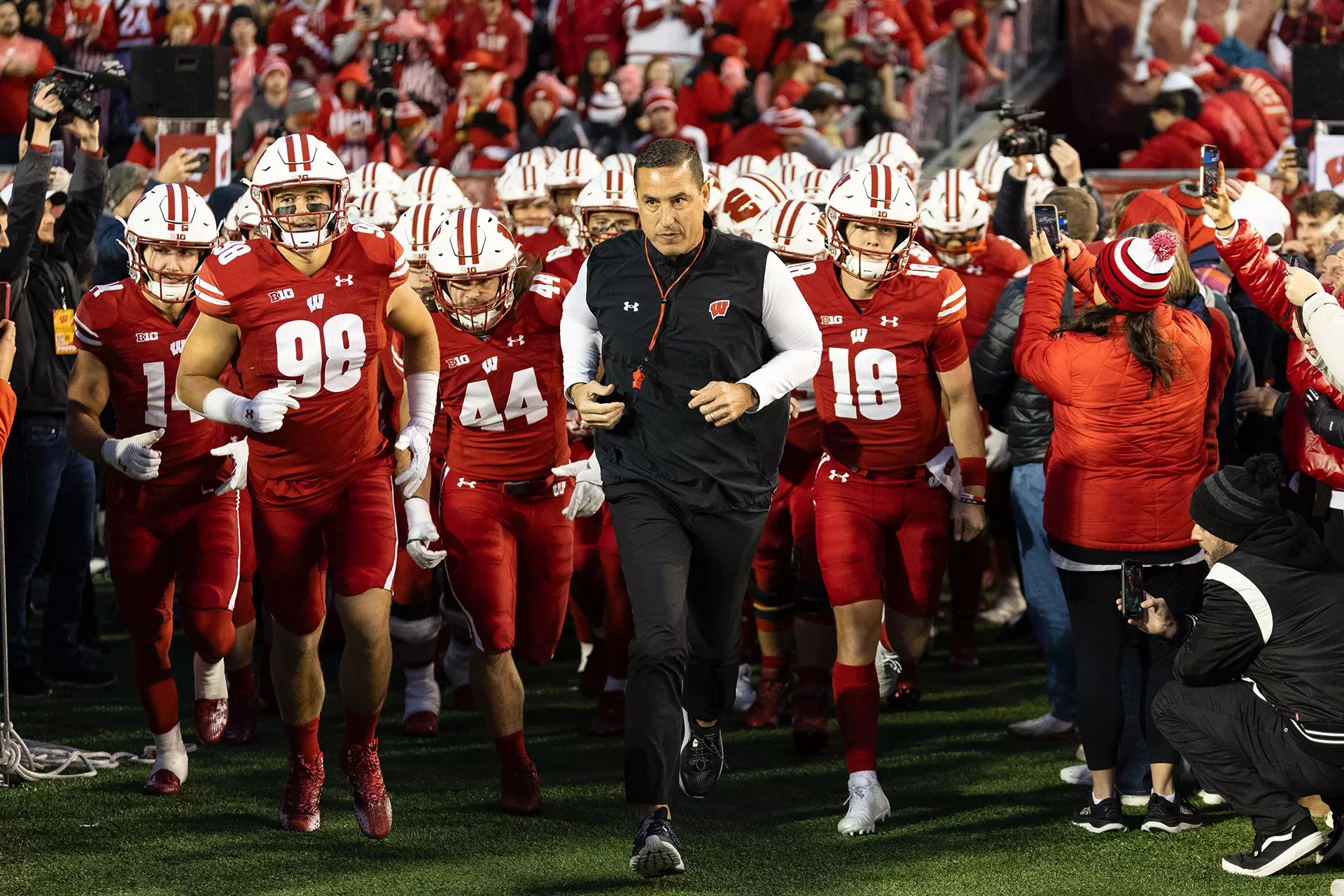
Wisconsin Badgers football salaries reflect program crisis despite massive investment. Luke Fickell earns $7.7 million for 2025, ranking 18th nationally amid consecutive losing seasons.
The Badgers posted 5-7 in 2024 and started 2-5 in 2025, breaking a 22-year bowl streak. Wisconsin’s Varsity Collective paid $1.7 million to athletes in its first year. Fickell’s $25+ million buyout creates job security despite fan frustration.
Discover the Wisconsin Badgers players biography and net worth by clicking on their name.

| Quarterbacks (QB) | Running Backs (RB) | Wide Receivers (WR) |
| Billy Edwards Jr. | Mason Lane | Mabrey Mettauer |
| Braedyn Locke | Joseph Griffin Jr. | C.J. Williams |
| Danny O’Neil | Tyrell Henry | Cole LaCrue |
| Eugene Hilton Jr. | Carter Smith | |
| Trech Kekahuna | Zach Gloudeman | |
| Vinny Anthony II |
Top 10 Highest Paid Wisconsin Football Staff 2024-2025
Wisconsin’s coaching staff salaries total approximately $13.7 million representing measured Big Ten investment. Jeff Grimes replaced fired Phil Longo as offensive coordinator earning estimated $1.2 million.
Mike Tressel received $100,000 raise to $900,000 as defensive coordinator with $200,000 bonus potential.
| Rank | Name | Position | Annual Salary | Contract Status | Notes |
| 1 | Luke Fickell | Head Coach | $7,700,000 | Through 2032 | $100k annual increases |
| 2 | Jeff Grimes | Offensive Coordinator | $1,200,000 | Through 2026 | Hired January 2025 |
| 3 | Mike Tressel | Defensive Coordinator | $900,000 | Through 2026 | $100k raise, bonus potential |
| 4 | A.J. Blazek | Offensive Line | $650,000 | Through 2025 | Retained from staff |
| 5 | Matt Mitchell | OLB/Special Teams | $421,280 | Through 2025 | $50k raise received |
| 6 | Paul Haynes | Cornerbacks | $475,000 | Through 2025 | Fickell hire |
| 7 | Kenny Guiton | Quarterbacks | $433,500 | Through 2025 | Moved from WRs |
| 8 | Nate Letton | Tight Ends | $357,000 | Through 2025 | Cincinnati connection |
| 9 | Jack Cooper | Safeties | $325,000 | Through 2025 | Promoted internally |
| 10 | Jordan Reid | Wide Receivers | $300,000 | Through 2025 | New hire |
Jeff Grimes replaced Phil Longo after Longo’s November 2024 firing with two games remaining. Grimes’ estimated $1.2 million salary reflects Wisconsin’s commitment to offensive improvement. Longo’s Air Raid system failed to produce results in Madison.
Mike Tressel earned $100,000 raise bringing salary to $900,000 plus performance bonuses up to $200,000 based on defensive metrics. His extension through 2026 provides continuity as Wisconsin seeks Big Ten competitiveness.
Wisconsin’s assistant pool reaches approximately $6 million. Combined with Fickell’s $7.7 million, total staff compensation of $13.7 million ranks 10th-12th in Big Ten. This reflects fiscal restraint compared to Ohio State ($24.3M) and Michigan ($22.1M).
How Much Does Luke Fickell Make at Wisconsin?
Luke Fickell earns $7.7 million base salary for 2025 ranking 18th-21st nationally according to coaching salary surveys. His contract includes automatic $100,000 annual increases reaching approximately $8.3 million by 2032 through extended deal approved February 2025.
Fickell’s original seven-year contract extended two years through March 31, 2032. Extension didn’t impact buyout structure. He receives $3 million direct university salary with remaining $4.7 million paid by UW Foundation through additional compensation agreements.
Bonus structure allows maximum $1.45 million additional earnings. Includes $350,000 for Big Ten Championship victory, $200,000 for College Football Playoff qualification, $400,000 for CFP semifinals, $500,000 for national championship victory. These remain theoretical given current struggles.
Buyout structure creates massive financial protection. If fired after 2025 season, Wisconsin owes approximately $25.4 million equating to $334,736 monthly payments through March 2032.
Represents one of college football’s largest potential buyouts providing job security despite consecutive losing seasons.
Wisconsin Football Program Financial Overview
Wisconsin athletics operates budget exceeding $170 million annually. Football serves as primary revenue driver alongside men’s basketball. Program reported record expenses of $170.9 million in 2024-25 budget while navigating increased Big Ten competition.
Big Ten media rights distribute full conference shares to Wisconsin as original member. Projected 18% increase in 2024-25 with nearly $11 million more than previous budget. Distributions from Big Ten Championship and basketball tournament decrease as revenue splits among 18 conference members.
Football ticket sales generated $24.08 million in fiscal 2024 ranking among Big Ten’s middle tier. Camp Randall Stadium’s 80,321 capacity produces consistent revenue despite smaller venue than conference powerhouses Michigan ($50.3M), Ohio State ($47.9M), Penn State ($44.5M).
Athletic department projected using $28 million gift funds for 2024-25 operations. Additional $27.5 million donor funds allocated for capital projects. Ticket sales across sports projected at $35.4 million representing 6% increase attributed to higher football pricing.
Wisconsin faces significant financial pressures including revenue-sharing requirements starting 2025. Potentially adds $20+ million annual costs while maintaining competitive coaching salaries and facility investments in expensive Big Ten landscape.
Wisconsin NIL Programs & The Varsity Collective
Wisconsin operates The Varsity Collective as primary alumni-driven collective paying athletes $1.7 million in inaugural year.
Focuses on equitable distribution across all sports and genders rather than concentrating funds on football stars. Contrasts with Oregon’s $23 million Division Street collective.
Badger Athlete Partners launched December 2025 partnering with Learfield to expand athlete marketing opportunities.
Athletic Director Chris McIntosh emphasized expansion as critical for transfer portal competitiveness and recruiting retention. Creates enhanced infrastructure for brand partnerships.
Corporate programs include Exact Sciences Athletes featuring 12 student-athletes with career coaching, community engagement, health advocacy opportunities. Structured programs reflect Wisconsin’s emphasis on educational value alongside financial compensation.
Sixth Man Society supports men’s basketball NIL efforts with donor tiers ranging $25,000 to $100,000 annually.
Offers benefits including coach access, practice viewing, exclusive events. Wisconsin’s overall NIL funding significantly trails Big Ten leaders creating recruitment challenges.
Wisconsin Assistant Coaches Salaries
Mike Tressel’s $900,000 defensive coordinator salary after $100,000 raise reflects investment in defensive stability amid program struggles.
Performance bonuses up to $200,000 depend on defensive metrics providing incentive structure for Big Ten competitiveness.
Jeff Grimes earns estimated $1.2 million as offensive coordinator replacing fired Phil Longo. Represents Wisconsin’s commitment to offensive transformation following disappointing results under Longo’s system. Exact salary details remain undisclosed per conservative disclosure practices.
Position coaches earn $300,000-$650,000 annually with A.J. Blazek’s $650,000 offensive line salary leading assistant positions. Wisconsin’s emphasis on line development historically produced NFL talent justifying continued investment despite current struggles requiring comprehensive roster improvement.
Assistant salary pool totaling approximately $6 million represents measured spending compared to Big Ten leaders. Matt Mitchell received $50,000 raise as outside linebackers coach and special teams coordinator.
Newer hires like Jordan Reid ($300,000) and Jack Cooper ($325,000) reflect market-rate positioning.
Wisconsin vs Ohio State Financial Reality
Luke Fickell’s $7.7 million salary trails Ryan Day’s $12.5 million by $4.8 million reflecting performance gaps beyond market differences.
Day maintains championship expectations while Fickell faces program crisis with consecutive losing seasons and massive buyout protection creating uncomfortable dynamics.
Coordinator spending heavily favors Ohio State. Jim Knowles ($2.2M) and Brian Hartline ($2M) combined $4.2 million nearly triples Wisconsin’s coordinators at roughly $2.1 million. Demonstrates resource disparity affecting recruiting and retention in competitive landscape.
NIL spending shows substantial disadvantage. Ohio State’s estimated $20+ million collective budget dwarfs Wisconsin’s modest efforts.
Varsity Collective paying just $1.7 million to all athletes creates recruiting challenges as Wisconsin competes with financial disadvantages and program struggles.
Program Crisis and Financial Misalignment
Wisconsin’s financial commitments appear misaligned with results. Fickell’s $25+ million buyout protects coach presiding over program’s worst stretch in two decades. Assistant salaries remain competitive despite underwhelming performance metrics.
5-7 record in 2024 followed by 2-5 start in 2025 represents first back-to-back losing seasons since 2001. Ended 22-year bowl streak raising questions about return on investment for coaching expenditures exceeding $13 million annually.
Wisconsin athletics faces difficult decisions balancing fiscal responsibility with competitive necessity.
Revenue sharing requirements adding $20+ million annually combined with coaching commitments and facility needs create budget pressures amid declining fan confidence and donor frustration.
FAQs
How much does Luke Fickell make?
Luke Fickell earns $7.7 million base salary for 2025 with automatic $100,000 annual increases through 2032, ranking 18th-21st nationally. His massive buyout exceeding $25 million provides job security despite consecutive losing seasons.
How much NIL money do Wisconsin players get?
Wisconsin’s The Varsity Collective paid $1.7 million to athletes in its first year, focusing on equitable distribution across all sports. The new Badger Athlete Partners program launched December 2025 aims to expand opportunities but operates with modest funding compared to Big Ten leaders.
What is Mike Tressel’s salary?
Mike Tressel earns $900,000 as Wisconsin’s defensive coordinator after receiving a $100,000 raise, plus performance bonuses up to $200,000 based on defensive metrics. His extension through 2026 provides stability as Wisconsin seeks defensive improvement.
How much does Wisconsin athletics make?
Wisconsin athletics operates on budget exceeding $170 million with football ticket sales generating $24.08 million in fiscal 2024. The program faces new financial pressures from revenue sharing requirements potentially adding $20+ million in annual athlete payments starting 2025.
Why is Wisconsin struggling despite high coaching salaries?
Wisconsin’s $13.7 million coaching investment hasn’t prevented consecutive losing seasons. Program faces recruiting disadvantages due to modest NIL funding compared to conference competitors while dealing with transfer portal challenges and performance issues that don’t justify financial commitment to coaching staff.