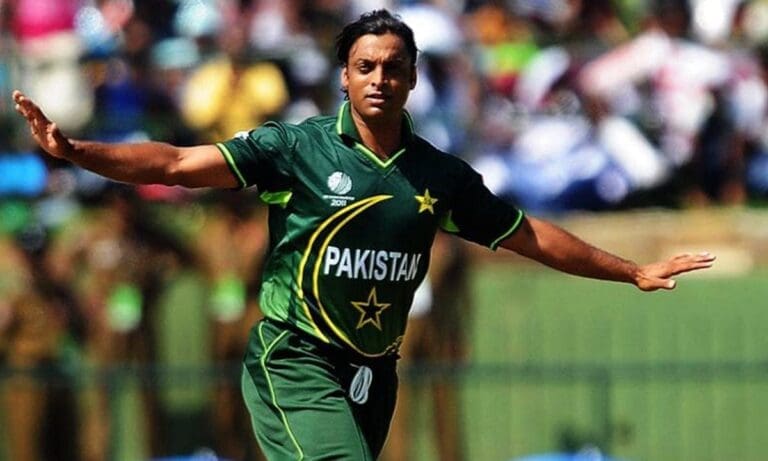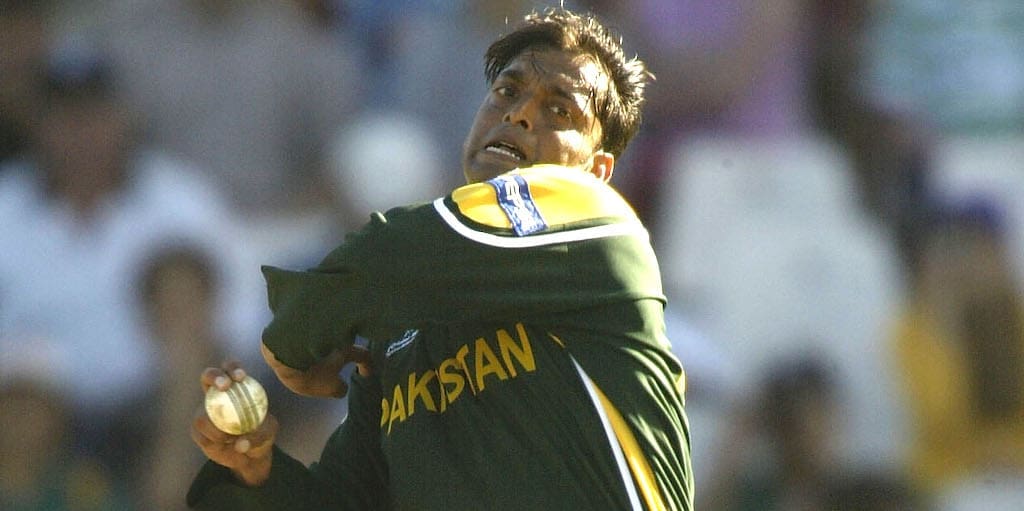
The fastest ball in cricket history remains one of sport’s most iconic records. On March 22, 2003, during the ICC World Cup in South Africa, Shoaib Akhtar from Pakistan hurled a cricket ball at 161.3 km/h (100.23 mph) against England. More than two decades later, this thunderbolt stands as the undisputed speed record in cricket.
What makes this record even more remarkable is its consistency across time. Despite advancements in sports science, training methods, and athlete conditioning, no bowler has come close to surpassing Akhtar’s mark.
Only two bowlers have matched the 100 mph barrier: Brett Lee (161.1 km/h in 2005) and Shaun Tait (161.1 km/h in 2010), both just 0.2 km/h short of Akhtar’s ultimate achievement.
The Unbreakable Record: Shoaib Akhtar’s 161.3 km/h
Shoaib Akhtar, the Rawalpindi Express, wasn’t just fast once. He regularly sustained 158-160 km/h across entire spells from 1997 to 2011, making him one of cricket’s fastest bowlers.
The measurement used modern radar technology, making it officially verified and indisputable, unlike estimated speeds from earlier eras.
Akhtar’s career showcased sustained excellence at an extreme pace. He accumulated 178 Test wickets at an average of 24.44 and 247 ODI wickets across multiple World Cups.
What set him apart was consistency, aggression, and an intimidating presence that made batsmen uncomfortable every time he arrived at the crease.
Why the Record Still Stands After 22 Years
Despite superior training and sports science, Akhtar’s 2003 mark remains untouched. Modern bowlers prioritize longevity over records. Mitchell Starc bowls 145-152 km/h sustainably across 15+ years rather than chasing extremes.
Genetics determine speed limits: shoulder structure, rotator cuff mobility, and muscle composition can’t be trained beyond natural ceilings. Researchers suggest 161+ km/h represents the human arm’s upper velocity limit in cricket.
Top Fastest Balls Ever Recorded in Cricket
| Rank | Bowler | Country | Speed (km/h) | Speed (mph) | Year |
| 1 | Shoaib Akhtar | Pakistan | 161.3 | 100.23 | 2003 |
| 2 | Brett Lee | Australia | 161.1 | 100.1 | 2005 |
| 3 | Shaun Tait | Australia | 161.1 | 100.1 | 2010 |
| 4 | Mitchell Starc | Australia | 160.4 | 99.57 | 2015 |
| 5 | Jeff Thomson | Australia | 160.6 | 99.83 | 1975 |
| 6 | Andy Roberts | West Indies | 159.5 | 99.12 | 1975 |
| 7 | Fidel Edwards | West Indies | 157.7 | 97.94 | 2003 |
| 8 | Mitchell Johnson | Australia | 156.8 | 97.49 | 2013 |
Modern Fastest Bowlers: Who’s Closest Today?
Mitchell Starc holds the fastest active bowler record at 160.4 km/h recorded during a Test match against New Zealand in 2015.
At 35, he maintains 145-152 km/h sustainably while accumulating 400+ Test wickets. This balance between speed and longevity defines modern pace bowling philosophy.
Mark Wood (England) consistently bowls 150+ km/h (93+ mph) in Test cricket with steep bounce that troubles world-class batsmen. His high arm action and athletic build make him the fastest currently active Test bowler, regularly tested against top-ranked teams.
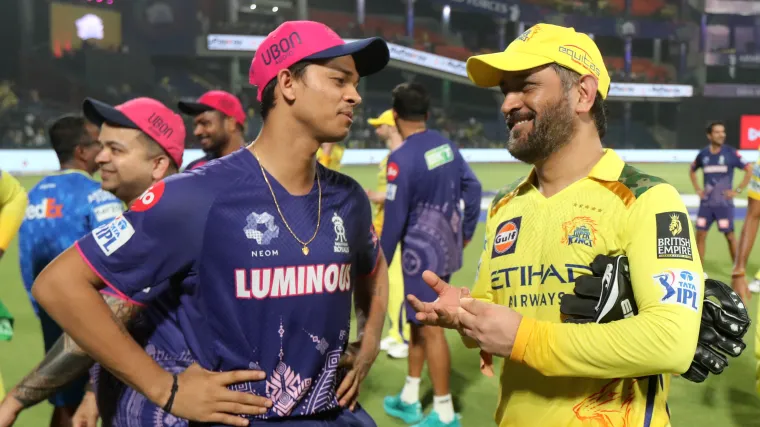
Mayank Yadav (India) represents the future. At just 21 years old, he clocked IPL 2024’s fastest delivery at 150+ km/h. His raw pace, combined with competitive exposure in T20 leagues, makes him the most realistic threat to modern records.
If he develops the consistency and injury resilience that sustained Akhtar, he could challenge existing benchmarks within the next decade.
The Science Behind Extreme Pace
Bowling at 160+ km/h requires four key elements:
- Body Frame – Taller bowlers like Starc (1.96m) gain mechanical advantage through longer arm extension and greater rotational power. Height isn’t everything, but it helps.
- Core Strength – Explosive hip rotation and abdominal conditioning generate the majority of velocity. Modern bowlers undergo specialized training to maximize rotational power from the ground up.
- Pain Tolerance – Extreme pace bowling injures the shoulder, elbow, and knee. Akhtar played through stress fractures and shoulder problems, demonstrating uncommon dedication to maintaining pace despite injury.
- Technical Precision – Bowling action matters significantly. Unique releases and body angles (like Lasith Malinga’s slinging action) sometimes generate surprising pace despite shorter run-ups or unconventional mechanics.
Can Shoaib Akhtar’s Record Ever Be Broken?
The short answer: unlikely. While young bowlers like Mayank Yadav show promise, moving from 150 km/h to 161+ km/h is exponential rather than incremental.
Modern cricket’s emphasis on injury prevention, career longevity, and sustainable pace suggests record-chasing may never again be a priority.
Yet cricket has always produced surprises. If an athlete emerges with Akhtar’s obsessive drive for speed, combined with modern training methods and genetic advantages, the record could fall.
Until then, Shoaib Akhtar’s 161.3 km/h remains cricket’s most elusive record, a testament to one man’s extraordinary ability and the limits of human performance.
FAQs
What is the fastest ball ever bowled in cricket?
Shoaib Akhtar’s 161.3 km/h (100.23 mph) delivery against England during the 2003 ICC World Cup is the fastest ball ever recorded in cricket history. This record has stood for over 22 years and remains unbeaten.
Has anyone come close to breaking Shoaib Akhtar’s record?
Only two bowlers have exceeded 100 mph: Brett Lee (161.1 km/h in 2005) and Shaun Tait (161.1 km/h in 2010). Mitchell Starc’s 160.4 km/h in 2015 is the closest in the modern era. All are within 0.2-1 km/h of Akhtar’s record.
Why don’t modern bowlers bowl faster than in 2003?
Modern bowling is limited by human physiology rather than training methods. The human arm, shoulder, and rotator cuff have natural speed limits. Additionally, today’s bowlers prioritize career longevity and sustainable pace over chasing one-off speed records.
Who is the fastest active bowler in 2025?
Mitchell Starc (Australia) is the fastest among currently active international bowlers, maintaining speeds of 145-152 km/h. Mark Wood (England) consistently bowls 150+ km/h in Test cricket. Mayank Yadav (India) represents emerging talent with 150+ km/h regularly clocked in T20 cricket.
Can Mayank Yadav break the fastest ball record?
Mayank Yadav has potential given his young age and current pace. However, increasing from 150 km/h to 161+ km/h requires not just talent but exceptional genetics, consistent training, and injury-free development. Modern cricket’s focus on injury prevention makes record-chasing less likely than in Akhtar’s era.
RELATED ARTICLES