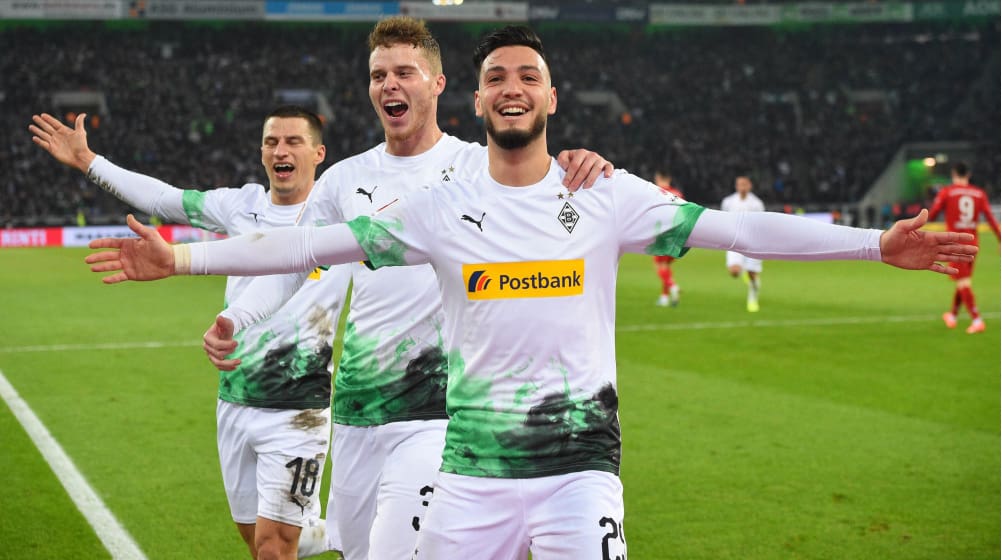
Borussia Mönchengladbach operates on a €51.6 million annual wage bill, approximately €993,000 weekly. This positions them as the 6th highest-paying Bundesliga club.
The club’s wage structure reflects deliberate investment in midfield control and defensive stability rather than expensive attacking showpieces.
Florian Neuhaus commands the highest salary at €4 million annually (€76,923 weekly) following recent contract extensions.
The German midfielder’s competitive wages reflect his central role in the club’s tactical system. His contract security through 2027 signals management confidence in sustained midfield dominance.
Top 10 Highest-Paid Players
| Rank | Player | Position | Weekly | Annual | Contract |
| 1 | Florian Neuhaus | Midfielder | €76.9k | €4.0M | 2027 |
| 2 | Nico Elvedi | Defender | €53.8k | €2.8M | 2026 |
| 3 | Jonas Omlin | Goalkeeper | €50.0k | €2.6M | 2027 |
| 4 | Rocco Reitz | Midfielder | €53.8k | €2.8M | 2027 |
| 5 | Franck Honorat | Winger | €50.0k | €2.6M | 2029 |
| 6 | Tim Kleindienst | Striker | €51.9k | €2.7M | 2027 |
| 7 | Robin Hack | Winger | €51.9k | €2.7M | 2027 |
| 8 | Giovanni Reyna | Midfielder | €51.9k | €2.7M | 2025 |
| 9 | Kevin Stöger | Midfielder | €48.1k | €2.5M | 2026 |
| 10 | Kevin Diks | Defender | €48.1k | €2.5M | 2027 |
Florian Neuhaus’ €4M salary emerged following restructuring that freed wages from departed players including Alassane Plea and Julian Weigl.
Defensively-focused top earners (Elvedi, Omlin) indicate investment priority.
Bundesliga Wage Hierarchy
| Club | Annual Wage Bill | Ranking | Notes |
| Bayern Munich | €264.9M | 1st | 5x Gladbach spending |
| Borussia Dortmund | ~€140M | 2nd | 2.7x Gladbach |
| RB Leipzig | ~€110M | 3rd | 2.1x Gladbach |
| Bayer Leverkusen | ~€90M | 4th | 1.7x Gladbach |
| VfB Stuttgart | ~€65M | 5th | 1.3x Gladbach |
| Gladbach | €51.6M | 6th | Mid-tier spender |
| Eintracht Frankfurt | ~€45M | 7th | Below Gladbach |
| Union Berlin | ~€40M | 8th | Below Gladbach |
Gladbach ranks 6th among 18 Bundesliga clubs. Bayern’s €264.9M wage bill dwarfs all competition.
The gap between 1st and 6th creates mathematical disadvantage requiring exceptional tactical coherence.
Recent Departures and Their Impact
Exiting Players:
- Alassane Plea (€90.7k/week) → PSV Eindhoven
- Julian Weigl (€64k/week) → Borussia Dortmund
- Ko Itakura (€30k/week) → PSV interest
Freed Wages: Approximately €185,000 weekly redirected toward new contracts for core midfielders and defensive reinforcement.
These departures forced strategic reconstruction. Rather than replacing stars with replacements, Gladbach restructured internal wages, elevating Neuhaus and Reitz into premium earner status while maintaining overall spending discipline.
Salary Tiers Explained
| Tier | Range | Players | Count |
| Elite | €50k+ | Neuhaus, Elvedi, Omlin, Reitz, Honorat, Kleindienst, Hack, Reyna | 8 |
| Senior | €35-50k | Stöger, Diks, Netz, Friedrich | 4 |
| Core Squad | €20-35k | Scally, Sippel, Lainer, Tabakovic | 6 |
| Development | <€20k | Academy players, rotation options | 10+ |
The elite tier comprises experienced operators capable of controlling matches independently.
Defensive clustering (Elvedi, Omlin, Friedrich) reflects system philosophy emphasizing stability over star attacking power.
Key Player Profiles
Florian Neuhaus (€76.9k/week)
German midfielder and legitimate star earning top-tier wages. His €4M salary represents investment in homegrown talent retention. Neuhaus provides creative direction from midfield with technical security competitors value.
Nico Elvedi (€53.8k/week)
Swiss defender earning elite wages at defensive position. His €2.8M annual salary reflects critical importance to tactical structure. Elvedi’s composure on the ball enables aggressive pressing without vulnerability.
Jonas Omlin (€50k/week)
First-choice goalkeeper earning €2.6M annually. Swiss international providing shot-stopping reliability. His wages justify consistent performance in maintaining defensive organization.
Rocco Reitz (€53.8k/week)
Emerging midfielder matched with Neuhaus at elite salary tier. His €2.8M annual earnings signal long-term midfield partnership investment. Reitz provides tactical versatility in possession phases.
The 2023-24 Restructuring
Gladbach’s previous wage bill reached €57.75M in 2022-23. Strategic departures reduced total spending while elevating remaining player compensation:
- 2022-23 wage bill: €57.75M
- 2025 wage bill: €51.6M
- Players freed: €6.15M annual capacity
- Redeployed toward: Neuhaus, Reitz premium contracts
This demonstrates strategic contraction creating quality concentration. Fewer highly-paid operators outperformed bloated rosters with overlapping talent.
The adjustment reflects financial discipline without compromising competitive ambition.
Defensive Investment Priority
Gladbach’s wage structure emphasizes defensive solidity:
| Category | Earners | Weekly | Strategy |
| Defenders | Elvedi (€53.8k), Friedrich (€32k), Diks (€48.1k), Netz (€30k) | €164k+ | Experienced backline |
| Goalkeeper | Omlin (€50k), Sippel (€15k) | €65k | First-choice + depth |
| Midfield | Neuhaus (€76.9k), Reitz (€53.8k), Stöger (€48.1k) | €178.8k | Control + creativity |
| Attack | Honorat (€50k), Kleindienst (€51.9k), Hack (€51.9k) | €153.8k | Experience-based |
Defensive wages exceed attacking wages by €11k weekly. This structure generated 43 goals conceded in 34 matches during recent seasons, protecting defensive integrity crucial for cup progression and European qualification.
Contract Stability Timeline
| Expiry | Players | Count | Notes |
| 2025 | Giovanni Reyna, others | 3 | Short-term commitments |
| 2026 | Nico Elvedi, Kevin Stöger, Nico Gaitán | 3 | Senior defensive spine |
| 2027 | Neuhaus, Reitz, Omlin, Honorat, Kleindienst | 5+ | Long-term security |
| 2028+ | Future signings | – | Forward-looking strategy |
Most core earners locked through 2026-2027 provide stability without overcommitting resources. Strategic expiration timing allows 12-18 month renewal flexibility rather than crisis management.
Highest Earners by Position
Attacking Positions:
- Tim Kleindienst (€2.7M) – Clinical finishing, experience-based wages
- Franck Honorat (€2.6M) – Creative outlet, defensive recovery
- Robin Hack (€2.7M) – Flexibility between wing and central positions
Midfield:
- Florian Neuhaus (€4.0M) – System centerpiece
- Rocco Reitz (€2.8M) – Possession control, progressive passing
Defensive Positions:
- Nico Elvedi (€2.8M) – Aerial dominance, ball-playing ability
- Jonas Omlin (€2.6M) – Reflexes and positioning
- Kevin Diks (€2.5M) – Fullback versatility
FAQs
Who is Gladbach’s highest-paid player?
Florian Neuhaus earns €4 million annually (€76,923 weekly) on a deal through 2027.
What’s Gladbach’s total wage bill?
€51.6 million annually, €993,000 weekly. Ranks 6th in Bundesliga, below Bayern, Dortmund, Leipzig, Leverkusen, and Stuttgart.
How many players earn €50k+ weekly?
Eight players in the elite earning tier, representing focused investment in experienced operators.
Why did Gladbach reduce spending from 2022-23?
Strategic departures (Plea, Weigl, Itakura) freed €6.15M in annual wages. Redeployment toward core midfielders (Neuhaus, Reitz) created quality concentration over quantity.
Does Gladbach focus on attack or defense?
Defensive investment slightly exceeds attacking wages. The club prioritizes stability enabling tactical flexibility rather than star-dependent attacking systems.
What happened to Alassane Plea?
The former top earner (€90.7k/week) transferred to PSV Eindhoven, freeing substantial wage capacity for internal restructuring.
Which contracts are set to expire soon?
Giovanni Reyna expires 2025. Most core players (Neuhaus, Reitz, Omlin, Honorat) extend through 2027-2029, providing long-term stability.
How does Gladbach compete against Bayern?
Bayern’s €264.9M wage bill is 5x larger. Gladbach competes through tactical coherence, youth development, and mid-tier precision rather than financial dominance.