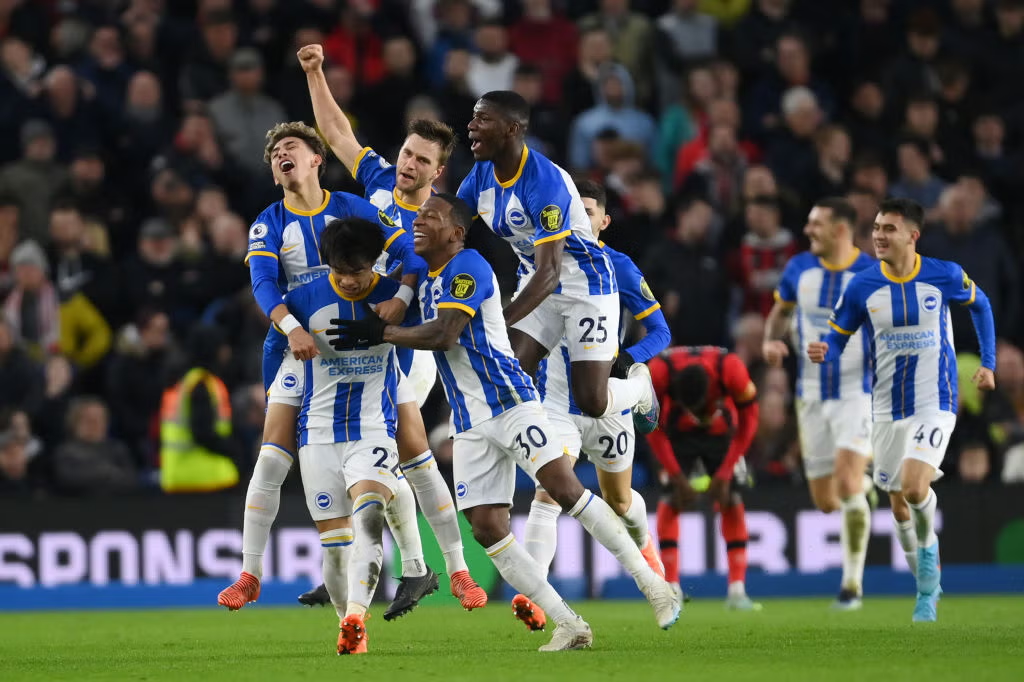
Brighton & Hove Albion maintains a £58.1 million wage bill for 2025-26, positioning them as mid-tier Premier League spenders.
Ferdi Kadıoğlu leads the Seagulls at £87,500 weekly (£4.6 million annually), with club legends Kaoru Mitoma and Lewis Dunk joint-second at £80,000 per week.
The South Coast club employs 26 first-team players with an average salary of £44,700 weekly, below the Premier League average.
Brighton’s disciplined wage structure enables sustainable growth while competing for European qualification under innovative recruitment strategies.
Explore Brighton & Hove Albion stars’ complete career information through their individual player biography and net worth profiles.
| Player Name | Position | Nationality |
| Bart Verbruggen | Goalkeeper | Netherlands |
| Jason Steele | Goalkeeper | England |
| Tom McGill | Goalkeeper | Canada |
| Killian Cahill | Goalkeeper | Ireland |
| Carl Rushworth | Goalkeeper | England |
| Tariq Lamptey | Defender | Ghana |
| Igor Julio | Defender | Brazil |
| Adam Webster | Defender | England |
| Lewis Dunk | Defender | England |
| Eiran Cashin | Defender | Ireland |
| Jan Paul van Hecke | Defender | Netherlands |
| Pervis Estupiñán | Defender | Ecuador |
| Joël Veltman | Defender | Netherlands |
| Jacob Slater | Defender | England |
| Charlie Tasker | Defender | England |
| James Milner | Midfielder | England |
| Solly March | Midfielder | England |
| Brajan Gruda | Midfielder | Germany |
| Carlos Baleba | Midfielder | Cameroon |
| Kaoru Mitoma | Midfielder | Japan |
| Ferdi Kadioglu | Midfielder | Turkey |
| Diego Gómez | Midfielder | Paraguay |
| Yasin Ayari | Midfielder | Sweden |
| Mats Wieffer | Midfielder | Netherlands |
| Matt O’Riley | Midfielder | Denmark |
| Jack Hinshelwood | Midfielder | England |
| Joe Knight | Midfielder | England |
| Jeremy Sarmiento | Midfielder | Ecuador |
| Andrew Moran | Midfielder | Ireland |
| João Pedro | Forward | Brazil |
| Simon Adingra | Forward | Ivory Coast |
| Georginio Rutter | Forward | France |
| Yankuba Minteh | Forward | Gambia |
| Danny Welbeck | Forward | England |
| Harry Howell | Forward | England |
| Tom Watson | Forward | England |
| Mark O’Mahony | Forward | Ireland |
Top 10 Highest-Paid Brighton & Hove Albion Players
Brighton’s wage hierarchy rewards defensive stability and creative wingers. Kadıoğlu’s £4.6 million contract reflects his versatility playing both fullback positions and midfield.
| Player | Position | Weekly Salary | Annual Salary | Contract Until |
| Ferdi Kadıoğlu | Defender | £87,500 | £4.6 million | 2028 |
| Kaoru Mitoma | Winger | £80,000 | £4.2 million | 2027 |
| Lewis Dunk | Defender | £80,000 | £4.2 million | 2026 |
| Georginio Rutter | Forward | £75,000 | £3.9 million | 2028 |
| James Milner | Midfielder | £60,000 | £3.1 million | 2026 |
| Mats Wieffer | Midfielder | £60,000 | £3.1 million | 2029 |
| Danny Welbeck | Forward | £60,000 | £3.1 million | 2026 |
| Olivier Boscagli | Defender | £60,000 | £3.1 million | 2030 |
| Bart Verbruggen | Goalkeeper | £50,000 | £2.6 million | 2028 |
| Jan Paul van Hecke | Defender | £50,000 | £2.6 million | 2027 |
Four players tied at £60,000 weekly create balanced wage distribution.
Milner’s veteran experience justifies his £3.1 million salary despite age 39, providing leadership and mentorship to younger teammates.
Wage Bill and Premier League Comparison
Brighton’s £58.1 million wage bill ranks 10th-12th in the Premier League, significantly below Manchester City (£200M+), Arsenal (£177.9M), and Chelsea (£165M).
The Seagulls spend approximately one-third of what traditional “Big Six” clubs allocate to player wages.
The £44,700 average weekly salary sits below the Premier League’s £86,000 mean. This financial discipline enables Brighton to profit from player sales while maintaining competitive squads through smart recruitment.
Brighton’s wage-to-revenue ratio remains around 50-55%, among the Premier League’s healthiest.
This sustainable approach funds continued investment in facilities, scouting networks, and academy development.
Richest Brighton & Hove Albion Players by Net Worth
Several Brighton squad members accumulated wealth through previous clubs or lengthy Premier League careers.
Most maintain moderate fortunes compared to elite European players.
| Player | Position | Estimated Net Worth | Age | Previous Major Clubs |
| James Milner | Midfielder | $25 million | 39 | Liverpool, Manchester City |
| Danny Welbeck | Forward | $20 million | 34 | Manchester United, Arsenal |
| Kaoru Mitoma | Winger | $15 million | 28 | Brighton (3 seasons) |
| Lewis Dunk | Defender | $12 million | 33 | Brighton (career) |
| Georginio Rutter | Forward | $8 million | 23 | Leeds United, Hoffenheim |
Milner accumulated $25 million through Manchester City (£150,000/week) and Liverpool (£140,000/week) careers spanning 15+ years.
His Brighton contract pays significantly less but extends his Premier League longevity.
Welbeck built $20 million across Manchester United and Arsenal earning £75,000-£100,000 weekly.
His £60,000 Brighton salary represents reduced wages in exchange for regular playing time.
Mitoma’s $15 million came entirely through Brighton contracts and Japanese market endorsements.
His £80,000 weekly wage represents excellent value given his £40+ million market valuation.
Position-Based Salary Analysis
Brighton’s wage allocation emphasizes defensive organization and wing play. The club’s system requires technical defenders capable of initiating attacks from deep positions.
- Defensive Investment: £23.4 million combined (Kadıoğlu, Dunk, Boscagli, Van Hecke, Webster lead)
- Midfield Spending: £12.9 million total (Milner, Wieffer, Baleba highest)
- Forward Wages: £10.1 million combined (Rutter, Welbeck dominate spending)
- Goalkeeping: £3.6 million total (Verbruggen £2.6M, Steele £1M backup)
The defensive-heavy wage structure reflects Brighton’s tactical identity. Seven defenders earn £50,000+ weekly, demonstrating commitment to build-from-the-back philosophy.
Verbruggen’s £50,000 weekly salary represents exceptional value for a 23-year-old first-choice Premier League goalkeeper.
His contract through 2028 provides long-term stability at moderate cost.
Performance Bonuses and Contract Incentives
Brighton structures contracts with achievement-based bonuses adding 15-25% to base salaries.
European qualification bonuses reach £300,000-£700,000 per player when secured.
Premier League survival bonuses pay all first-team players £150,000-£300,000, though Brighton’s consistent mid-table finishes make these automatic. Top-half finish bonuses add £100,000-£250,000 extra.
Goal and assist bonuses reward attackers £30,000-£80,000 per season based on targets. Clean sheet bonuses pay defenders and goalkeepers £20,000-£50,000 for meeting defensive metrics.
Sell-on clause agreements often include future payment provisions for players. When Brighton sells talent for profit, squad members receive modest bonuses (£25,000-£100,000) tied to club financial success.
FAQs
Who is Brighton’s highest-paid player?
Ferdi Kadıoğlu leads Brighton wages at £87,500 weekly (£4.6 million annually). His contract through 2028 reflects his versatility playing multiple positions and Turkish international status.
What is Brighton & Hove Albion’s total wage bill?
Brighton’s 2025-26 wage bill totals £58.1 million, ranking 10th-12th in the Premier League. The squad’s average salary of £44,700 weekly sits below the league’s £86,000 mean.
How much does Kaoru Mitoma earn at Brighton?
Mitoma earns £80,000 weekly (£4.2 million annually) as Brighton’s joint-second highest earner alongside Lewis Dunk. His contract runs through 2027, though extensions are likely given his £40+ million market value.
Why is Brighton’s wage bill so low compared to other Premier League clubs?
Brighton operates a sustainable financial model emphasizing smart recruitment over expensive signings. The club profits from selling developed talent (£200M+ in recent years) while maintaining competitive squads through data-driven scouting.
Do Brighton players receive bonuses for player sales?
Yes, Brighton includes modest profit-sharing clauses in contracts. When the club sells players for substantial profits, squad members receive bonuses ranging from £25,000-£100,000 depending on seniority and the sale amount.