It’s the 70th minute. The score is tied, both teams are beginning to tire, and the manager turns toward the bench. A quick winger starts warming up. Moments later, two players are waiting beside the fourth official.
For fans, it’s a familiar sight. But what looks like a routine substitution can completely transform a soccer match.
When following starting lineups, player availability, and match information on MatchXI.com, it’s easy to focus on the eleven players who begin the game. Yet the substitutes waiting on the sidelines can be just as important to the final result.
Modern soccer substitution rules give coaches more flexibility than ever before. Understanding how these rules work, and why managers make particular changes, can make watching a match considerably more interesting.
How Many Substitutions Are Allowed in Soccer?
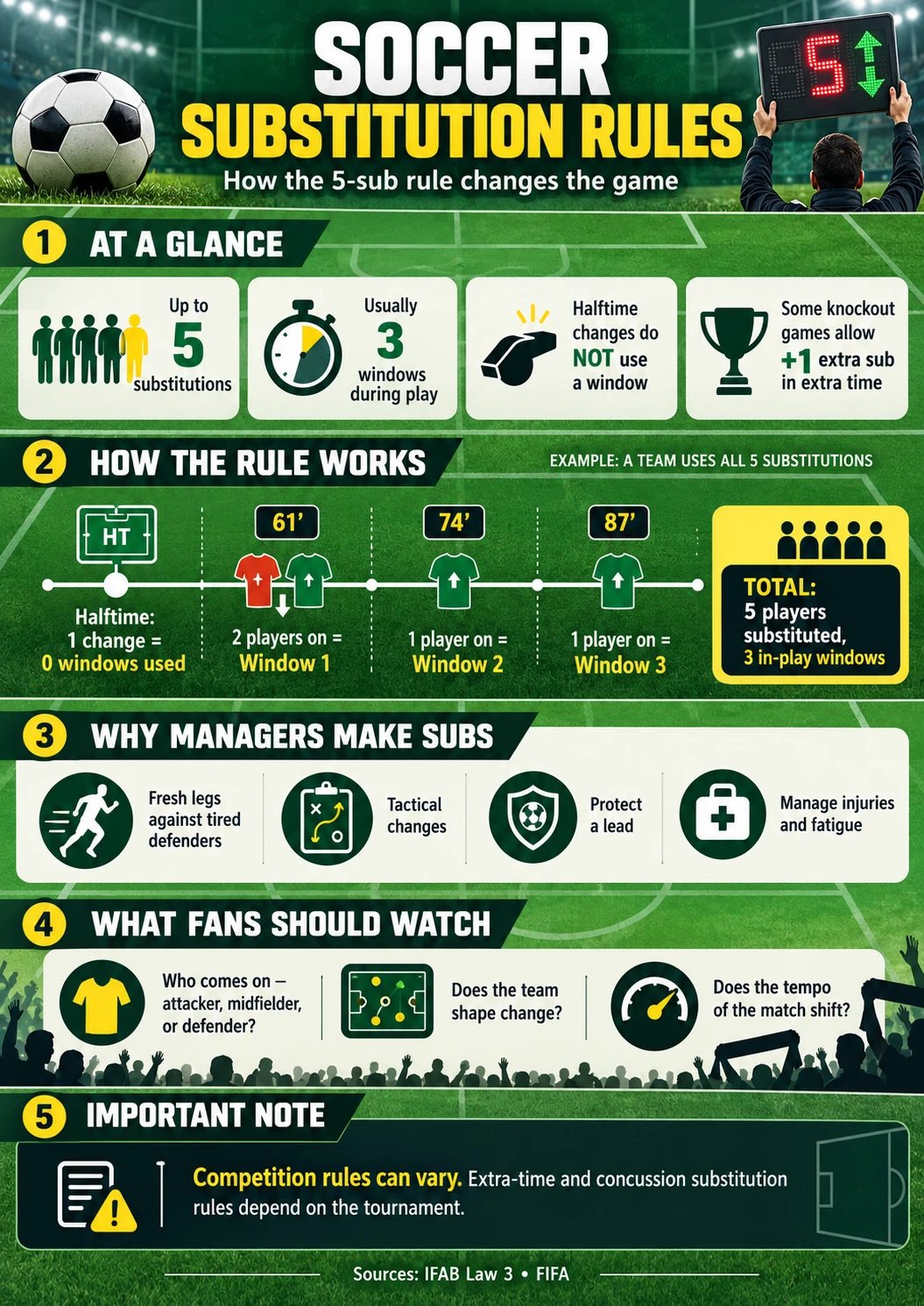
In many top-level professional competitions, teams can make up to five substitutions during a match. When the five-substitute rule applies, teams normally have three opportunities to make changes during playing time, with additional changes permitted at halftime.
This creates an important distinction between the number of players a coach can replace and the number of occasions on which replacements can be made.
For example, a manager cannot necessarily substitute one player at five separate stoppages.
Instead, substitutions must be organized carefully to remain within the permitted opportunities.
The exact rules depend on the competition, but the five-substitute system has become a familiar part of professional football.
The Five-Sub Rule: How Does It Work?
The International Football Association Board (IFAB), which maintains the Laws of the Game, explains the requirements under Law 3.
In competitions applying the standard five-substitute system, the following principles are especially important:
- Teams may use a maximum of five regular substitutions.
- Teams generally have three substitution opportunities during play.
- Multiple players can be replaced during the same stoppage.
- Halftime substitutions do not count toward the three in-play opportunities.
- A substituted player normally cannot return in professional competition.
This means a coach can replace two or three players simultaneously without using multiple substitution windows.
Example: Using All Five Substitutions
Imagine a manager making the following changes during a match:
| Match time | Substitutions made | Opportunities used |
|---|---|---|
| Halftime | 1 | 0 |
| 61st minute | 2 | 1 |
| 74th minute | 1 | 2 |
| 87th minute | 1 | 3 |
| Total | 5 | 3 |
The team has used all five substitutions while remaining within the permitted three in-play opportunities.
This is why managers sometimes make two or three changes together, even if one player appears more tired than the others.
A coach must think about future possibilities, not only immediate problems.
Why Did Soccer Introduce Five Substitutions?
For decades, three substitutions were the standard in major professional competitions.
However, as fixture schedules became increasingly demanding, the need for greater flexibility grew.
The temporary introduction of five substitutions during the COVID-19 period eventually helped establish a new approach to managing player workloads.
According to FIFA’s history of World Cup substitutions, the tournament has seen several important changes:
- In 1970, substitutions were introduced at the men’s World Cup.
- From 1998, teams could make three substitutions.
- In 2018, a fourth substitution became available in extra time.
- In 2022 and 2026, the World Cup permitted five normal-time substitutions, with an additional one in extra time.
These changes reflect how professional soccer has evolved.
Players are expected to cover considerable distances, press opponents repeatedly, and maintain concentration through demanding schedules.
Additional substitutions provide coaches with more opportunities to manage fatigue and reduce the physical burden on players.
But the benefits aren’t limited to fitness.
How Substitutions Can Change a Soccer Match
Sometimes the most important decision a manager makes doesn’t involve the starting lineup.
It comes from recognizing the right moment to introduce a different player.
1. Fresh Legs Against Tired Defenders
Imagine a winger entering a match in the 75th minute.
The opposing full-back has already spent more than an hour sprinting, tackling, and tracking runners.
Suddenly, that defender must deal with an attacker who has fresh legs and the confidence to attempt one-on-one dribbles.
Even if the substitute isn’t the team’s most technically gifted player, the physical advantage can be significant.
Late-game attacking substitutions often aim to exploit exactly this situation.
2. Protecting a Narrow Lead
Not every substitution is designed to score another goal.
Suppose a team leads 1-0 with ten minutes remaining.
The manager might replace an attacking midfielder with a more defensive player, asking the team to become compact and protect the spaces between defenders.
Alternatively, a coach could introduce a fast forward to threaten counterattacks and discourage the opposition from committing too many players forward.
Both approaches can protect a lead, but they require different skills.
3. Responding to an Opponent’s Tactical Changes
Soccer is a game of constant adjustments.
If one team introduces an additional striker, the other might respond by bringing on another defender or a midfielder capable of covering more ground.
Sometimes the manager doesn’t need to change the formation at all.
Replacing a struggling player with someone more comfortable in a particular matchup can be enough.
For example, a physically strong center-back might be introduced to handle an opponent relying on long balls and aerial duels.
4. Managing Injuries and Fatigue
A player who has taken a knock may struggle to perform at full intensity.
Rather than risk further problems, a manager can choose to make a substitution.
Likewise, players returning from injuries may be given limited minutes as they rebuild match fitness.
The availability of additional substitutes makes it easier to manage those situations while maintaining a competitive team.
The starting eleven reveals how a team plans to begin. The substitutions reveal how its manager responds when the original plan needs to change.
Why Do Some Coaches Wait So Long to Make Substitutions?
Fans often become frustrated when their team is struggling, yet the manager seems reluctant to change anything.
Why wait until the 80th minute when an attacker has clearly been ineffective?
The answer isn’t always simple.
Coaches must consider several factors before making a change:
- The current score: A manager protecting a draw may have different priorities from one chasing a victory.
- Available substitutes: The bench may lack a suitable replacement for a particular position.
- Physical condition: Some players are capable of maintaining their intensity longer than others.
- Remaining substitution opportunities: Using the final window too early could create problems if another player becomes injured.
- Upcoming fixtures: A coach may want to protect an important player from unnecessary minutes.
There is also the question of timing.
A substitute needs to understand the pace of the match, establish communication with teammates, and adapt to the opponent’s movements.
Introducing too many players at once can sometimes disrupt a team’s rhythm.
The challenge is finding the right balance between fresh energy and established chemistry.
Can Teams Make Additional Substitutions in Extra Time?
Yes, depending on the competition’s regulations.
Some knockout tournaments allow an additional substitution when a match enters extra time.
Teams may also carry unused substitutions and opportunities from normal time into the additional period.
Consider a team that used four substitutions during regulation.
If the competition permits one extra substitution in extra time, the manager could potentially have two regular substitutions available: the unused normal-time substitution and the additional extra-time substitution.
The exact number of opportunities must also be considered.
For fans, this can explain why a coach preserves certain players on the bench during the closing stages of a knockout match.
A specialist penalty taker, goalkeeper, or attacking player might become particularly valuable if the game continues beyond 90 minutes.
What Happens When a Player Is Substituted?
Most substitutions follow a straightforward procedure.
The coach informs the match officials, the replacement prepares near the halfway line, and the referee authorizes the change at an appropriate stoppage.
The player leaving the field must follow the referee’s instructions and ordinarily exit at the nearest boundary.
Under the IFAB’s updated substitution procedure, players are generally required to leave within ten seconds of the substitution board being displayed or the referee’s signal, except where safety, security, or injury prevents this.
If the requirement is not met, the incoming player may have to wait until a later stoppage before entering.
This is intended to discourage deliberate delays and keep the game moving.
Once the replacement enters, the substitution is complete.
Can a Substituted Player Return to the Field?
In most professional soccer matches, the answer is no.
Once a player has been replaced, that player cannot re-enter the match as a regular substitute.
However, certain forms of youth, grassroots, veterans’, and disability football may permit return substitutions under the relevant governing body’s rules.
College and other amateur competitions can also use regulations that differ from those of professional leagues.
That is why fans should avoid assuming every soccer competition follows precisely the same substitution system.
What About Concussion Substitutions?
Player safety is another important consideration.
The IFAB Laws of the Game allow competitions to adopt a protocol for additional permanent concussion substitutions.
Under this protocol, a player with an actual or suspected concussion can be permanently replaced without the change counting against the team’s regular substitution allowance.
The protocol also provides for an additional substitution option for the opposing team.
Importantly, the availability of these substitutions depends on the competition adopting the relevant rules.
A suspected concussion should never be treated as an ordinary tactical decision. Protecting the player’s health takes priority over the match situation.
Three Things to Watch When Substitutes Enter a Match
The next time you’re watching a game, pay attention to more than the names appearing on the substitution board.
Watch Where the Substitute Plays
A replacement might occupy a completely different area from the player leaving.
A team could remove a midfielder and introduce a striker, creating a more aggressive attacking structure.
Alternatively, a forward might leave while a defender enters to strengthen the defensive line.
Look at the Players Around the Substitute
A substitution can change several players’ responsibilities.
If a winger is replaced by a central midfielder, another attacker might move wider, while a full-back takes on additional offensive duties.
One change on the team sheet can create a chain reaction across the pitch.
Notice Whether the Game’s Tempo Changes
Some substitutes are introduced specifically to increase intensity.
Watch whether the team begins pressing higher, moving the ball faster, or making more runs behind defenders.
If the opposition is tiring, a sudden increase in tempo may create valuable scoring opportunities.
Do More Substitutions Automatically Make a Team Better?
Not necessarily.
Having more options is useful, but making the right decision remains essential.
A successful substitution depends on the player’s qualities, the circumstances of the match, and how well the replacement understands the team’s tactical responsibilities.
There are also situations where keeping an experienced player on the field may be preferable to introducing a fresh but less reliable alternative.
Substitutions can influence a match, but they do not guarantee success.
A manager might make all five changes and still lose. Another might use only two and secure an important victory.
What matters is whether those decisions improve the team’s chances in the circumstances.
Final Thoughts
Soccer substitution rules may seem like a minor technical detail, but they play a major role in the modern game.
The five-substitute system has given managers additional freedom to manage player workloads, respond to opponents, and alter matches through timely decisions.
Yet the limit on substitution opportunities means that these choices still require careful planning.
For supporters, understanding the rules adds another layer to the experience of watching football.
The next time a coach turns toward the bench, consider what’s happening on the pitch. Is the team running out of energy? Does it need a different attacking approach? Is the manager preparing for extra time?
Sometimes the most important player in a match isn’t someone who starts it.
It’s the substitute who arrives at exactly the right moment.
RELATED ARTICLES