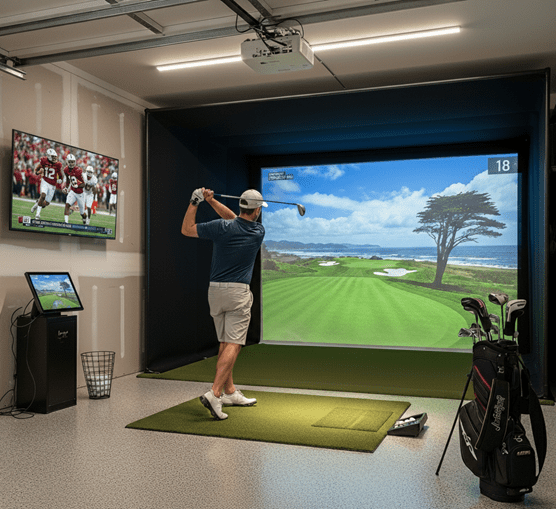
For decades, the path to athletic mastery followed a rigid schedule. Professional athletes were bound by the seasons and the availability of elite facilities.
Golfers, in particular, were at the mercy of the weather, daylight hours, and the commute to the local club. However, a significant shift has occurred in how high-performance athletes—and now dedicated amateurs—approach their craft.
The secret to this evolution isn’t just harder work; it’s “Deep Practice” made possible by controlled, accessible environments.
The Science of Constant Repetition
In his research on talent, author Daniel Coyle noted that elite skill is built through “chunking” actions into repeatable motions until they become second nature.
In sports like golf, where a millimeter of face angle at impact determines the difference between a fairway find and a lost ball, consistency is everything.
The problem with traditional practice at a driving range is the lack of environmental control. Wind, varying turf quality, and distractions can dilute the quality of a practice session.
By moving the training environment indoors, athletes can isolate variables and focus entirely on the mechanics of the swing. This is why we see a surging trend of home-based professional hubs.
The Infrastructure of a Home Training Hub
The transition from “hitting into a net” to “professional simulation” has become the gold standard for those serious about their progress. When building out a home facility, safety and immersion are the two most critical factors.
You cannot achieve “Deep Practice” if you are worried about a stray ball damaging your home or a ricochet causing injury.
For many homeowners, the challenge is finding a permanent space that can handle the rigors of high-velocity impact.
If you have a dedicated garage or basement, building a DIY golf simulator enclosure allows for a custom-fit solution that mirrors the dimensions of a professional studio.
These structures provide the necessary “blackout” environment to make high-end projectors pop, while the specialized impact-absorbing materials ensure that shots are contained safely.
This level of customization allows the user to choose specific frame dimensions and fabric weights, ensuring the setup fits the unique geometry of their home while providing the same visual feedback found in commercial academies.
Flexibility for the Modern Athlete
However, not everyone has the luxury of a dedicated “museum room” for their sports hobbies. This is where the newest evolution in sports tech comes in.
We are seeing a rise in multi-purpose spaces—garages that still need to house cars or family rooms that need to remain functional for movie night. The “man cave” is evolving into a “transformer room” that serves multiple roles throughout the day.
To solve this, many are opting for a retractable golf simulator enclosure. This technology allows the training hub to disappear in seconds, providing a professional-grade impact screen and side protection when it’s time to grind, and a clear, open floor plan when the workout is over.
This flexibility has removed the final barrier for athletes who previously thought they lacked the “real estate” for a high-end setup.
By utilizing motorized rollers or track systems, these enclosures keep the peace in a shared household while maintaining the integrity of the practice environment.
Data-Driven Improvement and Mental Fortitude
Beyond the physical structure, the modern home hub is powered by data. High-speed launch monitors and infrared sensors provide instant feedback on ball speed, spin rate, and launch angle.
When this data is paired with a professional-grade enclosure, the experience becomes indistinguishable from being on the course.
This environment also fosters a unique type of mental fortitude. Practicing in a simulator allows an athlete to play “virtual” rounds on the world’s most difficult courses, such as St. Andrews or Pebble Beach, from their own living room.
This exposure to high-pressure scenarios—hitting a tight tee shot over a digital “water hazard”—builds a level of comfort that translates directly to the real-world course.
The brain begins to treat the simulated environment with the same respect as the grass, narrowing the gap between practice performance and tournament results.
The Economic Shift in Sports Training
Historically, this level of technology was reserved for the top 1% of the PGA Tour. Today, the democratization of sports tech has brought the cost down significantly.
When you calculate the expenses associated with a traditional club membership—dues, cart fees, range balls, and the cost of fuel—a home setup often pays for itself within a few seasons.
Furthermore, the “time tax” of traditional sports is being eliminated. The modern athlete often juggles a career and family life; finding four to five hours for a full round of golf is a tall order. However, finding 45 minutes to play 18 holes virtually in a home enclosure is highly achievable.
This increased accessibility leads to a training volume that was previously impossible. Instead of practicing twice a week, athletes are getting in high-quality, data-backed reps every single day.
Conclusion: The Future is Indoors
As technology continues to advance, the “off-season” is becoming a relic of the past. The ability to maintain peak physical form and technical precision through the winter months means that when spring arrives, these athletes aren’t spending weeks “shaking off the rust.” They are ready to compete at their highest level from day one.
The evolution of home training habits represents a broader shift in how we view sports. It is no longer just about the outdoors; it is about the intersection of high-end engineering, data science, and personal dedication.
Whether through a permanent custom build or a space-saving retractable system, the ability to train like a pro is now only a few steps away in the comfort of home.
For those looking to master their game, the question is no longer if they should bring their practice home, but how they will design the space to make it happen.