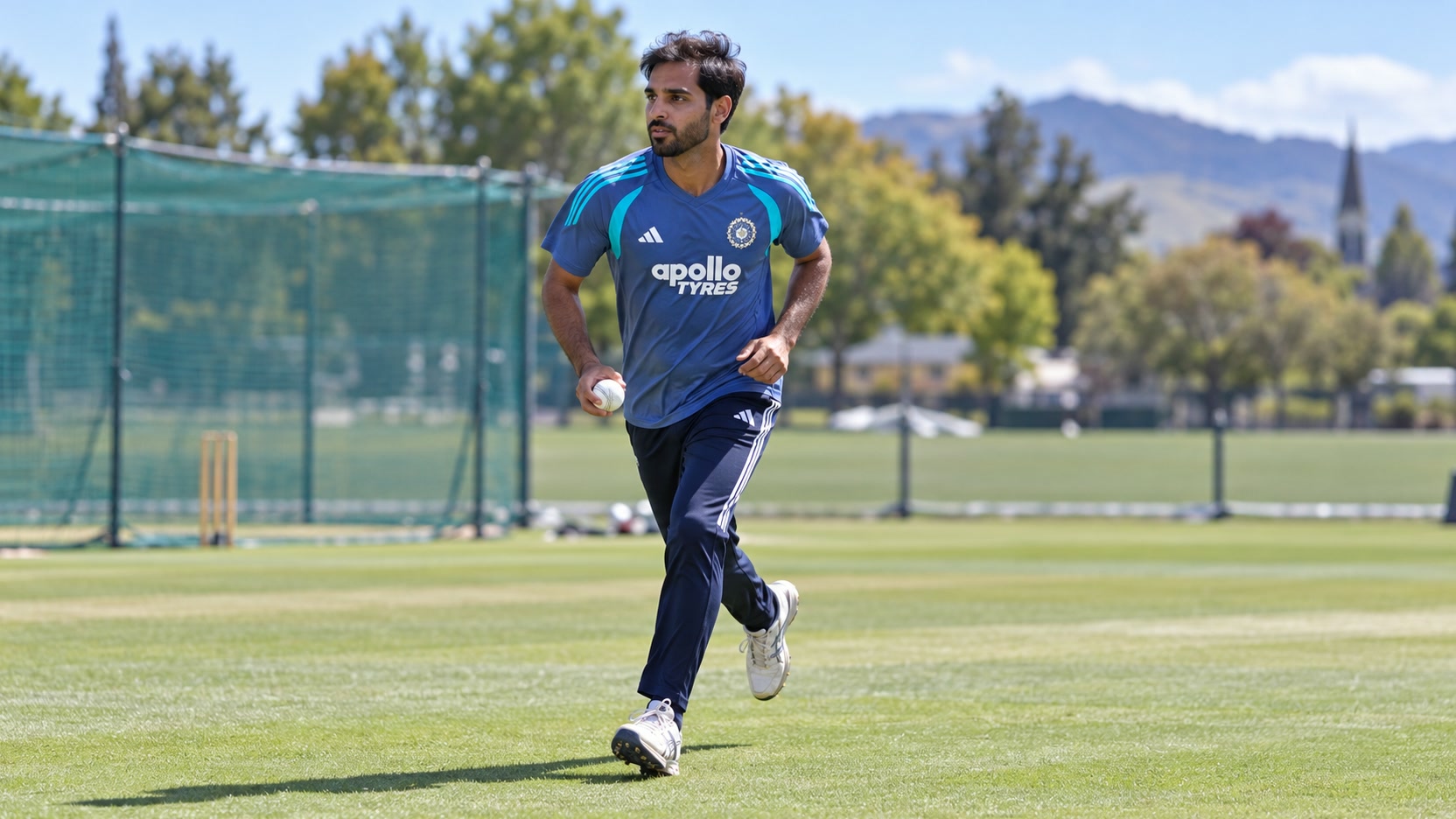
Bhuvneshwar Kumar’s overseas return took center stage as India chose to bowl against New Zealand in Thursday’s opening T20 international at Hagley Oval in Christchurch, New Zealand.
New Zealand attacked early through Tim Seifert and Finn Allen, giving Shreyas Iyer’s side an immediate examination of its bowling plans at the start of the series.
The BCCI match center recorded New Zealand at 81 for two after eight overs during this report, with India yet to bat and the contest still underway.
According to India Today’s live coverage, Mayank Yadav provided India’s first breakthrough before Axar Patel removed Allen, interrupting a threatening start from the hosts in Christchurch.
New Zealand tests India’s early control
That opening passage captured the central contest: India wanted early control with the ball, while New Zealand looked to turn attacking intent into a platform for acceleration.
The Cricbuzz commentary showed consecutive overs costing 17 runs during the powerplay, one bowled by Bhuvneshwar and the next by Arshdeep Singh, lifting the early scoring tempo.
Bhuvneshwar conceded 21 runs across his first two overs. Seifert’s boundary hitting illustrated how quickly an experienced bowler’s margin for error can disappear in international T20 cricket.
The immediate challenge was therefore practical rather than sentimental. India needed to interrupt scoring sequences, protect useful fielding areas and keep the hosts from dictating every exchange.
Mayank’s introduction offered a different threat through pace. Axar’s subsequent intervention added another route to control, showing why changes of bowling style mattered after the opening assault.
Those wickets did not settle the innings. They changed its shape, requiring New Zealand’s incoming batters to rebuild momentum while India searched for a sustained period of pressure.
Why Bhuvneshwar matters to India
Ahead of the opener, Iyer told reporters that India had lacked bowling experience in recent series, with PTI’s report carried by Rediff detailing his assessment of Bhuvneshwar’s value.
The captain highlighted the veteran’s understanding of T20 cricket and recent IPL success, explaining why his presence carries significance beyond the figures from any single spell alone.
Bhuvneshwar’s role also creates a useful contrast with Mayank. Experience in managing movement and lengths sits alongside a younger bowler’s speed, giving Iyer different options within an innings.
For India, making those options complement each other is the larger test. A productive over must be followed by pressure elsewhere if wickets are to change momentum.
The opening test of a long tour
The opener begins an unusually extensive assignment. The ICC’s tour announcement confirmed five T20 internationals, five ODIs and two Tests across a 12-match visit to New Zealand this season.
Christchurch also hosts the second T20I on October 24, before the teams move to Wellington, Auckland and Hamilton to complete the shortest-format leg of their extended tour.
That schedule gives both teams opportunities to adjust, but an opening victory would still provide an advantage before they return to the same venue for Saturday’s second match.
India’s first priority remained completing its bowling innings efficiently. New Zealand’s task was converting the early attacking start into a total that would keep pressure on the chase.
At the eight-over checkpoint, neither objective had been resolved. The opening exchanges had instead established a lively contest between New Zealand’s aggression and India’s search for bowling control.