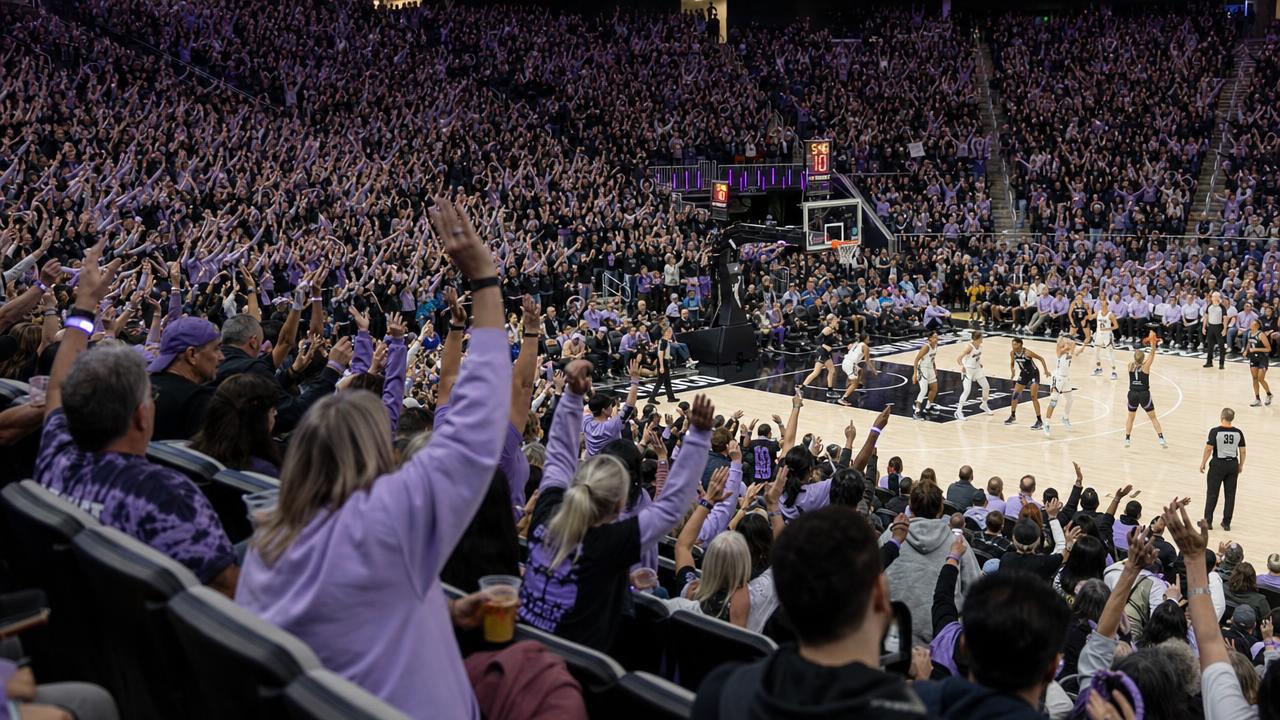
The Golden State Valkyries’ home-court edge is more than a loud crowd. At Chase Center, the team has built a visible, full-arena identity around the fan experience.
That identity was on display in Game 1 against the Atlanta Dream. With Golden State trailing by seven early in the fourth quarter, fans sang “What’s Up?” and did the wave.
As Front Office Sports reported, the moment preceded a 17–6 Valkyries run that turned the game around. It offered a vivid example of how the arena’s atmosphere can become part of the contest.
Golden State calls its home arena Ballhalla, and the nickname captures a deliberately cultivated sense of place. The team’s approach joins on-court ambition with marketing, visibility around the city and an energetic game-night environment.
The results at Chase Center have been striking. The Valkyries went 17–5 at home during the regular season, the best home record in the league, and won all five of their home playoff games.
Those records give the crowd’s reputation a measurable basketball backdrop. They do not establish that atmosphere alone caused the wins, but they show how formidable Golden State has been on its own floor.
Attendance is another part of the picture. The Valkyries have sold out every home game since entering the WNBA last year and led the league in total and average home attendance.
That consistency makes Ballhalla more than a playoff spectacle. A packed building has been a feature of the franchise from its first season, helping give home games a recognizable identity.
The organization behind that identity is the Golden State Group, owned by Joe Lacob and Peter Guber. The group also owns the NBA’s Warriors and has invested across the Valkyries operation.
That investment, as described in the report, reaches roster construction, marketing and the overall fan experience. The pieces work together: the team’s public presence extends beyond the arena, while game nights bring that identity into focus.
Valkyries logos appear on billboards and trains around San Francisco. The team stores outside Chase Center promote both the Valkyries and Warriors, giving the WNBA club prominent space alongside its established NBA counterpart.
The contrast matters because the Warriors’ regular season was set to begin Tuesday, yet Valkyries branding remained visible throughout the city. The franchise has made its own presence part of the local sports landscape.
Guard Veronica Burton credited investment from ownership, the front office and coaching staff, while also pointing to the fans. Her assessment underscores that the home-court product is not built by one department alone.
That combination is the broader blueprint: resources support the team and its presentation, while a committed audience supplies the noise and participation. The singing-and-wave moment showed those elements colliding during a pivotal stretch.
The Valkyries’ commercial growth has been substantial, too. The report said the franchise became the first WNBA team to reach $100 million in annual revenue and, citing CNBC, the first valued at $1 billion.
Those milestones do not explain every detail of the team’s business, but they place Ballhalla within a larger story of a new franchise quickly building an audience and a valuable brand.
Mike Evans, the 49ers wide receiver, attended the Valkyries’ semifinal Game 2 against the Las Vegas Aces and called it probably the best basketball game he had attended.
His reaction offered an outside perspective on an atmosphere that has become a point of distinction for the club. The report also noted that NFL players have taken notice of the arena.
Coach Natalie Nakase has treated the crowd as an active part of the home advantage. Before Game 1, she asked for “hostility” from Ballhalla, then challenged fans to raise the level for Game 2.
That request reflects a useful tension in the Valkyries’ formula: a strong environment is not presented as finished. Even after praising the audience, Nakase asked it to bring more.
For a young franchise, the challenge is sustaining a connection that has already produced sellouts and a clear arena identity. Golden State’s early record gives that ambition a compelling start, not a guarantee.
Ballhalla’s significance, then, is not simply that it gets loud. Its crowd, the club’s citywide visibility and its investment in the fan experience have become intertwined parts of the Valkyries’ identity.
The crowd’s fourth-quarter singalong was a snapshot, not the whole blueprint. But it showed how a home audience can turn a game into a shared performance—and how Golden State has made that feeling central to its WNBA presence.