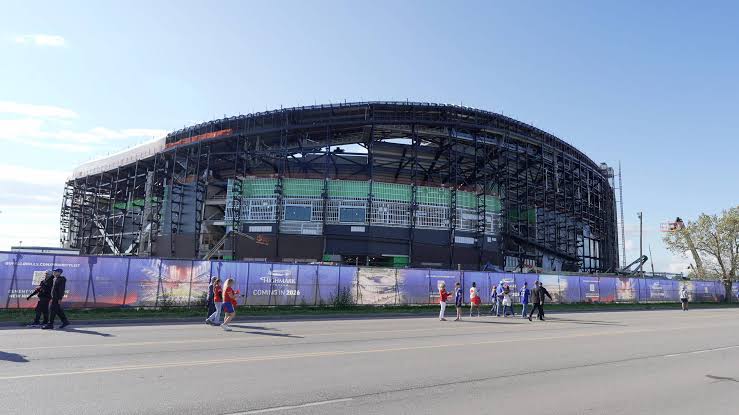
The Buffalo Bills’ new stadium is Highmark Stadium in Orchard Park, New York. It officially opened in 2026 with a capacity of 60,108, a natural grass field and a final construction cost of just over $2.1 billion.
The open-air venue replaced the Bills’ previous stadium across Abbott Road and was designed specifically around football, weather protection, sightlines and the game-day atmosphere created by Bills Mafia. It also keeps the franchise in Western New York under a long-term stadium agreement.
This guide covers the new Highmark Stadium’s capacity, cost, location, design, financing, playing surface, canopy, technology and other key facts.
Buffalo Bills New Stadium at a Glance
| Fact | Details |
|---|---|
| Stadium | Highmark Stadium |
| Team | Buffalo Bills |
| Location | Orchard Park, New York |
| Capacity | 60,108 |
| Cost | Just over $2.1 billion |
| Playing surface | Natural grass |
| Stadium type | Open-air |
| Architect | Populous |
| Groundbreaking | June 5, 2023 |
| Ribbon cutting | June 23, 2026 |
| First regular-season game | September 17, 2026 vs. Detroit Lions |
| Public contribution | $850 million |
Where Is the Buffalo Bills’ New Stadium?
The new Highmark Stadium is in Orchard Park, New York, a suburb south of Buffalo. The Bills remained in the same community rather than relocating downtown.
The new venue was built directly across from the team’s former stadium, keeping the familiar Orchard Park game-day location while giving the franchise a completely new facility.
The project covers roughly 1.6 million square feet on a 242-acre site, according to New York State’s announcement marking completion of the stadium.
How Much Did the Buffalo Bills’ New Stadium Cost?
The final cost of the new Highmark Stadium was just over $2.1 billion.
That figure is significantly higher than the early estimates announced when the stadium agreement was first developed. Rising construction costs and design additions pushed the total upward during the build.
At the official opening, Bills executives confirmed that the final project cost came in at slightly more than $2.1 billion. The Bills described the stadium as the largest construction project in Western New York history.
Who Paid for the Bills’ New Stadium?
The stadium was built through a public-private partnership involving the Buffalo Bills, New York State and Erie County.
The public contribution totaled $850 million, consisting of $600 million from New York State and $250 million from Erie County.
The Bills and team ownership were responsible for the remaining stadium construction costs, including cost overruns beyond the original project estimate.
The financing structure drew considerable attention because of the size of the public contribution.
As the project’s total cost increased, however, the public share became a smaller percentage of the overall final cost than it had represented under the original estimate.
What Is the Capacity of the Buffalo Bills’ New Stadium?
Highmark Stadium has an official capacity of 60,108.
That makes the new building smaller in standard seating capacity than the Bills’ previous home, but the design prioritizes closer sightlines, premium seating, wider concourses and improved fan amenities.
The stadium also has expandable capacity for certain major events beyond normal Bills games.
Is the New Bills Stadium a Dome?
No. Highmark Stadium is an open-air stadium.
The Bills chose to preserve the outdoor football environment associated with games in Western New York rather than build a fully enclosed dome.
However, the stadium incorporates a large canopy designed to provide substantial seating-bowl coverage and reduce exposure to rain, snow and wind.
Earlier design information from the Bills said the canopy was intended to cover about 65% of the seats while also working with the stadium’s exterior structure to reduce swirling wind inside the bowl.
This gives the building a middle ground between a traditional fully exposed outdoor stadium and an enclosed venue.
What Surface Does Highmark Stadium Use?
The Bills’ new stadium uses a natural grass playing surface.
That is a major change from the artificial turf used at the team’s previous stadium. Natural grass was one of the key football-specific decisions built into the new venue.
What Are the Main Features of the New Highmark Stadium?
The Bills describe the building as a “football-first” stadium. Its design focuses on keeping fans close to the field while modernizing nearly every part of the game-day experience.
Canopy Coverage
A large canopy covers much of the seating bowl and is designed to provide protection from the elements while also helping control wind and contain crowd noise.
360-Degree Concourses
The stadium features continuous concourses with views into the bowl. Fans can move around the building while remaining visually connected to the field.
Improved Sightlines
The seating bowl uses a stacked design that places many seats closer to the field than in the previous stadium. Accessibility and sightlines were major design priorities.
Two Major Video Boards
The stadium includes two modern video boards and an upgraded sound system designed to target audio more precisely throughout the seating bowl.
Radiant Heating
Because Buffalo weather remains part of the experience, radiant heating is installed at selected gathering points in the concourses.
5G Connectivity
Highmark Stadium and its surrounding campus use enhanced 5G infrastructure intended to improve connectivity during crowded events.
Frictionless Food and Beverage Areas
Modern food and beverage marketplaces are designed to reduce lines and improve movement through the concourses.
The Bills detailed many of these features while releasing updated stadium renderings, including 360-degree concourse visibility, radiant heat and upgraded audio-visual systems.
When Did the New Bills Stadium Open?
The stadium’s official ribbon-cutting ceremony took place on June 23, 2026.
The Bills then hosted their Return of the Blue & Red practice in August before preseason games began at the venue.
The first regular-season game at the new Highmark Stadium came on September 17, 2026, when Buffalo hosted the Detroit Lions on Thursday Night Football. The Bills won 41-31, giving the new venue an immediate high-scoring debut.
The team’s official stadium-opening coverage also confirmed the 60,108 capacity, natural grass field and final cost above $2.1 billion.
Why Did the Buffalo Bills Build a New Stadium?
The previous stadium opened in 1973 and had served the franchise for more than five decades. Although it underwent multiple renovations, replacing it eventually became more practical than continuing to modernize the older structure.
The new stadium was designed to provide modern premium seating and hospitality areas, improved concourses and concessions, better weather protection, updated player facilities, modern video and connectivity systems, improved accessibility and a long-term home for the Bills in Western New York.
Does the New Stadium Have Better Player Facilities?
Yes. The stadium includes football-specific spaces such as a modern locker room, training and recovery areas, team dining facilities and an indoor turf warmup field.
The design keeps major player areas close together so the team can move efficiently through pregame preparation, treatment, warmups and field access.
Who Owns Highmark Stadium?
New York State owns the new Highmark Stadium through the Erie County Stadium Corporation structure following the formal transfer of stadium ownership in August 2026.
The Bills operate from the venue under the long-term stadium and lease agreements associated with the project.
How Long Will the Bills Stay in Orchard Park?
The stadium agreement was structured around a 30-year commitment that keeps the Buffalo Bills in Western New York for decades.
That long-term security was one of the central goals of the stadium project. The Bills remained in Orchard Park rather than moving to a different region or building a downtown Buffalo stadium.
Can Highmark Stadium Host Events Other Than Bills Games?
Yes. Although the stadium was designed primarily for football, its expandable capacity, premium areas and modern event infrastructure allow it to host other large-scale events.
The building and surrounding campus were designed with year-round use in mind, including hospitality functions and non-NFL events.
Old Highmark Stadium vs. New Highmark Stadium
| Feature | Previous Stadium | New Highmark Stadium |
|---|---|---|
| Opening | 1973 | 2026 |
| Location | Orchard Park | Orchard Park |
| Design | Open-air | Open-air with major canopy coverage |
| Playing surface | Artificial turf | Natural grass |
| Standard capacity | Larger than new venue | 60,108 |
| Concourses | Traditional layout | 360-degree field visibility |
| Technology | Upgraded over time | Built with modern video, audio and 5G systems |
Watching Buffalo Bills Games
Fans who cannot attend games at Highmark Stadium can follow Buffalo throughout the season through the league’s television and streaming partners.
Our guide to watching Buffalo Bills games live throughout the season explains the team’s broadcast options, while our complete NFL live streaming and TV guide covers the wider league schedule.
FAQs
What is the Buffalo Bills’ new stadium called?
The Bills’ new stadium is called Highmark Stadium, continuing the naming partnership associated with the team’s previous home.
Where is the Buffalo Bills’ new stadium?
Highmark Stadium is in Orchard Park, New York, across from the site of the Bills’ previous stadium.
How many seats are in the new Bills stadium?
The official capacity is 60,108.
How much did the Buffalo Bills’ new stadium cost?
The final construction cost was just over $2.1 billion.
Is the new Buffalo Bills stadium a dome?
No. Highmark Stadium is open-air, but a large canopy provides substantial seating-bowl coverage and helps protect fans from wind and precipitation.
Does the new Bills stadium have real grass?
Yes. The playing field uses natural grass.
When did the new Buffalo Bills stadium open?
The official ribbon cutting took place June 23, 2026. The first regular-season game was played September 17, 2026.
Who paid for the new Bills stadium?
The project was a public-private partnership. New York State and Erie County contributed a combined $850 million, while the Bills and team ownership covered the remaining project costs and overruns.