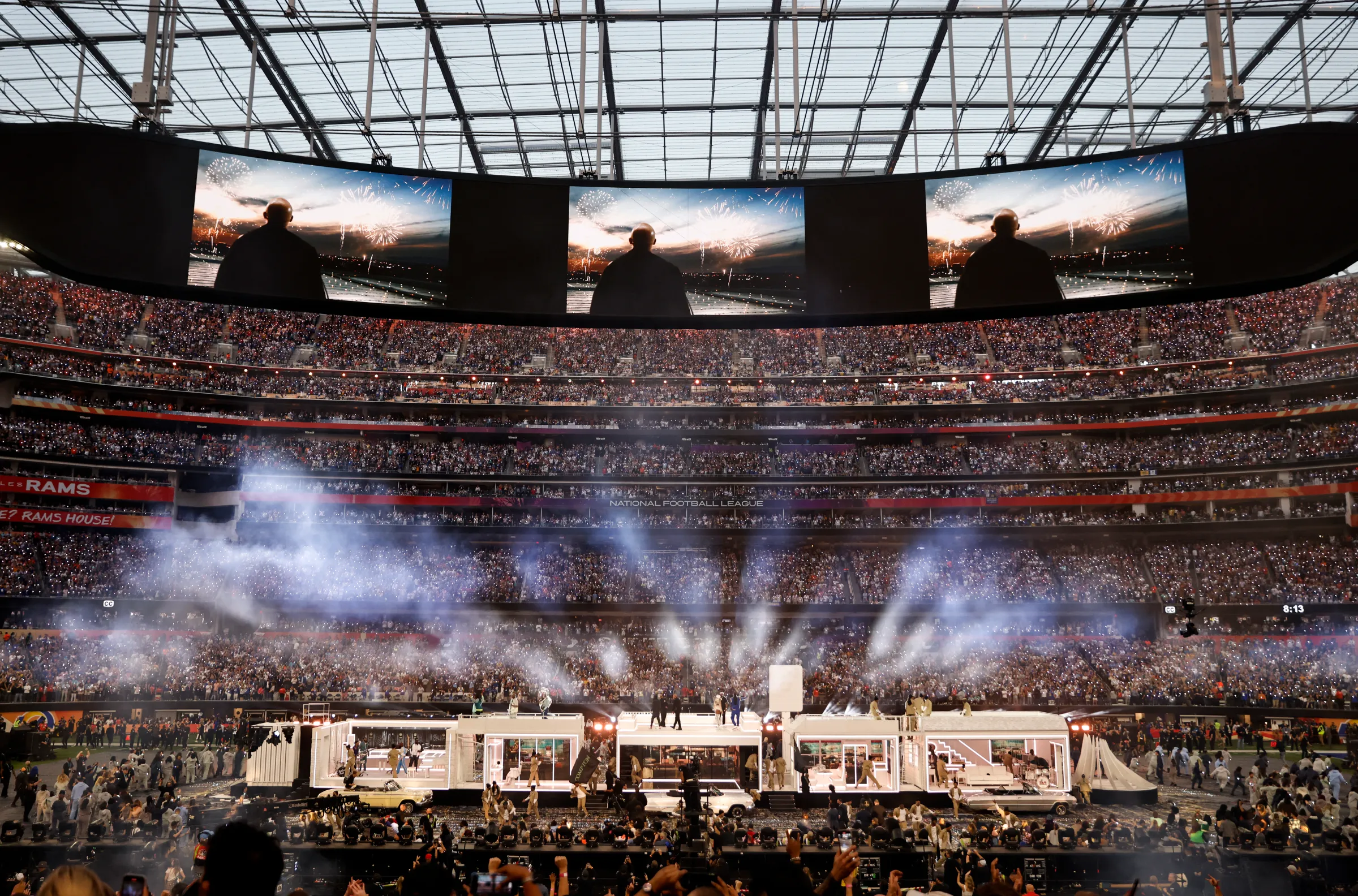
The Super Bowl halftime show has evolved from marching bands and themed pageants into one of the biggest live music events in the world.
What began with college bands at Super Bowl I in 1967 now regularly features global stars, elaborate staging, surprise guests and performances watched by audiences far beyond football.
This guide lists the Super Bowl halftime shows by year, from the earliest band-led productions to modern headliners such as Michael Jackson, Prince, Beyoncé, Rihanna, Kendrick Lamar and Bad Bunny.
It also explains when the show changed, which artists have appeared more than once and which performances became major cultural moments.
If you are also following the football side of the event, our complete guide to watching NFL games live and finding the right TV channel covers the league’s current broadcast and streaming options.
Super Bowl Halftime Shows by Year
The table below lists the principal halftime performers for every Super Bowl through Super Bowl LX in 2026.
Early shows often used marching bands, drill teams and themed productions rather than a single headline artist, so several entries include the major groups or performers associated with that year’s presentation.
| Super Bowl | Year | Halftime performer(s) |
|---|---|---|
| I | 1967 | University of Arizona Marching Band, Grambling State University Marching Band |
| II | 1968 | Grambling State University Marching Band and Miami-area high school bands |
| III | 1969 | Florida A&M University Band and Miami-area high school bands |
| IV | 1970 | Carol Channing, Lionel Hampton, Doc Severinsen, Al Hirt, Marguerite Piazza and Southern University Marching Band |
| V | 1971 | Southeast Missouri State Marching Band, Up with People and Anita Bryant |
| VI | 1972 | Ella Fitzgerald, Carol Channing, Al Hirt, USAFA Cadet Chorale and U.S. Marine Corps Drill Team |
| VII | 1973 | University of Michigan Marching Band, Andy Williams and Woody Herman |
| VIII | 1974 | University of Texas Longhorn Band and Judy Mallett |
| IX | 1975 | Mercer Ellington and Grambling State University Marching Band |
| X | 1976 | Up with People |
| XI | 1977 | Los Angeles Unified All-City Band, New Mouseketeers and Disney characters |
| XII | 1978 | Tyler Apache Band and Belles, Pete Fountain and Al Hirt |
| XIII | 1979 | Ken Hamilton and performers in a Caribbean-themed production |
| XIV | 1980 | Up with People and Grambling State University Marching Band |
| XV | 1981 | Southern University Marching Band and Helen O’Connell |
| XVI | 1982 | Up with People |
| XVII | 1983 | Los Angeles Super Drill Team |
| XVIII | 1984 | University of Florida and Florida State University marching bands |
| XIX | 1985 | Tops in Blue |
| XX | 1986 | Up with People |
| XXI | 1987 | George Burns, Mickey Rooney, Grambling State University Marching Band, USC Marching Band and Disney characters |
| XXII | 1988 | San Diego State, Cal State Northridge and USC marching bands |
| XXIII | 1989 | Elvis Presto |
| XXIV | 1990 | Doug Kershaw, Pete Fountain, Irma Thomas and Louisiana marching bands |
| XXV | 1991 | New Kids on the Block |
| XXVI | 1992 | Gloria Estefan and University of Minnesota Marching Band |
| XXVII | 1993 | Michael Jackson |
| XXVIII | 1994 | Clint Black, Tanya Tucker, Travis Tritt and The Judds |
| XXIX | 1995 | Patti LaBelle, Teddy Pendergrass, Tony Bennett, Arturo Sandoval and Miami Sound Machine |
| XXX | 1996 | Diana Ross |
| XXXI | 1997 | The Blues Brothers, ZZ Top and James Brown |
| XXXII | 1998 | Boyz II Men, The Temptations, Smokey Robinson, Queen Latifah and Grambling State University Marching Band |
| XXXIII | 1999 | Gloria Estefan, Stevie Wonder, Big Bad Voodoo Daddy and Savion Glover |
| XXXIV | 2000 | Phil Collins, Christina Aguilera, Enrique Iglesias and Toni Braxton |
| XXXV | 2001 | Aerosmith, NSYNC, Britney Spears, Mary J. Blige and Nelly |
| XXXVI | 2002 | U2 |
| XXXVII | 2003 | Shania Twain, No Doubt and Sting |
| XXXVIII | 2004 | Janet Jackson, Justin Timberlake, P. Diddy, Nelly, Kid Rock and Jessica Simpson |
| XXXIX | 2005 | Paul McCartney |
| XL | 2006 | The Rolling Stones |
| XLI | 2007 | Prince |
| XLII | 2008 | Tom Petty and the Heartbreakers |
| XLIII | 2009 | Bruce Springsteen and the E Street Band |
| XLIV | 2010 | The Who |
| XLV | 2011 | The Black Eyed Peas, Usher and Slash |
| XLVI | 2012 | Madonna with LMFAO, Nicki Minaj, M.I.A. and Cee Lo Green |
| XLVII | 2013 | Beyoncé with Destiny’s Child |
| XLVIII | 2014 | Bruno Mars with Red Hot Chili Peppers |
| XLIX | 2015 | Katy Perry with Lenny Kravitz and Missy Elliott |
| 50 | 2016 | Coldplay with Beyoncé and Bruno Mars |
| LI | 2017 | Lady Gaga |
| LII | 2018 | Justin Timberlake |
| LIII | 2019 | Maroon 5 with Travis Scott and Big Boi |
| LIV | 2020 | Shakira and Jennifer Lopez, with Bad Bunny and J Balvin |
| LV | 2021 | The Weeknd |
| LVI | 2022 | Dr. Dre, Snoop Dogg, Eminem, Mary J. Blige and Kendrick Lamar, with 50 Cent and Anderson .Paak |
| LVII | 2023 | Rihanna |
| LVIII | 2024 | Usher, with Alicia Keys, Jermaine Dupri, H.E.R., will.i.am, Lil Jon and Ludacris |
| LIX | 2025 | Kendrick Lamar, with SZA and Mustard |
| LX | 2026 | Bad Bunny |
The early history is especially easy to oversimplify because many halftime shows were themed productions rather than modern concerts.
Historical performer lists from Sports Illustrated’s year-by-year Super Bowl halftime archive help document those band-led and multi-act years.
Who Performed at the 2026 Super Bowl Halftime Show?
Bad Bunny headlined the Super Bowl LX halftime show on February 8, 2026, at Levi’s Stadium in Santa Clara, California. The NFL, Apple Music and Roc Nation had announced the Puerto Rican superstar as the headliner ahead of the game.
The selection continued the modern trend toward internationally recognized artists and reflected the increasingly global audience for both the NFL and the halftime show.
The NFL’s official halftime show page provides the league’s presentation of the Super Bowl LX production.
When Did the Super Bowl Halftime Show Become a Major Concert?
For roughly the first two decades, Super Bowl halftime entertainment looked more like a large stadium pageant than a standalone pop concert.
College marching bands, drill teams, Disney productions, patriotic themes and large ensemble performances were common.
The shift toward contemporary recording stars became much more obvious in the early 1990s.
New Kids on the Block appeared in 1991, Gloria Estefan headlined in 1992, and Michael Jackson’s 1993 appearance changed expectations for what a Super Bowl halftime show could be.
Jackson’s performance was built around a single global superstar rather than a broad themed production.
That model became the blueprint for the modern era: major headliner, recognizable catalog, large visual production and worldwide media attention.
Michael Jackson’s 1993 Halftime Show Changed the Format
Super Bowl XXVII is one of the most important turning points in halftime history. Michael Jackson opened with an extended period of stillness before moving into a set built around some of his biggest songs.
The larger significance was structural. The NFL had demonstrated that halftime could be marketed as an entertainment event with its own star power instead of functioning only as an intermission for the football game.
That approach directly influenced the artist-driven productions that followed through the 1990s and into the 2000s.
The Rock Era of the 2000s
After the controversial Super Bowl XXXVIII halftime show in 2004, the NFL moved toward a run of veteran rock acts.
Paul McCartney performed in 2005, followed by The Rolling Stones in 2006, Prince in 2007, Tom Petty and the Heartbreakers in 2008, Bruce Springsteen and the E Street Band in 2009, and The Who in 2010.
That stretch produced several of the most recognizable halftime performances in Super Bowl history.
Prince’s 2007 performance, delivered in the rain in Miami, is particularly well remembered because of the combination of weather, staging and his performance of “Purple Rain.”
The Modern Pop and Hip-Hop Era
The 2010s brought a wider mix of pop, rock, R&B and hip-hop performers. Madonna, Beyoncé, Bruno Mars, Katy Perry, Coldplay, Lady Gaga and Justin Timberlake all headlined during the decade.
Hip-hop became even more central in the 2020s. Super Bowl LVI in 2022 brought together Dr. Dre, Snoop Dogg, Eminem, Mary J. Blige and Kendrick Lamar, with appearances from 50 Cent and Anderson .Paak.
Kendrick Lamar later returned as the headline performer for Super Bowl LIX in 2025.
The NFL reported that his show with guest SZA drew 133.5 million viewers, making it the most-watched Super Bowl halftime show at that point and surpassing the audience benchmark associated with Michael Jackson’s 1993 performance.
Which Artists Have Performed at More Than One Super Bowl Halftime Show?
Several major artists have returned to the halftime stage in different roles.
- Gloria Estefan appeared in 1992 and again in 1999.
- Justin Timberlake appeared with Janet Jackson in 2004 and returned as the solo headliner in 2018.
- Beyoncé headlined in 2013 and returned as a guest during Coldplay’s 2016 show.
- Bruno Mars headlined in 2014 and returned during the 2016 Coldplay production.
- Kendrick Lamar appeared in the 2022 ensemble and returned as headliner in 2025.
- Bad Bunny appeared as a guest during the 2020 Shakira and Jennifer Lopez show before headlining Super Bowl LX in 2026.
Early-era performers such as Al Hirt and groups such as Up with People and Grambling State University’s marching band also appeared multiple times when the format relied more heavily on recurring bands and large productions.
Most-Watched Super Bowl Halftime Show
According to the NFL, Kendrick Lamar’s Super Bowl LIX performance in 2025 reached 133.5 million viewers, making it the most-watched halftime show at the time.
The performance featured SZA as a prominent guest and came during a period when the Super Bowl itself was reaching record television audiences.
Audience comparisons across decades are not always perfectly like-for-like because measurement methods, simulcasts and streaming distribution have changed. Still, the figure shows how large the halftime show has become as a standalone entertainment event.
Why Super Bowl Halftime Performers Matter
For artists, the halftime show offers something few music events can match: a concentrated global audience during one of the most watched annual broadcasts in the United States.
The slot can introduce an artist’s catalog to new audiences, revive older hits and generate a surge of interest across streaming platforms and social media.
For the NFL, the entertainment helps broaden the Super Bowl beyond football and creates a second major reason for casual viewers to tune in.
The result is a hybrid event in which the game and halftime performance each have their own audience, conversation and cultural impact.
Who Chooses the Super Bowl Halftime Performer?
The modern selection process involves the NFL and its entertainment partners. Roc Nation has played a major role in the league’s live music strategy since 2019, while Apple Music became the title sponsor of the halftime show beginning with Super Bowl LVII in 2023.
The final choice is influenced by factors such as global recognition, catalog strength, live-performance ability, cultural relevance and the practical demands of producing a highly compressed stadium show.
Do Super Bowl Halftime Performers Get Paid?
Super Bowl halftime performers are generally not paid a traditional appearance fee comparable to a normal concert booking.
The NFL covers production-related expenses, while artists receive enormous promotional exposure from performing in front of a massive television and streaming audience.
The production itself can be exceptionally expensive because the stage must be assembled, performed on and removed within a narrow halftime window while the football field remains usable for the second half.
How Long Is the Super Bowl Halftime Show?
The televised musical performance normally runs for roughly 12 to 15 minutes, although the full halftime break is longer because crews need time to build and remove the stage.
Artists therefore compress years of hit songs into medleys rather than performing full concert versions.
That is why a typical halftime show can include a large number of recognizable songs despite its short running time.
FAQs
Who performed at the first Super Bowl halftime show?
The first Super Bowl halftime show in 1967 featured the University of Arizona Marching Band and Grambling State University Marching Band, along with additional stadium entertainment. Early Super Bowl halftime shows were built around marching bands and themed pageants rather than major pop headliners.
Who performed at the 2026 Super Bowl halftime show?
Bad Bunny headlined the Super Bowl LX halftime show on February 8, 2026, at Levi’s Stadium in Santa Clara, California.
Who had the most-watched Super Bowl halftime show?
The NFL reported that Kendrick Lamar’s Super Bowl LIX halftime show in 2025 attracted 133.5 million viewers, making it the most-watched halftime performance at that time.
When did Michael Jackson perform at the Super Bowl?
Michael Jackson performed at Super Bowl XXVII in 1993. His appearance is widely regarded as a turning point that helped establish the modern superstar-headliner format.
Did Beyoncé perform at more than one Super Bowl?
Yes. Beyoncé headlined the Super Bowl XLVII halftime show in 2013 and returned as a guest during Coldplay’s Super Bowl 50 performance in 2016.
How many times has Kendrick Lamar performed at the Super Bowl halftime show?
Kendrick Lamar appeared in the Super Bowl LVI ensemble in 2022 and returned as the headline performer for Super Bowl LIX in 2025.
Was Bad Bunny in a Super Bowl halftime show before 2026?
Yes. Bad Bunny appeared during the 2020 Super Bowl LIV halftime show headlined by Shakira and Jennifer Lopez before returning as the headliner for Super Bowl LX in 2026.
How long does the Super Bowl halftime performance last?
The main musical performance usually lasts about 12 to 15 minutes, although the overall halftime break is longer because of stage setup and removal.
Do Super Bowl halftime performers get paid?
They generally do not receive a normal concert-style appearance fee. The NFL covers major production expenses, while the artists benefit from the enormous promotional exposure associated with the broadcast.
Why were early Super Bowl halftime shows mostly marching bands?
The halftime show originally followed the tradition of college and professional football entertainment, where marching bands and themed field productions were common. The emphasis shifted toward major recording artists as television audiences grew and the Super Bowl became a larger entertainment event.