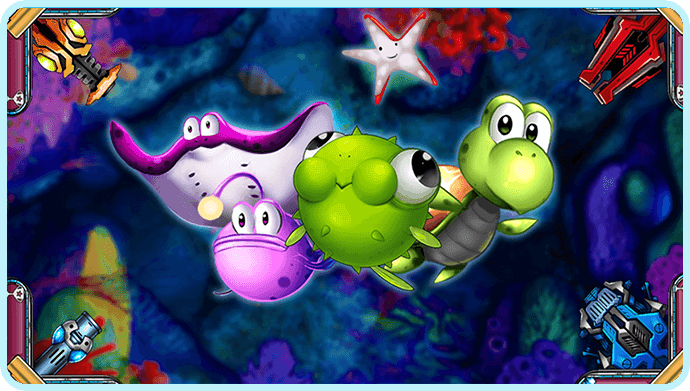
A fish shooting game can look deceptively simple. You see a colorful underwater scene, choose a cannon, aim at moving fish, and start firing. Yet beneath that straightforward interface is a combination of target selection, timing, weapon management, scoring rules, and sometimes chance-based mechanics.
For a new player, understanding how those elements interact is far more useful than simply firing as quickly as possible. The appeal comes from the combination of simple controls and increasingly complex decisions, making these games accessible to beginners while still offering plenty to learn.
The good news is that beginners do not need to master every feature immediately. The most effective starting point is to understand the basic gameplay loop and learn what each part of the interface actually means.
Once you know how cannons, fish values, ammunition, special weapons, and movement patterns work together, the screen becomes much easier to read. Whether you are playing a traditional arcade version or an online title, learning the mechanics first allows you to make more deliberate decisions instead of relying on random shooting.
Understanding the Basic Gameplay Loop
At its core, a fish shooting game revolves around a simple cycle: identify a target, aim the cannon, fire, and evaluate the result. Fish move across an underwater playing field, usually following different paths and speeds.
The player controls a cannon positioned around the edge or bottom of the screen and directs shots toward selected targets. Different games may use touch controls, a mouse, buttons, or other input methods, but the fundamental interaction remains similar.
The important distinction for beginners is that the objective is not necessarily to shoot the largest fish visible. A larger target may have a greater potential value, but it can also require more ammunition, stronger weapons, or sustained attacks.
Smaller fish are often easier to capture and can help new players become familiar with aiming, movement, and the timing of shots. Learning this relationship between target value and difficulty is one of the first meaningful lessons in fish shooting gameplay.
Different titles can also implement their mechanics differently. Some games emphasize straightforward arcade scoring, while others incorporate multipliers, special fish, bonus rounds, or additional weapons.
In versions involving monetary stakes, the cost of each shot and the rules governing rewards become especially important. No shooting pattern can guarantee a particular outcome when chance-based systems are involved, so beginners should understand the rules of the specific game rather than assuming every title works identically.
Learning How Cannons and Shots Work
The cannon is the primary tool in a fish shooting game, but it is more than simply a button that produces ammunition. Many games allow players to adjust cannon strength or shot value.
Increasing the power can make attacks more effective against difficult targets, but it can also increase the resources consumed with every shot. Understanding that trade-off is central to efficient play.
A common beginner mistake is to assume that stronger is automatically better. In practice, the appropriate cannon setting depends on the target, the game’s rules, and the resources available.
Using a high-powered shot against an easy target may provide little practical advantage, while repeatedly using weak shots against a difficult target can consume resources without producing a result.
Starting with lower settings can give new players time to become comfortable with the controls and understand how different shots behave.
Accuracy also matters. Holding down the firing control and filling the screen with projectiles may feel productive, but it can make it harder to evaluate which shots are actually effective. Controlled firing encourages players to observe fish movement, consider target value, and decide whether continuing an attack makes sense.
This becomes particularly important when targets move toward the edge of the screen, where continuing to fire may simply consume ammunition without enough opportunity to complete the attack.
Recognizing Fish Types and Target Values
Not every fish on the screen has the same role. Most fish shooting games differentiate targets through size, appearance, movement behavior, difficulty, or assigned value.
Small fish generally move in simpler patterns and are easier to hit, while larger or special creatures may require substantially more attention. Some games also introduce boss fish or rare targets with significantly higher reward values.
For beginners, the most useful skill is learning to read the screen before choosing a target. Look at how quickly the fish is moving, whether it is approaching an accessible position, and whether other creatures are likely to interfere with your shots.
A target with an attractive value is not necessarily a sensible target if it is about to disappear from the playing area. Likewise, repeatedly attacking a difficult creature without understanding how much ammunition it requires can quickly become inefficient.
Some games display multipliers or other numerical indicators beside fish. These numbers can help players understand relative target value, but they should not automatically be interpreted as guaranteed returns.
The cost of the shots required to capture a target is part of the equation. In games where each shot consumes credits or another resource, understanding the relationship between potential reward and total shooting cost is much more important than simply chasing the biggest number on screen.
Using Special Weapons and Bonuses
Once players understand ordinary cannon shots, special weapons are usually the next mechanic to explore. Depending on the game, these can include explosive attacks, lasers, piercing shots, nets, chain reactions, or other temporary abilities.
Their exact operation varies considerably between titles, so reading the game’s instructions before using them is worthwhile.
The main principle is to understand what situation a special weapon is designed to address. A weapon capable of affecting multiple targets may be most useful when fish are clustered together, while a precision weapon may be better suited to a single difficult target.
Some games also feature chain reactions in which one successful capture triggers effects against nearby fish. These mechanics can change the rhythm of a round and reward players who pay attention to positioning rather than simply firing continuously.
Beginners should also resist the temptation to use every special ability immediately. If a bonus weapon is limited, timing becomes part of the mechanic. Waiting for a favorable group of targets may provide more value than activating an ability against one ordinary fish.
This does not mean there is a universal best moment across all games. Instead, players should learn what each weapon actually does and observe how its effect interacts with different target formations.
Understanding Aim, Timing, and Movement
Good aiming in a fish shooting game is not simply about pointing directly at the fish. Targets are moving, which means players need to account for direction and speed.
Depending on the game’s projectile behavior, aiming slightly ahead of a moving target can be more effective than aiming at its current position. This is particularly noticeable when fish travel quickly across the screen.
Movement patterns are another useful source of information. Fish may travel in groups, follow predictable routes, circle parts of the screen, or enter and leave through particular areas.
Spending a few moments observing these patterns can improve decision-making. Instead of reacting to every movement, players can begin anticipating where a target will be when the shot reaches it.
The same principle applies to groups of fish. A dense formation may create an opportunity for an area-based weapon, while a scattered group may favor individual targeting.
The goal is not to develop a rigid shooting routine but to recognize what the screen is presenting at a particular moment. This makes gameplay more deliberate and can reduce unnecessary shots.
Managing Resources and Avoiding Common Beginner Mistakes
Resource management becomes increasingly important when a game uses ammunition, credits, or wager-based shots. Every action has a cost, so players should understand how quickly repeated firing can consume their available resources.
This is one reason controlled shooting is generally more sensible than automatically maintaining a constant stream of fire.
Another common mistake is chasing a target simply because several shots have already been invested in it. Previous shots do not necessarily mean that the next shot is more likely to succeed.
In games with chance-based mechanics, past outcomes should not be treated as evidence that a particular target is due to be captured. Players should evaluate each situation based on the game’s actual mechanics rather than allowing previous results to dictate the next decision.
Players exploring bắn cá xèng should therefore pay close attention to the particular game’s rules, shot costs, target values, and applicable restrictions before committing resources.
If the game involves real money, it is especially important to treat spending as entertainment rather than as a reliable source of income.
Establishing a fixed limit before playing can help prevent impulsive decisions, particularly during fast-paced rounds where the visual excitement can encourage continuous firing.
Building Skill Through Observation
The fastest way to improve at a new fish shooting game is often to observe rather than immediately trying to maximize results. Spend the first few sessions learning what different fish look like, how quickly they move, what the cannon settings do, and how special weapons behave.
This approach creates a practical understanding of the game without requiring complicated theories.
Pay attention to which targets are easy to hit and which consistently require more resources. Notice how long fish remain on screen and how their movement changes when they appear in groups.
If the game provides a practice or demonstration mode, it can be a useful way to become comfortable with the interface before committing resources.
The objective at this stage is familiarity: knowing what you are looking at allows you to make better decisions later.
Most importantly, remember that skill and chance can coexist. Timing, aiming, and target selection can influence how you interact with an arcade-style game, but chance-based reward mechanics can still affect individual outcomes.
Recognizing that distinction prevents beginners from assuming that a particular strategy can guarantee success. It also encourages a healthier approach in which learning the game itself becomes part of the experience.
Conclusion
Learning bắn cá game mechanics does not require complicated strategies. The strongest foundation comes from understanding how the cannon works, recognizing different fish types, evaluating target values, and learning how movement affects aiming.
Beginners should start slowly, become familiar with the interface, and focus on making deliberate decisions rather than firing continuously. Special weapons and bonuses can then be introduced once the basic gameplay feels comfortable.
Successful gameplay begins with understanding rather than guesswork. Pay attention to the relationship between ammunition, target difficulty, potential rewards, and timing. Avoid chasing losses or assuming that previous outcomes determine what happens next, especially when chance-based mechanics are involved.
By combining observation with sensible resource management, beginners can approach bắn cá games with greater confidence and a much clearer understanding of what is happening on the screen.
RELATED ARTICLES