The third shot drop is the swing that turns pickleball from a fast, chaotic scramble into a controlled doubles chess match.
It is also the shot that gets recreational players punished the most. Float it too high and the other team cashes an easy overhead, basically free points with the odds heavily tilted against you.
The good news is you usually do not need a new “touch” gene. Most pop-ups come from two fixable things: contact point that is too far in front and a paddle face that is too open at impact.
Clean those up, and your drop starts landing in the kitchen more often, with a trajectory that forces your opponents to hit up instead of down.
Why Third Shot Drops Pop up (and what the court dimensions tell you)
Pickleball gives you a tight margin. The net is 36 inches at the posts and 34 inches in the middle. The non-volley zone line is 7 feet from the net.
You are trying to send the ball over a 34 inch barrier and have it land in a 7 foot deep target area that is protected by two opponents who are waiting to volley anything that sits up.
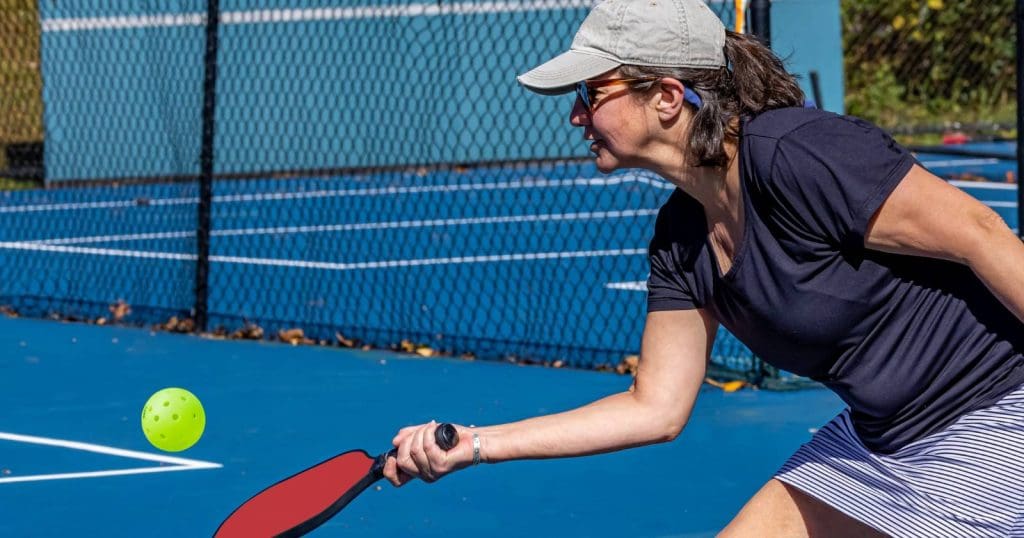
Most pop-ups happen because players treat the drop like a mini-lob. They lift with the shoulder, open the paddle face, and contact out in front.
That combination adds height and hang time, which is exactly what the defending team wants.
The Contact-point Fix: Let the Ball Get to You
If you remember one cue, make it this: contact closer to your front hip, not out by your lead foot. When the ball is too far in front, your wrist tends to extend and the paddle face opens. That creates a high launch angle, even if you think you are “taking pace off.”
Give yourself an extra beat and let the ball travel. The swing should feel more like a gentle push with a compact motion. Your goal is not maximum spin. Your goal is a repeatable arc that clears the net by a small margin and lands soft.
Paddle-face Control: Aim with the Edge, Not the Face
A useful checkpoint is to feel like you are showing the edge of the paddle to the net for a split second through contact.
You are not literally chopping the ball, but that feeling helps prevent the wide-open face that causes pop-ups.
If you want reps quickly, start by finding Pickleball courts near me. Then commit to a simple rule for a week: on every third shot drop attempt, your finish stays below chest height. High finishes usually mean you lifted the ball instead of sending it on a controlled arc.
Footwork That Makes the Drop Easier (and looks more “pro” than it feels)
Many players try to hit the drop while drifting forward. That forward momentum forces a last-second deceleration, and the hands panic.
Instead, get set behind the ball and hit while balanced. If you are moving, you are more likely to flip the paddle face open to keep the ball from dying into the net.
Try a small split step as your opponent strikes the return, then a couple of calm adjustment steps. When you arrive, think “quiet feet, quiet hands.” It is the same concept tennis players use on touch volleys: stability first, finesse second.
One Drill That Fixes 80 Percent of Pop-ups
The Net-clearance Constraint Drill
Pick a visual target: imagine a line about one paddle-length above the net tape. Your goal is to send the ball over that “window” and have it land in the kitchen. You are training two things at once: lower trajectory and softer landing.
Start from the baseline with a partner blocking returns back to you, or use a gentle feed. Count only the drops that clear low and bounce in the non-volley zone.
If you pop one up, reset your cue to “contact at the hip” and “edge to the net.” After a short session, the lower arc starts to feel normal instead of risky.
Gear Tweaks That Help, Without Chasing a Magic Paddle
Equipment will not fix bad contact, but it can make good mechanics easier to repeat. If your paddle feels too lively, you will tend to decelerate and get handsy, which often opens the face.
A slightly heavier paddle can smooth out the stroke and reduce the urge to flick. The tradeoff is that you need to be honest about your shoulder and elbow tolerance.
Grip size matters too. A grip that is too small can encourage extra wrist action, which is great for speed-ups but messy for touch.
Many adult players settle somewhere in the 4 to 4.5 inch range, but the real test is control: you should be able to keep the paddle face stable through a gentle drop without strangling the handle.
Match-day Decision Rules: When Not to Force the Drop
Even a strong drop is a lower-percentage shot if the return pins you deep and your opponents are already set at the kitchen.
In those spots, a safer play is a higher, deeper ball to the middle, buying time to move forward.
Think of it like bankroll management: you do not take a thin-edge bet every rally just because you can.
Your best drop chances are when the return sits up, when you can contact from inside the baseline, or when the return is deep but slow enough that you can set your feet.
If you choose those moments, your “drop percentage” climbs fast, and your opponents start missing their volleys because they are forced to hit up.
RELATED ARTICLES