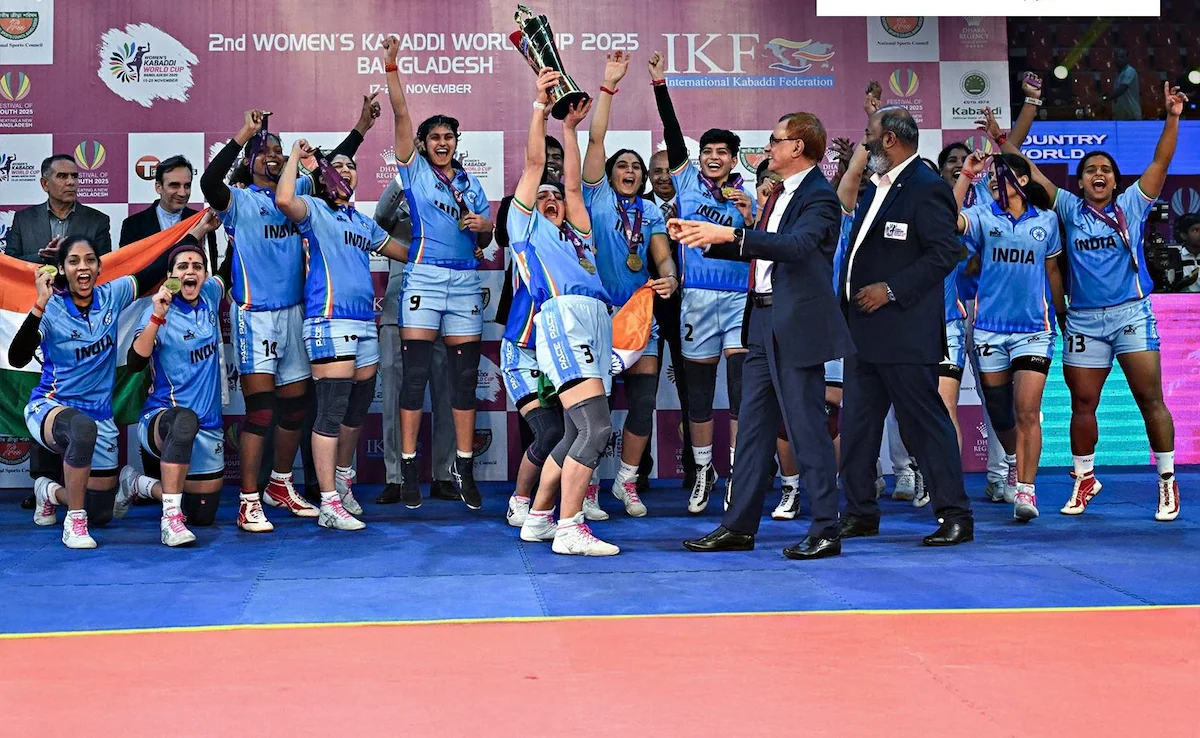
India has established unprecedented dominance in the Kabaddi World Cup, winning all five international titles since the tournament’s inception. Iran consistently emerges as the runner-up, appearing in four finals across men’s and women’s competitions.
The Kabaddi World Cup features two distinct formats; standard style (organized by the International Kabaddi Federation) and circle style (governed by Punjab); with India claiming 9 total titles across both disciplines through 2025.
Men’s Kabaddi World Cup Winners (Standard Style)
| Year | Host | Champion | Runner-Up | Final Score | Tournament Details |
| 2004 | Mumbai | India | Iran | 55-27 | Inaugural edition; 12 teams in 3 pools |
| 2007 | Panvel | India | Iran | 29-19 | 14 teams; 4 groups of 3-4 teams |
| 2016 | Ahmedabad | India | Iran | 38-29 | 12 teams in 2 pools of 6 teams |
India’s men’s kabaddi team won the inaugural championship in 2004 with a dominant 55-point margin over Iran. Pankaj Shirsat captained India to back-to-back titles in 2004 and 2007, establishing early dominance.
Anup Kumar led the team to their third consecutive victory in 2016, creating a perfect record; India has never lost a Kabaddi World Cup final.
Iran has finished runner-up in all three men’s standard-style editions, maintaining consistency as the second-strongest kabaddi nation.
Women’s Kabaddi World Cup Winners
| Year | Host | Champion | Runner-Up | Final Score | Tournament Details |
| 2012 | Patna | India | Iran | 25-19 | Inaugural women’s edition; 16 teams in 4 groups |
| 2025 | Dhaka | India | Chinese Taipei | 35-28 | First World Cup outside India; 11 teams in 2 groups |
India’s women’s kabaddi team claimed the inaugural title in 2012, defeating Iran 25-19 in Patna. The team remained unbeaten throughout the tournament, winning all group matches before defeating Indonesia in the quarter-finals and Japan in the semi-finals.
This victory marked India’s fourth consecutive Kabaddi World Cup championship overall, cementing women’s dominance alongside their men’s team.
In 2025, India reclaimed the title in Dhaka, Bangladesh, marking a historic milestone; the first Kabaddi World Cup held outside India. Captain Ritu Negi led the team through an unbeaten campaign, defeating Iran 33-21 in the semi-final.
India’s 35-28 victory over Chinese Taipei in the final proved decisive despite hosts Bangladesh securing their maiden World Cup medal with a semi-final appearance.
All-Time Kabaddi World Cup Statistics
| Metric | Data | Notes |
| Total Tournaments | 5 | 3 men’s + 2 women’s standard style |
| India Gold Medals | 5 | 100% win rate in all finals |
| Iran Appearances | 4 finals | Runner-up in all men’s + 1 women’s final |
| Tournaments Outside India | 1 | Women’s 2025 in Dhaka, Bangladesh |
| Total Nations Participated | 40+ | Across all editions 2004-2025 |
| Winning Margins (men’s) | 28-38 pts | Largest: 2004 (55-27); Closest: 2007 (29-19) |
India’s dominance reflects both the sport’s deep roots in Indian culture and substantial investment in kabaddi development.
Iran’s consistent runner-up finishes demonstrate the sport’s growth beyond India’s borders, with other nations gradually improving their competitive standing.
Men’s Circle Style Kabaddi World Cup
| Year | Host | Champion | Runner-Up | Score |
| 2010 | Punjab, India | India | Philippines | ; |
| 2011 | Punjab, India | India | Pakistan | 45-40 |
| 2012 | Punjab, India | India | Australia | 49-21 |
| 2013 | Punjab, India | India | New Zealand | 49-21 |
| 2014 | Punjab, India | India | New Zealand | 36-27 |
| 2020 | Lahore, Pakistan | Pakistan | India | 43-41 |
The circle style tournament, organized by Punjab’s government, showcases a different kabaddi variant.
India won six of seven editions from 2010-2020 before Pakistan secured their maiden title in 2020 with a remarkable 43-41 comeback victory.
This remains the only non-India world title in circle style, breaking Indian invincibility in this format.
Key Statistics & Tournament Milestones
India’s perfect record across standard-style tournaments shows unprecedented consistency. The 2004 inaugural final’s 55-27 scoreline remains the largest margin of victory across all men’s editions.
India’s women’s team matched this dominance by winning back-to-back championships in 2012 and 2025, despite a 13-year gap between tournaments.
The 2025 Women’s World Cup marked a watershed moment for kabaddi’s global expansion. Bangladesh hosting the tournament attracted 11 nations from Asia, Africa, and Europe, reflecting the sport’s rapid international growth beyond traditional South Asian strongholds.
Emerging nations like Zanzibar, Kenya, Uganda, and Poland demonstrated kabaddi’s expanding footprint, with Bangladesh earning their first-ever World Cup medal.
Iran’s four finalist appearances across 2004-2025 establish them as kabaddi’s consistent second power.
Despite their runner-up status, Iran has developed competitive teams capable of reaching multiple finals, suggesting potential for future championship victories as kabaddi training infrastructure improves globally.
Tournament Format & Evolution
Early editions (2004, 2007) featured 12-16 teams divided into multiple pools with round-robin group stages.
Teams finishing first and second from each group advanced to the knockout stages. The 2016 men’s tournament adopted a two-pool format with 12 teams, streamlining competition while maintaining competitive integrity.
Women’s tournaments started with 16 teams (2012) before scaling down to 11 nations (2025).
The group-stage format remained consistent, with top-two finishers from each pool advancing to the semi-finals.
This structure ensures every team plays multiple matches, providing adequate preparation time and competitive opportunities for emerging kabaddi nations.
India’s Winning Captains
Sanjeev Baliyan captained India’s inaugural 2004 victory, establishing the winning tradition. Pankaj Shirsat repeated success in 2007 before Anup Kumar claimed the 2016 men’s title.
Captain Ritu Negi led India’s women’s team to back-to-back victories in 2012 and 2025, becoming the only captain to win consecutive World Cup titles in women’s kabaddi.
Notable Achievements & Records
India’s men’s team achieved multiple landmarks: they lost only one match in the entire 2016 tournament (group stage to South Korea) yet still won the championship by dominating the knockout stage.
This demonstrates Indian kabaddi’s ability to recover from setbacks; a mark of team quality and tournament experience.
Chinese Taipei’s 2025 runner-up finish in the women’s event represents the strongest performance by a non-Indian, non-Iranian team in World Cup history.
Their unbeaten group stage (4-0) followed by semi-final victory over hosts Bangladesh showcased emerging kabaddi powerhouses.
Bangladesh’s historic semi-final qualification in 2025 ended a 13-year drought for non-India/Iran medals.
Their 40-31 victory over Thailand secured the tournament’s first home-team medal from the hosting nation, breaking the pattern of India-Iran dominance.
All-Time Kabaddi World Cup Medal Count
| Country | Gold | Silver | Bronze | Total |
| India | 5 | 0 | 0 | 5 |
| Iran | 0 | 4 | 0 | 4 |
| Chinese Taipei | 0 | 1 | 0 | 1 |
| Bangladesh | 0 | 0 | 1 | 1 |
| Japan | 0 | 0 | 2 | 2 |
| Thailand | 0 | 0 | 2 | 2 |
| Other Nations | 0 | 0 | 1+ | 1+ |
Upcoming Tournaments
The International Kabaddi Federation announced the resumption of men’s tournaments in January 2025 following COVID-19 disruptions.
Women’s tournaments are scheduled for 2026, expanding the competitive calendar and offering more opportunities for developing kabaddi nations to gain international experience and improve rankings.
FAQs
Which country has won the most Kabaddi World Cups?
India holds a perfect 5-0 record across all Kabaddi World Cup editions (2004, 2007, 2016 men’s and 2012, 2025 women’s). They have never lost a World Cup final, establishing unprecedented dominance unmatched by any other sport’s world championship.
Who was the runner-up in all Kabaddi World Cup finals?
Iran appeared in four World Cup finals; 2004, 2007, 2016 (men’s) and 2012 (women’s); finishing runner-up in all editions. Chinese Taipei reached their first World Cup final in 2025, becoming the first non-India/Iran team to compete for the title.
What is the difference between standard style and circle style Kabaddi World Cups?
Standard style (rectangular court, indoor) is organized by the International Kabaddi Federation with tournaments in 2004, 2007, 2016 (men’s) and 2012, 2025 (women’s). Circle style (circular court, outdoors) is governed by Punjab’s government with annual tournaments from 2010-2020. India won standard-style dominantly, while Pakistan won circle style’s only non-India championship in 2020.
When was the first women’s Kabaddi World Cup held?
The inaugural Women’s Kabaddi World Cup took place in Patna, Bihar in 2012, eight years after the men’s tournament began. India defeated Iran 25-19 in the final with an unbeaten campaign throughout the tournament.
Where was the 2025 Women’s Kabaddi World Cup held?
Dhaka, Bangladesh hosted the 2025 Women’s World Cup at the Shaheed Suhrawardi Indoor Stadium from November 17-24, 2025. This marked the first-ever Kabaddi World Cup; men’s or women’s; held outside India, representing a watershed moment for kabaddi’s global expansion and development.
What was India’s winning margin in the largest Kabaddi World Cup final?
India defeated Iran 55-27 in the 2004 inaugural men’s final in Mumbai, establishing a 28-point margin that remains the largest victory in any standard-style World Cup final. This dominant performance set the tone for India’s future championship dominance.