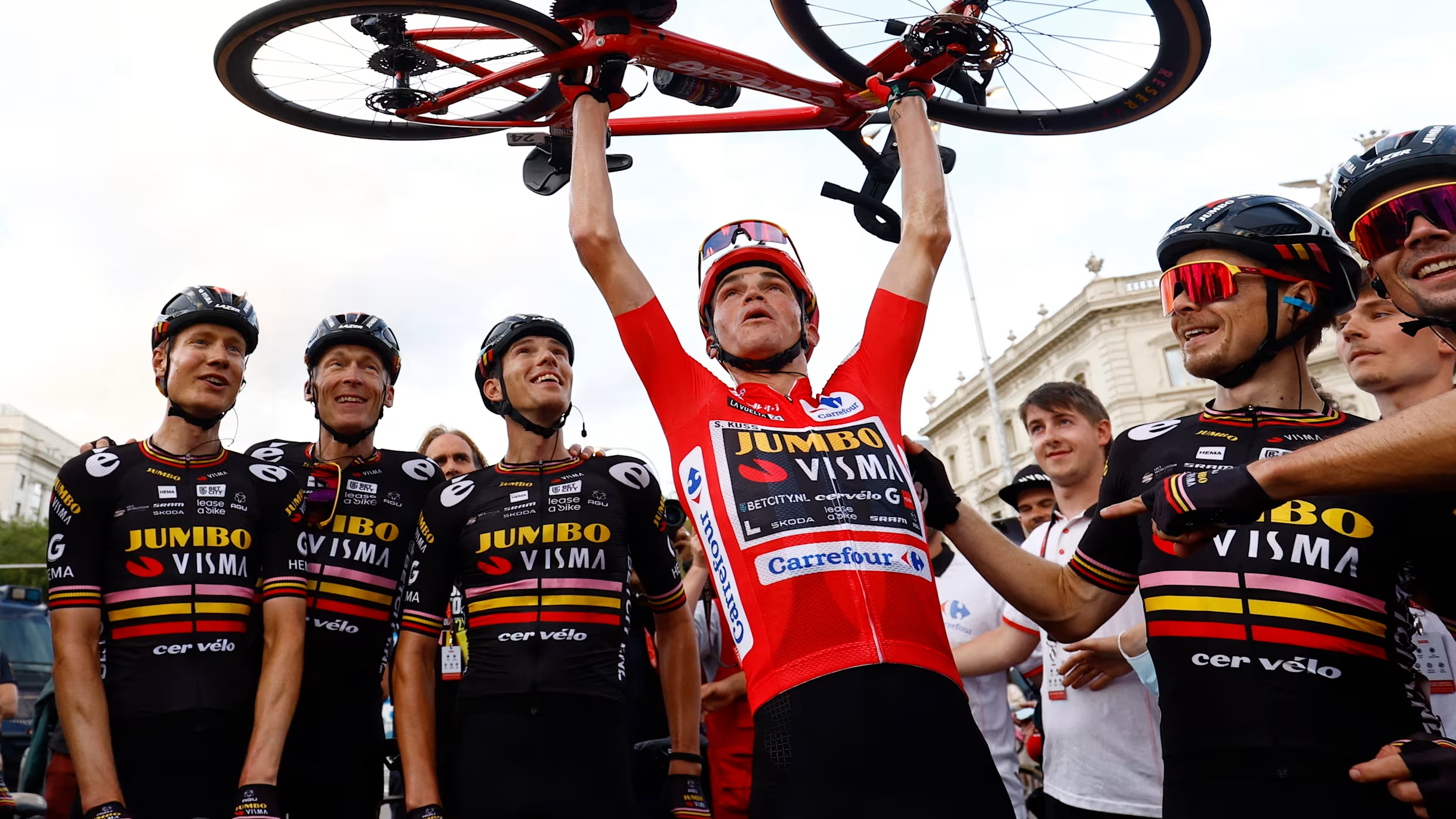
The Vuelta a España was established in 1935 by Spanish newspaper Informaciones to rival the Tour de France and Giro d’Italia.
Suspended during the Spanish Civil War (1937–1940) and World War II (1943–1944), the race moved from its spring schedule to September in 1995, transforming it into the final Grand Tour of the cycling calendar.
Today, it ranks among cycling’s three most prestigious races, attracting world-class riders competing for the red jersey (maillot rojo) over 21 stages and approximately 3,500 kilometers.
In this article we will discuss about Vuelta a España Winners List in detail.
Vuelta a España Winners List – All-Time Records (Most Victories)
| Rider | Wins | Years | Nationality |
| Roberto Heras | 4 | 2000, 2003, 2004, 2005 | Spain |
| Primož Roglič | 4 | 2019, 2020, 2021, 2024 | Slovenia |
| Alberto Contador | 3 | 2008, 2012, 2014 | Spain |
| Tony Rominger | 3 | 1992, 1993, 1994 | Switzerland |
| Chris Froome | 2 | 2011, 2017 | Great Britain |
| Bernard Hinault | 2 | 1978, 1983 | France |
| Pedro Delgado | 2 | 1985, 1989 | Spain |
Roberto Heras holds the record for most Vuelta wins with four overall victories, though 21 of his 22 career Grand Tour podiums occurred on Spanish soil;a sign of his comfort in Spain’s demanding terrain.
Primož Roglič equaled this feat when he won his fourth Vuelta in 2024 after dominating the 2019–2021 period with three consecutive victories.
Vuelta a España Winners 2020–2025
| Year | Winner | Country | Team | Margin |
| 2025 | Jonas Vingegaard | Denmark | Visma–Lease a Bike | — |
| 2024 | Primož Roglič | Slovenia | Red Bull-Bora-Hansgrohe | 2:36 over Ben O’Connor |
| 2023 | Sepp Kuss | USA | Jumbo-Visma | 17 seconds over Jonas Vingegaard |
| 2022 | Remco Evenepoel | Belgium | Soudal–Quick-Step | — |
| 2021 | Primož Roglič | Slovenia | Jumbo-Visma | — |
| 2020 | Primož Roglič | Slovenia | Jumbo-Visma | — |
Primož Roglič secured his record-tying fourth Vuelta in 2024 after a masterclass in patience and mountain dominance.
Starting 4:51 down to Ben O’Connor after the first week, the Slovenian methodically chipped away, reclaiming the red jersey on Stage 19 before sealing victory in the final time trial through Madrid with a 2:36 advantage.
The 34-year-old’s triumph completed Slovenia’s dominance of the 2024 Grand Tours alongside Tadej Pogačar’s Giro and Tour de France victories.
Vuelta a España Winners 2010–2019
| Year | Winner | Country | Margin |
| 2019 | Primož Roglič | Slovenia | 2:16 over Alejandro Valverde |
| 2018 | Simon Yates | Great Britain | — |
| 2017 | Chris Froome | Great Britain | 2:39 over Vincenzo Nibali |
| 2016 | Nairo Quintana | Colombia | 1:23 over Chris Froome |
| 2015 | Fabio Aru | Italy | 57 seconds over Tom Dumoulin |
| 2014 | Alberto Contador | Spain | 1:10 over Chris Froome |
| 2013 | Chris Horner | USA | 41 years old (oldest winner) |
| 2012 | Alberto Contador | Spain | — |
| 2011 | Chris Froome | Great Britain | 13 seconds over Juan José Cobo* |
| 2010 | Vincenzo Nibali | Italy | — |
*Juan José Cobo’s 2011 victory was later overturned for doping. Chris Froome was awarded the win retrospectively in 2019, becoming the first British Grand Tour winner.
Chris Horner made cycling history in 2013 by winning at age 41, the oldest Grand Tour winner ever.
After 10 Grand Tour attempts without finishing better than ninth, Horner finally broke through, defeating Vincenzo Nibali and Alejandro Valverde.
Vuelta a España Winners List 2000–2009
| Year | Winner | Country |
| 2009 | Alejandro Valverde | Spain |
| 2008 | Alberto Contador | Spain |
| 2007 | Denis Menchov | Russia |
| 2006 | Alexander Vinokourov | Kazakhstan |
| 2005 | Denis Menchov | Russia |
| 2004 | Roberto Heras | Spain |
| 2003 | Roberto Heras | Spain |
| 2002 | Aitor González | Spain |
| 2001 | Ángel Casero | Spain |
| 2000 | Roberto Heras | Spain |
Roberto Heras launched his four-win record in 2000, claiming his first of three consecutive victories (2003–2005).
Alberto Contador won back-to-back editions in 2008 and 2012, becoming the first Spanish cyclist to win all three Grand Tours when he took the 2008 Vuelta.
The 2005 race saw Denis Menchov initially disqualified, but Roberto Heras’s initial positive test was later overturned by court appeal, confirming his fourth victory.
Vuelta a España Winners 1990–1999
| Year | Winner | Country |
| 1999 | Jan Ullrich | Germany |
| 1998 | Abraham Olano | Spain |
| 1997 | Alex Zülle | Switzerland |
| 1996 | Alex Zülle | Switzerland |
| 1995 | Laurent Jalabert | France |
| 1994 | Tony Rominger | Switzerland |
| 1993 | Tony Rominger | Switzerland |
| 1992 | Tony Rominger | Switzerland |
| 1991 | Melchor Mauri | Spain |
| 1990 | Marco Giovannetti | Italy |
Swiss riders dominated the 1990s, with Tony Rominger claiming three consecutive victories (1992–1994).
Laurent Jalabert’s 1995 win was particularly notable; he became only the third rider ever to win the general, points, and mountain classifications in a single Grand Tour.
The decade marked Spain’s declining dominance as international riders increasingly competed at the highest level.
Vuelta a España Winners 1980–1989
| Year | Winner | Country |
| 1989 | Pedro Delgado | Spain |
| 1988 | Sean Kelly | Ireland |
| 1987 | Luis Herrera | Colombia |
| 1986 | Álvaro Pino | Spain |
| 1985 | Pedro Delgado | Spain |
| 1984 | Éric Caritoux | France |
| 1983 | Bernard Hinault | France |
| 1982 | Juan Fernández | Spain |
| 1981 | Giovanni Battaglin | Italy |
| 1980 | Lucien Van Impe | Belgium |
This decade marked cycling’s globalization—Luis Herrera became the first non-European Vuelta winner in 1987, signaling Colombian and Latin American cyclists’ emergence as Grand Tour contenders.
Bernard Hinault won the 1983 Vuelta after previously winning the 1978 edition, while Éric Caritoux captured the 1984 race by just 6 seconds, the smallest margin ever recorded.
Vuelta a España Winners 1970–1979
| Year | Winner | Country |
| 1979 | Joop Zoetemelk | Netherlands |
| 1978 | Bernard Hinault | France |
| 1977 | Freddy Maertens | Belgium |
| 1976 | José Pesarrodona | Spain |
| 1975 | Eddy Merckx | Belgium |
| 1974 | José Manuel Fuente | Spain |
| 1973 | Eddy Merckx | Belgium |
| 1972 | Faustino Sevilla | Spain |
| 1971 | Juan Manuel Santisteban | Spain |
| 1970 | Luis Ocaña | Spain |
Eddy Merckx claimed two Vuelta victories (1973, 1975), adding to his legendary status as the only cyclist to win all three Grand Tours twice.
Luis Ocaña won in 1970 before his career-altering crash at the 1971 Tour de France.
Bernard Hinault emerged as a dominant force, capturing his first Vuelta in 1978 in his best year, when he also won the Tour de France.
Vuelta a España Winners 1960–1969
| Year | Winner | Country |
| 1969 | Eddy Merckx | Belgium |
| 1968 | Felice Gimondi | Italy |
| 1967 | Gregorio San Miguel | Spain |
| 1966 | Juan López-Carril | Spain |
| 1965 | Rolf Wolfshohl | Germany |
| 1964 | Álvaro Robles | Spain |
| 1963 | Jacques Anquetil | France |
| 1962 | Rudi Altig | Germany |
| 1961 | Angelino Soler | Spain |
| 1960 | Jacques Anquetil | France |
Jacques Anquetil won the 1963 Vuelta while becoming the first cyclist to win all three Grand Tours.
Angelino Soler holds the record as the youngest Vuelta winner at just 21 years old in 1961.
Eddy Merckx, still in his early 20s, captured his first Vuelta in 1969, launching what would become one of cycling’s greatest careers.
Vuelta a España Winners 1950–1959
| Year | Winner | Country |
| 1959 | Jacques Anquetil | France |
| 1958 | Jesús Loroño | Spain |
| 1957 | Jesús Loroño | Spain |
| 1956 | Angelo Conterno | Italy |
| 1955 | Jean Dotto | France |
| 1954 | Race Cancelled | — |
| 1953 | Race Cancelled | — |
| 1952 | Race Cancelled | — |
| 1951 | Race Cancelled | — |
| 1950 | Emilio Rodríguez | Spain |
The 1950s saw Spain’s continued dominance, though the race was suspended from 1951–1954 due to Spain’s international isolation during the Cold War.
Jacques Anquetil emerged as an international star, winning three editions between 1959 and 1963. The race resumed in 1955 with Jean Dotto’s victory after the four-year hiatus.
Vuelta a España Winners 1935–1949
| Year | Winner | Country |
| 1949 | Race Not Held | — |
| 1948 | José Luis Tomás | Spain |
| 1947 | Renzo Soldani | Italy |
| 1946 | Dalmacio Langarica | Spain |
| 1945 | Race Not Held | — |
| 1944 | Race Not Held | — |
| 1943 | Race Not Held | — |
| 1942 | Julián Berrendero | Spain |
| 1941 | Julián Berrendero | Spain |
| 1940–1937 | Race Cancelled (Spanish Civil War) | — |
| 1936 | Gustaaf Deloor | Belgium |
| 1935 | Gustaaf Deloor | Belgium |
Belgian cyclist Gustaaf Deloor won the inaugural 1935 Vuelta and repeated in 1936, remaining the only two-time winner by the same rider in the race’s early years.
Julián Berrendero, Spain’s first champion after the Civil War, won consecutive editions in 1941–1942. The race’s early history was turbulent, suspended for seven years across two world conflicts.
Most Victories by Nationality
Spain dominates the Vuelta’s history, with 23 different Spanish cyclists winning 32 editions; more than any other nation.
France follows with 9 victories through cyclists including Jacques Anquetil, Bernard Hinault, and Laurent Jalabert.
Belgium has produced 8 winners including Gustaaf Deloor and Eddy Merckx, while other nations contribute occasional champions.
Youngest and Oldest Winners
Angelino Soler holds the record as the youngest Vuelta winner at 21 years and 168 days when he captured the 1961 race.
Nearly 50 years later, Chris Horner shattered expectations by winning the 2013 Vuelta at 41 years and 328 days; the oldest Grand Tour winner in cycling history.
Before Horner’s breakthrough, Tony Rominger held the record at 33 years old when he won his final Vuelta in 1994.
FAQs
Who won the 2024 Vuelta a España?
Primož Roglič won the 2024 Vuelta, his fourth overall victory, tying Roberto Heras’s all-time record. Roglič overcame Ben O’Connor’s 4:51 lead after the first week to win by 2:36. It was a masterful display of mountain dominance and tactical riding from the Slovenian.
Who has won the Vuelta the most times?
Roberto Heras (Spain) and Primož Roglič (Slovenia) share the record with four Vuelta wins each. Heras won in 2000, 2003, 2004, and 2005. Roglič claimed victories in 2019, 2020, 2021, and 2024.
What is the red jersey in the Vuelta a España?
The red jersey (maillot rojo) is awarded to the overall race leader based on cumulative stage times. Introduced as the official leader’s jersey in 2010, it replaced the previous golden jersey to strengthen the race’s distinct identity from the Tour de France’s yellow jersey.
Has any rider won the Vuelta three times in a row?
Yes. Primož Roglič achieved consecutive victories from 2019–2021, becoming only the second rider to win three Vueltas in succession after Tony Rominger (1992–1994). Roglič later extended his record to four total wins in 2024.
What year did the Vuelta move to September?
The Vuelta moved from its traditional spring schedule to September in 1995, avoiding direct competition with the Giro d’Italia held in May. This change significantly boosted international participation and prestige, positioning the Vuelta as the season’s final Grand Tour.
How many stages does the Vuelta a España have?
The modern Vuelta consists of 21 day-long stages completed over a 23-day period including two rest days. The format was standardized in the 1990s and covers approximately 3,500 kilometers across Spain and neighboring countries. The race traditionally concludes in Madrid.