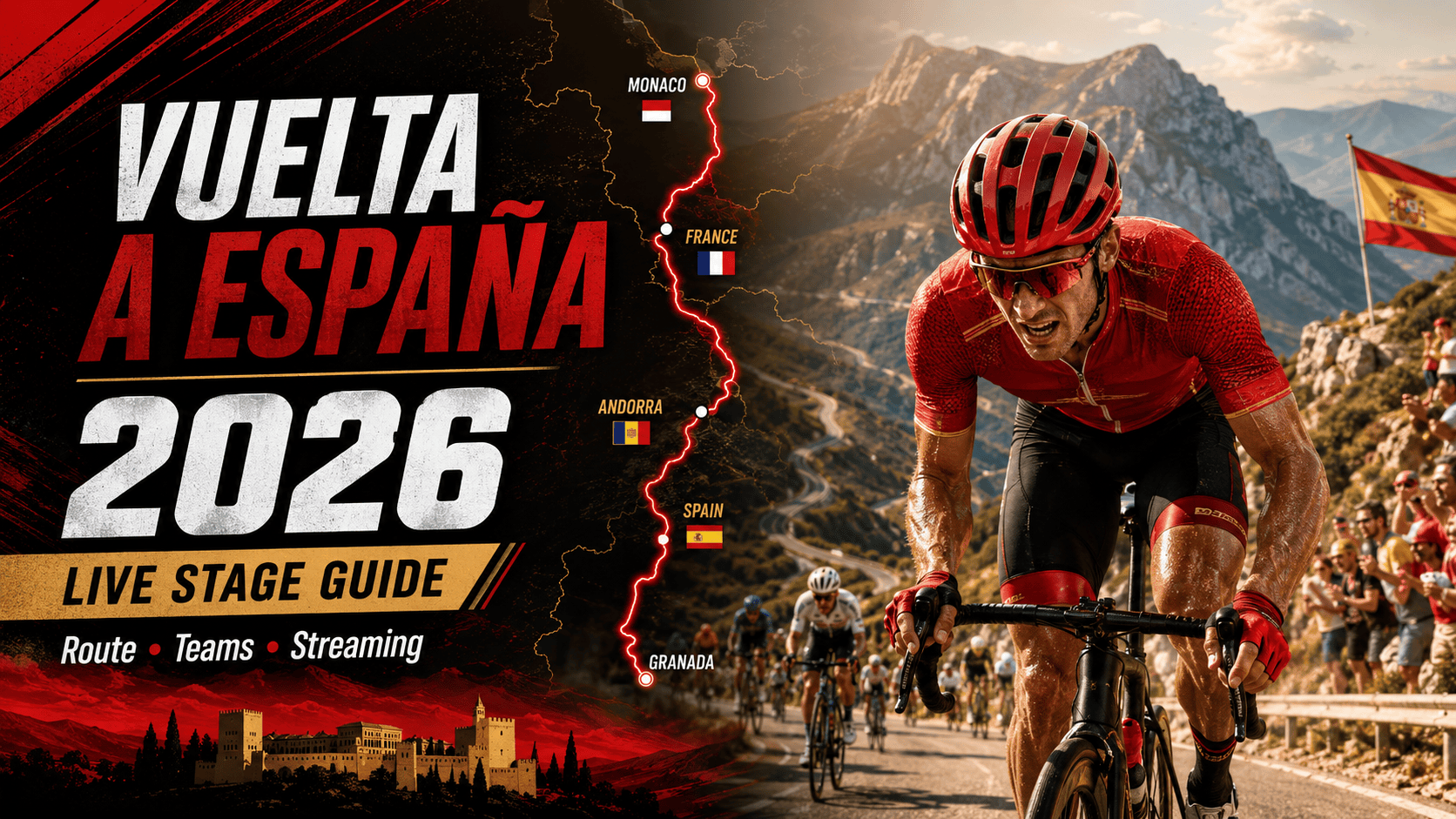
Three weeks. Four countries. Twenty-one stages. More than 58,000 metres of climbing.
The 2026 Vuelta a España runs from August 22 through September 13, taking the peloton on a 3,275-kilometre journey from Monaco to Granada.
The 81st edition of Spain’s Grand Tour begins with a short individual time trial around Monaco, travels through France and Andorra, crosses Spain toward the Mediterranean coast and eventually spends its entire final 10 stages in Andalusia.
This is not a route designed to let the general-classification riders ease themselves into the race.
The first mountain stage arrives on Stage 4 in Andorra. Alto de Aitana closes the opening week. Calar Alto and Sierra de La Pandera wait in week two.
A 32.5-kilometre individual time trial could reshape the standings in the final week before Peñas Blancas and the brutal Stage 20 finish at Collado del Alguacil provide the last opportunities to win—or lose—the red jersey.
The race then finishes in Granada on Sunday, September 13, rather than following the traditional Madrid finale.
For viewers in the United States, NBC Sports and Peacock hold the rights. TNT Sports and Warner Bros. Discovery’s streaming platforms carry the race in the UK and across much of Europe, RTVE provides Spanish coverage, SBS shows the race free in Australia, while FloSports, ESPN, J Sports, Sky Sport and other regional broadcasters handle various international markets.
Here is everything you need to follow the 2026 Vuelta a España from the opening time trial in Monte Carlo to the final celebrations in Granada.
Essential Information
| Detail | Vuelta a España 2026 |
|---|---|
| Edition | 81st |
| Dates | August 22–September 13, 2026 |
| Number of stages | 21 |
| Total distance | 3,275 km |
| Start | Monaco |
| Finish | Granada, Spain |
| Countries visited | Monaco, France, Andorra, Spain |
| Mountain stages | 6 |
| Medium-mountain stages | 4 |
| Flat stages | 4 |
| Hilly stages | 4 |
| Hilly stage with uphill finish | 1 |
| Individual time trials | 2 |
| Rest days | 2 |
| Defending champion | Jonas Vingegaard |
| Leader’s jersey | Red |
The official route classification contains six mountain stages, four medium-mountain stages, four hilly stages, four flat stages, one additional hilly stage ending uphill and two individual time trials.
Two rest days divide the race into its familiar three-week structure.
Race organizers also describe the 2026 route as one of the hardest editions in Vuelta history, with more than 58,000 metres of total elevation gain.
How to Watch Vuelta a España 2026 in the United States
The official Vuelta broadcaster list identifies NBC Sports / Peacock as the rights holder in the United States.
NBC’s broader cycling-rights agreement also includes La Vuelta a España among its A.S.O./Unipublic properties.
Peacock
For viewers primarily interested in streaming, Peacock should be the first service to check.
NBC has used Peacock as the central streaming home for its major cycling portfolio, including start-to-finish coverage of all 21 stages of the 2026 Tour de France.
The exact daily Vuelta start times and any supplemental NBC/NBCSN windows should be checked when NBC publishes its event-specific schedule closer to August 22.
Because European road stages often finish in the late afternoon locally, live Vuelta viewing generally falls in the morning in the United States.
That can make Peacock particularly useful: instead of waiting for a television replay, viewers can follow the race live during the European afternoon.
Can I Watch Every Stage?
The official broadcaster designation gives NBC Sports and Peacock the US rights.
Check NBC’s final schedule before race week for confirmation of which stages receive full live coverage, television simulcasts, replays and supplementary programming.
How to Watch Vuelta a España Online in Spain
Spain has one of the simplest setups.
The official Vuelta broadcaster list names RTVE and Eurosport as Spanish broadcasters.
RTVE’s involvement is particularly important because it gives Spanish viewers access to extensive home-market coverage of their national Grand Tour.
Eurosport provides an alternative for viewers who already subscribe to its cycling coverage.
Spanish commentary naturally carries a different atmosphere than international feeds, particularly during mountain stages when crowds line the climbs and the route moves through familiar cycling regions.
For a race spending its final ten stages entirely in Andalusia, domestic coverage should have no shortage of local context.
How to Watch Vuelta a España 2026 Live in the UK and Ireland
Cycling coverage changed substantially in Britain after the Eurosport channels were integrated into TNT Sports in 2025.
Grand Tour cycling is now part of the TNT Sports portfolio in the UK and Ireland, with streaming through Warner Bros. Discovery’s platforms.
WBD’s long-term rights agreement explicitly includes La Vuelta a España from 2026 through at least 2030 across its European channels and platforms.
That makes TNT Sports the key destination for British viewers.
Streaming Vuelta a España in the UK
Warner Bros. Discovery distributes its cycling coverage through its streaming ecosystem alongside the TNT Sports linear channels.
Subscribers should check the current WBD platform available with their package, as the company’s streaming branding and bundles have changed across European markets.
The major advantage for cycling fans is the ability to watch extended live race coverage rather than waiting for a short television highlights package.
How to Watch the Vuelta for Free in Australia
Australia arguably gets the best deal.
SBS broadcasts the Vuelta a España live and free, with streaming available through SBS On Demand.
In March 2026, SBS confirmed that its cycling portfolio now includes all three men’s Grand Tours—the Giro d’Italia, Tour de France and Vuelta a España—live and free.
That makes SBS On Demand one of the strongest legal free options anywhere in the world.
There is one obvious drawback.
Spain is many hours behind Australia, meaning major stages can run late at night or into the early morning depending on the viewer’s time zone.
For Australian fans, on-demand replays can therefore be almost as important as the live stream.
Canada, New Zealand and Other Countries
The Vuelta maintains a broad international broadcast network.
According to the official broadcaster directory:
| Region | Official Broadcaster |
|---|---|
| United States | NBC Sports / Peacock |
| Canada | FloSports |
| Spain | RTVE, Eurosport |
| Europe | Eurosport / WBD streaming |
| Belgium | VRT |
| Denmark | TV2 |
| Netherlands | NOS |
| Norway | TV2 Norway |
| Australia | SBS |
| New Zealand | Sky Sport |
| Japan | J Sports |
| Southeast Asia | Eurosport |
| Latin America & Caribbean | ESPN |
| Colombia | Caracol TV, Canal RCN |
| Middle East & North Africa | Abu Dhabi Sports |
| Sub-Saharan Africa | SuperSport |
Local rights can affect which stages, feeds, languages and replay options are available. Check the broadcaster’s schedule for your territory immediately before the race.
Can You Watch the Vuelta a España for Free?
Yes—but it depends heavily on where you live.
Spain
RTVE provides domestic coverage as one of the official rights holders.
Australia
SBS and SBS On Demand provide live free coverage.
Belgium and the Netherlands
The official broadcaster list includes VRT in Belgium and NOS in the Netherlands, alongside WBD’s broader European coverage.
Availability of individual live stages and streams should still be checked locally.
Highlights
The official Vuelta platforms publish race news, stage information, classifications, video and highlights throughout the event.
For anyone who cannot spend several hours watching a complete road stage, highlights are often the more practical option—especially on transitional days where the decisive action may come in the final hour.
Can You Watch the Vuelta While Traveling?
Streaming rights are territorial.
A subscription that carries the Vuelta at home may not provide the same stream in another country.
Before traveling, check:
- Whether your broadcaster supports international portability.
- Whether your subscription works at your destination.
- Which broadcaster officially holds Vuelta rights there.
- Whether replays remain available outside your home territory.
VPNs can alter an internet connection’s apparent location, but streaming providers may restrict their use under their terms.
The most reliable option is the licensed broadcaster for the country you are physically visiting.
Monaco to Granada: A Vuelta That Heads South
Most Grand Tours are easier to understand if you look at them as three separate races.
- The first week establishes the hierarchy.
- The second exposes weaknesses.
- The third decides who survives.
The 2026 Vuelta follows that pattern, but its geography gives each week a very different personality.
Week 1: Monaco, France, Andorra and the Mediterranean
The race begins Saturday, August 22 with a 9-kilometre individual time trial in Monaco.
It is short enough that nobody should win the Vuelta there—but long enough for an elite time trialist to take the first red jersey and create immediate gaps.
Stage 2 heads from Monaco to Manosque over 215.2 kilometres before Stage 3 takes the race from Gruissan to the high-altitude finish at Font Romeu. Then comes the first true mountain test: a compact 104.9-kilometre Stage 4 beginning and ending in Andorra la Vella.
The peloton then moves south through Catalonia and Valencia.
Stage 7 finishes at Aramón Valdelinares, while Stage 9 provides one of the first major GC checkpoints with a mountain finish at Alto de Aitana on the Costa Blanca.
Only after Aitana do the riders receive their first rest day.
Week 2: The race turns toward Andalusia
Racing resumes September 1 with Stage 10 from Alcaraz to Elche de la Sierra.
Stage 11 gives the sprinters a flatter 156.1-kilometre route between Cartagena and Lorca, but their relief is brief.
The following day ends at Calar Alto, one of the race’s six officially designated mountain stages.
Stage 13 runs 193.2 kilometres between Almuñécar and Loja before another critical weekend arrives.
On Saturday, September 5, Stage 14 climbs from Jaén to Sierra de La Pandera.
On Sunday, Stage 15 travels from Palma del Río to Córdoba before the second and final rest day.
By this point, the race should have a recognizable hierarchy—but the final week gives the leader very little room to relax.
Week 3: Time trial, Peñas Blancas and Collado del Alguacil
The final six stages take place entirely in southern Spain.
Stage 16 heads toward La Rábida and Palos de la Frontera before Stage 17 provides a relatively flat 189.2-kilometre run into Seville.
Then the race changes.
Stage 18 is a 32.5-kilometre individual time trial from El Puerto de Santa María to Jerez de la Frontera.
It is long enough to matter enormously.
A pure climber who enters Stage 18 with a one-minute advantage over a strong time trialist may no longer be leading by the end of the afternoon.
And there is no easy recovery day afterward.
Stage 19 covers 205.1 kilometres from Vélez-Málaga to the uphill finish at Peñas Blancas in Estepona.
Then comes the final mountain showdown.
Full Vuelta a España 2026 Stage Schedule
| Stage | Date | Route | Distance | Type |
|---|---|---|---|---|
| 1 | Aug. 22 | Monaco → Monaco | 9 km | Individual TT |
| 2 | Aug. 23 | Monaco → Manosque | 215.2 km | Hilly |
| 3 | Aug. 24 | Gruissan-Aude → Font Romeu | 166.7 km | Medium mountains |
| 4 | Aug. 25 | Andorra la Vella → Andorra la Vella | 104.9 km | Mountain |
| 5 | Aug. 26 | Falset → Roquetes | 171.1 km | Hilly |
| 6 | Aug. 27 | Alcossebre → Castelló | 176.8 km | Medium mountains |
| 7 | Aug. 28 | Vall d’Alba → Aramón Valdelinares | 149.9 km | Mountain |
| 8 | Aug. 29 | Puçol → Xeraco | 176.4 km | Flat |
| 9 | Aug. 30 | Villajoyosa → Alto de Aitana | 187.5 km | Mountain |
| — | Aug. 31 | Rest Day | — | — |
| 10 | Sept. 1 | Alcaraz → Elche de la Sierra | 184.5 km | Hilly |
| 11 | Sept. 2 | Cartagena → Lorca | 156.1 km | Flat |
| 12 | Sept. 3 | Vera → Calar Alto | 166.5 km | Mountain |
| 13 | Sept. 4 | Almuñécar → Loja | 193.2 km | Medium mountains |
| 14 | Sept. 5 | Jaén → Sierra de La Pandera | 152.7 km | Mountain |
| 15 | Sept. 6 | Palma del Río → Córdoba | 181.2 km | Medium mountains |
| — | Sept. 7 | Rest Day | — | — |
| 16 | Sept. 8 | Cortegana → La Rábida | 186 km | Hilly |
| 17 | Sept. 9 | Dos Hermanas → Sevilla | 189.2 km | Flat |
| 18 | Sept. 10 | El Puerto de Santa María → Jerez | 32.5 km | Individual TT |
| 19 | Sept. 11 | Vélez-Málaga → Peñas Blancas | 205.1 km | Uphill finish |
| 20 | Sept. 12 | La Calahorra → Collado del Alguacil | 187 km | Mountain |
| 21 | Sept. 13 | Carrefour Granada → Granada | 99.4 km | Flat |
All distances and route classifications come from the official 2026 Vuelta route.
Who Won the Vuelta in 2025?
Jonas Vingegaard won the 2025 Vuelta a España, claiming his first overall victory in the Spanish Grand Tour.
The Dane finished 1 minute 16 seconds ahead of João Almeida, with Tom Pidcock completing the podium at 3:11. Jai Hindley finished fourth and Matthew Riccitello fifth.
Vingegaard’s victory also made Denmark the 15th nation to produce a Vuelta champion.
The 2025 edition ended unusually when protests in Madrid caused Stage 21 to be shortened before the intended finish, and organizers did not hold the normal final podium ceremony.
Pogačar Returns to Chase the Grand Tour Set
The biggest pre-race storyline in 2026 is Tadej Pogačar.
Pogačar confirmed in early August that he intends to start the Vuelta, returning to the race for the first time since his breakthrough Grand Tour debut in 2019.
And he has unfinished business.
The Slovenian has already won the Tour de France and Giro d’Italia, but La Vuelta remains the Grand Tour missing from his palmarès.
His only previous Vuelta appearance came in 2019, when he finished third overall and won three stages.
His presence immediately changes the race.
A climber-friendly route with more than 58,000 metres of elevation, seven significant uphill finishes and two individual time trials gives an all-round GC rider plenty of opportunities to create separation.
Roglič is Chasing History of His Own
Primož Roglič entered 2026 with an explicit goal of returning to the Vuelta and chasing a record fifth overall victory.
His Red Bull–BORA–hansgrohe team identified the Spanish Grand Tour as a major target in its 2026 Grand Tour plan.
Roglič has already won the race four times.
A fifth victory would therefore give the 2026 edition a historical dimension of its own.
The opening time trial also suits a rider who has repeatedly used time trials and short explosive climbs to build his Vuelta campaigns.
Don’t Treat Preliminary Start Lists as Final
The complete rider list remains subject to change until teams confirm their final selections.
What is already confirmed is the field of 23 participating teams.
The organizer has selected all 18 UCI WorldTeams, the three leading eligible ProTeams from the 2025 ranking—Tudor, Pinarello-Q36.5 and Cofidis—plus Spanish wildcards Burgos-Burpellet-BH and Equipo Kern Pharma.
All 23 Teams at the 2026 Vuelta
The confirmed teams are:
- Alpecin–Premier Tech
- Bahrain Victorious
- Decathlon–CMA CGM
- EF Education–EasyPost
- Groupama–FDJ United
- INEOS Grenadiers
- Lidl–Trek
- Lotto Intermarché
- Movistar Team
- NSN Cycling Team
- Red Bull–BORA–hansgrohe
- Soudal Quick-Step
- Team Jayco AlUla
- Team Picnic–PostNL
- Team Visma–Lease a Bike
- UAE Team Emirates XRG
- Uno-X Mobility
- XDS Astana Team
- Tudor Pro Cycling Team
- Pinarello–Q36.5 Pro Cycling Team
- Cofidis
- Burgos-Burpellet-BH
- Equipo Kern Pharma
The official Vuelta team announcement confirms those 23 squads for the 81st edition.
Which Stages Should Casual Fans Watch?
You do not need to watch all 21 stages to understand the race.
If your time is limited, prioritize these.
Stage 1 — Monaco Time Trial
August 22
Only 9 kilometres, but it establishes the first red jersey and immediately shows which GC riders have arrived in form.
Stage 4 — Andorra
August 25
The first official mountain stage comes just four days into the race.
It should provide the first meaningful indication of which overall contenders are genuinely competitive.
Stage 9 — Alto de Aitana
August 30
A 187.5-kilometre mountain stage ending at Alto de Aitana immediately before the first rest day.
Nobody wants to spend the rest day knowing they lost several minutes the afternoon before.
Stage 12 — Calar Alto
September 3
Another summit test as the Vuelta settles into Andalusia.
Stage 14 — Sierra de La Pandera
September 5
A classic-looking Vuelta mountain stage placed at the heart of the second weekend.
Stage 18 — Final Time Trial
September 10
At 32.5 kilometres, this is considerably more consequential than the Monaco opener.
It could turn a narrow climbing advantage into a deficit.
Stage 19 — Peñas Blancas
September 11
A massive 205.1-kilometre day with an uphill finish.
Coming immediately after the time trial makes it tactically fascinating.
Stage 20 — Collado del Alguacil
September 12
The last mountain stage.
The final chance to take the red jersey by force.
If the GC remains close, this is the stage you should not miss.
What Do the Vuelta Jerseys Mean?
A Grand Tour isn’t only about the overall winner.
Several competitions run simultaneously.
Red Jersey — General Classification
The red jersey, or La Roja, belongs to the rider with the lowest cumulative time across the race.
This is the classification that determines the overall Vuelta champion.
If Rider A has completed the race in 60 hours and Rider B has taken 60 hours and 45 seconds, Rider A leads by 45 seconds.
Green Jersey — Points Classification
The points competition rewards consistent stage finishes and intermediate sprint results.
Fast finishers can build large totals on flatter stages, but the Vuelta’s terrain often allows versatile riders to challenge pure sprinters.
Mountains Classification
Climbers collect points at designated mountain summits.
Harder categorized climbs normally offer more points.
A rider can therefore win the mountains competition without being close to winning the overall race.
White Jersey — Young Rider
The young-rider classification measures the best eligible rider by general-classification time.
It often provides an early indication of a future Grand Tour contender.
Team Classification
Teams also compete collectively, with stage times contributing to an overall team classification.
That competition receives less attention than the red jersey but matters to squads without a realistic individual GC winner.
How Does a Grand Tour Actually Work?
If you mainly watch football, tennis or golf, the Vuelta can initially seem confusing.
The rider who crosses the line first does not necessarily lead the race.
Each stage has its own winner.
But the overall Vuelta is determined by cumulative time.
Imagine this:
Rider A finishes Stage 1 in 20 minutes.
Rider B finishes in 20:10.
Rider A therefore leads by 10 seconds.
The next day, Rider B finishes 20 seconds ahead.
Rider B now leads the overall classification by 10 seconds.
Repeat that process over 21 stages and thousands of kilometres.
Time bonuses, crashes, mechanical problems, time trials, breakaways and mountain attacks can all influence the final result.
That is what makes Grand Tour racing different.
The battle taking place at the front of a stage might determine the stage winner, while another battle two minutes behind determines the red jersey.
What Is a Breakaway?
Most road stages begin with riders attempting to escape from the main group, known as the peloton.
If five riders build a four-minute advantage, they form the breakaway.
Whether they survive depends on several factors:
- How dangerous they are in the overall standings
- Which teams want to chase
- The stage profile
- Wind
- Distance remaining
- Sprint-team strategy
- Mountain terrain
A breakaway might hold a 10-minute lead halfway through a stage and still be caught before the finish.
On another day, the peloton may deliberately allow it to survive.
Understanding that tactical contest makes long stages much more interesting to watch.
FAQs
When does the Vuelta a España 2026 start?
The 2026 Vuelta begins on Saturday, August 22 with a 9-kilometre individual time trial in Monaco.
When does the 2026 Vuelta finish?
Stage 21 takes place on Sunday, September 13, finishing in Granada.
How many stages are in the Vuelta a España?
There are 21 stages and two rest days.
How long is the Vuelta a España 2026?
The official route totals approximately 3,275 kilometres.
Where does the 2026 Vuelta start?
The Grand Départ takes place in Monaco. Stage 1 starts and finishes there before Stage 2 travels from Monaco into France.
Where does the Vuelta finish?
For 2026, the race finishes in Granada rather than Madrid. Race organizers highlighted Granada and the Alhambra as the setting for the conclusion of the 81st edition.
What channel is the Vuelta on in the United States?
The official Vuelta broadcaster directory lists NBC Sports / Peacock for the United States.
Can I watch the Vuelta on Peacock?
Peacock forms part of NBC Sports’ US cycling coverage, and the Vuelta’s official broadcaster list specifically identifies NBC Sports/Peacock for the American market.
What channel shows the Vuelta in the UK?
Grand Tour cycling moved into the TNT Sports portfolio in the UK and Ireland following the integration of Eurosport content. Warner Bros. Discovery’s current long-term cycling agreement includes La Vuelta through at least 2030.
Can I watch the Vuelta free in Australia?
Yes. SBS and SBS On Demand carry the race live and free in Australia.
Who won the 2025 Vuelta?
Jonas Vingegaard won the 2025 general classification ahead of João Almeida and Tom Pidcock.
Is Tadej Pogačar riding the Vuelta in 2026?
Pogačar confirmed his intention to race the 2026 Vuelta in early August. Victory would give him the one Grand Tour title still missing from his career.
Is Primož Roglič racing the Vuelta?
Red Bull–BORA–hansgrohe identified the 2026 Vuelta as a major target for Roglič, with the Slovenian pursuing a fifth overall title. Final start lists can still change before race day.
When is the final Vuelta time trial?
The second individual time trial is Stage 18 on Thursday, September 10, covering 32.5 kilometres from El Puerto de Santa María to Jerez de la Frontera.
What is the hardest stage of the 2026 Vuelta?
There is no official single “hardest stage,” but Stage 20 to Collado del Alguacil stands out because it is a 187-kilometre mountain stage on the penultimate day. Stage 9 to Alto de Aitana, Stage 12 to Calar Alto and Stage 14 to Sierra de La Pandera are other major mountain tests.
Why does the leader wear red?
Red is the Vuelta’s general-classification leader jersey. The rider with the lowest accumulated race time wears La Roja.
Three Weeks, One Red Jersey
The 2026 Vuelta has almost everything you would ask for from a Grand Tour.
It begins with the pressure of a time trial.
The mountains arrive almost immediately.
The route crosses Monaco, France, Andorra and Spain, passes along the Mediterranean and then commits its final ten stages to Andalusia.
There are opportunities for sprinters, breakaway specialists, time trialists and climbers—but the overall winner will need to handle all of them.
For US viewers, NBC Sports and Peacock are the key services. British viewers can follow through Warner Bros. Discovery’s TNT Sports ecosystem. Australians get an excellent free option through SBS, while RTVE and Eurosport provide major coverage in Spain.
And the race could carry genuine history.
Tadej Pogačar is returning in pursuit of the Grand Tour title he has never won, while Primož Roglič entered the season targeting a fifth Vuelta victory.
Between them and the rest of a 23-team field lies 3,275 kilometres and more than 58,000 metres of climbing.
It starts with nine kilometres against the clock in Monaco on August 22.
It may ultimately be decided high above Granada on September 12.
And one day later, the final red jersey of the 2026 Grand Tour season will reach Granada.