Step into any packed gym on a Friday night and you’ll feel it instantly — volleyball is organized chaos, a symphony performed at full speed.
The rallies unfold in seconds, spikes echo off the walls, and defenders throw themselves across the floor to keep the ball alive. To the untrained eye, it looks unpredictable.
But beneath every explosive exchange lies structure. That structure begins with understanding position in volleyball. Without it, the match feels like a blur of motion. With it, the rhythm becomes clear.
Even when you glance at something as simple as a scoreboard — whether it’s a local league result or a youth academy update like a Riga volleyball school score — what you’re really seeing is the outcome of disciplined positioning and tactical execution.
Every point earned reflects coordinated movement, defined roles, and athletes performing their responsibilities with precision. Volleyball may feel chaotic in the moment, but its success is built on organization, awareness, and mastery of each role on the court.
Every player on the court has a purpose — and those purposes interlock like gears in a finely tuned machine. If you’ve ever asked yourself, what are the 6 position in volleyball, you’re already thinking like a coach.
Knowing who attacks, who sets, who defends, and who anchors the back row completely changes how you watch — and play — the sport.
And then there’s that question beginners often whisper during matches: whats a DS in volleyball and why does that player keep running in and out of the game?
These aren’t just technical details. They’re the blueprint of winning volleyball. From the setter directing traffic like a floor general to the outside hitter soaring near the antenna, each role shapes the rhythm of a rally.
In the sections ahead, we’ll break down how the court is divided, how rotations transform responsibilities, and why mastering the six roles turns a group of athletes into a true team.
What Does “Position in Volleyball” Really Mean?
At first glance, volleyball might look simple: six players per side, rally the ball, score the point. But the deeper truth is that each athlete occupies a defined tactical role.
A position in volleyball is more than a spot on the floor — it’s a job description that blends movement patterns, technical responsibilities, and strategic awareness.
On paper, players are arranged in three front-row and three back-row spots. During play, they rotate clockwise after winning the serve from the opponent. That rotation system ensures that every athlete cycles through different zones of the court.
However, while locations change, roles usually remain consistent. A middle blocker who rotates into the back row is often replaced by a libero or defensive specialist. A setter who moves to the front row becomes eligible to block.
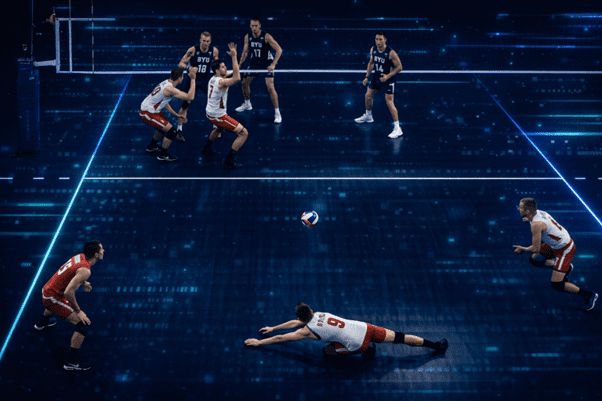
Positioning dictates offensive timing. It shapes defensive coverage. It influences who attacks from which angle and who stays ready for the dig. When a team transitions from defense to offense — that split second after a dig — each player must instinctively move to their assigned responsibility.
The outside hitter widens toward the left antenna. The middle prepares for a quick set. The setter hunts for the second contact.
Understanding positions also clarifies strategy. Systems like the 5–1 (one setter, five attackers) or 6–2 (two setters who alternate as attackers) revolve around role distribution.
So when people ask about the 6 volleyball positions, they’re really asking about the skeleton that supports every rally.
Remove that structure, and the game collapses into confusion. Embrace it, and the sport becomes a beautifully choreographed contest of timing and intelligence.
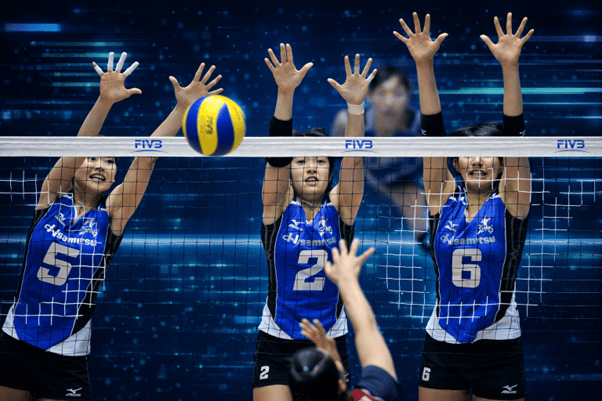
The 6 Volleyball Positions Explained
Let’s answer the big question directly: what are the 6 position in volleyball? On the court at any given time, a team fields six distinct roles, each carrying specialized duties. Together, they form the engine of competitive play.
The 6 Volleyball Positions & Their Core Responsibilities
| Position Name | Abbreviation | Primary Role | Court Zone |
| Setter | S | Orchestrates offense, sets the ball | Near net, front row |
| Outside Hitter | OH | Main attacker, serve receive | Left side |
| Middle Blocker | MB | Blocks opponents, quick attacks | Center net |
| Opposite Hitter / Right Side | OP | Attacks from right side | Right front |
| Libero / Defensive Specialist | L / DS | Back-row defense, passing | Backcourt |
| Defensive Specialist | DS | Defensive support | Sub in back row |
The setter is the strategist — the quarterback of volleyball. Every attack flows through their hands.
The outside hitter is often the primary scorer, expected to handle serve receive and deliver powerful swings from the left side. The middle blocker patrols the net, reading the opponent’s setter and shutting down quick attacks.
On the right side stands the opposite hitter, a versatile force who contributes both offensively and defensively.
In the backcourt, the libero — easily recognized by a contrasting jersey — specializes in passing and digging. Meanwhile, a defensive specialist may substitute in the back row to strengthen reception or defensive coverage.
Rotations complicate the picture. As players rotate, they momentarily occupy different physical spots on the floor, yet their responsibilities remain anchored to their role. The outside hitter rotating into the back row focuses on passing and defense.
The middle often exits for the libero. The setter adjusts from back-row playmaker to front-row blocker.
That constant motion is what gives volleyball its strategic depth. Six roles, one seamless machine.
Deep Dive: Key Roles on Court
Setter
Precision. Vision. Nerve. A great setter blends all three. This player touches the ball more than anyone else and determines the tempo of every rally. A setter must read blockers, disguise intentions, and deliver hittable balls from imperfect passes.
The best setters make chaos look controlled, turning off-balance digs into scoring chances. Their influence is subtle but absolute — change the setter, and you change the identity of the team.
Pin Hitter: What Is a Pin Hitter in Volleyball?
So, what is a pin hitter in volleyball? The term refers to attackers who hit from the “pins,” or antennae, at either end of the net — typically the outside and opposite hitters.
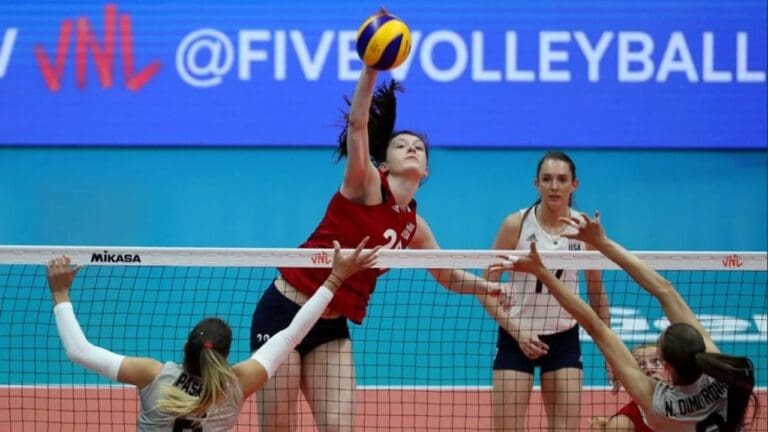
These players stretch the defense horizontally. By attacking from the edges, they create angles that force blockers to commit and defenders to scramble.
Pin hitters thrive in high-pressure situations. When a rally breaks down and the play becomes predictable, the ball often goes to the outside. Why? Because pin hitters are trained to score against organized blocks.
Their ability to tool the hands of defenders or swing cross-court under pressure makes them indispensable in tight matches.
Middle Blocker
The middle blocker is the team’s first line of defense at the net. Quick footwork and explosive jumping are essential. Middles read the opponent’s setter, close blocks with teammates, and execute rapid “quick sets” that catch defenses off guard.
Timing is everything. A split-second delay can mean the difference between a stuff block and an open seam.
Opposite Hitter
Stationed on the right side, the opposite balances the attack. Often facing the opponent’s strongest outside hitter, this player must block effectively while contributing offensively.
In many systems, the opposite is a reliable scorer in transition plays and a stabilizing presence during extended rallies.
Libero vs Defensive Specialist
Though they share back-row duties, the libero and defensive specialist are not identical. The libero wears a different jersey and can replace back-row players without formal substitutions.
This role focuses on serve receive, digging, and ball control. A defensive specialist, meanwhile, is substituted in specific rotations for targeted defensive improvement.
Both roles enhance stability, but the libero is a permanent defensive anchor, while the DS is a tactical adjustment.
Understanding that difference clarifies substitutions and rotation strategy — and answers that early question about defensive roles once and for all.
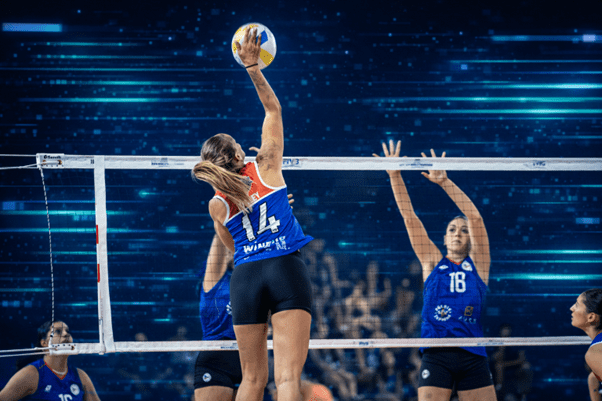
Two Essential Lists Every Player Should Study
By now, we’ve mapped the court and defined the roles. But roles alone don’t win rallies — skills do. No matter where an athlete lines up, there are fundamentals that separate dependable contributors from spectators.
Top 5 Skills Every Volleyball Player Needs
- Serving precision: A strong serve isn’t just about power; it’s about intent. Targeting seams between passers, forcing weaker receivers to handle the ball, or varying pace keeps opponents uncomfortable. Great servers think two contacts ahead.
- Passing and receiving: Serve receive is the hidden engine of offense. A perfect pass allows the setter to use the full width of the net. A poor pass limits options and makes attacks predictable. Ball control is the quiet art behind every highlight swing.
- Blocking and reading attacks: Blocking begins with anticipation. Recognizing a hitter’s approach angle, shoulder position, and timing helps defenders close space at the net. Even a well-formed block that doesn’t score can funnel the ball toward waiting defenders.
- Quick decision-making: Volleyball unfolds in fractions of seconds. Whether it’s a setter choosing a quick set or a libero deciding to take the second ball, decisive action keeps rallies alive. Hesitation, even brief, often costs a point.
- Court communication: The best teams sound like orchestras — constant calls of “mine,” “line,” or “tip.” Communication prevents collisions, clarifies coverage, and builds trust. Silence breeds confusion; clarity breeds confidence.
Now let’s flip the lens and look at where things commonly go wrong.
Common Mistakes Beginners Make by Position
- Setter over-setting: Young setters sometimes try to be magicians, forcing difficult balls into tight spaces instead of choosing the safest option. Simplicity often beats flair.
- Outside hitter ignoring angles: Swinging hard is impressive, but smart hitters use the entire court. Ignoring cross-court or line options makes attacks easier to defend.
- Middle blocker footwork errors: Slow lateral movement or poor timing leaves gaps in the block. Middles must stay light on their feet and read the setter early.
- Opposite ignoring transition defense: After attacking, the opposite must quickly shift into defensive readiness. Failing to reset leaves the backcourt exposed.
- Libero or defensive specialist misreading hitters: Back-row defenders who guess instead of read often drift out of position. Studying approach patterns and body language is essential.
Mistakes are part of development, but recognizing patterns accelerates improvement.
How Positioning Shapes Team Strategy
Zoom out from the individual and you’ll see the grand design. Systems determine how the six players function as a unit.
The 5–1 system relies on one dedicated setter who runs the offense in all rotations. This approach builds rhythm and leadership consistency. Hitters adapt to one playmaker’s tempo, and offensive chemistry grows over time.
The 6–2 system, on the other hand, employs two setters who alternate when rotating to the back row. This creates three front-row attackers at all times, often increasing offensive firepower. It demands versatility and seamless substitution timing.
Defensively, rotations influence coverage schemes. When a middle blocker rotates to the back row and is replaced, the backcourt may shift slightly deeper. When a strong opposite lines up against a dominant outside hitter, teams may adjust block assignments to create matchup advantages.
Strategic positioning also dictates serve targeting. A coach might instruct servers to pressure a weaker passer or force the opponent’s setter into uncomfortable movement. Every serve, substitution, and rotation tells a tactical story.
In essence, alignment is strategy made visible.
Volleyball may look spontaneous, but beneath every diving save and thunderous spike lies thoughtful structure.
Understanding roles on the court reveals why rallies unfold the way they do. It explains why one player directs traffic, another anchors the defense, and another soars at the antenna when the set floats high.
The beauty of the sport is that while responsibilities are defined, growth comes from versatility. Setters benefit from practicing defense. Middles sharpen instincts by studying back-row coverage. Cross-training builds smarter athletes and stronger teams.
So the next time you watch a match — or step onto the court yourself — pay attention to movement before the ball is struck. Study rotations. Notice transitions. Explore drills that challenge different responsibilities.
Because once you truly grasp how the pieces fit together, volleyball stops being chaos and starts being choreography. And that’s when the game becomes unforgettable.
FAQ About Volleyball Positions
How many players are on the court in volleyball?
At any given moment, six athletes represent each team — three stationed in the front row near the net and three covering the backcourt. When a team wins back the serve, everyone shifts one spot clockwise. This rotation keeps the game dynamic while preserving each player’s core position in volleyball.
What is the primary role of a libero?
The libero is the defensive backbone of the team. Wearing a contrasting jersey, this specialist operates exclusively in the back row, focusing on precise passing and controlled digs. While the libero cannot attack above net height, their ball control and court awareness often determine whether a rally survives or collapses.
Can a defensive specialist serve?
In most formats, yes. A defensive specialist (DS) is a regular substitute, meaning they follow standard rotation rules and can serve if they rotate into the correct position. Unlike the libero, the DS does not have special substitution privileges but provides valuable flexibility in the back row.
What is a pin hitter in volleyball?
A pin hitter attacks from the outer edges of the net — near the antennas, often called “pins.” This term typically refers to outside hitters and opposite hitters. These players create scoring opportunities from sharp angles and are frequently trusted to deliver in high-pressure moments.
Are positions fixed throughout a match?
Not exactly. Players rotate through different zones on the court, but their responsibilities remain tied to their designated role. Strategic substitutions — especially involving liberos and defensive specialists — help teams maintain structure within the constant motion of rotation.