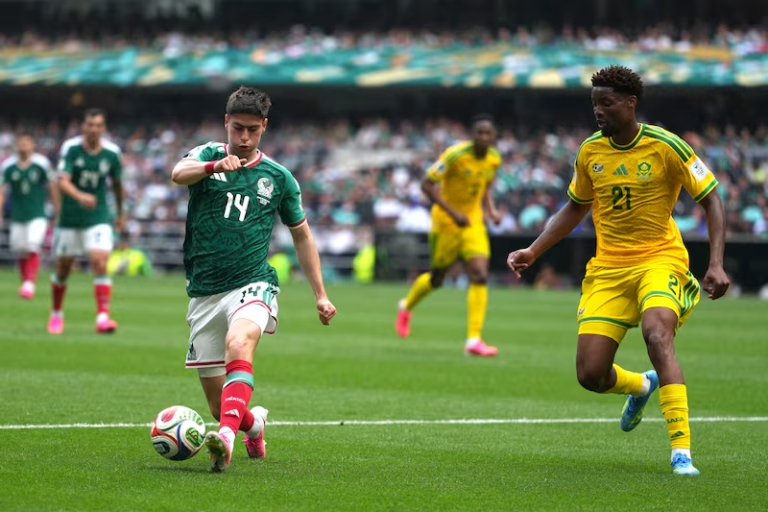
Every FIFA World Cup introduces a new generation of stars. Some arrive with lofty expectations, while others seize unexpected opportunities.
The expanded 48-team format has created even more chances for young players to shine on soccer’s biggest stage.
As the knockout rounds gather momentum, several emerging talents have become central figures in their nations’ campaigns.
Their performances have not only helped keep their teams alive but have also turned them into some of the tournament’s most compelling stories.
1. Ayyoub Bouaddi (Morocco)
Morocco’s memorable run has been built on discipline, composure, and midfield control. At the center of it is 18-year-old Ayyoub Bouaddi, whose maturity has stood out throughout the tournament against elite opposition.
The Lille midfielder looked remarkably comfortable against Brazil, receiving the ball in tight spaces, escaping pressure, and helping Morocco manage the tempo during sustained spells of possession against one of the tournament favorites.
His influence has carried into the knockout stage, where Morocco eliminated the Netherlands in a dramatic penalty shootout. Bouaddi’s ability to link defense and attack has helped Morocco stay compact in central areas without losing creativity.
Morocco’s knockout run has put greater attention on players like Bouaddi. Fans following the remaining World Cup fixtures and betting markets through FanDuel Sportsbook can track how one of the tournament’s breakout midfielders fits into the wider road to the final.
2. Johan Manzambi (Switzerland)
Switzerland entered the tournament with a reputation for organization and defensive stability. Johan Manzambi has added something just as valuable: unpredictability. That balance has made Switzerland far more difficult to contain.
The 20-year-old creative midfielder began as a substitute before changing the Bosnia and Herzegovina match with a brilliant second-half brace. Since earning a starting role, he has added another goal and an assist during Switzerland’s run.
Those numbers tell only part of the story. Manzambi excels through movement, drifting into dangerous pockets of space and arriving late in the penalty area just as defenders lose track of him. That timing gives Switzerland a sharper attacking edge.
Fresh from an impressive club season with Freiburg, Manzambi now looks perfectly suited to the World Cup stage. If Switzerland keeps advancing, his energy and attacking instincts in central areas should become even more important.
3. Gilberto Mora (Mexico)
Few players have faced greater expectations than Gilberto Mora. Playing a home World Cup at just 17 years old could overwhelm even experienced professionals, but Mexico’s young playmaker has embraced the moment with confidence.
Operating between midfield and attack, Mora constantly searches for spaces others overlook. His quick combinations and first-time passing have added speed to Mexico’s offense while giving teammates more freedom in advanced areas.
History has already followed him. At 17 years and 240 days, Mora became the youngest player ever to represent a host nation at a FIFA World Cup, but the record only tells part of the story. His performances have matched the milestone.
His calm decision-making under pressure has energized Mexico’s run into the Round of 16. European clubs were already monitoring his development, and every appearance reinforces the belief that Mexico has one of its brightest long-term stars.
4. Antonio Nusa (Norway)
Norway’s return to the World Cup has understandably centered around Erling Haaland. Antonio Nusa has ensured the conversation no longer begins and ends there. Opponents can no longer focus solely on Haaland in decisive attacking moments.
The dynamic winger has become the creative spark that makes Norway’s attack more unpredictable. With opponents focusing heavily on Haaland inside the penalty area, Nusa has found room to isolate defenders on the left flank.
His Round of 32 performance against Ivory Coast showed exactly why he matters. Nusa scored the opening goal and repeatedly forced defenders backward with direct running during Norway’s decisive attacking spells and sharp one-on-one play.
That willingness to attack defenders changes Norway’s shape in the final third. Rather than relying on one central threat, Norway can now stretch opponents from wider areas, making them a far more dangerous knockout opponent.
5. Luc de Fougerolles (Canada)
Canada’s progress has surprised many observers, but its defensive consistency has been anything but accidental during its tournament run. Luc de Fougerolles has emerged as one of the foundations of that success.
The Fulham defender entered the starting lineup during an injury crisis and immediately provided calm leadership beyond his 20 years. Comfortable at center back and right back, he has given Canada valuable tactical flexibility across the backline.
His greatest strength lies in positioning. Instead of relying on desperate recovery tackles, de Fougerolles anticipates danger early, forces attackers into difficult angles, and wins possession cleanly. That discipline has helped Canada stay organized under pressure.
Breakout defenders rarely receive the same attention as exciting attackers, but World Cups are often shaped by players who prevent goals as much as those who score them. Canada’s knockout run shows why de Fougerolles deserves wider recognition.
The Bigger Meaning Behind Their Rise
These five players represent more than individual success stories. Each has shown how today’s young footballers can arrive on the international stage with the tactical education, confidence, and match experience needed to handle knockout pressure.
Their influence also shows how quickly a World Cup can reshape careers. Strong performances over a few weeks can elevate reputations, attract transfer interest, and redefine expectations for club and country. A single tournament can change futures.
Fans tracking player performances, team trends, and knockout-round insights can explore 2026 FIFA World Cup stats & analysis for added context. These emerging stars prove every World Cup belongs to a new generation, not just established legends.
The Spotlight Is Only Getting Brighter
The knockout stage has already turned Bouaddi, Manzambi, Mora, Nusa, and de Fougerolles into names recognized well beyond their home countries.
With several of their tournament journeys still unfolding, each remaining opportunity offers another chance to shape the competition and their careers.
By the time the trophy is lifted, one or more of these players may no longer be considered emerging stars. Their impact is already shaping the tournament. They may simply be remembered as some of the defining figures of the 2026 FIFA World Cup.
RELATED ARTICLES