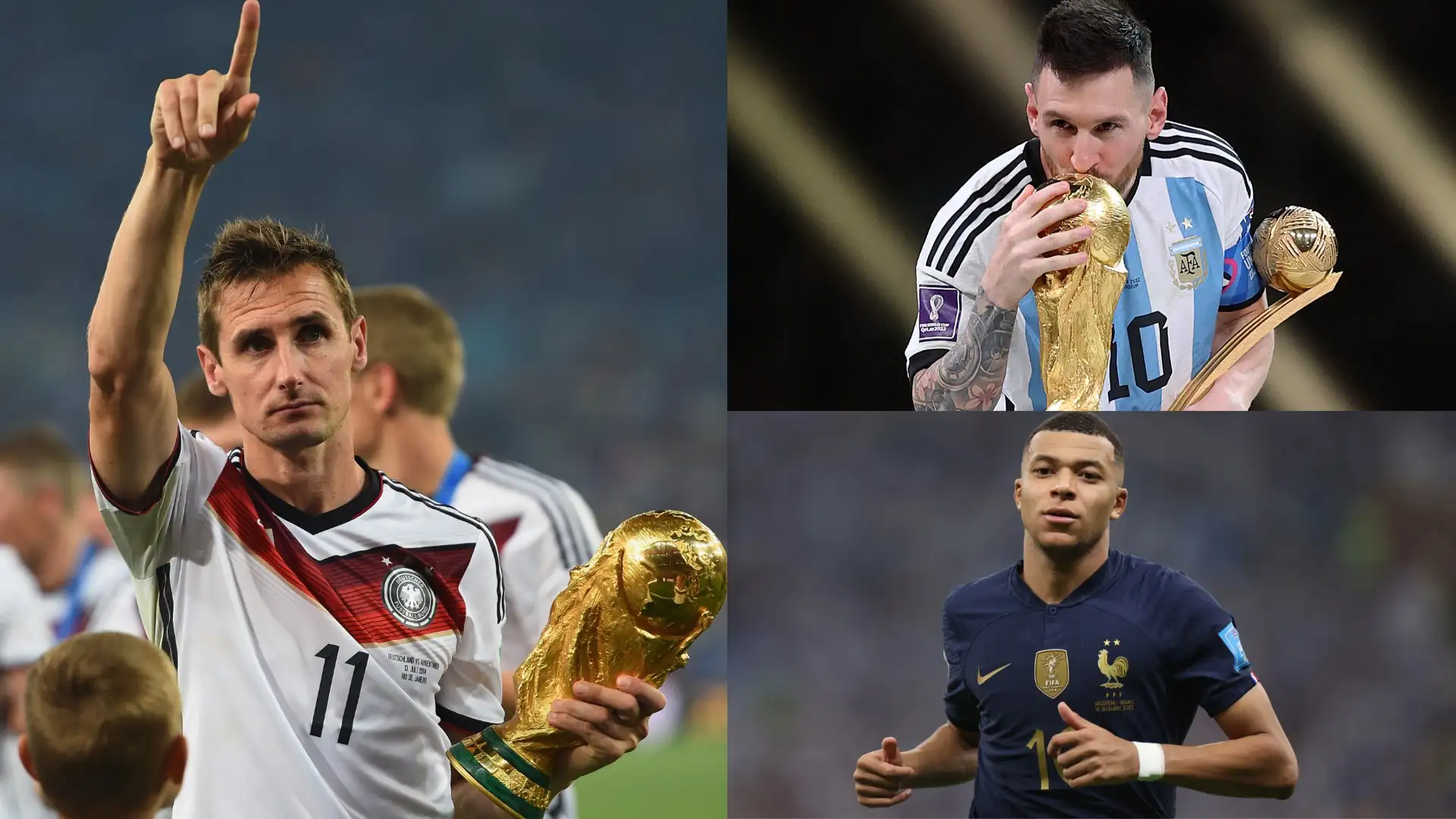
Germany’s Miroslav Klose holds the all-time FIFA World Cup scoring record with 16 goals across four tournaments (2002-2014).
Brazil’s Ronaldo comes second with 15 goals, followed by Gerd Müller with 14. Just Fontaine and Lionel Messi share fourth place with 13 goals each, though Fontaine achieved his total in a single tournament while Messi needed five.
Only 16 players have scored 10 or more World Cup goals in tournament history. The records split into two distinct categories: career totals accumulated across multiple tournaments, and single-tournament performances.
Fontaine’s 13 goals in the 1958 World Cup remains the unmatched single-tournament record.
All-Time FIFA World Cup Top Scorers (Career Totals)
| Rank | Player | Goals | Tournaments | Matches | Goals/Match |
| 1 | Miroslav Klose (Germany) | 16 | 4 (2002-2014) | 24 | 0.67 |
| 2 | Ronaldo (Brazil) | 15 | 3 (1998-2006) | 19 | 0.79 |
| 3 | Gerd Müller (West Germany) | 14 | 2 (1970-1974) | 13 | 1.08 |
| T4 | Just Fontaine (France) | 13 | 1 (1958) | 6 | 2.17 |
| T4 | Lionel Messi (Argentina) | 13 | 5 (2006-2022) | 26 | 0.50 |
| 6 | Pelé (Brazil) | 12 | 4 (1958-1970) | 14 | 0.86 |
| 7 | Kylian Mbappé (France) | 12 | 2 (2018-2022) | 14 | 0.86 |
| 8 | Sándor Kocsis (Hungary) | 11 | 1 (1954) | 5 | 2.20 |
| T9 | Jürgen Klinsmann (Germany) | 11 | 3 (1990-1998) | 17 | 0.65 |
| 10 | Thomas Müller (Germany) | 10 | 4 (2010-2022) | 19 | 0.53 |
| T11 | Gabriel Batistuta (Argentina) | 10 | 3 (1994-2002) | 12 | 0.83 |
| T11 | Gary Lineker (England) | 10 | 2 (1986-1990) | 12 | 0.83 |
| T11 | Teófilo Cubillas (Peru) | 10 | 3 (1970-1982) | 13 | 0.77 |
| T11 | Grzegorz Lato (Poland) | 10 | 3 (1974-1982) | 20 | 0.50 |
| T11 | Helmut Rahn (West Germany) | 10 | 2 (1954-1958) | 10 | 1.00 |
The all-time career leaders share one common advantage: longevity.
Participating in multiple tournaments provides more match opportunities, which directly impacts total goals. Klose’s 16-goal record came from competing in four consecutive World Cups over 12 years.
Each tournament offered him 5-7 matches depending on Germany’s progression, accumulating to 24 total appearances.
Compare this to Fontaine’s single tournament run in 1958. Despite scoring at a remarkable 2.17 goals-per-match rate, he only had six matches to build his total. Fontaine never played another World Cup due to career-ending injury in 1962.
The goals-per-match column reveals the efficiency gap. While Klose converted 0.67 goals per game across his career, Fontaine and Kocsis both exceeded 2.00 goals per match in their limited appearances.
Gerd Müller’s 1.08 rate across 13 games shows sustained excellence at a level modern players rarely match.
Miroslav Klose: The Unmatched Career Leader (16 Goals Across Four Tournaments)
Miroslav Klose built his record through consistency rather than explosive single-tournament performances.
His tournament-by-tournament breakdown:
- 2002 World Cup: 5 goals (including hat-trick on debut vs Saudi Arabia)
- 2006 World Cup: 5 goals (won Golden Boot<span> on home soil in Germany)
- 2010 World Cup: 4 goals (third-place finish)
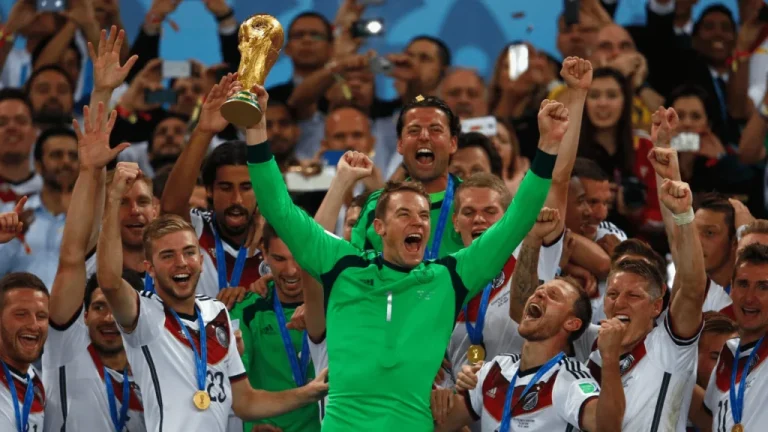
- 2014 World Cup: 2 goals (winner’s medal)
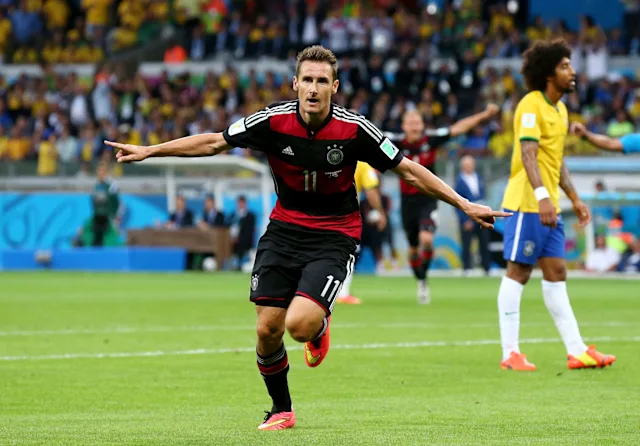
The decisive 16th goal came in the 2014 semi-final against Brazil at the Mineirão Stadium.
Klose scored in Germany’s historic 7-1 victory, breaking Ronaldo’s record with the Brazilian legend watching from the stands. The timing was perfect symbolism – one era ending as another began.
What made Klose special was reliability, not brilliance. He scored in all three group-stage matches in 2002, repeated the feat partially in 2006, and maintained production across different German squads and tactical systems.
His 25.4% shot conversion rate from 63 attempts shows clinical finishing.
One notable gap: Klose appeared in two World Cup finals (2002 and 2014) but failed to score in either. Eleven of his 16 goals came in group-stage matches, with only five in knockout rounds.
Ronaldo: Brazil’s Phenomenon (15 Goals, Three Tournaments)
Ronaldo held the all-time record for eight years (2006-2014) after surpassing Gerd Müller’s 14-goal mark.
His three tournaments tell a story of redemption:
1998: 4 goals across six matches, but the final against France remains shrouded in mystery. After suffering a seizure hours before kickoff, Ronaldo played but Brazil lost 3-0.
2002: Eight goals in seven games, including two in the final against Germany. This Golden Boot-winning performance came after two years of knee injury rehabilitation. Ronaldo scored in every match except the group-stage opener, carrying Brazil to their fifth title.
2006: 3 goals brought his total to 15, establishing a record that stood until Klose’s breakthrough in 2014.
The efficiency numbers support his legendary status. Fifteen goals in just 19 appearances translates to 0.79 goals per match, substantially better than Klose’s 0.67 rate despite competing in one fewer tournament.
Gerd Müller: Der Bomber’s Clinical Record (14 Goals, Two Tournaments)
Gerd Müller compressed world-class production into just two World Cup campaigns.
His 1970 performance remains one of the most dominant single-tournament displays ever: 10 goals in six matches.
Only Fontaine’s 13-goal haul in 1958 surpasses it. Müller won the Golden Boot and would have claimed the trophy if West Germany hadn’t lost to Italy in the semi-finals.
Four years later, Müller added four more goals across seven matches, including the winning goal in the 1974 final against the Netherlands.
That goal, scored in the 43rd minute at the Olympiastadion in Munich, secured the title on home soil.
All 14 of Müller’s World Cup goals came inside the penalty box. Seven came from inside the six-yard box.
The nickname “Der Bomber” captured his predatory instincts – give him half a yard of space near goal and he’d punish you.
The record stood for 32 years (1974-2006), an testament to how difficult accumulating double-digit World Cup goals truly is.
Just Fontaine, Lionel Messi & Pelé: The 12-13 Goal Club
Three legends share space at 12-13 career goals, each with distinct paths to their totals.
Just Fontaine scored all 13 goals in the 1958 tournament – a single-edition record that has stood for 66 years.
The French striker averaged 2.17 goals per match across six games, a rate no one has matched over a full tournament run. His career ended in 1962 due to injury before he could add to his total.
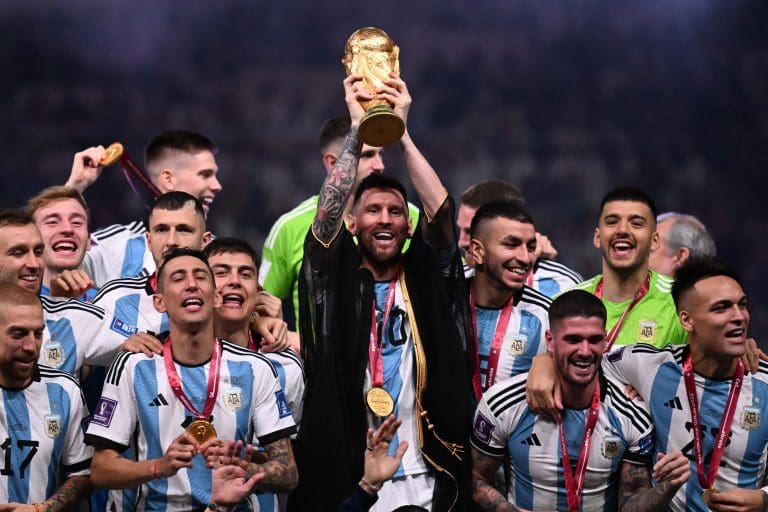
Lionel Messi needed five World Cups (2006-2022) to reach 13 goals. Seven came in Argentina’s victorious 2022 campaign, where Messi became the first player to score in every knockout round of a single tournament.
He claimed two Golden Balls (2014, 2022) and finally secured the one trophy that had eluded him.
Pelé accumulated 12 goals across four tournaments (1958-1970) while winning three titles.
He scored six goals as a 17-year-old in 1958, including a hat-trick in the semi-final against France. His three championship medals remain unmatched in men’s World Cup history.
Most Goals in a Single FIFA World Cup Tournament
The single-tournament record belongs to a different era of football.
| Rank | Player | Goals | Year | Matches | Goals/Match |
| 1 | Just Fontaine (France) | 13 | 1958 | 6 | 2.17 |
| 2 | Sándor Kocsis (Hungary) | 11 | 1954 | 5 | 2.20 |
| 3 | Gerd Müller (West Germany) | 10 | 1970 | 6 | 1.67 |
| 4 | Kylian Mbappé (France) | 8 | 2022 | 7 | 1.14 |
Fontaine’s 1958 performance sits in its own category. He scored in all six of France’s matches, including four against West Germany in the third-place playoff.
The tournament was his only World Cup appearance before career-ending injury.
Why has the record stood for 66 years? Modern defensive tactics make sustained goal-scoring at that rate nearly impossible.
Teams defend deeper, midfields track runners more aggressively, and data analytics strip away the element of surprise.
Reaching seven matches in a tournament (possible only by making the final) and averaging two goals per game requires both individual brilliance and favorable matchups.
One detail adds to Fontaine’s legend: he borrowed boots throughout the tournament after damaging his own pair in training.
The borrowed boots carried him to a record that may never fall.
Active Players Chasing History
Three active players have reached double digits, but only one has realistic time to challenge Klose’s record.
Kylian Mbappé sits at 12 goals from just two tournaments (2018, 2022). At 26 years old, he could realistically play in four more World Cups (2026, 2030, 2034, 2038).
The math on catching Klose:
- Mbappé needs 5 more goals to tie the record
- If France reaches the semi-finals or better in 2026, he’ll play 6-7 matches
- Averaging 2-3 goals in 2026 would put him at 14-15 career goals
- Two more strong tournaments (2030, 2034) could push him past 20 goals
The 2026 World Cup expansion to 48 teams helps. The maximum matches increase from seven to eight (if a team reaches the final without playing a Round of 32 match).
More matches create more opportunities.
Lionel Messi finished at 13 goals across five tournaments. At 38 in 2026, he’s unlikely to add to his total.
Thomas Müller concluded with 10 goals after four tournaments, having likely played his last World Cup in 2022.
Notable World Cup Scoring Records & Achievements
Beyond the career and single-tournament lists, several scoring records stand out:
- Most goals in World Cup finals: Kylian Mbappé leads with 4 goals across two finals (1 in 2018, hat-trick in 2022)
- Only player to score in 5 World Cups: Cristiano Ronaldo (2006, 2010, 2014, 2018, 2022)
- Youngest World Cup goal scorer: Pelé at 17 years, 249 days (1958 vs Wales)
- Most goals in a single match: Oleg Salenko (Russia) with 5 goals vs Cameroon in 1994
- Hat-trick in a World Cup final: Geoff Hurst (England, 1966) and Kylian Mbappé (France, 2022)
- Most World Cup hat-tricks: Multiple players with 2 (Fontaine, Klose, Batistuta, others)
Ronaldo’s five-tournament scoring streak shows remarkable longevity, though his 8 total goals across those five World Cups highlights the difference between participation and prolific scoring.
FAQs
How many World Cup goals has Messi scored compared to Ronaldo?
Lionel Messi scored 13 World Cup goals across five tournaments (2006-2022), while Cristiano Ronaldo scored 8 goals across five tournaments (2006-2022). Messi’s tally includes seven goals in Argentina’s 2022 championship run.
How many goals did Pelé score in World Cup finals?
Pelé never scored in a World Cup final. His 12 career goals came from group stages and knockout rounds across four tournaments, but he didn’t find the net in the 1958, 1962, or 1970 finals. Brazil won all three titles regardless.
Who scored the most goals in a single World Cup match?
Russia’s Oleg Salenko scored 5 goals in a single match against Cameroon during the 1994 World Cup group stage. Russia won 6-1, but both teams had already been eliminated before the match.
What is the record for most World Cup tournaments scored in?
Cristiano Ronaldo holds the record with goals in 5 consecutive World Cups (2006, 2010, 2014, 2018, 2022). Four players scored in four tournaments: Pelé, Uwe Seeler, Miroslav Klose, and Lionel Messi.
Can Kylian Mbappé break Miroslav Klose’s all-time record?
Yes, it’s realistic. Kylian Mbappé has 12 goals at age 26 from two tournaments. If he plays in 2026, 2030, and 2034 while maintaining his current scoring rate (0.86 goals/match), he could reach 18-22 career goals, surpassing Klose’s 16-goal record.
Who has won the most World Cup Golden Boots?
No player has won multiple Golden Boots. The award goes to each tournament’s top scorer, and 31 different players have claimed it across 22 World Cups. Miroslav Klose won in 2006 with 5 goals.
How many goals has Cristiano Ronaldo scored in World Cups?
Cristiano Ronaldo scored 8 goals across five World Cups (2006, 2010, 2014, 2018, 2022). While he holds the record for scoring in the most tournaments, his total output places him 34th on the all-time career list.
What’s the youngest age to score in a World Cup?
Pelé scored at 17 years, 249 days during Brazil’s 1-0 quarter-final victory over Wales in 1958. He remains the youngest World Cup goal scorer in men’s tournament history.
Who scored in the most consecutive World Cup tournaments?
Four players scored in four consecutive World Cups: Pelé (1958-1970), Uwe Seeler (1958-1970), Miroslav Klose (2002-2014), and Cristiano Ronaldo (2006-2018). Ronaldo extended his streak to five in 2022.
How will the 2026 World Cup expansion affect scoring records?
The 2026 expansion to 48 teams increases the maximum matches from 7 to 8. Teams reaching the final will play one additional game, creating more scoring opportunities. This helps active players like Kylian Mbappé chase career records, though defensive tactics may limit the actual impact on goal totals.