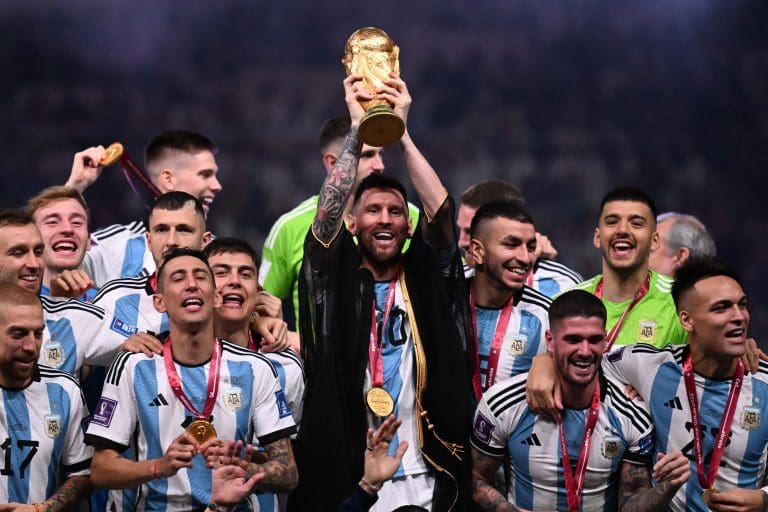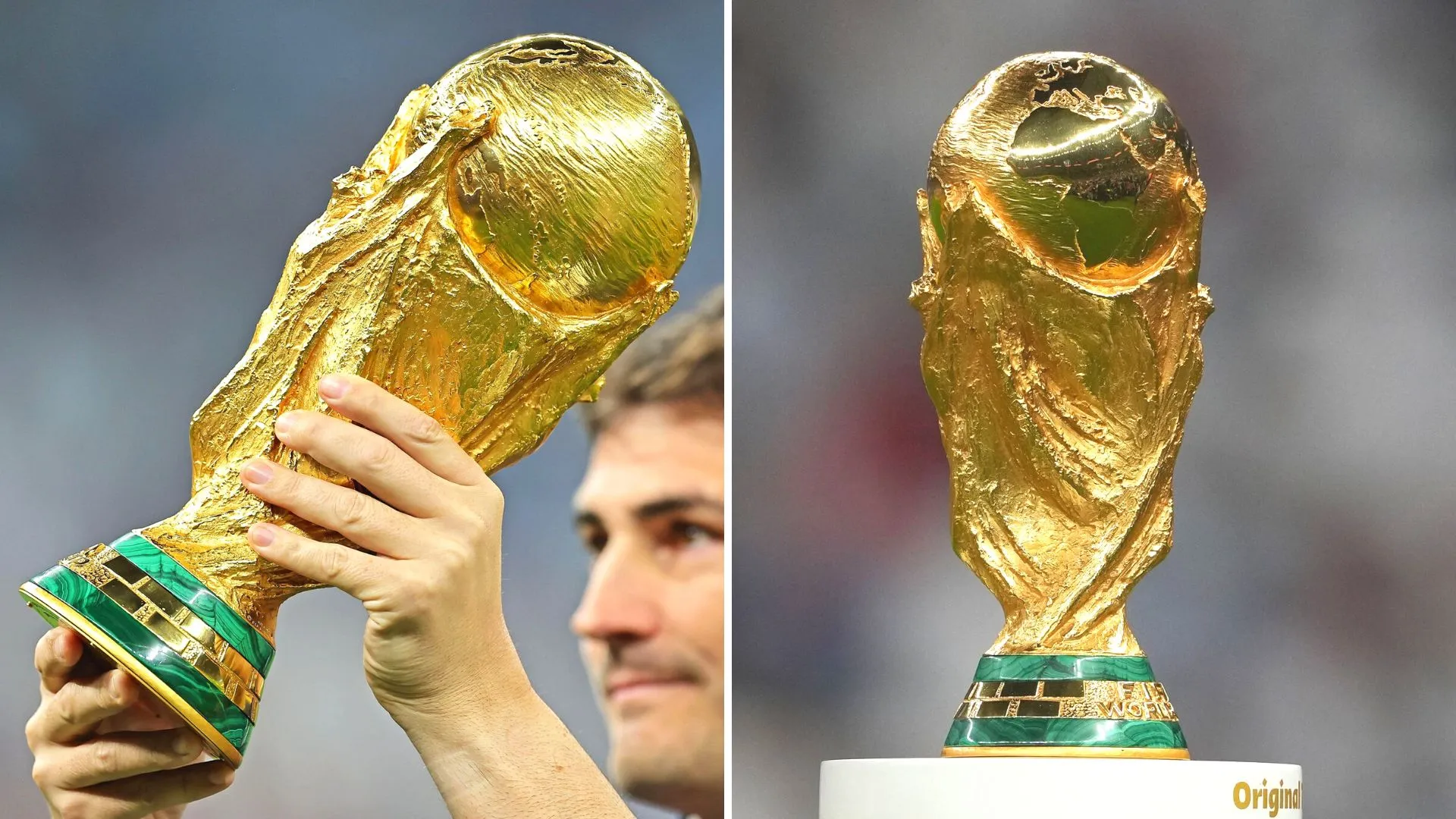
The trophy weighs 6.175 kilograms (13.61 pounds). It’s made of 18-karat gold with a hollow interior, standing 36.8 centimeters tall.
This guide breaks down the specifications: why it weighs 6.175 kg, what materials make up that weight, and how it compares to the Jules Rimet Trophy.
You’ll learn the trophy’s composition, dimensions, and value.
How Much Does the FIFA World Cup Trophy Weigh?
The trophy weighs 6.175 kilograms (13.61 pounds).
That’s the total weight including the gold structure and malachite base. The interior is hollow, not solid gold.
If the trophy were solid 18-karat gold, it would weigh 70-80 kilograms. Players couldn’t lift that overhead during celebrations. The hollow construction keeps the weight manageable while maintaining substance.
The trophy stands 36.8 centimeters tall (14.5 inches) with a base diameter of 13 centimeters. When winning captains hoist it above their heads, that 6.175 kg represents perfect balance.
This weight matters for practical reasons. The current design gives you the gravitas of gold without an impossible lifting challenge.
What Materials Make Up the Trophy?
The trophy consists of three main components:
18-karat Gold Structure
The body is 75% gold and 25% silver-copper alloy. This composition provides durability while reducing weight. Pure 24-karat gold would be too soft and too heavy for regular handling.
Malachite Base
Two bands of vibrant green malachite wrap around the base. This semi-precious stone symbolizes growth and renewal, reflecting the World Cup’s four-year cycle.
Hollow Interior
The trophy’s core is empty. Italian manufacturer GDE Bertoni confirmed this hollow construction, which drops the weight from a hypothetical 70-80 kg down to 6.175 kg.
The trophy contains 4.927 kilograms of pure gold out of its 6.175 kg total weight. The calculation: 18-karat gold is 75% pure, but the hollow interior means less material overall.
According to FIFA’s official documentation, Italian sculptor Silvio Gazzaniga designed the trophy in 1971, winning against 53 other submissions.
His design features two human figures holding up a globe, with a spiral base. FIFA introduced it at the 1974 World Cup in West Germany.
How Does It Compare to the Jules Rimet Trophy?
The current trophy differs significantly from its predecessor:
| Specification | Current Trophy | Jules Rimet Trophy |
| Weight | 6.175 kg (13.61 lbs) | 3.8 kg (8.4 lbs) |
| Height | 36.8 cm (14.5 in) | 35 cm (13.7 in) |
| Material | 18-karat gold | Gold-plated sterling silver |
| Base | Malachite (green) | Lapis lazuli (blue) |
| Years Used | 1974-present | 1930-1970 |
| Status | FIFA custody, Zurich | Stolen 1983, never recovered |
The current trophy is 62% heavier and slightly taller. It uses actual 18-karat gold rather than gold-plated silver.
FIFA commissioned the new trophy after Brazil won the 1970 World Cup for the third time, earning permanent ownership of the Jules Rimet Trophy.
The Jules Rimet was stolen from Brazilian Football Confederation headquarters in Rio de Janeiro in December 1983 and never recovered.
What is the Trophy Worth?
The trophy’s estimated value is $20 million based on cultural and historical significance.
The pure gold content alone is worth approximately $250,000 (based on 4.927 kg of pure gold at current prices).
The gap between material value and total worth reflects the trophy’s status as a one-of-a-kind artifact.
For comparison:
- FIFA World Cup Trophy: $20 million
- Stanley Cup: $23,000
- UEFA Champions League Trophy: $10,000
The original production cost in 1974 was $50,000. Today, reproducing the same trophy would cost approximately $242,700.
Winning teams don’t keep the original trophy. They receive a gold-plated bronze replica to celebrate permanently.
The original remains at the FIFA World Football Museum in Zurich, Switzerland, under 24/7 surveillance. It only leaves for ceremonial events like the World Cup final, escorted by security teams.
FAQs
Is the World Cup trophy solid gold?
No. The trophy is hollow inside and made of 18-karat gold. If it were solid gold, it would weigh 70-80 kg, impossible for players to lift during celebrations. The hollow construction keeps it manageable at 6.175 kg.
How much pure gold is in the trophy?
The trophy contains 4.927 kilograms of pure gold. Since it’s 18-karat gold (75% purity), roughly 4.93 kg of the 6.175 kg total weight is actual gold, with 25% being silver and copper alloy for durability.
Who designed the FIFA World Cup Trophy?
Italian sculptor Silvio Gazzaniga designed the current trophy in 1971. FIFA selected his design from 53 submissions. He also designed the original UEFA Cup and UEFA Super Cup trophies.
Do winners keep the World Cup trophy?
No. Winners receive a gold-plated bronze replica to keep permanently. The original remains at the FIFA World Football Museum in Zurich, Switzerland, appearing only for ceremonial events.
How tall is the World Cup trophy?
The trophy stands 36.8 centimeters (14.5 inches) tall with a base diameter of 13 centimeters (5.1 inches). It’s slightly taller than the Jules Rimet Trophy, which was 35 cm tall.
What does the malachite base symbolize?
The two malachite bands symbolize growth and renewal, reflecting the World Cup’s four-year cycle. Malachite was chosen for its vibrant green color, durability, and global presence across continents.
Where is the trophy kept?
The trophy is stored at the FIFA World Football Museum in Zurich, Switzerland, under 24/7 surveillance. It only leaves for official events like the World Cup final and draw ceremonies, with security escorts.
Why is it heavier than the Jules Rimet Trophy?
The current trophy weighs 6.175 kg compared to the Jules Rimet’s 3.8 kg because it’s made from 18-karat gold rather than gold-plated sterling silver. The heavier construction emphasizes prestige while remaining liftable.