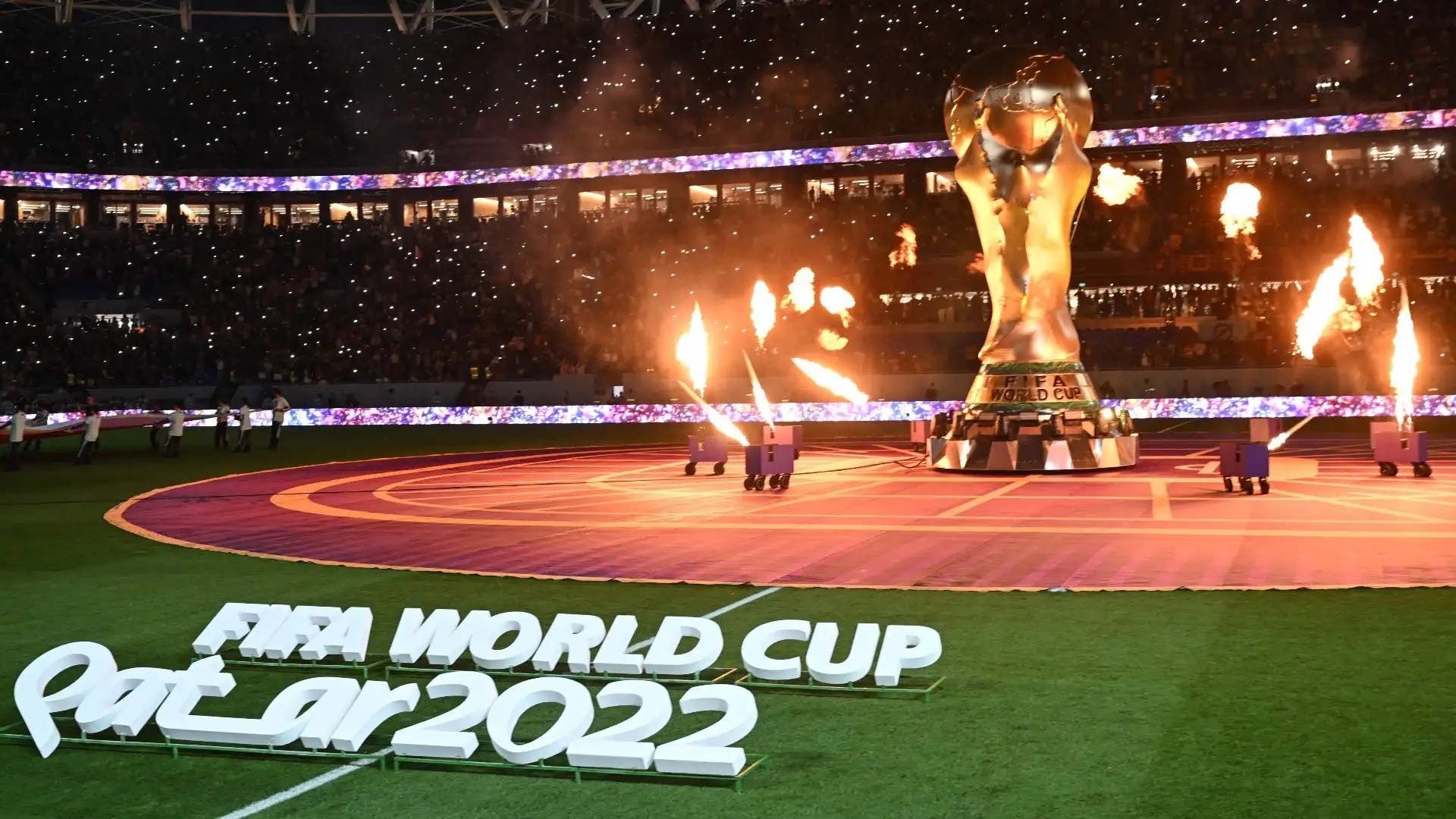
You’ve probably seen headlines about Qatar spending $220 billion on the World Cup. But how much did they actually earn back?
The short answer: Qatar pulled in roughly $4-6 billion in direct revenue from hosting the tournament. Stack that against the $220 billion investment, and you’re looking at a massive short-term loss.
Most people don’t realize FIFA kept $7.5 billion from commercial deals tied to the tournament, while Qatar’s earnings came almost entirely from tourism and operational reimbursements.
Over a million visitors showed up, and the event contributed about 1% to Qatar’s GDP. Nearly all of that $220 billion went toward infrastructure projects under Qatar National Vision 2030, not just World Cup stadiums.
Qatar’s Direct Earnings From World Cup 2022
Qatar’s actual take from the World Cup breaks down into a few clear buckets, landing somewhere between $4 billion and $6 billion total.
Tourism drove most of it. Visitor spending during the tournament generated $2.3-4.1 billion, according to IMF analysis.
More than one million people flew in for the month-long event, filling hotels, restaurants, and shops across Doha. That tourist activity added 0.7-1.0% to Qatar’s 2022 GDP, or about $1.6-2.4 billion in gross value.
FIFA paid Qatar roughly $1.7 billion, but don’t confuse this with profit. That money covered operational costs for running the tournament – things like the $440 million prize pool for teams, venue operations, and logistics. FIFA essentially reimbursed Qatar for staging the event.
Hospitality packages brought in another $243 million. Qatar sold 259,116 hospitality packages across six different tiers.
What catches people off guard is that 39% of those packages were bought by Qatari residents themselves.
| Revenue Source | Amount (USD) | Details |
| Tourism & Visitor Spending | $2.3-4.1 billion | 1+ million visitors, 0.7-1.0% of GDP |
| FIFA Operational Reimbursement | $1.7 billion | Covered tournament costs, prize money |
| Hospitality Packages | $243 million | 259,116 packages sold |
| Ticket Sales (Qatar’s share) | Part of $686M total | FIFA kept majority |
| Broadcasting (Qatar’s share) | Portion of $3.4B total | FIFA retained most |
| Total Qatar Earnings | ~$4-6 billion | Against $220B investment |
The difference between what FIFA earned globally ($7.5 billion) and what Qatar took home gets lost in most coverage.
FIFA’s revenue came from selling TV rights, sponsorships, and licensing deals worldwide. Qatar only saw the local economic activity.
The $220 Billion Investment
Only about $6.5-8 billion of that $220 billion actually went to building World Cup stadiums.
Seven new venues plus renovating one existing stadium – that’s barely 3-4% of total spending.
The rest? All infrastructure projects Qatar was planning anyway under Qatar National Vision 2030:
- Doha Metro system: $36 billion
- New international airport
- Hundreds of kilometers of highways
- Luxury hotels (100+ properties)
- New port facilities
- Expanded gas and oil infrastructure
- Entire new city districts
Qatar’s approach differed completely from previous hosts. Russia spent $15 billion total in 2018. Brazil dropped $15 billion in 2014.
Qatar spent 15 times more, but most of that money accelerated development projects that would have happened over the next 20-30 years.
One hidden cost: the tax breaks Qatar gave FIFA and official sponsors. As part of the hosting agreement, FIFA required exemptions from Qatari taxes for itself and dozens of corporate partners. The exact figure remains impossible to pin down.
Those eight stadiums need ongoing upkeep, but Qatar only has 300,000 permanent residents.
Most venues are now being partially dismantled, with seats and materials shipped to developing countries. What remains gets repurposed into schools, clinics, and community facilities.
Did Qatar Make a Profit?
Not even close.
- Investment: $220 billion
- Revenue: $4-6 billion
- Net result: Roughly $214-216 billion loss
Qatar’s goal wasn’t making money off ticket sales. The country can absorb this loss – its annual GDP sits around $180 billion, and public debt is declining from 45% to under 39% of GDP.
Most World Cup hosts lose money. Russia and Brazil both spent about $15 billion and struggled to break even. What makes Qatar unique is the scale of spending and the explicit framing as a strategic investment rather than a sports event that needs to pay for itself.
Financial analysts say the Net Present Value stays negative for decades, possibly “several generations” according to finance professors who studied the economics.
If Qatar sees $17 billion in economic benefit annually (their optimistic estimate), you’d need 23 consecutive years just to break even. More realistic projections have annual benefits dropping to maybe half that.
FIFA’s $7.5 Billion: Who Really Profited?
While Qatar dealt with a $214 billion hole, FIFA had its most profitable World Cup ever.
FIFA’s $7.5 billion came from four years of commercial deals. TV broadcasting rights made up 45% – $3.4 billion from selling coverage to networks worldwide.
Marketing and sponsorships from companies like Adidas and Coca-Cola added $1.8 billion (29%). Licensing deals for official merchandise brought in $769 million (15%).
Compare that to Russia 2018, when FIFA earned $6.4 billion. The jump to $7.5 billion represents a $1.1 billion increase, and FIFA’s already projecting $11 billion for the 2026 tournament.
| Revenue Stream | FIFA’s Take | Qatar’s Take |
| TV Broadcasting | $3.4B | $0 (indirect benefit only) |
| Sponsorships | $1.8B | $0 (local sponsor benefits) |
| Licensing | $769M | $0 (local retail sales) |
| Hospitality/Tickets | $949M | Portion through tourism |
| Total | $7.5B | $4-6B |
The setup heavily favors FIFA. They own the commercial rights globally and let host countries handle physical hosting costs.
FIFA pays for prize money and team travel, but the host builds every stadium, hotel, road, and airport needed.
Long-Term Economic Impact
Qatar’s banking on payoffs that stretch across decades.
Qatar Airways posted record numbers – $1.21 billion in net profit for fiscal year 2022-23, with revenue jumping 45% to $21 billion. Passenger counts grew 71% compared to the previous year.
The Qatar Stock Exchange gained 24% through mid-2022, outperforming regional markets.
Tourism makes up the biggest long-term bet. Qatar wants tourism to reach 12% of GDP by 2030, up from maybe 2-3% before the World Cup.
Regional spillover effects reached about $4 billion across Gulf Cooperation Council countries.
The UAE, particularly Dubai, captured roughly 80% as an estimated 300,000 visitors used neighboring countries as accommodation bases and commuted to Qatar for matches.
Maintenance costs for all that new infrastructure run into hundreds of millions annually. Hotels built for peak tournament capacity sit underutilized during normal periods.
FAQs
How much money did FIFA make from Qatar World Cup?
FIFA earned $7.5 billion in revenue through the four-year commercial cycle tied to Qatar 2022. This came primarily from TV broadcasting rights (45%), marketing partnerships (29%), and licensing (15%). FIFA kept this commercial revenue while paying Qatar $1.7 billion to cover operational tournament costs.
Did Qatar profit from hosting the World Cup?
No. Qatar earned $4-6 billion in direct revenue against a $220 billion investment, resulting in a massive short-term loss. The event was designed as a strategic long-term investment in economic diversification and National Vision 2030 infrastructure rather than immediate profit generation.
How much did Qatar spend on World Cup stadiums?
Qatar spent $6.5-8 billion on building seven new stadiums and renovating one existing stadium. This represents only 3-4% of the total $220 billion World Cup-related spending. The remaining funds went toward infrastructure projects like the $36 billion Doha Metro, new airport, highways, and hotels.
How much revenue did Qatar generate from tourism during World Cup?
Tourism spending and World Cup-related activities generated $2.3-4.1 billion in revenue for Qatar, contributing 0.7-1.0% to the country’s 2022 GDP. Over one million visitors attended the tournament, with 39% of hospitality packages purchased by Qatari residents.
How does Qatar’s World Cup spending compare to previous hosts?
Qatar spent approximately $220 billion, roughly 15 times more than Russia ($15B in 2018) or Brazil ($15B in 2014). However, Qatar’s spending included massive National Vision 2030 infrastructure projects accelerated for the event, while previous hosts focused primarily on tournament-specific facilities.
Will Qatar recover its World Cup investment?
Unlikely in the short or medium term. With $220 billion invested versus $4-6 billion direct earnings, financial analysts project negative NPV for decades. Qatar aims to leverage infrastructure and global visibility for long-term tourism growth (targeting 12% of GDP by 2030) rather than cash recovery.
What was Qatar’s GDP contribution from the World Cup?
The World Cup contributed 0.7-1.0% to Qatar’s 2022 GDP through tourism and broadcasting revenue ($1.6-2.4 billion in gross value added terms). Qatar’s overall GDP growth in 2022 was 4.1%, outperforming previous World Cup host nations.
How much did Qatar Airways earn from World Cup?
Qatar Airways reported record profits during the World Cup period, with net profit reaching $1.21 billion in fiscal year 2022-23. Revenue increased 45% to $21 billion, and passenger numbers grew 71% compared to the previous year.
What happened to Qatar’s World Cup stadiums?
Most World Cup stadiums are being partially dismantled and repurposed. Seating capacity is being reduced and materials shipped to developing countries for stadium construction. Remaining structures will become schools, health clinics, cafes, and community facilities since only 300,000 permanent residents don’t justify eight large-capacity stadiums.
What was the economic spillover to neighboring countries?
Approximately $4 billion in tourism revenue went to the broader GCC region, with the UAE (particularly Dubai) capturing 80% of World Cup spectators who stayed in neighboring countries. Around 300,000 visitors used neighboring GCC countries as accommodation bases and commuted to Qatar for matches.