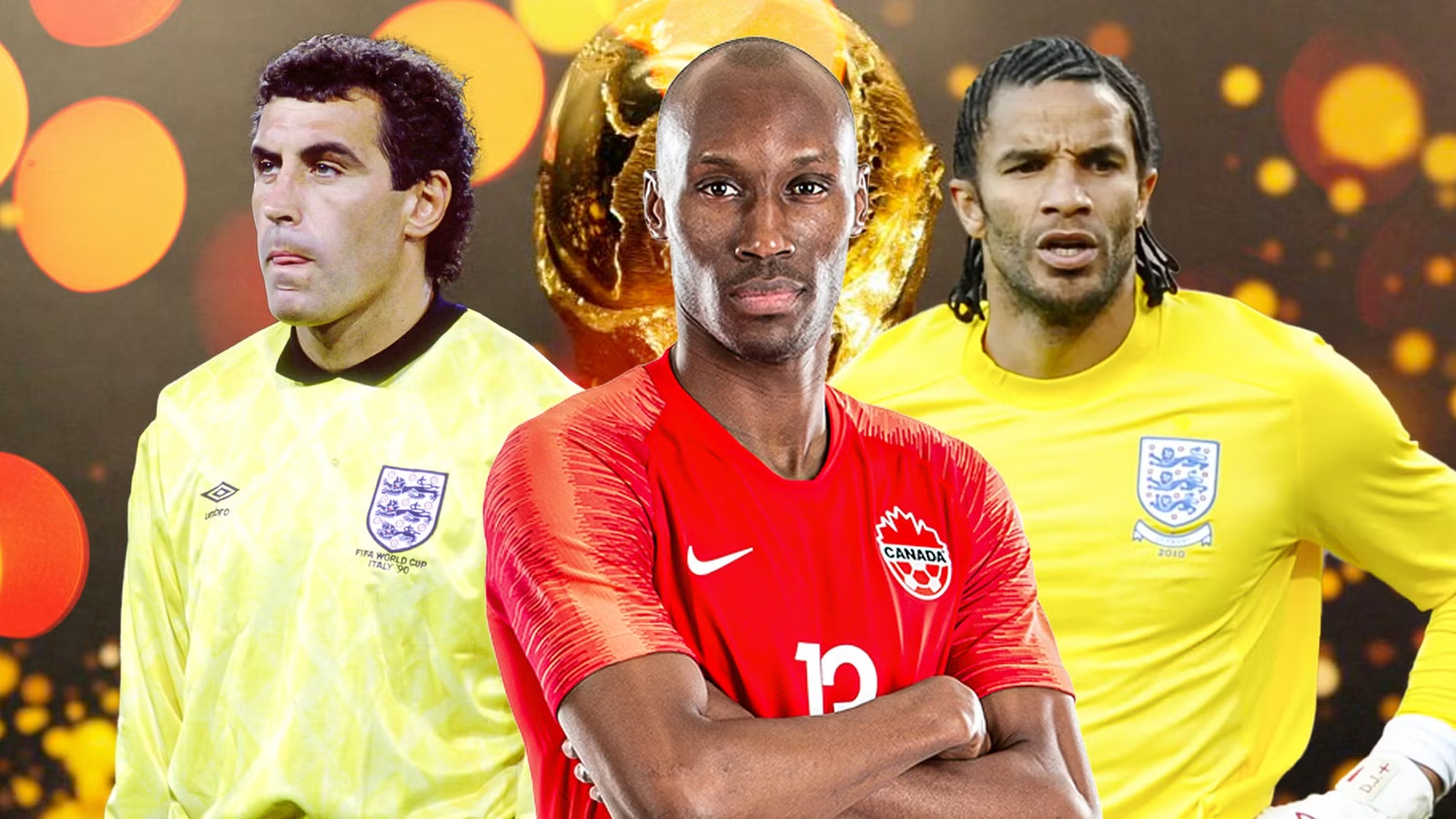
The FIFA World Cup is built for players in their prime, usually late 20s to early 30s. But a rare few have stepped onto that stage well into their 40s, rewriting what is possible in professional football.
Egyptian goalkeeper Essam El-Hadary holds the current record as the oldest World Cup player in history, appearing at 45 years and 161 days old on 25 June 2018 against Saudi Arabia.
Nine of the ten oldest World Cup players in history are goalkeepers. The position rewards experience, positioning, and reading the game, skills that sharpen with age rather than fade.
This article ranks all ten, breaks down their exact records, and explains the pattern behind the numbers.
The 10 Oldest World Cup Players — Quick Reference
| Rank | Name | Age | Match Date | Country | Position | Tournament |
| 1 | Essam El-Hadary | 45 yrs, 161 days | 25 June 2018 | Egypt | Goalkeeper | 2018 Group Stage |
| 2 | Faryd Mondragón | 43 yrs, 3 days | 24 June 2014 | Colombia | Goalkeeper | 2014 Group Stage |
| 3 | Roger Milla | 42 yrs, 39 days | 28 June 1994 | Cameroon | Forward | 1994 Group Stage |
| 4 | Pat Jennings | 41 yrs, 0 days | 12 June 1986 | N. Ireland | Goalkeeper | 1986 Group Stage |
| 5 | Peter Shilton | 40 yrs, 292 days | 7 July 1990 | England | Goalkeeper | 1990 Third-Place Playoff |
| 6 | Dino Zoff | 40 yrs, 133 days | 11 July 1982 | Italy | Goalkeeper | 1982 World Cup Final |
| 7 | Ali Boumnijel | 40 yrs, 71 days | 23 June 2006 | Tunisia | Goalkeeper | 2006 Group Stage |
| 8 | Jim Leighton | 39 yrs, 334 days | 23 June 1998 | Scotland | Goalkeeper | 1998 Group Stage |
| 9 | David James | 39 yrs, 330 days | 27 June 2010 | England | Goalkeeper | 2010 Group Stage |
| 10 | Ángel Labruna | 39 yrs, 8 months | 15 June 1958 | Argentina | Forward | 1958 Knockout Stage |
Two facts define this list at a glance. Nine of the ten are goalkeepers, with Roger Milla and Ángel Labruna the only outfield exceptions.
The youngest player on this list is 39 years and 8 months old, an age when most footballers have already been retired for years.
#1 Essam El-Hadary — The Record Holder (45 Years, 161 Days)
Essam El-Hadary made his World Cup debut at 45 years and 161 days old, starting for Egypt against Saudi Arabia in Volgograd on 25 June 2018. That single match gave him three records at once: oldest player, oldest debutant, and oldest captain at a World Cup finals.
In the first half, he saved a penalty from Fahad Al-Muwallad, pushing the ball onto the bar and becoming the first African goalkeeper to save a penalty at a World Cup. Saudi Arabia were awarded a second penalty before half-time, which beat him. Egypt lost 2-1.
His career numbers explain why he was still playing at that level.
He made 159 international appearances for Egypt between 1996 and 2018, across a 22-year international career, won four Africa Cup of Nations titles, was named best goalkeeper at the tournament three times, and played over 1,000 combined club and international matches.
El-Hadary’s record is unlikely to be broken soon. He was 45 years old. The next oldest player on this list is nearly two and a half years younger.
#2 Faryd Mondragón — The 16-Year Gap (43 Years, 3 Days)
Faryd Mondragón appeared for Colombia against Japan on 24 June 2014, aged 43 years and 3 days.
He had also played for Colombia at the 1998 World Cup in France, meaning he appeared at two World Cups separated by 16 years, the longest gap between World Cup appearances in tournament history.
With Colombia leading 4-1 and already through to the knockout round, coach José Pékerman brought Mondragón on with five minutes remaining. It was a deliberate send-off for a veteran who had waited 16 years for another World Cup moment.
He remained on the bench as Colombia progressed to the quarter-finals against Brazil, making him the oldest footballer to be part of a World Cup knockout squad. He announced his retirement from all football after Colombia’s elimination.
#3 Roger Milla — Oldest Goalscorer and Outfield Anomaly (42 Years, 39 Days)
Roger Milla holds two records no outfield player has matched. At 42 years and 39 days, he scored a consolation goal in Cameroon’s 6-1 loss to Russia on 28 June 1994, making him both the oldest player in World Cup history at the time and the oldest goalscorer in World Cup history, a record he still holds today.
Milla had retired from international football at 36. Only a direct request from Cameroon’s president brought him back for the 1990 World Cup, where his corner-flag goal celebrations became globally famous.
Four years later, at nearly 43, he returned again for the 1994 tournament. His goal against Russia was the final international strike of his career. He remains the only outfield player over 40 to score at a World Cup.
#4 Pat Jennings — The Birthday Farewell (41 Years, 0 Days)
Pat Jennings made his final international appearance on his 41st birthday, starting for Northern Ireland against Brazil in the 1986 World Cup group stage on 12 June 1986. It was his 119th cap across a 22-year international career, one of the longest in British football history.
Jennings built his reputation across two of English football’s fiercest rivals, spending his prime years at Tottenham before moving to Arsenal. His positioning and shot-stopping kept him at the highest level long after most goalkeepers had retired.
The match against Brazil was a fitting farewell, even if Northern Ireland lost. No goalkeeper from the British Isles has come close to matching his age at a World Cup since.
#5 Peter Shilton — England’s Most Capped Player (40 Years, 292 Days)
Peter Shilton captained England in the 1990 third-place playoff against Italy on 7 July 1990 at 40 years and 292 days old.
It was his 125th and final international cap across a 20-year England career, a record that still stands as the most appearances ever made by an England men’s player.
Shilton appeared at three World Cups: 1982, 1986, and 1990. His 1986 quarter-final is remembered for Maradona’s Hand of God goal, which beat him despite his protests.
Four years later, still at the top of his game at 40, he led England to third place before retiring from international football immediately after the tournament.
#6 Dino Zoff — The Oldest World Cup Winner (40 Years, 133 Days)
Dino Zoff is the only player on this list to have won the World Cup. He captained Italy to the 1982 title at 40 years and 133 days old, lifting the trophy as the oldest World Cup-winning player and oldest World Cup-winning captain in history. Both records remain unbroken.
Zoff kept clean sheets through Italy’s most important matches and marshalled a defence that conceded just two goals in the knockout rounds.
He retired from international football immediately after the final, closing a career that had spanned four World Cup tournaments from 1970 to 1982.
His 1982 win remains the clearest argument that a goalkeeper’s peak can arrive later than almost anyone expects.
#7 Ali Boumnijel — Tunisia’s Veteran Wall (40 Years, 71 Days)
Ali Boumnijel appeared for Tunisia at the 2006 World Cup in Germany at 40 years and 71 days old, making him the seventh oldest player in World Cup history.
He started all three of Tunisia’s group-stage matches against Saudi Arabia, Spain, and Ukraine, the only Tunisian goalkeeper on the squad trusted with every minute of the tournament.
Boumnijel had been Tunisia’s first-choice goalkeeper for over a decade by the time he reached Germany. His World Cup debut had come at France 1998, meaning he bridged two tournaments eight years apart.
Tunisia did not advance from the group stage in 2006, but Boumnijel’s consistency across all three matches at 40 years old placed him firmly in the conversation about the most durable goalkeepers in African football history.
#8 Jim Leighton — Scotland’s Last Line (39 Years, 334 Days)
Jim Leighton appeared for Scotland at the 1998 World Cup at 39 years and 334 days old, facing Brazil, Norway, and Morocco across all three group-stage matches.
He finished with 91 international caps and became the last player born in the 1950s to appear in a World Cup match.
Leighton’s career had an unusual arc. He was dropped by Manchester United manager Alex Ferguson before the 1990 FA Cup Final replay, one of the most public goalkeeper decisions in English football, but he rebuilt his career and remained Scotland’s number one well into his late 30s.
Scotland did not advance from the group stage in 1998, going out on goal difference, but Leighton’s performances gave them a chance in all three matches.
#9 David James — Stepping Up Under Pressure (39 Years, 330 Days)
David James became England’s starting goalkeeper at the 2010 World Cup under circumstances no player would choose.
Rob Green’s error against the USA in the opening match handed James the starting spot, and he held it for the remainder of the tournament at 39 years and 330 days old.
James kept clean sheets against Algeria and Slovenia, helping England through the group stage. England’s 4-1 defeat to Germany in the round of 16 ended the tournament for both the team and James internationally.
He retired from the national side after South Africa, finishing with 53 caps across a career that had seen him compete for the England jersey for over a decade against some of the best goalkeepers the country has produced.
#10 Ángel Labruna — The Historical Outfield Exception (39 Years, 8 Months)
Ángel Labruna appeared for Argentina at the 1958 World Cup in Sweden on 15 June against Czechoslovakia at 39 years and 8 months old.
As a forward with 37 caps and 17 international goals, he joins Roger Milla as the only outfield players to break into this all-time top ten.
Labruna built his greatest legacy at River Plate, where he formed part of the legendary La Máquina forward line during the 1940s alongside Juan Carlos Muñoz, José Manuel Moreno, and Adolfo Pedernera.
Argentina reached the knockout phase in 1958 but lost their final match. His inclusion at nearly 40 was a statement of continued quality, not a farewell gesture.
Why Are 9 of the 10 Oldest Players Goalkeepers?
Outfield play demands explosive pace, sharp lateral movement, and high-intensity pressing.
These attributes decline sharply through a player’s mid-30s. A striker at 40 simply cannot match defenders who are a decade younger in a sprint.
Goalkeeping works differently. Positioning, communication, shot-stopping technique, and penalty-box command are built through experience and do not erode the way speed does.
A 40-year-old goalkeeper who has studied thousands of shooting patterns can still perform at the highest level.
The two outfield exceptions, Roger Milla and Ángel Labruna, are separated by decades and continents and are widely regarded as the most exceptional physical specimens their countries ever produced. Their presence as forwards is the anomaly, not the norm.
FAQs
Who is the oldest player in World Cup history?
Essam El-Hadary of Egypt holds the record as the oldest World Cup player of all time. He was 45 years and 161 days old when he started against Saudi Arabia on 25 June 2018, breaking Faryd Mondragón’s previous record of 43 years and 3 days.
Who is the oldest goalscorer in World Cup history?
Roger Milla of Cameroon scored against Russia on 28 June 1994 at 42 years and 39 days old. He is the oldest goalscorer in World Cup history and the only outfield player over 40 to score at the tournament.
Why do goalkeepers dominate the oldest World Cup players list?
Goalkeeping relies on positioning, experience, and shot-stopping technique, which hold up with age far better than the pace and agility required of outfield players. Nine of the ten oldest World Cup players are goalkeepers for this exact reason.
Who is the oldest player to appear in a World Cup Final?
Dino Zoff of Italy was 40 years and 133 days old when he captained Italy in the 1982 World Cup Final against West Germany. He is also the oldest player ever to win a World Cup.
Who holds the record for the longest gap between World Cup appearances?
Faryd Mondragón played for Colombia at the 1998 World Cup and again at the 2014 World Cup, a gap of 16 years. He was 43 years and 3 days old during his final appearance, making it the longest gap between two World Cup games in tournament history.