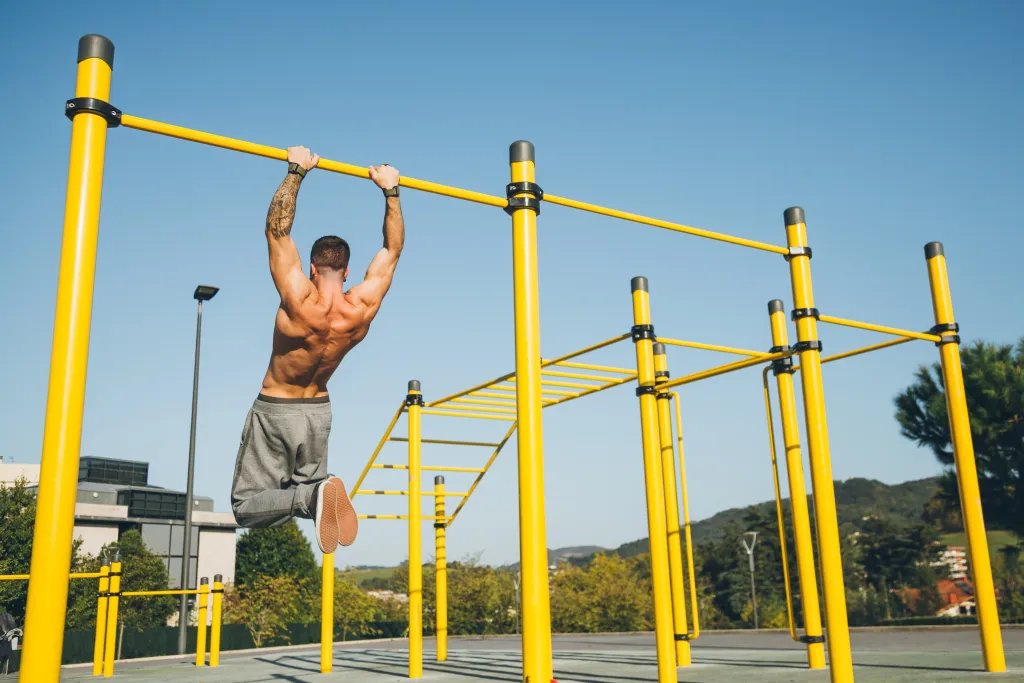
Calisthenics has grown from a niche bodyweight discipline into one of the fastest-rising forms of training globally. Here is what it actually is, and the 11 best apps to start or progress your practice in 2026.
What Is Calisthenics?
Calisthenics is a form of resistance training that uses an individual’s own body weight for resistance instead of barbells, dumbbells, or machines.
The word calisthenics combines the Greek words for beauty (kalos) and strength (sthenos), and the discipline originated from ancient Greek exercises designed for physical fitness and military readiness.
Calisthenics was used by ancient armies, including Alexander the Great’s, to build combat-ready soldiers without major training equipment.
The practice primarily relies on closed-chain movements – exercises where the hands or feet remain fixed against a surface.
Foundational movement patterns fall into four categories: push (push ups, dips), pull (pull ups, rows), squat and hinge (bodyweight squats, glute bridges), and core (planks, hollow holds). Calisthenics targets seven basic human movement patterns and includes calisthenics exercises like push-ups, squats, and burpees.
Since you cannot load a barbell, calisthenics progression involves gradually increasing exercise difficulty.
Progression can include changing rep ranges, sets, or body positions – moving from a knee push-up to a full push-up to an archer push-up to planche progressions. This same principle applies to muscle ups, chin ups, and front lever variations.
Bodyweight training has ranked among the top ten ACSM fitness trends for over a decade, according to the 2024 ACSM Worldwide Survey of Fitness Trends.
The World Street Workout & Calisthenics Federation (WSWCF), founded in 2011 in Riga, Latvia, organizes international competitions with codified judging rules.
For a deeper look at the history, philosophy, and core principles behind this discipline, a complete guide to what calisthenics is covers the full foundation.
Why Calisthenics Has Grown So Quickly
Calisthenics requires little or no equipment for workouts, which makes it one of the most accessible forms of physical exercise available.
Most bodyweight exercises require no equipment at all, and calisthenics can be performed almost anywhere, anytime – in a hotel room, a public park, or a small apartment.
For athletes in other sports, travel accessibility is a practical advantage. A basketball player on a road trip or a soccer player between camps can maintain a full body calisthenics workout without finding a gym membership or free weights.
Calisthenics can improve strength, endurance, and flexibility using nothing but your own body.
Skill-based progression keeps practitioners engaged for years. The path from a first pull-up to a muscle-up, front lever, or planche provides visible, measurable long-term goals that standard weight training rarely offers.
Calisthenics improves flexibility and coordination over time, and the energy output in calisthenics merges strength training with cardiovascular exercise – building muscular endurance and conditioning simultaneously.
The crossover with athletics is significant. Calisthenics focuses on relative strength, which is strength in relation to body weight – precisely the quality that matters most in field and court sports. Calisthenics can build muscle strength effectively without weights, and it rewards consistency over equipment.
Key Takeaways
- Calisthenics is resistance training using your own body weight instead of external weights.
- The WSWCF, founded in 2011, organizes international calisthenics championships with standardized rules.
- Men who performed 40 or more push-ups had 96% lower cardiovascular disease risk over ten years, per Yang et al. (2019).
- Mobile exercise apps ranked among the top ten global fitness trends in the 2024 ACSM survey.
- Calisthenics can accommodate all fitness levels through exercise variations and modified progressions.
- Bodyweight exercises can be modified to fit individual fitness levels, from beginners to advanced athletes.
How We Picked These Apps
We evaluated each app against six criteria: programming quality, skill-progression structure, beginner-friendliness, personalization depth, equipment flexibility, and value for money. Every app listed is a real, verified application available as of 2026.
We prioritized apps that offer clear progression pathways – the defining feature of any effective calisthenics training app. An app that provides random bodyweight exercises without structured advancement is a timer, not a coach.
We also weighted equipment flexibility (no-equipment options versus pull up bar or rings requirements) and whether each app’s free tier delivers enough value for a new user to make meaningful progress before paying.
The 11 Best Calisthenics Workout Apps
| App | Best For | Skill Progressions | Free Tier | Platforms |
| MadMuscles | AI-personalized bodyweight programs | Adaptive | Free trial | iOS, Android |
| Caliathletics | Structured skill progressions | Advanced | Limited | iOS, Android |
| Madbarz | Street-workout-style routines | Intermediate | Yes | iOS, Android |
| Thenx | Video tutorials and skill methodology | Advanced | Limited | iOS, Android, Web |
| Movement Athlete | Individualized calisthenics assessments | Advanced | Assessment free | iOS, Android, Web |
| Calisthenics Coach | Progressive overload through leverage | Intermediate | Yes | Android |
| Freeletics | AI-adaptive bodyweight HIIT | Basic | Limited | iOS, Android |
| Nike Training Club | Free general bodyweight conditioning | Basic | Full | iOS, Android |
| GMB Fitness | Movement, mobility, and skill-blended training | Intermediate | Limited | Web, iOS |
| FitnessFAST | Minimalist no-equipment routines | Basic | Yes | iOS, Android |
| Athlean-X | Athletic-style bodyweight programs | Intermediate | Limited | iOS, Android, Web |
1. MadMuscles – Best for AI-Personalized Bodyweight Programs
Who it suits: Beginners and intermediates who want a personalized calisthenics workout and nutrition plan built around their starting point.
What it does well: MadMuscles uses a quiz to assess users’ fitness levels and goals, then generates a customized exercise program covering workouts, meal plans, and progress tracking. The app delivers personalized workout and nutrition plans that adapt to user performance and fitness levels as they progress. Users can change their available equipment settings at any time – from no-equipment bodyweight exercises to resistance band and pull up bar setups.
Equipment: No equipment required; supports bodyweight-only, basic (dumbbells, resistance band), and full equipment configurations.
Subscription model: Free trial with premium subscription for full access; includes meal plans, multiple workout program types, and progress tracking integrated with Apple Health and Google Fit.
Strengths:
- Quiz-based intake builds a genuinely tailored calisthenics routine from day one
- 200+ exercises with video demonstrations and voice-guided instructions
- Dedicated calisthenics and military calisthenics programs alongside HIIT and strength options
Worth knowing:
- Less specialized for advanced statics like planche or front lever progressions than dedicated calisthenics apps
- Full meal planning and advanced features require a premium subscription
The verdict: The strongest option for beginners who want AI-driven personalization across workouts and nutrition.
2. Caliathletics – Best for Structured Skill Progressions
Who it suits: Practitioners who want a clear pathway from basic bodyweight exercises to advanced calisthenics skills.
What it does well: Caliathletics maps structured progressions toward pull-up, muscle-up, front lever, and planche with beginner through advanced tracks. Each skill has prerequisite exercises and a defined ladder of difficulty.
Equipment: Pull up bar required; parallettes and rings recommended for advanced tracks.
Subscription model: Freemium with limited free content; premium unlocks full skill trees and programming.
Strengths:
- Dedicated skill-tree format designed specifically for calisthenics progression
- Clear prerequisite mapping for every advanced movement
- Covers the full range from strength training exercises to static holds
Worth knowing:
- Limited free tier may frustrate budget-conscious users
- Assumes basic upper body strength; true beginners may need a foundation elsewhere
The verdict: The most structured path from basic pull ups to advanced skill work.
3. Madbarz – Best for Street-Workout-Style Routines
Who it suits: Users who train at parks or with basic bar access and want community-driven calisthenics training.
What it does well: Madbarz offers a large exercise library with circuits and timed HIIT-style routines rooted in the street workout tradition. Social features and leaderboards add a competitive element.
Equipment: Pull up bar and dip station recommended; many routines work with no equipment.
Subscription model: Free tier available; premium (~$9.99/month) unlocks full features and nutrition tracking.
Strengths:
- Strong community features with leaderboards and social sharing
- Routines designed for outdoor park equipment and minimal setups
- Effective for building upper body strength and muscular endurance
Worth knowing:
- Progression ladders are less structured than dedicated skill-based apps
- Premium pricing sits in the mid-range for bodyweight workout apps
The verdict: The go-to calisthenics app for street workout culture and park-based training.
4. Thenx – Best for Video Tutorials and Skill Methodology
Who it suits: Visual learners who want detailed breakdowns of calisthenics movements and techniques.
What it does well: Founded by Chris Heria, Thenx offers high-production video tutorials with progressive skill breakdowns covering everything from basic push ups to advanced static holds. Programs are structured from beginner to elite.
Equipment: Pull up bar and parallettes for most programs; some no-equipment options.
Subscription model: Premium at ~$19.99/month or ~$119.99/year – the highest-priced app on this list.
Strengths:
- Highest production quality videos among calisthenics workout apps
- Programs cover full body exercises across all difficulty levels
- Strong methodology for building muscle and strength through calisthenics
Worth knowing:
- Premium cost is significantly higher than competitors
- Free content is limited compared to the full library
The verdict: Premium video instruction for visual learners willing to invest.
5. Movement Athlete – Best for Individualized Calisthenics Assessments
Who it suits: Users who want their starting point assessed accurately before following a personalized calisthenics progression.
What it does well: Movement Athlete runs an in-depth movement assessment that places users at the correct progression level across multiple skill categories, then advances them gradually based on performance. AI-driven progressions adjust to reported difficulty.
Equipment: Pull up bar; rings and parallettes for advanced programming.
Subscription model: Free assessment; full programming requires a paid subscription.
Strengths:
- Assessment-based placement ensures appropriate starting difficulty
- Skill-based approach covers handstands, levers, and planche progressions
- Personalization rooted in actual movement capacity, not self-reported fitness level
Worth knowing:
- Interface can feel complex for users seeking simple bodyweight routines
- Leans toward intermediate and advanced practitioners
The verdict: The most thorough assessment-based calisthenics training app available.
6. Calisthenics Coach – Best for Progressive Overload Through Leverage
Who it suits: Practitioners committed to bodyweight-only training who want systematic progressive overload without external weights.
What it does well: Calisthenics Coach focuses on building strength through leverage manipulation and exercise variations. It provides clear progression from basic calisthenic exercises to advanced leverage positions.
Equipment: Pull up bar recommended; many exercises require no equipment.
Subscription model: Free with optional premium features on Android.
Strengths:
- Focused exclusively on bodyweight training progression
- Clean interface with clear exercise descriptions
- Good for building full body strength through leverage-based overload
Worth knowing:
- Limited to Android in most markets
- Smaller exercise library than competitors
The verdict: A focused, no-frills app for pure bodyweight progressive overload.
7. Freeletics – Best for AI-Adaptive Bodyweight HIIT
Who it suits: Time-constrained users who want short, intense bodyweight sessions that adapt based on feedback.
What it does well: Freeletics uses AI to adjust workouts based on user performance, recovery, and difficulty ratings. Sessions are typically 15–30 minutes and emphasize high-intensity physical activity.
Equipment: No equipment required for most workouts.
Subscription model: Free tier with limited workouts; premium unlocks the AI Coach and full programming.
Strengths:
- AI adaptation creates a responsive new exercise program each week
- Short sessions suit busy schedules and travel
- Effective for body composition improvements and cardiovascular conditioning
Worth knowing:
- More HIIT-focused than skill-focused – not ideal for learning planche or front lever
- Free tier is restrictive
The verdict: The best AI-driven option for fast, adaptive bodyweight conditioning.
8. Nike Training Club – Best Free Option for General Bodyweight Conditioning
Who it suits: Anyone who wants a comprehensive, free home workout app with structured multi-week programs.
What it does well: Nike Training Club provides hundreds of bodyweight and equipment-based workouts at no cost, including multi-week structured programs. Apple Health and Apple Watch integration make tracking seamless.
Equipment: No equipment required for bodyweight programs; some programs use dumbbells.
Subscription model: Fully free – all content accessible without a subscription.
Strengths:
- Entirely free with no paywalls on core content
- Wide variety of strength training, yoga, and mobility sessions
- Strong integration with Apple ecosystem
Worth knowing:
- Not a dedicated calisthenics app – lacks skill-specific progressions
- No calisthenics-specific programming for advanced movements like muscle ups or front levers
The verdict: The best free bodyweight workout app for general conditioning and physical fitness.
9. GMB Fitness – Best for Movement, Mobility, and Skill-Blended Training
Who it suits: Users who want flexibility, joint health, and movement quality alongside strength work.
What it does well: GMB Fitness programs blend strength, mobility, and skill work. The approach treats shoulder muscles, hip mobility, and core muscles as interconnected rather than isolated. Programs often start from a standing position or squat position and progress through full range movement patterns.
Equipment: No major equipment; some programs use rings or parallettes.
Subscription model: Paid programs with free introductory content and tutorials.
Strengths:
- Unique blend of calisthenics works with mobility and movement skill
- Programs address injury risk through joint preparation and mobility
- Strong for older adults and those returning to physical activity
Worth knowing:
- Not structured for maximal strength or advanced statics
- Pricing is per-program rather than subscription-based
The verdict: The best option for blending bodyweight strength with mobility and joint health.
10. FitnessFAST – Best for Minimalist No-Equipment Routines
Who it suits: Users who want quick, equipment-free sessions without complexity.
What it does well: FitnessFAST delivers short bodyweight routines – many under 20 minutes – designed for people with limited time. Exercises use your own body as the only resistance, including jump squats, planks, and push-up variations.
Equipment: No equipment at all.
Subscription model: Free tier available with premium upgrades for expanded content.
Strengths:
- True no-equipment bodyweight workout app
- Sessions designed to fit into 15–20 minute windows
- Accessible for complete beginners
Worth knowing:
- Limited progression depth for intermediate or advanced users
- Smaller exercise database than full-featured competitors
The verdict: The simplest option for time-constrained users who want resistance exercises with zero setup.
11. Athlean-X – Best for Athletic-Style Bodyweight Programs
Who it suits: Athletes who want performance-oriented bodyweight programming grounded in exercise science and sports medicine.
What it does well: Created by Jeff Cavaliere – a physical therapist with experience training professional athletes – Athlean-X programs apply athletic training principles to calisthenics. Exercises emphasize shoulder width grip mechanics, proper plank position alignment, feet shoulder width stance, and movement patterns that mirror real-life physical activities and sport demands.
Equipment: Pull up bar recommended; some programs use a resistance band or jump rope.
Subscription model: Paid programs with free YouTube content serving as an entry point.
Strengths:
- Programming designed by a credentialed healthcare professional and physical therapist
- Strong emphasis on injury prevention and correct form with attention to left knee, right foot, and left foot alignment
- Performance-oriented approach suits athletes adding calisthenics to broader training
Worth knowing:
- Not a standalone app – content delivered through website and YouTube alongside paid programs
- Less calisthenics-specific than dedicated progression apps
The verdict: The best option for athletes who want bodyweight training designed by a sports medicine professional.
How to Choose the Right Calisthenics App for You
Start with your current strength baseline. If you cannot yet perform full push ups or a single pull-up, you need an app that scales from the very beginning – apps like MadMuscles or Nike Training Club handle true beginners well.
If you can already perform basic bodyweight exercises with good form, a skill-focused app like Caliathletics or Movement Athlete will keep you progressing. Beginners should aim for 8 to 12 repetitions per exercise and start with one set of reps, increasing to three sets over time.
Consider your equipment access. If you have nothing but floor space, prioritize apps with no-equipment options – FitnessFAST, Freeletics, or MadMuscles with the equipment set to bodyweight-only.
If you have access to a pull up bar, parallettes, or rings, Caliathletics, Thenx, and Movement Athlete open up significantly more content.
Define your skill goal. General strength and health benefits require different programming than pursuing a planche or front lever. Warming up is essential to reduce injury risk before exercises, regardless of your goal level.
Match training frequency to your schedule. If you can train three to four days per week, most apps will serve you well. If you have only 15–20 minutes, Freeletics or FitnessFAST will deliver the most efficient sessions.
- True beginner, no equipment: MadMuscles or Nike Training Club
- Intermediate wanting skill progression: Caliathletics or Movement Athlete
- Time-constrained, wants intensity: Freeletics or FitnessFAST
- Athlete supplementing sport training: Athlean-X or GMB Fitness
Free Versus Paid Calisthenics Apps: What You Actually Get
Free apps provide exercises; paid apps provide structured progression and adaptation.
Paid subscriptions reliably offer adaptive programming, structured skill pathways, form guidance through video demonstrations, and progress tracking.
For calisthenics specifically, where progression depends on knowing when and how to advance to harder variations – from a slight bend in the arms to full lockout, from feet flat on the ground to legs forward in an L-sit – structured guidance matters more than in general fitness.
The best paid apps adjust your calisthenics routine based on reported difficulty and performance data.
A free app is genuinely sufficient for consistent, self-directed users who already understand progression principles. Nike Training Club provides a comprehensive library at no cost. Madbarz and Calisthenics Coach offer functional free tiers.
If you can program your own advancement from a starting position through increasingly difficult variations, a free tier may be all you need.
Calisthenics for Other Athletes: How It Crosses Over
Calisthenics calisthenics works across sports because it develops relative strength – the ability to control and move your own body efficiently. Calisthenics movements often mirror real-life physical activities, making the strength transferable to sport-specific demands.
Football and combat athletes benefit from the body control and joint stability that bodyweight exercises build. Building muscle through calisthenics develops functional upper body strength and core stability without the excessive bulk that can limit agility.
Calisthenics can enhance muscle endurance, especially in the core muscles and abdominal muscles, which are critical for absorbing and delivering contact.
Basketball players use calisthenics for explosive power, mobility, and travel-friendly conditioning during the season.
Single-leg variations – performed with left leg and right foot in alternating positions, hands shoulder width apart for balance – develop the lateral stability that court sports demand. Jump squats and bodyweight squats performed to full range build the posterior chain strength needed for repeated jumping.
Soccer players incorporate bodyweight work for posterior chain strength, single-leg stability, and injury resilience.
The shoulder width apart stance and straight line body alignment trained through planks and push-up variations improve coordination and reduce injury risk during direction changes.
Endurance athletes – runners and cyclists – use calisthenics to build strength without bulk that would compromise their primary discipline.
Calisthenics can improve strength, endurance, flexibility, and coordination simultaneously, making it ideal supplementary training. Virtually every professional sport now treats some form of bodyweight strength work as standard supplementary training.
What Research Says About Bodyweight Training
A 2019 study published in JAMA Network Open (Yang et al.) tracked approximately 1,104 male firefighters over ten years.
Men who could perform 40 or more push-ups had a 96% lower incidence of cardiovascular disease compared to those who could perform fewer than 10. Push-up capacity served as a stronger predictor of cardiovascular system health than treadmill-based testing in this cohort.
A systematic review and meta-analysis published in BMJ Open Sport & Exercise Medicine found that resistance training – including bodyweight and low-load resistance exercises – added to dietary interventions in adults with overweight or obesity produced significant improvements in lean mass, muscle strength, and cardiometabolic health markers compared to diet alone.
Many of the studied interventions included bodyweight training and resistance band work rather than heavy external weights.
A 2015 study found calisthenics improved flexibility in elderly adults, demonstrating that even older adults can achieve meaningful health benefits through structured bodyweight routines.
This aligns with broader evidence that calisthenics can improve strength, endurance, and flexibility across age groups, supporting neuromuscular function and improving performance in everyday tasks.
Frequently Asked Questions
What is calisthenics in simple terms?
Calisthenics is a form of strength training that uses your own body weight as resistance instead of machines or free weights. It includes exercises like push-ups, pull-ups, squats, and planks. The term comes from Greek words meaning beauty and strength. Calisthenics can be performed anywhere with little or no equipment and suits all fitness levels.
What is the best calisthenics app in 2026?
MadMuscles is the best overall calisthenics app for beginners and intermediates in 2026 due to its AI-driven personalization, adaptive programming, and combined workout-plus-nutrition approach. For advanced skill progressions toward planche and front lever, Caliathletics offers the most structured pathway. Your best choice depends on your current fitness level and goals.
Can you build muscle with calisthenics alone?
Yes. Calisthenics can build muscle strength effectively without weights when exercises are performed close to failure with adequate volume. Building muscle through bodyweight exercises follows the same physiological principles as weight training – progressive overload drives adaptation. Perform full body exercises with sufficient intensity and you will gain lean mass.
How long does it take to see results from calisthenics?
Most people notice improved muscle strength and body composition within four to six weeks of consistent calisthenics training three to four times per week. Visible changes in body weight and muscle definition typically appear by eight to twelve weeks. Results depend on training consistency, nutrition, sleep, and starting fitness level.
Do I need any equipment to start calisthenics?
No. Most bodyweight exercises require no equipment at all. You can begin a calisthenics workout with push-ups, bodyweight squats, planks, and glute bridges using only floor space. A pull up bar expands your options significantly. Most health conditions do not prevent participation, though consulting a healthcare professional before starting a new exercise program is advisable.
Is calisthenics better than weightlifting?
Neither is universally better. Calisthenics builds relative strength, mobility, and body control. Weight training allows higher absolute loads for maximal strength and targeted hypertrophy. For many people, calisthenics produces similar results when training intensity and volume are matched. The best choice depends on your goals – calisthenics excels for functional full body strength and requires no gym membership.
What is the best free calisthenics app?
Nike Training Club is the best fully free bodyweight workout app. It provides hundreds of workouts and multi-week structured programs at no cost. Madbarz and Calisthenics Coach also offer functional free tiers with enough content for productive calisthenics training without a subscription.
Can athletes from other sports benefit from calisthenics?
Yes. Benefits of calisthenics for athletes include improved relative strength, joint stability, injury resilience, and the ability to improve coordination across movement patterns. The discipline builds the body control and core strength that transfer directly to football, basketball, soccer, combat sports, and endurance activities. Calisthenics also provides a travel-friendly option when gym access is unavailable.
The Bottom Line
Calisthenics is resistance training that uses your own body weight, leverage, and skill progressions to build strength, mobility, and control – no barbells or machines required.
It originated from ancient Greek physical exercise traditions and remains one of the most accessible forms of training available in 2026.
For the best overall calisthenics app, MadMuscles combines AI personalization with adaptive programming and nutrition planning. For the best free option, Nike Training Club delivers comprehensive bodyweight conditioning without a paywall.
Beginners will find the clearest starting point in MadMuscles, while advanced practitioners pursuing statics and skill work should look to Caliathletics or Movement Athlete.
Calisthenics is one of the most accessible disciplines in physical fitness. You can start with nothing but your own body and floor space.
The right app removes the guesswork from progression, tracks your development, and makes consistency – the single most important factor in any training discipline – easier to maintain.
RELATED ARTICLES