

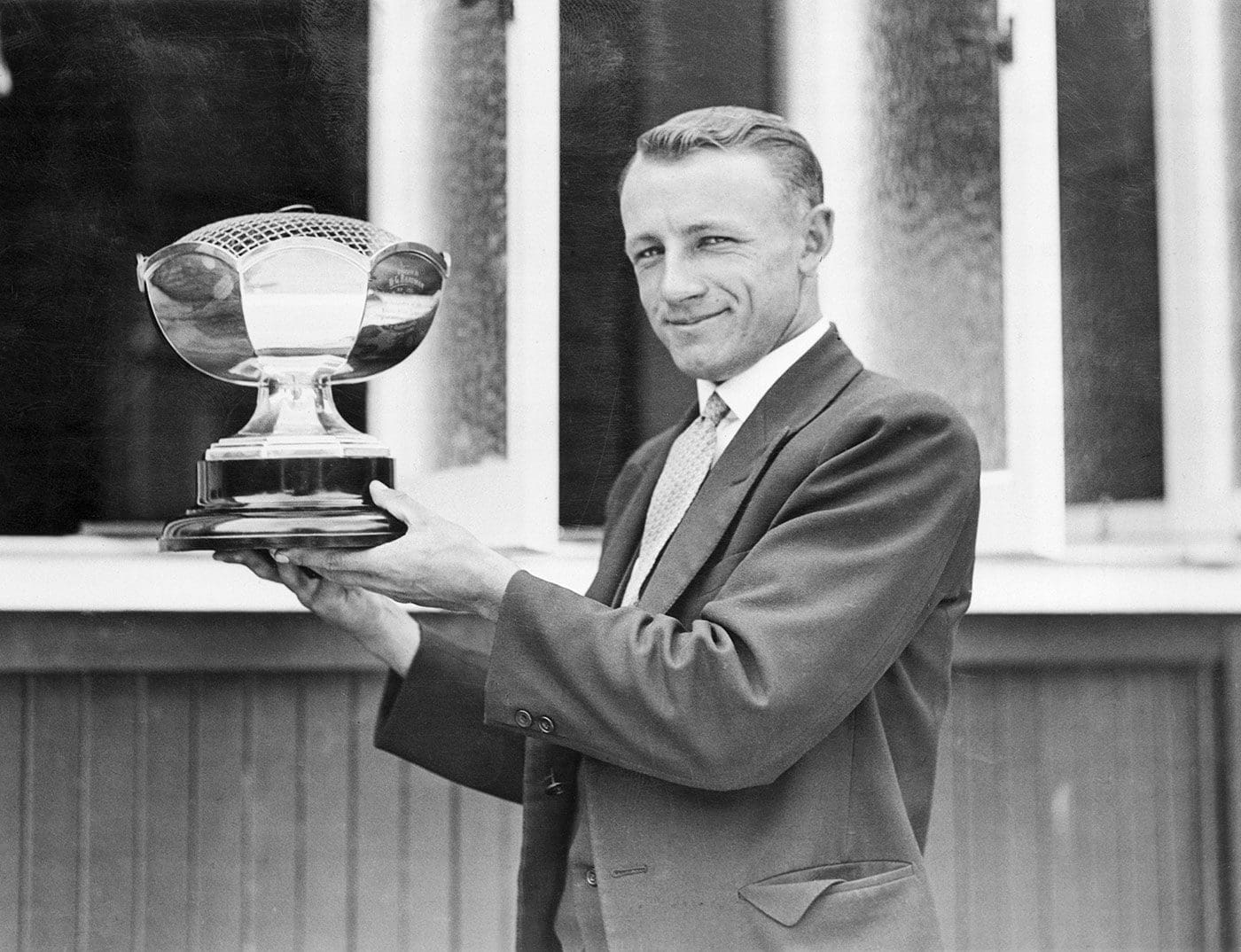
Sir Donald Bradman scored 100 runs in just 3 overs during a match between Blackheath and Lithgow on November 2, 1931, in New South Wales, Australia.
The legendary batsman reached his century in approximately 18 minutes, facing 22 deliveries out of 24 balls bowled across three eight-ball overs.
This extraordinary feat remains one of cricket’s most astonishing records, though it occurred in an unofficial club match. Bradman eventually retired on 256 runs with 14 sixes and 29 fours.
The Incredible Innings Breakdown
Bradman’s century came at a breathtaking pace that has never been replicated. The scoring sequence across three overs showcased pure batting dominance.
Over-by-Over Analysis
First Over (Bowled by Black): 33 runs
- Scoring sequence: 6, 6, 4, 2, 4, 4, 6, 1
- 7 boundaries including 3 sixes
- Partner Wendell Bill scored the single
Second Over (Bowled by Horrie Baker): 40 runs
- Scoring sequence: 6, 4, 4, 6, 6, 4, 6, 4
- 8 boundaries including 4 sixes
- Highest-scoring over
Third Over (Bowled by Black): 29 runs
- Scoring sequence: 1, 6, 6, 1, 1, 4, 4, 6
- Included 2 singles by Bill to rotate strike
- Bradman reached 100 with this over
| Over | Bowler | Balls | Runs Scored | Bradman’s Runs | Fours | Sixes |
| 1st | Black | 8 | 33 | 32 | 3 | 3 |
| 2nd | Baker | 8 | 40 | 40 | 4 | 4 |
| 3rd | Black | 8 | 29 | 28 | 2 | 3 |
| Total | – | 24 | 102 | 100 | 9 | 10 |
Match Context and Conditions
The Setting
The match took place at Blackheath Oval in the Blue Mountains. Blackheath was playing against Lithgow Potteries in a second-class fixture. The pitch featured a malthoid surface—a synthetic material that was new at the time. Bradman later described it as perfectly flat with uniform bounce.
Eight-Ball Overs
Australian domestic cricket used eight-ball overs during this era. This meant Bradman had 24 deliveries across three overs, not the 18 balls that would constitute three six-ball overs today. He faced 22 of these 24 balls, with his partner Bill facing the other two.
Complete Innings
Bradman didn’t stop at 100. He continued batting and eventually retired on 256 runs. His final tally included 29 fours and 14 sixes. Remarkably, he hit more sixes in this single innings than in his entire first-class career combined.
Why This Record Stands Apart
Unofficial Status
The International Cricket Council (ICC) does not officially recognize this innings. The match was a club-level fixture, not a first-class or professional game. Despite this, the feat is widely documented in newspapers from 1931 and cricket history books.
Historical Significance
This innings showcases Bradman’s unmatched ability to dominate bowlers. Even in a casual setting, his skill level exceeded anything seen before or since. The bat he used during this innings is displayed at the International Cricket Hall of Fame in Bowral, Australia.
Time Duration
The 100 runs took approximately 18 minutes. This included time to retrieve balls after his 10 sixes cleared the boundary. The actual batting time was even shorter.
Fastest Centuries in Official Cricket
International Cricket Records
AB de Villiers – 31 Balls (ODI)
- Match: South Africa vs West Indies, January 18, 2015
- Venue: New Wanderers Stadium, Johannesburg
- Final Score: 149 off 44 balls (16 sixes, 9 fours)
- Strike Rate: 338.63
- South Africa posted 439/2, won by 148 runs
De Villiers broke multiple records in this innings. He also recorded the fastest fifty in ODI history off just 16 balls. His century included a leg-bye that kept him on strike, demonstrating tactical awareness alongside brutal hitting.
Corey Anderson – 36 Balls (ODI)
- Match: New Zealand vs West Indies, January 1, 2014
- Venue: Queenstown, New Zealand
- Final Score: 131 off 47 balls
- Held the record briefly before de Villiers
Shahid Afridi – 37 Balls (ODI)
- Match: Pakistan vs Sri Lanka, October 4, 1996
- Venue: Nairobi, Kenya
- Final Score: 102 off 37 balls
- Held the record for nearly 18 years
T20 Cricket Records
Chris Gayle – 30 Balls (IPL)
- Match: Royal Challengers Bangalore vs Pune Warriors, April 23, 2013
- Final Score: 175* off 66 balls (17 sixes, 13 fours)
- Fastest century in professional cricket history
- RCB posted 263/5, the highest T20 team total at the time
AB de Villiers – 43 Balls (T20I)
- Match: South Africa vs West Indies, 2015
- Fastest in T20 International cricket
Test Cricket Records
Brendon McCullum – 54 Balls (Test)
- Match: New Zealand vs Australia, February 20, 2016
- Venue: Christchurch, New Zealand
- Final Score: 145 off 79 balls
- Fastest Test century in history
Viv Richards – 56 Balls (Test)
- Match: West Indies vs England, 1986
- Held the record for 30 years
FAQs
Is Don Bradman’s 3-over century officially recognized?
No, the ICC does not officially recognize Bradman’s 100 off 22 balls because it occurred in an unofficial club match. However, it’s widely documented in newspapers from 1931 and cricket history books as a factual event.
What is the fastest century in official cricket?
Chris Gayle’s 30-ball century in the IPL on April 23, 2013, is the fastest in professional cricket. In ODIs, AB de Villiers holds the record with 31 balls against West Indies in 2015.
How many balls did Bradman face to score 100?
Bradman faced 22 deliveries out of 24 balls bowled across three eight-ball overs. His partner Wendell Bill faced 2 balls, scoring singles to rotate the strike back to Bradman.
Has anyone scored 100 in 3 six-ball overs?
No. Three six-ball overs equal 18 legal deliveries. The fastest official century is 30 balls by Chris Gayle. Scoring 100 in 18 balls has never been achieved in any format of professional cricket.
What was Bradman’s final score in the Blackheath match?
Bradman retired on 256 runs, which included 29 fours and 14 sixes. He hit more sixes in this single innings than in his entire first-class career, demonstrating the unusual nature of the malthoid pitch.
Why It Remains Unmatched
Modern T20 cricket features aggressive batting and smaller boundaries. Yet no batsman has approached 100 runs in three overs. The fastest professional century requires 30 balls—12 more than Bradman faced. Even with power-hitting specialists and superior bats, the 22-ball mark seems untouchable.
Bradman’s Career Context
This innings showcases a different side of Bradman. His Test career emphasized consistency with an average of 99.94.
The Blackheath innings revealed explosive power rarely seen in first-class cricket. He could dominate in any format or situation.
Cricket Folklore
The century in three overs has achieved mythical status. Fans debate whether modern players could replicate it. The answer consistently remains no. Even accounting for eight-ball overs, the scoring rate exceeds anything seen in professional cricket.
Bradman’s feat sits comfortably in cricket folklore—unverified by officials but universally believed by historians and fans alike.
Wrapping Up
Sir Donald Bradman scored 100 runs in just 3 eight-ball overs (22 balls) on November 2, 1931, for Blackheath against Lithgow. Though unofficial, this remains cricket’s fastest century ever recorded. The closest official record is Chris Gayle’s 30-ball hundred in the IPL.
AB de Villiers’ 31-ball ODI century stands as the fastest in international cricket. Bradman’s 256-run innings with 14 sixes and 29 fours exemplifies batting dominance that transcends eras and formats.


