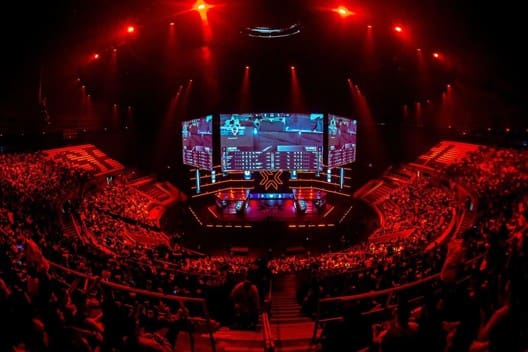
NRG beat Fnatic in Paris to win Valorant Champions 2025, and the org collected a $1,000,000 winner’s check on stage.
That number makes the headlines. It also hides how pro Valorant players actually get paid, because for most of the names lifting that trophy, prize money is the smallest line on the page.
Follow that money, and the answer to how much Valorant pros earn looks very different from the trophy photo. So let us actually follow it.
What a Pro Valorant Salary Actually Looks Like
Start with the paycheck that lands every month, since that base salary is the floor every pro builds on.
In the franchised VCT leagues, Riot sets a salary minimum for players on partnered teams, reported at roughly $50,000 per year in the Americas, with comparable floors in EMEA and the Pacific.
The ceiling is where it gets interesting. In North America, the richest region, top-tier players reportedly pull $30,000 to $40,000 per month, the bracket that turns aim merchants like yay into marquee signings.
EMEA runs a notch lower, with the best players closer to $25,000 a month and a working average nearer $10,000 to $12,000.
Set that against a rookie on a fresh partnered roster making the minimum, and you get a salary structure that is steep at the top and thin at the bottom.
The Salary Information
For years, those numbers were pure guesswork, until the scene got its most famous accidental receipt.
TenZ’s partner Kyedae was live on stream when a document slipped on camera and revealed nitr0 and sinatraa were each on $25,000 a month, about $300,000 a year, back in 2021.
TenZ himself was reportedly near $20,000 a month at Sentinels around that time, though plenty of fans assumed his true figure climbed past 40k once you counted everything Sentinels earned off his name.
Salary is only one of five income streams, and for a marquee player, it is rarely the biggest. This is roughly how the money stacks up for a top pro.
| Income Source | Who It Reaches | Rough Scale |
| Base salary | Every partnered-team player | ~$50k/year floor up to $30k to $40k a month at the NA top |
| Tournament prize money | Only winning teams, split many ways | $1M to a Champions winner, nothing to most |
| Champions skin sales | Shared across all partnered teams | Around $1M per team in a strong year |
| Twitch streaming | Players with an audience | Can out-earn the salary for stars like TenZ |
| Sponsorships and brand deals | Marketable names and their orgs | Varies wildly, often the hidden majority |
Prize Money
Prize money is the most visible income in esports and easily the most misleading. Valorant Champions, the season-ending world final, ran a $2,250,000 prize pool in 2025, the same as the year before.
The winner takes $1,000,000 of it, which sounds life-changing until you see how it splits.
That check lands with the org first, then gets carved among five players, the coach, the subs, and whatever the contract says about the org’s cut. A player’s share of a Champions title is real money, but it is not the seven-figure windfall the headline suggests.
Then there is the cruel math of who wins anything at all. EDward Gaming banked the million from the 2024 Champions prize pool in Seoul, and NRG took the 2025 crown in Paris, a result that made in-game leader Ethan the first player to win Champions twice.
Below the top four, the checks shrink fast, and the dozens of teams that never reach the event split nothing.
Add up every pro’s career winnings, and a few champions like aspas and Saadhak rank among the highest-earning pros of all time, while the median pro’s tournament earnings would not cover a year of rent.
The Champions Skin Bundle Is Where Teams Actually Cash In
Here is the income stream casual fans never think about, and it might be the most important one in Valorant esports.
Every year, Riot drops a Champions skin bundle, splits the net proceeds with the teams, and the totals are eye-watering.
The 2022 Champions bundle pulled in around $32 million and sent $16 million back to the 16 qualifying teams, better than a million dollars each and well up from the roughly $600,000 per team that the first bundle paid out in 2021. That alone dwarfed the event’s actual prize pool.
Streaming and Sponsorships
For the biggest names in the game, salary and prize money are almost a side hustle. TenZ is the obvious case study. His mechanical highlight reels built a Twitch and YouTube audience that, in a good month, plausibly out-earns his Sentinels salary outright.
A pro with a webcam, a personality, and a few hundred thousand followers turns every off-day into a second source of income through Twitch streams, subscriptions, and ad revenue.
Sponsorships are the other quiet giant. Peripheral brands, energy drinks, apparel labels, and fintech logos pay to sit on jerseys and inside content, and those brand deals routinely outweigh competitive winnings for a marketable star.
From Ranked Grind to Pro Salary
None of these paychecks exists without the first step every pro shares: the ranked ladder. Valorant has no draft and no tryout combine.
Scouts, academy coaches, and partnered orgs watch the top of the ranked ladder, where your ranking doubles as your resume.
The Radiant and high-Immortal pool, plus regional Premier and Challengers play, is where the next teenager who can out-aim an established roster gets spotted. Climbing to a high rank is the minimum requirement.
That is exactly why a whole market of ranked-ready Valorant accounts has grown up around the competitive ladder, since high-rank exposure is where careers begin, and a grind-ready account is the entry point to that climb.
From there, the path runs through Challengers and Academy teams, the development tier where orgs like Cloud9 and NRG groom prospects before promoting them to the main roster.
Riot reworked that pipeline for 2026, retiring Ascension for a Path to Champions where Challenger teams scrap directly against partnered squads for a slot, with Riot covering $75,000 in travel for each team that makes it.
The VCT schedule is a year-long climb, and almost everyone standing on a Champions stage started as a nameless, ranked grinder who refused to stop pushing rank.
RELATED ARTICLES