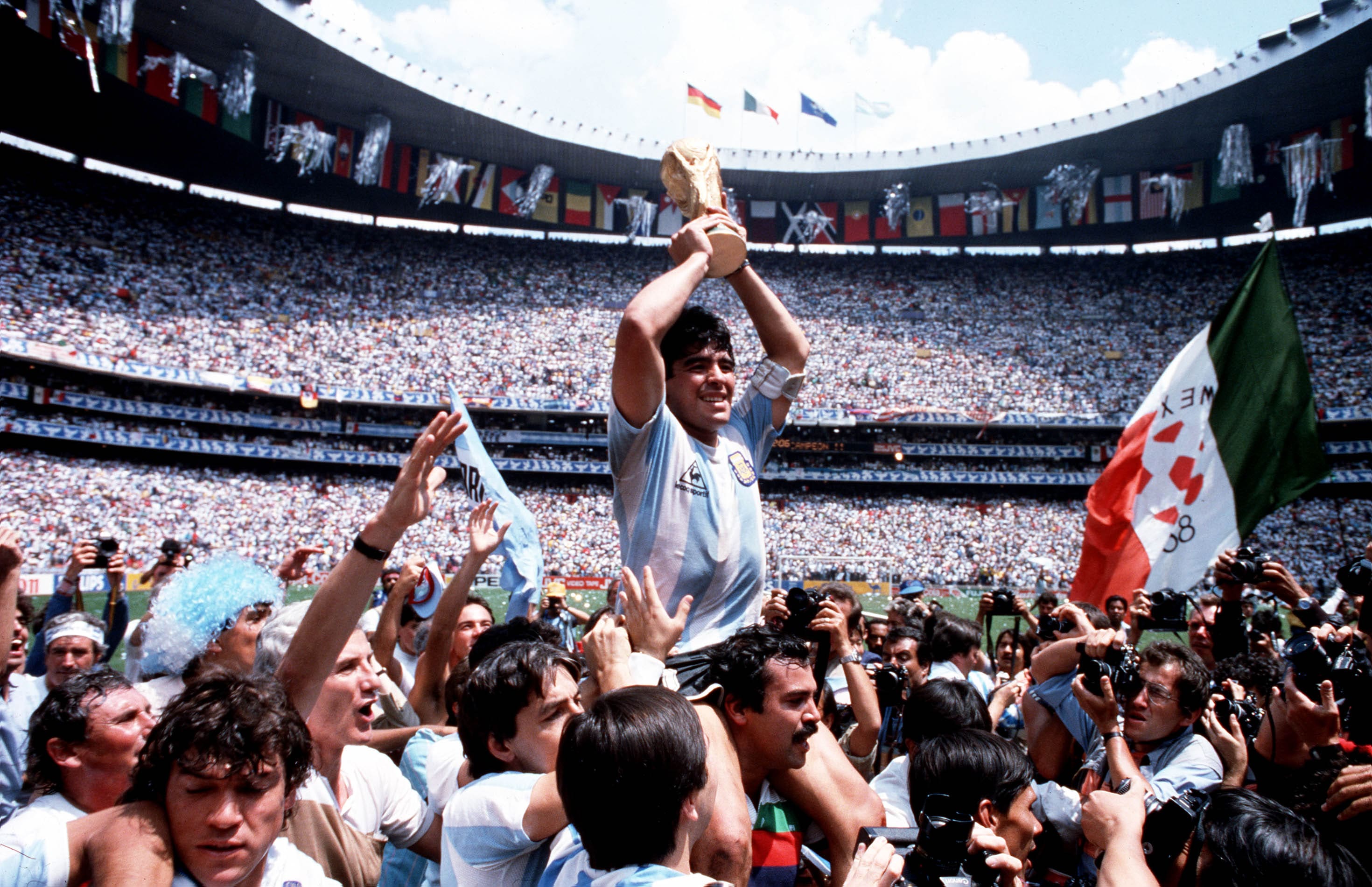
The summer of 1986 delivered football’s most complete individual performance. Diego Armando Maradona didn’t just win the World Cup for Argentina.
He dominated it with a level of control no player had achieved before or has matched since.
Across seven matches in the Mexican heat, Maradona scored five goals, created countless chances, and carried his nation to glory through moments of genius that still define the sport four decades later.
This wasn’t Pelé surrounded by world-class teammates in 1958. This wasn’t a stacked squad cruising to victory.
This was one 25-year-old shouldering the entire weight of Argentine expectations and delivering beyond what seemed humanly possible.
The Stage: Mexico 1986 World Cup Setup
Mexico stepped in as host after Colombia withdrew in 1983, becoming the first country to host two World Cups.
Eight months before kickoff, a devastating earthquake struck Mexico City in September 1985, killing over 25,000 people and causing $4 billion in damage.
The recovery effort was remarkable, as detailed by National Geographic’s coverage of the 1985 Mexico earthquake.
FIFA considered relocating, but Mexico rebuilt in time, though the disaster’s shadow hung over preparations.
The tournament featured 24 teams divided into six groups. The format allowed the top two teams from each group, plus the four best third-place finishers, to advance to a straight knockout round of 16.
This setup meant one bad match could end your campaign, but consistent brilliance could carry you all the way.
Argentina’s complete tournament path looked like this:
| Round | Opponent | Score | Maradona Goals |
| Group C | South Korea | 3-1 | 0 (3 assists) |
| Group C | Italy | 1-1 | 1 |
| Group C | Bulgaria | 2-0 | 0 (1 assist) |
| Round of 16 | Uruguay | 1-0 | 0 |
| Quarterfinal | England | 2-1 | 2 |
| Semifinal | Belgium | 2-0 | 2 |
| Final | West Germany | 3-2 | 0 (1 assist) |
FIFA scheduled matches at noon and 4 PM to maximize global TV audiences, forcing players to compete in scorching midday heat at high altitude.
Mexico City sits at 7,350 feet above sea level. The thin air affected stamina, ball movement, and recovery between matches. Most teams struggled. Maradona thrived.
Argentina’s System: Built Around One Man
Carlos Bilardo coached Argentina with a pragmatic 3-5-2 formation that prioritized defensive solidity. The system wasn’t beautiful.
It was effective. Argentina would drop into a compact block without the ball, frustrate opponents, then transition quickly when Maradona got possession.
The tactical blueprint centered on these core principles:
- Three center-backs provided defensive foundation and numerical advantage
- Five midfielders controlled the center of the pitch and protected possession
- Two forwards (Valdano and Burruchaga) made runs to finish Maradona’s service
- Complete freedom for Maradona to roam across attacking zones
- Quick transitions from defense to attack through the captain
Think of it as the 1986 version of what Mikel Arteta’s Arsenal does now: deep defending, patient buildup, then explosive moments.
The difference was Argentina’s explosive moments all ran through number 10.
Jorge Valdano and Jorge Burruchaga provided forward support, but their primary job was finishing chances Maradona created or occupying defenders to give him space.
The midfield trio of Sergio Batista, Héctor Enrique, and Ricardo Giusti offered protection and simple distribution. They weren’t asked to create. That was all Diego.
Bilardo’s instructions were clear: get the ball to Maradona, then let him decide. When Argentina needed to kill a game, they passed slowly and controlled possession. When they needed a goal, they gave it to their captain and got out of his way.
Group Stage Brilliance: Three Wins, Three Different Performances
Argentina navigated the group stage with three consecutive victories, each showcasing different aspects of Maradona’s genius:
- South Korea (3-1): Maradona controlled tempo and delivered precise set pieces for all three goals
- Italy (1-1): Scored a brilliant individual goal while man-marked by Napoli teammate Salvatore Bagni
- Bulgaria (2-0): Created space for teammates through gravitational pull, assisted Burruchaga’s goal
South Korea: The Statement Opener
June 2, 1986. Estadio Olímpico Universitario, Mexico City. Argentina faced South Korea in their opening match, and Maradona immediately became the target.
Every South Korean defender wanted to foul him, going in hard on challenges that would draw red cards today.
The grainy footage shows Maradona absorbing punishment, shrugging off tackles, and using his low center of gravity to stay upright.
He didn’t score, but he dominated. All three Argentine goals came from Maradona’s involvement.
The first two came from his dead ball delivery, floating precise set pieces into dangerous areas. The third came from a dribble and low cross that created chaos in the Korean box.
His passing range stood out most. Like Kevin De Bruyne if De Bruyne could also glide past defenders at will, Maradona controlled the tempo, picked out runs, and demonstrated the vision that made him unstoppable.
Italy: Tactical Chess Match
Three days later in Puebla, Argentina faced a much sterner test. Italy assigned Napoli teammate Salvatore Bagni to man-mark Maradona, with collective defensive support making space scarce.
This was sophisticated defending, not the crude fouling South Korea relied on.
Maradona adjusted. He dropped deeper less frequently, focusing on close control in tight spaces and sharp through balls. When Italy’s defenders got tight, his dribbling became the weapon. He worked in smaller areas, using quick touches and body feints to create separation.
Then he scored a goal that silenced doubters. Receiving the ball with his back to goal, he turned sharply, shielded possession from two defenders, and curled a precise finish past the goalkeeper. Pure technique under pressure.
This match also revealed Maradona’s defensive work rate. He chased, tackled, and pressured Italian ball carriers throughout.
The idea that Maradona couldn’t function in a modern pressing system gets debunked when you watch his energy and positioning without the ball. He worked hard in both phases.
Bulgaria: Creating Space for Others
Back at the Olímpico Universitario five days later, Argentina produced their most complete attacking performance against Bulgaria.
Maradona’s gravity pulled defenders toward him constantly, creating massive space for Valdano and Burruchaga to exploit.
He didn’t dominate the ball as much this match. He facilitated. His movement alone created opportunities, and when he did touch it, his passing was exquisite.
The cross for Burruchaga’s goal showed perfect weight and placement, dropping exactly where it needed to be.
Lesser performances by Maradona’s standards still meant controlling the game’s rhythm and creating chances others finished. That’s the mark of true greatness.
The Quarterfinal That Defined Everything: Argentina vs England
June 22, 1986. Estadio Azteca. 114,580 fans. Four years after the Falklands War, Argentina faced England in a match dripping with political tension.
The conflict over the disputed islands had ended in 1982 with British victory, leaving deep wounds in Argentina’s national psyche.
For historical context on how this war shaped the rivalry, see Britannica’s comprehensive account of the Falklands War.
Argentine media framed it as revenge. English players treated it as just another match. Maradona treated it as destiny.
Bobby Robson’s tactical plan was primitive: rough up Maradona, foul him early and often, make him uncomfortable.
England committed dangerous challenges that would trigger VAR red cards today. Terry Fenwick, Glenn Hoddle, and others went in hard. Maradona absorbed the punishment and kept coming.
The Hand of God
Early in the second half, Steve Hodge attempted a clearance and hooked the ball back toward his own goal.
As Peter Shilton came out to punch it clear, Maradona jumped with him and used his left hand to punch the ball into the net. He disguised it by flicking his head simultaneously, fooling the referee and linesman.
The goal counted. England protested. Maradona claimed it was scored “a little with the head of Maradona, and a little with the hand of God.”
Years later, in his 2002 autobiography, Maradona admitted the truth: “It wasn’t the hand of God, it was the hand of Diego! And it felt a little bit like pickpocketing the English.”
Was it cheating? Absolutely. Was it also a moment of incredible improvisation under pressure, executed by someone thinking faster than everyone else on the pitch? Also yes. Minutes earlier, Fenwick had raised his fist while competing for a header. Maradona seemed to copy the movement, but to score a goal instead.
Given the brutal treatment England dished out all match, calling Maradona the villain here requires selective memory.
The Goal of the Century
Four minutes later, Maradona received the ball near the halfway line with six England players between him and the goal. What happened next transcended sport and became art.
He accelerated past Peter Reid and Terry Butcher in midfield, using quick touches to maintain control at full speed. Glenn Hoddle lunged and missed. Maradona cut inside past Terry Fenwick with a sharp change of direction that left the defender on the ground.
Now in England’s penalty area with Butcher recovering and Shilton rushing out, Maradona feinted right, shifted the ball left with his left foot, and slotted it past Shilton before Kenny Sansom could close the angle. He’d dribbled 60 yards past five defenders with the ball glued to his foot.
FIFA voted it the greatest goal in World Cup history in 2002. A statue outside Azteca Stadium immortalizes the moment. No goal before or since captures individual brilliance the same way. You can watch the complete match highlights on FIFA’s official archive.
England finally opened up and attacked after going down 2-1, but the damage was done. Gary Lineker scored late, but Argentina held on. Maradona had delivered the performance that would define his career and cement his legend.
The Semifinals: Dismantling Belgium
June 25 brought Belgium in Puebla, and Maradona produced his most composed performance. Less spectacular than the England match but arguably more complete, this was refined dominance rather than explosive genius.
He controlled possession, created danger without rushing, and picked his moments perfectly. Then in the second half, he simply decided to win the match.
The first goal was a cheeky chip across the face of goal, created from nothing. The second was a sublime dribble through the Belgian midfield that would be the goal of the tournament in any year without the England match.
He just ran straight through them, changed pace at the perfect moment, and finished clinically.
Belgium had no answers. Argentina won 2-0, and Maradona added two more goals to his tally while controlling every aspect of play.
The Final: Delivering Under Ultimate Pressure
June 29, 1986. Azteca Stadium. West Germany. The ultimate test. Franz Beckenbauer assigned Lothar Matthäus, one of the world’s best midfielders, to man-mark Maradona.
The strategy worked defensively but robbed Germany of Matthäus’s creativity in their own attack.
Argentina struck first when Jorge Burruchaga delivered a high ball into the box and José Luis Brown headed it home in the 22nd minute.
Early in the second half, Héctor Enrique fed Jorge Valdano on a counterattack, and Valdano finished clinically past Harald Schumacher to make it 2-0.
Germany looked finished, but Beckenbauer substituted tall striker Dieter Hoeness, and the game shifted.
Karl-Heinz Rummenigge headed home in the 74th minute. With nine minutes left, Rudi Völler equalized from a corner kick.
Matthäus abandoned marking duties to drive Germany forward, and suddenly Argentina’s World Cup looked in jeopardy. That’s when Maradona stepped up.
Deep into German territory, he weaved past challenges, drew defenders, and spotted Burruchaga making a run.
The pass was perfect, splitting the defense and sending Burruchaga clear. He smashed it past Schumacher with six minutes remaining.
Argentina 3, West Germany 2. Maradona lifted the trophy he’d dreamed of since childhood.
The Statistical Record
Maradona finished the tournament with five goals and five assists across seven matches. Those numbers don’t capture his dominance, though.
He created chances others missed, drew fouls that set up dangerous free kicks, and commanded attention that created space for teammates.
| Tournament Statistics | Maradona’s Numbers |
| Matches Played | 7 |
| Goals Scored | 5 |
| Assists | 5 |
| Successful Dribbles (England match) | 12 |
| Shots Taken (England match) | 7 of 15 team total |
| Chances Created (England match) | 5 |
| Award Won | Golden Ball (MVP) |
Modern data from the England quarterfinal shows Maradona took seven of Argentina’s 15 shots and created five more.
He completed 12 successful dribbles in one match. The numbers support what the eyes see: complete control of the game’s most important moments.
Gary Lineker won the Golden Boot with six goals, but Maradona won the Golden Ball as tournament MVP. Nobody debated the choice.
Why 1986 Maradona Stands Above Everyone
Comparing eras in football is impossible, but 1986 Maradona occupies a unique space. This was before TV money concentrated talent at elite clubs.
The World Cup featured the best players in the world competing for their countries, not club teammates playing together year-round.
European leagues limited teams to three foreign players total. Maradona couldn’t surround himself with world-class talent at Napoli the way Lionel Messi had at Barcelona or Cristiano Ronaldo had at Real Madrid. He had to elevate average players to championship level.
The 1986 World Cup was also brutally physical. Defensive tactics dominated. Pressing wasn’t fashionable yet, but fouling was.
Maradona took punishment that would result in multiple red cards today and kept performing at the highest level.
Arrigo Sacchi, the legendary AC Milan and Italy manager, once said, “Football should always be played at the highest possible level, and no club will ever reach the level of an international side.” That was the reality of 1986. The World Cup was the pinnacle. And Maradona conquered it.
Jorge Valdano, his teammate, described Maradona’s impact: “He was a technical leader: a guy who resolved all difficulties that may come up on the pitch. He was in charge of making the miracles happen. That gives teammates a lot of confidence.
The scope of his celebrity was such that he absorbed all the pressures on behalf of his team-mates.”
That pressure absorption was crucial. Argentina’s players slept soundly before matches knowing Maradona would shoulder the burden.
If they lost, he’d take the blame. If they won, he’d share the glory. That’s leadership transcending tactics.
The Legacy: Four Decades Later
Maradona’s 1986 World Cup performance remains the standard against which all great individual tournament performances are measured. His achievements from that summer include:
- Five goals and five assists across seven matches
- Golden Ball award as tournament MVP
- Two iconic goals that defined football history
- Leading Argentina to their second World Cup title
- Creating the blueprint for complete attacking dominance
Pele in 1958, Ronaldo in 2002, Zinedine Zidane in 2006, Messi in 2022 – all exceptional, but none dominated every aspect of play the way Maradona did across seven matches in Mexico.
The Hand of God goal remains controversial, a moment where genius and gamesmanship intersected.
In Argentina, it’s celebrated not just as a goal but as symbolic revenge against the British after the Falklands War. The controversy adds to the legend rather than diminishing it.
The Goal of the Century, meanwhile, needs no context or controversy. Pure football artistry, the kind that makes people who don’t care about sports stop and watch.
FIFA’s decision to name it the greatest World Cup goal ever scored wasn’t hyperbole.
Napoli retired Maradona’s number 10 jersey in 2000, then renamed their stadium Stadio Diego Armando Maradona nine days after his death in November 2020. Argentina’s national team wears his number 10 as a badge of honor, though nobody fills those boots.
When people debate the greatest footballer of all time, Maradona’s 1986 World Cup is the first argument his supporters cite. Not his club achievements, not his longevity, not his goal-scoring records.
Just seven matches in Mexico where one man reached a level of football perfection nobody else has sustained across an entire tournament.
The footage remains grainy, the analysis subjective, the nostalgia powerful. But strip away everything except the evidence on the pitch, and the conclusion stays the same: Diego Maradona’s World Cup magic in 1986 represents football’s highest individual achievement.
FAQs
How many goals did Maradona score in the 1986 World Cup?
Maradona scored five goals in 1986: two against England, two against Belgium, and one against Italy in the group stage.
What made the Hand of God goal so controversial?
Maradona used his hand to punch the ball past England’s goalkeeper. The referee didn’t see it and awarded the goal.
Why is Maradona’s second goal against England called the Goal of the Century?
Maradona dribbled 60 yards past five English defenders before scoring. FIFA voted it the greatest World Cup goal in history.
How did Argentina’s tactics in 1986 maximize Maradona’s abilities?
Carlos Bilardo’s 3-5-2 formation provided defensive stability while giving Maradona complete freedom to roam, create, and control Argentina’s attacking play.
Who were Maradona’s most important teammates during the 1986 World Cup?
Jorge Valdano and Jorge Burruchaga provided attacking support. Sergio Batista, Hector Enrique, and Ricardo Giusti controlled midfield with defensive discipline.
How did altitude and environmental conditions affect play in Mexico?
Mexico City’s 7,350-foot altitude and scorching heat drained most teams. Maradona maintained elite performance throughout despite these harsh conditions.
How does Maradona’s 1986 performance compare to modern World Cup performances?
No player since has dominated an entire tournament like Maradona did in 1986. His complete control remains unmatched across seven matches.