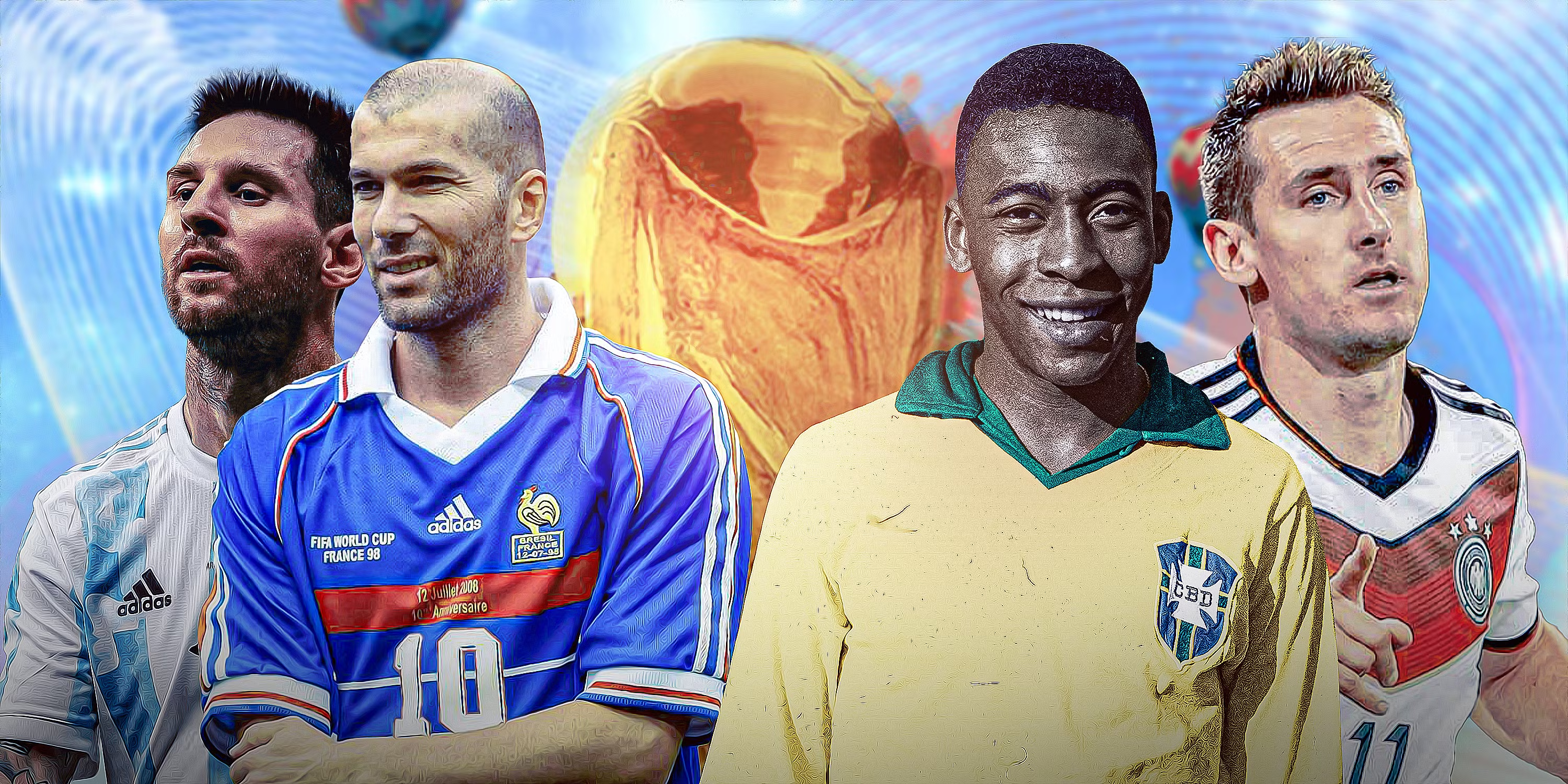
You’re about to discover the players who turned the World Cup into something bigger than football. These aren’t just names in record books.
They’re athletes who delivered when billions watched, when everything was on the line, when a single moment could define an entire nation’s sporting history.
The World Cup has crowned 471 winners since 1930, but only a handful of World Cup legends transformed the tournament into their personal stage.
From Pele’s teenage brilliance in 1958 to Messi’s 2022 redemption at 35, these 20 legends rewrote what’s possible when the pressure peaks every four years.
#1) Pele: The Three-Time Champion Who Set the Standard
Pele remains the only player in World Cup history to win three tournaments. He burst onto the scene at 17 in 1958, becoming the youngest player to score in a final when he netted twice against Sweden in a 5-2 victory.
That tournament saw him score a hat-trick in the semi-final against France, setting records that still stand today.
Brazil won again in 1962, though injury limited his impact. Then came 1970, where Pele captained what many consider the greatest team ever assembled.
He scored four goals and created countless more, including the assist for Carlos Alberto’s thunderous final strike against Italy.
His 12 World Cup goals came across 14 matches, but the numbers barely capture his influence.
Two of his most iconic moments are actually misses, including the drag-wide against Uruguay after rounding the goalkeeper without touching the ball, and the header famously saved by Gordon Banks.
#2) Diego Maradona: The 1986 One-Man Show
Maradona played every minute of every match in 1986, scoring five goals and making five assists to mark the most domineering individual displays in any World Cup before or since. Against England in the quarter-finals, he scored twice within four minutes.
The first, punched over Peter Shilton, became the infamous “Hand of God.” The second is widely considered the greatest World Cup goal ever, as he dribbled from inside his own half past five England players.
Argentina won the Golden Ball as tournament MVP, carrying Argentina to their second title. He reached another final in 1990, though injury limited his effectiveness in the 1-0 loss to West Germany.
His 1994 tournament ended in disgrace with a failed drug test, but his 1986 performance stands alone among World Cup legends.
#3) Lionel Messi: The Patient Champion
Messi had been the world’s greatest footballer for over a decade before he finally won a World Cup at age 35.
He became the first player to win two Golden Balls, earning the award in 2014 despite losing the final to Germany, then again in 2022 after leading Argentina to victory.
His World Cup journey started in 2006 at 18, when he scored and assisted in a 6-0 win over Serbia.
The 2010 tournament saw criticism despite several assists, as Argentina fell to Germany in the quarter-finals. Four years later, he scored four goals but lost another final to Germany.
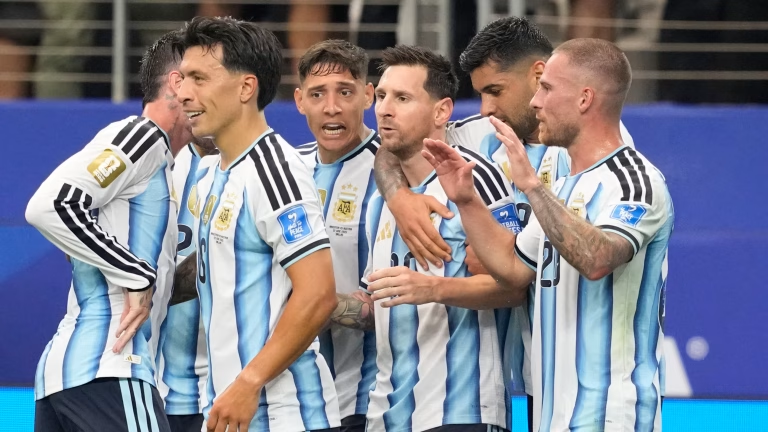
The 2022 redemption was complete. Messi scored in every knockout round, finishing with seven goals and three assists across seven matches. At 35, he finally lifted the trophy that had eluded him throughout his legendary career.
#4) Miroslav Klose: The Record-Breaking Predator
Klose confirmed his status as a World Cup great at Brazil 2014, not only by helping Germany win the trophy, but by becoming the all-time finals top scorer with 16 goals.
He scored in four consecutive tournaments from 2002 to 2014, averaging four goals per World Cup.
Klose finished second in the Golden Boot race at the 2002 finals, before finally claiming it himself at Germany’s home finals in 2006.
His goal in the 7-1 semi-final demolition of Brazil in 2014 broke Ronaldo’s record of 15 goals, setting a mark that still stands.
The German striker reached the 2002 final, won bronze in 2006 and 2010, and finally captured gold in 2014 at age 36. His consistency across four tournaments makes him the ultimate World Cup poacher.
#5) Zinedine Zidane: The Artist Who Delivered Titles
Zidane scored twice in the 1998 final against Brazil, leading France to their first World Cup title on home soil. He won the Ballon d’Or that year for his performances with both France and Juventus.
Four years later, he dominated the 2006 tournament before his career ended with a red card for headbutting Marco Materazzi in the final.
That 2006 tournament showcased Zidane at his technical peak. He controlled matches with vision and skill that few have matched, turning 34 years old during the competition.
His penalty in the final briefly gave France the lead before Italy won on penalties.
The headbutt remains one of football’s most infamous moments, but it can’t erase what Zidane achieved. Two World Cup finals, one trophy, countless moments of genius spread across three tournaments.
#6) Franz Beckenbauer: The Revolutionary Sweeper
Beckenbauer won the World Cup in 1974 and was awarded the Ballon d’Or two years later for the second time in his career.
He revolutionized the sweeper position, playing with freedom that turned defense into attack. His five goals across 18 World Cup appearances are remarkable for a defender.
West Germany’s Franz Beckenbauer is the second to win the World Cup both as player and manager, winning as captain in 1974 and as manager in 1990. Only Mario Zagallo and Didier Deschamps have matched this feat.
Beckenbauer appeared at three World Cups as a player. He captained Germany’s 1974 triumph on home soil, finally winning after reaching the 1966 final as a player. His nickname “Der Kaiser” (The Emperor) reflected his commanding presence on the pitch.
#7) Ronaldo: The Phenomenon Who Came Back
Ronaldo’s 15 World Cup goals made him the tournament’s most prolific scorer until Klose broke the record.
He won the Golden Ball in 1998 despite mysterious illness before the final against France, where Brazil lost 3-0. Four years later came redemption.
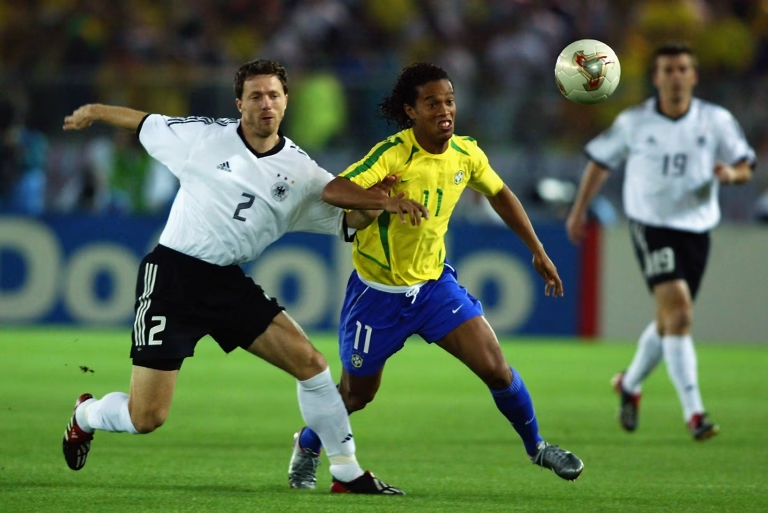
The 2002 tournament saw Ronaldo score eight goals, including both strikes in the 2-0 final victory over Germany.
His raw pace and finishing ability from all angles made him unstoppable. He added three more goals in 2006, overtaking Gerd Muller’s record before Klose eventually surpassed him.
Two World Cup titles, 15 goals across three tournaments, and a comeback story that defined resilience. The seizure or panic attack that struck him before the 1998 final makes his 2002 triumph even more remarkable.
#8) Garrincha: The Winger Who Never Lost
Brazil never lost a game in which Garrincha and Pele both played. The winger’s dribbling ability and unpredictable style terrorized defenders in 1958 and 1962.
He won two World Cups, becoming the 1962 tournament’s top scorer when Pele got injured.
When Pele got injured at the 1962 World Cup, Garrincha stepped up, scoring four goals including two in the quarter-final against England and two in the semi-final against Chile. He was named tournament MVP, carrying Brazil to consecutive titles.
His playing style inspired the first “ole” chants from football fans. The bow-legged winger used his physical limitation as an advantage, making movements defenders couldn’t predict. Across 50 appearances for Brazil, he scored 12 goals and created countless more.
#9) Gerd Muller: The Box Predator
Muller scored 14 goals in 13 World Cup games and sits behind only Klose and Ronaldo in the all-time rankings.
He won the 1970 Golden Boot with 10 goals, including two hat-tricks. Four years later, he scored the winning goal in the 1974 final against Johan Cruyff’s Netherlands.
Short and stocky, Muller possessed a prodigious leap and instincts to finish from close range that few have matched.
He scored 68 goals in 62 games for West Germany, including a record 66 in a single Bayern Munich season in 1972-73.
His World Cup career lasted just two tournaments. He broke into the German team late in 1966 and retired from international football after 1974 due to an argument with the German Football Association.
Those two tournaments produced 14 goals and one World Cup title.
#10) Lothar Matthaus: The Five-Tournament Warrior
No outfield player has ever managed to play in five different World Cups except Lothar Matthaus.
The box-to-box midfielder went from squad player in 1982 to man-marking Diego Maradona in the 1986 final. Though Argentina won that match, Matthaus limited Maradona’s impact.
He captained West Germany to World Cup glory in 1990, beating Maradona’s Argentina in a rematch of the 1986 final.
Argentina’s captain described Matthaus as the ‘best adversary I’ve ever had’. His leadership and versatility made him effective at both ends of the pitch.
Across 25 World Cup matches spanning 20 years, Matthaus won 150 caps for both West Germany and the reunified nation. His longevity and consistency at the highest level remain unmatched among outfield players.
#11) Johan Cruyff: The Genius Who Never Won
Probably the greatest player to never win the World Cup, Cruyff scored four goals in his lone appearance in 1974, leading the Netherlands to second place and being named the tournament’s most outstanding player.
His Total Football philosophy, practiced under Rinus Michels, revolutionized how the game was played.
The “Cruyff Turn” was born at the 1974 World Cup, when he fooled Swedish defender Jan Olsson with a move that’s still taught to young players today. Holland reached the final but lost 2-1 to West Germany, denying Cruyff the trophy his talent deserved.
He never played another World Cup. Disputes with the Dutch federation and concerns about safety kept him away from the 1978 tournament. One World Cup, one final, one lasting legacy that changed football forever.
#12) Kylian Mbappe: The Modern Phenomenon
Mbappe made his World Cup debut at age 19 in 2018 and became the second teenager in the competition’s history to score in the final after Pele.
France won 4-2 against Croatia, with Mbappe’s long-range effort sealing their second World Cup title.
The 2022 tournament saw even greater individual brilliance. Mbappe scored a hat-trick in the final against Argentina, though France lost on penalties.
He won the Golden Boot with eight goals, bringing his World Cup total to 12 at just 23 years old.
Mbappe’s tally of 12 goals places him as the competition’s joint-sixth all-time top scorer. With potentially two or three more World Cups ahead of him, he could challenge Klose’s record of 16 goals.
#13) Ronaldinho: The Joyful Artist
Ronaldinho’s 2002 World Cup featured the famous free-kick against England that sailed over David Seaman, sending Brazil to the quarter-finals.
He was just 22, playing alongside Ronaldo and Rivaldo in an attack that terrorized defenses.
Brazil won the tournament, with Ronaldinho pulling strings from midfield. His no-look passes, outrageous flicks, and constant smile made him a fan favorite. Though he won the Ballon d’Or in 2005, his World Cup peak came early in his career.
The 2006 tournament in Germany saw expectations soar, but Brazil fell to France in the quarter-finals. Ronaldinho’s influence had waned, and he never recaptured his 2002 magic at the World Cup level.
#14) Paolo Rossi: The 1982 Resurrection
Rossi scored six goals to lead Italy to 1982 World Cup glory, winning the Golden Boot, Golden Ball and the tournament itself.
He also won that year’s Ballon d’Or. Not bad for a player who’d served a three-year match-fixing ban, reduced to two years.
Rossi looked out of form and off the pace in the first group stage of 1982, but came alive in the second round. His hat-trick against Brazil in one of the tournament’s greatest matches announced his return.
He scored both goals against Poland in the semi-final, then opened the scoring in the 3-1 final victory over West Germany.
Nine World Cup goals across two tournaments made him one of Italy’s all-time leading scorers in the competition.
The 1982 performance remains one of the most dramatic individual tournament displays in World Cup history.
#15) Bobby Moore: England’s Defensive Icon
Captain Bobby Moore was hoisted up by his teammates holding the Jules Rimet trophy after England defeated West Germany in 1966.
Pele later described him as “the greatest defender I ever played against.” Moore’s composure under pressure defined England’s only World Cup triumph.
He led by example at Wembley, marshaling a defense that conceded just three goals in six matches.
The 1970 tournament in Mexico saw Moore produce what many consider his finest performance, despite England’s quarter-final exit to West Germany.
His tackle on Jairzinho in the 1970 group match against Brazil is still studied as textbook defending. Moore intercepted the ball cleanly, never committing a foul, stopping one of the world’s fastest wingers at full speed.
#16) Lev Yashin: The Black Spider
Yashin is generally regarded as one of the greatest goalkeepers of all time, appearing in three World Cups for the USSR and conceding just 18 goals across 13 matches.
His athleticism, imposing stature and quick reflexes revolutionized goalkeeping.
He helped the Soviet Union finish fourth in 1966, their best World Cup performance. Known as “The Black Spider” for his all-black kit and ability to seemingly extend his reach beyond human limits, Yashin made a fourth trip to the 1970 World Cup as third-choice backup and assistant coach.
Russia’s love affair with goalkeepers stems directly from Yashin’s brilliance during the 1950s and 60s. He remains the only goalkeeper to win the Ballon d’Or, earning it in 1963.
#17) Cafu: The Energizer Bunny
Cafu is the only player to appear in three consecutive World Cup finals. He won in 1994 as a squad player, started the losing 1998 final against France, and captained Brazil to victory in 2002 against Germany.
The right-back’s tireless running up and down the flank made him devastating in attack and reliable in defense.
He formed partnerships with Ronaldo, Rivaldo, and Ronaldinho that terrorized opponents. His stamina seemed endless, covering every blade of grass.
Across 20 World Cup matches, Cafu never seemed to tire. He continued playing at the highest level through the 2006 tournament, retiring from international football at 36 with two World Cup titles and a legacy as one of the game’s finest full-backs.
#18) Thomas Muller: The Space Interpreter
Thomas Muller scored five goals at the 2010 World Cup, winning the Golden Boot by virtue of having more assists, and was named Best Young Player.
Four years later came his finest hour. His goal opened the scoring in the 7-1 semi-final demolition of Brazil, setting the tone for Germany’s eventual triumph.
Muller’s positioning intelligence is unmatched. He drifts into spaces defenders don’t expect, appearing to be in the wrong place until the ball arrives.
His 10 World Cup goals across three tournaments place him among Germany’s all-time greats.
The 2018 tournament saw Germany crash out in the group stage, denying Muller a fourth World Cup appearance. His legacy remains as one of the most efficient scorers in tournament history.
#19) Jairzinho: The Hurricane
Jairzinho scored seven goals for Brazil’s legendary 1970 World Cup-winning team, finding the net in every round of the tournament in Mexico.
He bagged the third goal as Brazil thrashed Italy 4-1 in the final. No player has since scored in every match of a World Cup campaign.
The versatile winger earned his nickname “O Furacao” (The Hurricane) for his explosive pace and power. Playing alongside Pele, Tostao, and Rivelino in what many consider the greatest team ever assembled, Jairzinho still managed to stand out.
His seven goals placed him second only to Gerd Muller’s 10 at the 1970 tournament. The achievement of scoring in every round remains one of the World Cup’s most impressive individual records.
#20) Just Fontaine: The 1958 Scoring Machine
Fontaine scored 30 goals for France in only 21 appearances, including a record 13 goals in the 1958 World Cup in just six matches.
He won the tournament’s Golden Boot and holds the record for most consecutive matches with a goal at the World Cup with six.
That 1958 performance came from nowhere. Fontaine only made the squad because René Bliard got injured.
He wasn’t even France’s first-choice striker when the tournament started. By the end, he’d set a single-tournament record that has stood for over 65 years.
France finished third in 1958, with Fontaine scoring in every match including four against West Germany in the third-place playoff. Injuries ended his career at 28, but his World Cup legacy remains untouchable.
How These World Cup Legends Changed the Game
Each player brought something unique to the tournament. Pele’s youth and athleticism raised expectations for what teenagers could achieve.
Maradona proved one player could carry an entire nation. Beckenbauer showed defenders could create as much as they destroyed.
Modern players like Messi and Mbappe benefit from superior training, nutrition, and sports science. Yet they still chase records set 40, 50, even 70 years ago. The World Cup reveals who performs when pressure peaks and billions watch.
These 20 World Cup legends didn’t just win matches or score goals. They created moments that transcend football, becoming part of global sporting culture.
Their performances shaped how we understand excellence at the highest level.
FAQs
Who is the greatest World Cup player of all time?
Most experts agree the debate comes down to three players. Pele won three World Cups, more than anyone else. Maradona’s 1986 performance represents the highest individual peak. Messi finally achieved World Cup glory after a career of near-misses, completing his legacy. Statistics favor Pele and Klose for longevity and goal-scoring. Individual dominance points to Maradona’s 1986 and Zidane’s 1998. There’s no single correct answer because different eras, different styles, and different roles make direct comparison impossible.
How many players have won multiple World Cups?
Only 21 players have won the World Cup more than once. Pele stands alone with three titles in 1958, 1962, and 1970. Twenty others won twice, mostly Brazilians and Italians from different eras. Cafu is the only player to appear in three consecutive finals, winning in 1994 and 2002 while losing in 1998. Modern squad rotation and longer careers mean we might see more multiple winners, though winning even once requires exceptional timing and talent.
Which World Cup had the most legendary performances?
The 1970 World Cup in Mexico featured several all-time great displays. Pele’s Brazil team is considered the best ever assembled. Gerd Muller scored 10 goals for West Germany. Gordon Banks made his legendary save against Pele. The 1986 tournament belongs to Maradona. His individual dominance across seven matches has never been matched. He scored five, assisted five, and controlled Argentina’s every attacking move. No player has carried a team so completely to World Cup glory.
Do modern players have an advantage over past legends?
Modern players benefit from better pitches, lighter balls, superior boots, and advanced sports science. They’re faster, stronger, and can play more matches without breaking down. GPS tracking and video analysis help them prepare better than past generations could imagine. Yet the pressure hasn’t changed. Billions still watch. Careers still rise or fall based on World Cup performances. Pele at 17 and Mbappe at 19 both delivered in finals. Raw talent and mental strength transcend eras, even if the surrounding infrastructure has evolved dramatically.